Desert Online General Trading LLC
Dubai, United Arab Emirates
Desert Online General Trading LLC
Dubai, United Arab Emirates

Full description not available
M**A
A superb read
Full of anecdotal facts. Couldn’t put it down. Extremely useful to start thinking about building checklists in an optimal format that lead people to excel and reduce mistakes.
K**Z
Very useful for business, life and other areas
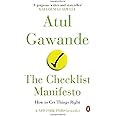
If you have a process at work or at home that involves having several things you need to do, and you want to reduce errors and improve control and outcomes, then I recommend this book.The author, a U.S. surgeon, decribes his involvement in the development and adoption of the WHO Safe Surgery Checklist, which started to be introduced world wide from early 2009. Use of the Checklist has generally reduced surgery complications by about a third, saving many lives and large amounts of money, a very large improvement from such a simple innovation.The author describes how checklists have been used for many years in the building industry to put up large complicated buildings properly. He describes how checklists were first developed and used by test pilots in the 1930's, and are now standard procedure when passenger aircraft take off, or are involved in emergencies. He tells how some restaurants use checklists to improve the quality of what is served to customers. He describes how some investment funds are starting to use checklists to make better and quicker investment decisions.The author makes the important point that use of a checklist results in people communicating and acting as a team and thus reduces errors and improves outcomes.The book does contain brief descriptions of the principles involved in constructing checklists, and reading this book should be sufficient for most users to be able to design their own checklists, and apply them in practice. The book does mention other important points such as separate communications checklists and pause points, for which it is best if you read the book.I think the contents of the book can be applied generally, at work and in one's personal life. I am a UK accountant, and have applied the principles to introduce new checklists at my place of employment.I think this book covers an area neglected in business and life; the importance of using a proper checklist to prevent errors and omissions, and improve outcomes.The book is quite short, well written and exciting at times. A bit of an important milestone in my view.
C**A
The highly thoughtful Gawande, is a treasure
Atual Gawande is an American-raised indian Born surgeon practicing in Boston and he is also a writer for the New Yorkerhe has written 3 books, all three of them excellent. Complications his first is a revelation, better his middle one I enjoyed less, and this third one, the Checklist, is spellbindingly goodGawande is no mere doctor he was also a Rhodes Scholar (i.e seriously bright) earning a PPE in Oxford England in the late 90s.To me, it seems that this is the secret to his appeal, he is a seriously intelligent and gifted academic, who later turned to the practical art of surgery. So he is very well rounded. The central feature of his writing is to convey to the layperson that there are no easy choices, no bravura macho surgeons who can reliably fix everything. He is searingly honest about the shortcomings of medecine and his own shortcomings in particular, relaying again and again over all three books where he has screwed up, often very badly. These accounts read very well as fair accounts of how difficult it is to actually do any significant surgery on anyone without killing them, or making them iller. He is neither too harsh nor seeking to exculpate himself. He starts with the premise that (nearly) all doctors want to help, but that medecine can be horribly complicated and difficult, that they make mistakes and they are sometimes out of their depth, and that they are all learning on the job.What is magnificent about checklists is that, you'd think there wouldn't be much to say about them, that could hold your interest for very long. In this you'd be seriously wrong. it turns out that our prejudicial views on checklists (we don't like them and find them patronising) is in inverse proportion to how useful they are regardless of your levels of commitment to excellence, ingenuity or sheer brilliance. In the heat of an emergency many of the things that go wrong are EXACTLY the kinds of things that simple checklists can help you spot when your mind skips steps to focus on what you think is essential.in this book, Gawande focusses on the usefulness of checklists in medecine, commercial flying, architecture/engineering and finance and he does a masterful writerly job of keeping you engaged and enlgightened as he slowly builds a very compelling case for dropping the prejudice and adopting the checklist in more and more areas of life.One fascinating aside to me, is that the going through a checklist with other people (say before operating) was no mere mechanical procedure, but that it had a 'activating effect' of equalising the status and hierarchy of all concerned, suddenly you were no longer just some nurse or mere technician in awe of the surgeon. In fact, taking responsibility for your own part of the checklist made you a vital member of a team, and it was this team building spirit that made people work better together, think better and most importantly handle disasters with far greater focus as they knew each other and didn't waste time on blame or evasion. Much more commonly checklists even prevented disasters because since everyone felt part of a team, the junior members were not so intimidated into not pointing out errors which could later develop into disasters. It's a list on a piece of paper, but adhering to it in this public and collegiate way, had a profound impact on the psychology of the practitioners solidifying their sense of being part of a team and therefore being steadfast in calling things as they saw them, rather than simply deferring to authority and keeping quiet (a frequent cause of all types of disasters).Gawande is a good friend of Malcolm Gladwell, but he is no mere wannabe, Gawande has his own unique authorial voice and he comes across as a genuinely likeable, clever decent and highly sophisticated but down to earth human being. He is such a good writer that not least of his skills is how funny he sometimes is when he points out the absurdities of human foibles (especially his own) and of taking on any ambitious human endeavour. He is no pious preacher.
Trustpilot
3 days ago
2 days ago