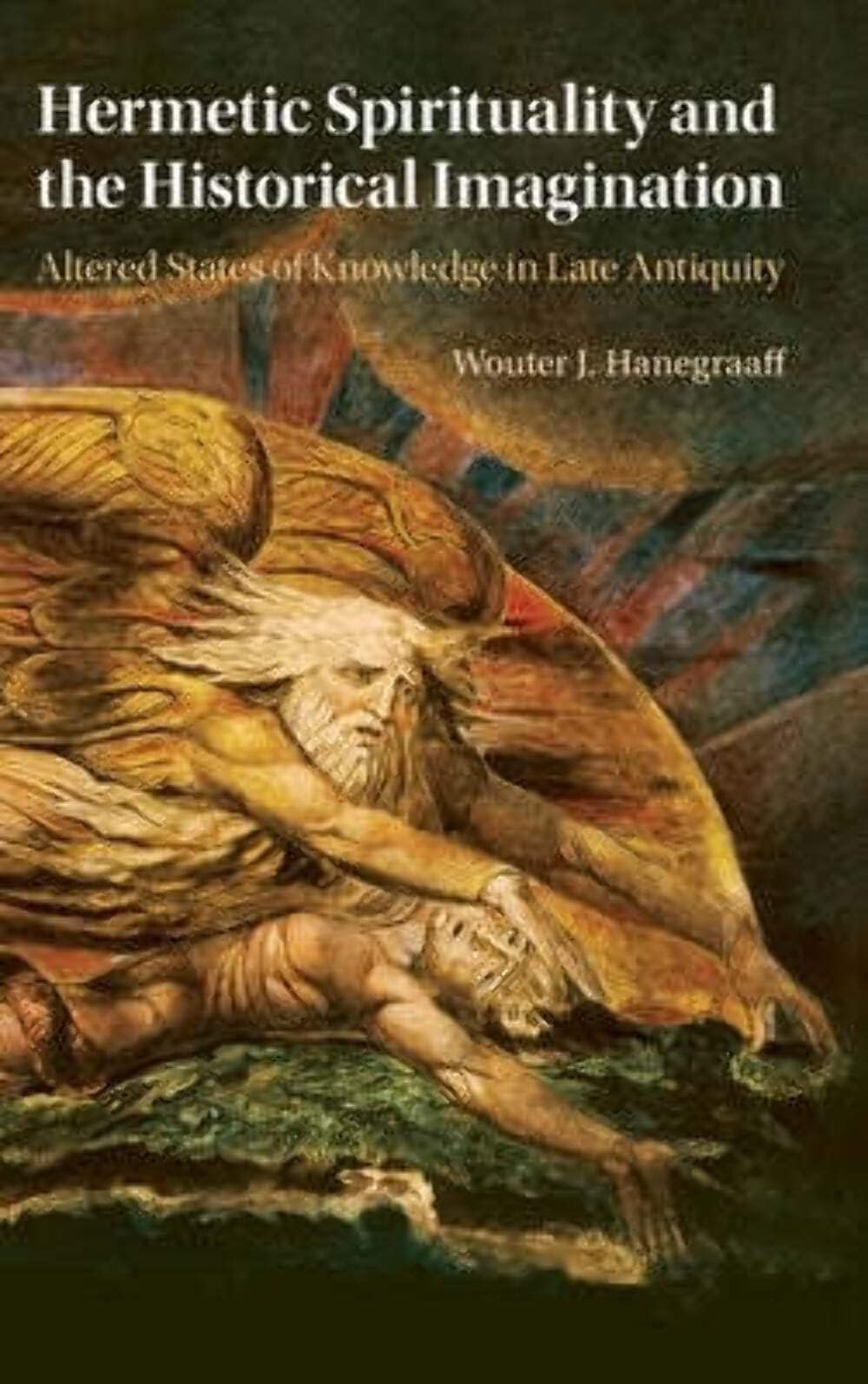
Hermetic Spirituality and the Historical Imagination: Altered States of Knowledge in Late Antiquity
Product ID: 718179876
Buy anything from 5,000+ international stores. One checkout price. No surprise fees. Join 2M+ shoppers on Desertcart.
Desertcart purchases this item on your behalf and handles shipping, customs, and support to Vietnam.
Buy Hermetic Spirituality and the Historical Imagination: Altered States of Knowledge in Late Antiquity by Hanegraaff, Wouter J online on desertcart.ae at best prices. ✓ Fast and free shipping ✓ free returns ✓ cash on delivery available on eligible purchase. Review: This book is helpful for those on a path of Hermetic spirituality, written by one of the top experts on the subject. Academic, but also deeply insightful. Review: The author argues the embodied condition, spiritual practice, & translating the untranslatable. For the latter the author chooses the receptivity of Gadamer over the paranoia of Derrida. He examines the “drug” of the written word. He finds scholarly interpretations of Nous, Logos & imagination have lead us astray; as have Greece & Christianity over Egypt & Islamic transmission. An interesting, well-written book, where publication lag time is an advocate for earlier release of affordable, common paperbacks following their traditional, highly priced hardback versions. Almost a metaphor for what the author argues.
| Customer reviews | 4.9 4.9 out of 5 stars (22) |
| Dimensions | 15.24 x 3.18 x 22.86 cm |
| Edition | New |
| ISBN-10 | 1009123068 |
| ISBN-13 | 978-1009123068 |
| Item weight | 762 g |
| Language | English |
| Print length | 400 pages |
| Publication date | 30 June 2022 |
| Publisher | Cambridge University Press |
S**Y
This book is helpful for those on a path of Hermetic spirituality, written by one of the top experts on the subject. Academic, but also deeply insightful.
3**8
The author argues the embodied condition, spiritual practice, & translating the untranslatable. For the latter the author chooses the receptivity of Gadamer over the paranoia of Derrida. He examines the “drug” of the written word. He finds scholarly interpretations of Nous, Logos & imagination have lead us astray; as have Greece & Christianity over Egypt & Islamic transmission. An interesting, well-written book, where publication lag time is an advocate for earlier release of affordable, common paperbacks following their traditional, highly priced hardback versions. Almost a metaphor for what the author argues.
P**S
This book represents a step backward, again, in historical time for Hanegraaff, who first wrote about New Age spirituality, then (that which has been designated as) esotericism. Yet as he does so, he reveals more and more about the ways in which we construct our own identities in the modern, secular, Western world. This is his first book of specialist textual analysis, bookended by meditations and analysis that continue his ongoing project. I really enjoyed his careful and tentative reconstruction of Hermetic spirituality, but I did find the middle of the book much less exciting than his previous books. Lastly, it's a gripe I rarely bring up, but it is disappointing that this book comes in print-on-demand format. It's very expensive. At least the POD quality is high, as far as the printing is concerned. There were no lightly printed areas. I guess it was inevitable that even first-run academic books would become POD: Brill has been doing this for years. Yet why then this doesn't lower the high price, always justified by low print runs, is beyond me. Thank you.
J**A
And the best book I have read so far this year. Really good. Read it slowly. Expect to spend some time here. After I finished it, my copy was full of highlights and notes. I want to read it again, after I let the ideas soak in a bit and mull them over. An excellent book, which I strongly recommend for anyone interested in learning about the authentic hermeticism.
M**N
Wouter Hanegraaff's book Hermetic Spirituality and the Historical Imagination: Altered States of Knowledge in Late Antiquity advances the field of Hermetic studies, especially after the error is corrected in his cosmos-ascent model, per astral ascent mysticism, so that the Fate-soaked fixed stars are no longer excluded entirely from his sky, but are allowed into his cosmos model, where they belong: sphere 8, the Ogdoad. Hanegraaff's model of the so-called "cosmos" doesn't have any fixed stars. Look up into his sky: there are no stars, only 5 planets + sun & moon. This is not a model of the cosmos, nor of cosmos rebirth, because his visible sky cannot have any stars, per his admission in footnote 114, page 294: "Whether the fixed stars should be included [with Saturn, sphere 7] or should rather be associated with the Ogdoad [sphere 8] remains an open question for me." This is the most closed question in the cosmos; it is a basic, simple given that the Fate-soaked fixed stars are what defines sphere 8, called "the Ogdoad". The initiate Tat asks Hermes to be brought into the Ogdoad (Heimarmene; Fatedness; fixed stars; sphere 8; the soul) and also into the Ennead (above heimarmene, above the cosmos; sphere 9; the spirit). Since Hanegraaff omits fixed stars from their sphere 8 (which they define), there's no functional difference in his model between rebirth phase 1 into the Ogdoad, and rebirth phase 2 into the Ennead. The end result of entheogenic mental model transformation is not the repression of fixed stars (Fatedness) as Hanegraaff attempts; the end result is a coordinated, harmonious combination of first affirming Heimarmene, and then affirming transcending Heimarmene, honoring both ways of thinking, together. Hanegraaff cannot place the fate-soaked fixed stars in sphere 8, because he wrongly says "the Ogdoad above the heimarmene". The Ogdoad is not above heimarmene. The cosmos does not consist of 7 spheres, as Hanegraaff writes. Per looking up at the sky, the cosmos consists of 8 spheres. All ancient writings agree; no Hermetic text says the cosmos consists of 7 spheres, or that sphere 8 is outside the cosmos. The cosmos consists of 7 planetary spheres and also the sphere of the fixed stars. Sphere 8 is not "hypercosmic", as he writes. Sphere 9 is actually hypercosmic. I have read his book multiple times in hardcover and ebook format, and David Litwa's book Hermetica I, to confirm that no Hermetic writing says the cosmos has 7 spheres, and that sphere 8 (defined by the fixed stars) is somehow "outside the cosmos". The main visible thing you see in the sky that is the cosmos, is the fixed stars, defining sphere 8 of the cosmos. Per Hanegraaff's own writings in this book and elsewhere, sphere 8 = the Demiurge = the zodiac = Heimarmene headquarters. Hanegraaff spreads the following equations separated apart to hide the self-contradiction: Ogdoad = sphere 8 = fixed stars = heimarmene = Fate = cosmos. By spreading the equations into separate pages, he writes inconsistently: Heimarmene = Fate = fixed stars = sphere 8 = Ogdoad = above Heimarmene. Other hermetic scholars follow suit, waffling in self-contradictory fashion: in one paragraph, Ogdoad is above heimarmene; in alternating paragraphs, sphere 8 is the Fate-soaked fixed stars. Switching between saying "sphere 8" and "Ogdoad" tries to hide the self-contradiction, in order to misguidedly purify the Ogdoad of heimarmene by making the stars go missing in every other paragraph, inconsistently. The solution is to always give the sphere number (7, 8, or 9) and equate Heimarmene consistently with the fixed stars and sphere 8 and the name "Ogdoad", and understand that rebirth is initially into conformity with pure Heimarmene - not yet above Heimarmene. My other correction of this book is its claim that anything you can think of is entheogenic, as if to propose "non-drug entheogens", a contradiction in terms. Entheogenic practices in the broad sense actually means combining visionary plants with mental model formation and observation and various techniques - not omitting visionary plants. In 2004, I posted in Egodeath Yahoo Group about that point, a post titled "Entheogenic Esotericism", 8 years before Hanegraaff's keynote article speech titled "Entheogenic Esotericism". To summarize, as the million stars to steer by in the cosmos rebirth model that Hermetic scholars struggle to coherently present: The mind starts with naive possibilism-thinking (level 0), becomes increasingly attuned to Heimarmene (Fate; eternalism) in entheogenic sessions 1-7, becomes fully reshaped and aligned harmoniously with Heimarmene (Fatedness; 4D spacetime block universe eternalism) in sphere 8 (the fixed stars); and then reconciles and marries the two ways of thinking together in sphere 9: embrace and include Heimarmene coordinated with the transcending of Heimarmene; marry qualified possibilism-thinking and qualified eternalism-thinking, to reach completion of initiation, per all brands of religion in Late Antiquity, flourishing starting around 150 CE. -- Michael Hoffman, theorist of ego death and transcendence
Trustpilot
1 month ago
1 week ago