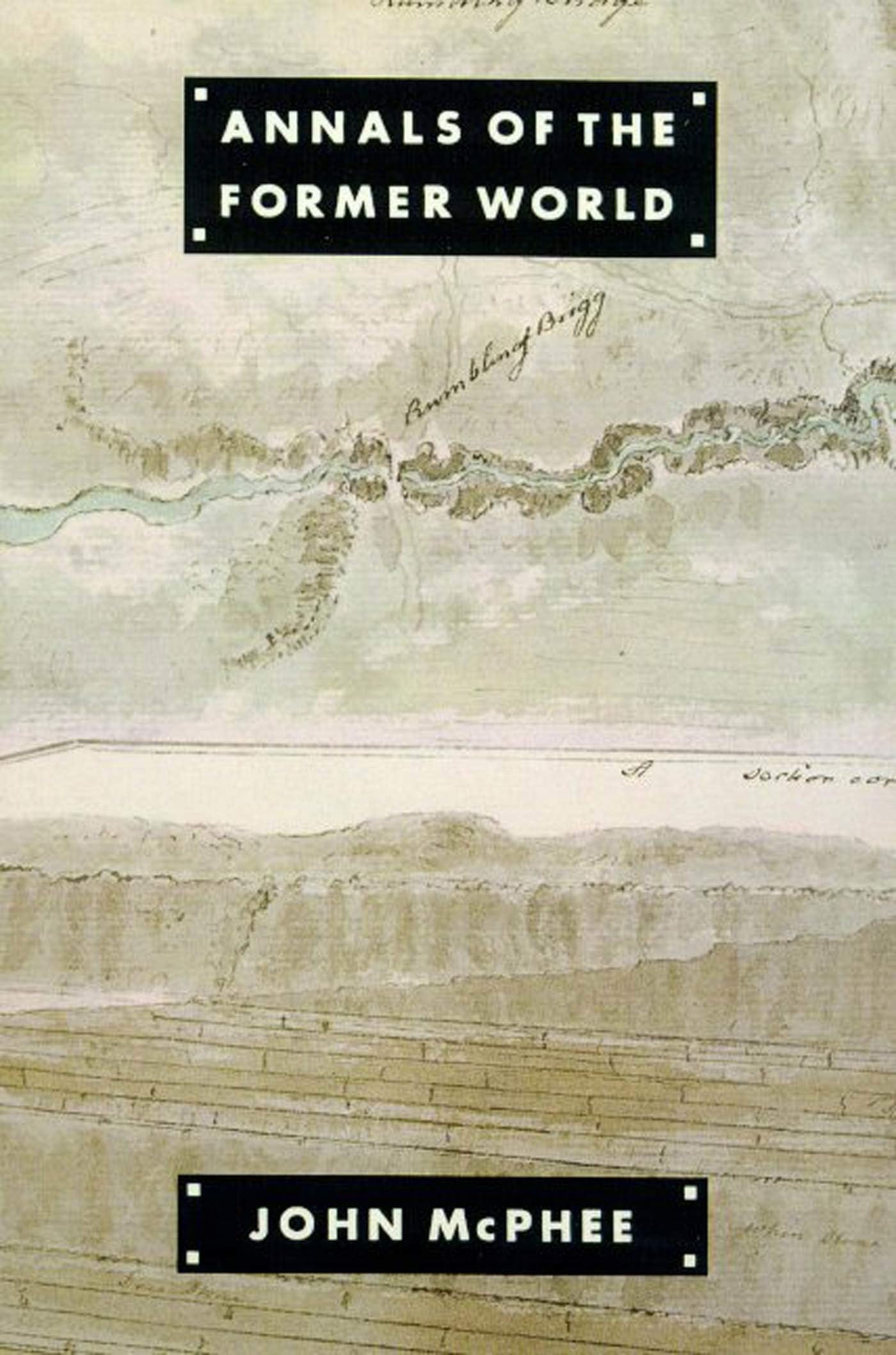

Annals of the Former World
Product ID: 7112147
Buy anything from 5,000+ international stores. One checkout price. No surprise fees. Join 2M+ shoppers on Desertcart.
Desertcart purchases this item on your behalf and handles shipping, customs, and support to Vietnam.
Annals of the Former World [McPhee, John] on desertcart.com. *FREE* shipping on qualifying offers. Annals of the Former World Review: Deep Time - Take a field trip through North America's Basin and Range province, stretching East to West from Utah to California and South to North from Mexico to Oregon, and you're in a land being pulled apart by Tectonic Forces to someday becoming an arm jutting out from North America into the Pacific Ocean. Baja and California will become first a very long peninsula then later a archipelago west of the continent. Our world is indeed changing all around us. If you really love reading about Geology and Geography then John McPhee's Pulitzer Prize winning 1998 book "Annals of the Former World" may be just what you're looking for. It's actually like reading 5 shorter books on different aspects of geology: regional landscapes, exotic features, exploring the craton and even California*. But no matter what your interest are, if you tackle this monumental work of over 700 pages be prepared for lots of technical terminology in the Earth Sciences and Geography along with some interesting bits of cultural-history, biographies of various geologist and what frontier life was like in the various regions covered. Some readers may not like McPhee's frequent philosophical or biographical passages, that can be quite long and cover a lot of ground, but his inner thoughts just reflect his passion for geology and all the related sciences'. For me this was a long, tough but rewarding read. Some portions of the book flowed along smoothly while others left me feeling somewhat overwhelmed by the author's lengthy and technical writing style, so unless you're up for a very challenging read you might want to look elsewhere. But I, for one, found this to be an enjoyable book that took me to remote location around North America, the Globe, and back into Earth's Deep Time exploring the origins of our landscape, where it came from and where it's going. McPhee's writing is very descriptive, giving you a clear picture of the places he, and his geologist friends, were traveling through. There aren't many illustrations in the Kindle edition; a few photos, some charts and maps, so my iPad got a real workout as I looked up various mountain ranges and other geological regions. But it became clear to me that if I were to take a motor trip through the western United States I would want to have a friendly geologist with me just to help me understand what we were looking at. All features on the Earth have a long history and it helps to have some idea of their origins and the events that led to their present condition. In this book you'll learn about sea mounts and hot-spots, plate tectonics and continental drift, how mountains grow and erode away, how seas come and go and how long all this has been going on. Be sure to read the author’s Afterword: “A Narrative Table of Contents”, it will explain a lot of questions you may have. In my case I read it after but it would also make a good introduction to the author and book. The science in this book was cutting-edge in 1998 but things are always changing and new theories can spring up almost overnight. Over the past decade new observations have lead to new ideas and new ways of looking at the land and its history. But things in geology change at a very slow pace, so whatever “dated” material there may be in the text shouldn’t make any difference to the general reader. If you're interested in learning the history of land formations, diamonds, glacial till or just plain old rocks, than "Annals of the Former World" is a good bet! I had no technical or downloading problems with this Kindle edition. *As far as I can tell the text was also published as 4 or 5 different books, one for each chapter. Last Ranger Review: Surprising, Deep, and Fascinating. - I most enjoyed "Basin and Range" in this tetralogy of geological nonfiction, as that is also the physiography of the land where I live. John McPhee is your best guide and storyteller of our immense, vast, and deep continental history. I cannot properly review the work in a short space, but let me disclose a rather astounding little surprise of the book: While traveling through the Nevada desert at night, McPhee and his companion (a geological expert) witness a large hovering vessel--a vehicle looking very alien and extraterrestrial--fly and propel itself in the most unusual and technologically unique way (but too advanced and luminescent to be military, especially 35 years ago). The next morning the local paper had comments from a number of locals who also reported seeing it. The incident is described in less than a page, only a short aside in the progressive, westward description of the continent, numbering hundreds of pages on an otherwise unrelated subject (or is it?). But by this point, McPhee has already established his credibility with conscientious articulations about his subjects, as well as restrained and informed expressions of the Earth, so that this aside cannot be dismissed so easily. For me, it caused a tumbler to fall in my brain, which seems to have had cascading effects, to the point that I have re-assessed possibilities for such phenomena on Earth. Which ironically brings me full circle to McPhee's subject. If I accept McPhee's account (and I think I just might) it is impossible to not think of the time it must take to travel to Earth from distant origins. Even with incomprehensible technology, the time in travelling must have been immense. And the conclusion emerging from both McPhee's written descriptions, and the cracks in the rocks themselves, is the breath-taking sense of deep time. (Could it be that if visits have occurred, they were only by artificial life forms that can physically endure thousands or even millions of years? Would they have been created by organic life forms? Did they rule over them? But I digress.) The point is that reading McPhee's book and the study of geology give me the sense of how recently we have come along. How even the oldest of the rocks we see, the Precambrian gneiss or schist, could well have come a billion years after other rock planets had been left by those who sought to gather and collect rocks on other planets. If you visit the Grand Canyon you get to see rocks that go back almost half of the 4.5 billion years that span the age of our world. These are the real documents of our Earth's history. And maybe even reflections of eras that coincide with glorious ages of exploration by others in our universe. Maybe that brief blip about a possible alien encounter, in the middle of a lengthy and conscientiously-described account of the geological history of our land, is not so out of place.
| Best Sellers Rank | #118,090 in Books ( See Top 100 in Books ) #16 in Geology (Books) #103 in Travel Writing Reference #655 in U.S. State & Local History |
| Customer Reviews | 4.7 4.7 out of 5 stars (867) |
| Dimensions | 6.1 x 1.8 x 9.05 inches |
| Edition | First Edition |
| ISBN-10 | 0374518734 |
| ISBN-13 | 978-0374518738 |
| Item Weight | 1.75 pounds |
| Language | English |
| Print length | 720 pages |
| Publication date | June 15, 2000 |
| Publisher | Farrar, Straus and Giroux |
L**R
Deep Time
Take a field trip through North America's Basin and Range province, stretching East to West from Utah to California and South to North from Mexico to Oregon, and you're in a land being pulled apart by Tectonic Forces to someday becoming an arm jutting out from North America into the Pacific Ocean. Baja and California will become first a very long peninsula then later a archipelago west of the continent. Our world is indeed changing all around us. If you really love reading about Geology and Geography then John McPhee's Pulitzer Prize winning 1998 book "Annals of the Former World" may be just what you're looking for. It's actually like reading 5 shorter books on different aspects of geology: regional landscapes, exotic features, exploring the craton and even California*. But no matter what your interest are, if you tackle this monumental work of over 700 pages be prepared for lots of technical terminology in the Earth Sciences and Geography along with some interesting bits of cultural-history, biographies of various geologist and what frontier life was like in the various regions covered. Some readers may not like McPhee's frequent philosophical or biographical passages, that can be quite long and cover a lot of ground, but his inner thoughts just reflect his passion for geology and all the related sciences'. For me this was a long, tough but rewarding read. Some portions of the book flowed along smoothly while others left me feeling somewhat overwhelmed by the author's lengthy and technical writing style, so unless you're up for a very challenging read you might want to look elsewhere. But I, for one, found this to be an enjoyable book that took me to remote location around North America, the Globe, and back into Earth's Deep Time exploring the origins of our landscape, where it came from and where it's going. McPhee's writing is very descriptive, giving you a clear picture of the places he, and his geologist friends, were traveling through. There aren't many illustrations in the Kindle edition; a few photos, some charts and maps, so my iPad got a real workout as I looked up various mountain ranges and other geological regions. But it became clear to me that if I were to take a motor trip through the western United States I would want to have a friendly geologist with me just to help me understand what we were looking at. All features on the Earth have a long history and it helps to have some idea of their origins and the events that led to their present condition. In this book you'll learn about sea mounts and hot-spots, plate tectonics and continental drift, how mountains grow and erode away, how seas come and go and how long all this has been going on. Be sure to read the author’s Afterword: “A Narrative Table of Contents”, it will explain a lot of questions you may have. In my case I read it after but it would also make a good introduction to the author and book. The science in this book was cutting-edge in 1998 but things are always changing and new theories can spring up almost overnight. Over the past decade new observations have lead to new ideas and new ways of looking at the land and its history. But things in geology change at a very slow pace, so whatever “dated” material there may be in the text shouldn’t make any difference to the general reader. If you're interested in learning the history of land formations, diamonds, glacial till or just plain old rocks, than "Annals of the Former World" is a good bet! I had no technical or downloading problems with this Kindle edition. *As far as I can tell the text was also published as 4 or 5 different books, one for each chapter. Last Ranger
J**T
Surprising, Deep, and Fascinating.
I most enjoyed "Basin and Range" in this tetralogy of geological nonfiction, as that is also the physiography of the land where I live. John McPhee is your best guide and storyteller of our immense, vast, and deep continental history. I cannot properly review the work in a short space, but let me disclose a rather astounding little surprise of the book: While traveling through the Nevada desert at night, McPhee and his companion (a geological expert) witness a large hovering vessel--a vehicle looking very alien and extraterrestrial--fly and propel itself in the most unusual and technologically unique way (but too advanced and luminescent to be military, especially 35 years ago). The next morning the local paper had comments from a number of locals who also reported seeing it. The incident is described in less than a page, only a short aside in the progressive, westward description of the continent, numbering hundreds of pages on an otherwise unrelated subject (or is it?). But by this point, McPhee has already established his credibility with conscientious articulations about his subjects, as well as restrained and informed expressions of the Earth, so that this aside cannot be dismissed so easily. For me, it caused a tumbler to fall in my brain, which seems to have had cascading effects, to the point that I have re-assessed possibilities for such phenomena on Earth. Which ironically brings me full circle to McPhee's subject. If I accept McPhee's account (and I think I just might) it is impossible to not think of the time it must take to travel to Earth from distant origins. Even with incomprehensible technology, the time in travelling must have been immense. And the conclusion emerging from both McPhee's written descriptions, and the cracks in the rocks themselves, is the breath-taking sense of deep time. (Could it be that if visits have occurred, they were only by artificial life forms that can physically endure thousands or even millions of years? Would they have been created by organic life forms? Did they rule over them? But I digress.) The point is that reading McPhee's book and the study of geology give me the sense of how recently we have come along. How even the oldest of the rocks we see, the Precambrian gneiss or schist, could well have come a billion years after other rock planets had been left by those who sought to gather and collect rocks on other planets. If you visit the Grand Canyon you get to see rocks that go back almost half of the 4.5 billion years that span the age of our world. These are the real documents of our Earth's history. And maybe even reflections of eras that coincide with glorious ages of exploration by others in our universe. Maybe that brief blip about a possible alien encounter, in the middle of a lengthy and conscientiously-described account of the geological history of our land, is not so out of place.
G**S
I read my first book by John McPhee earlier this year, "Oranges", after it was included in a short list of Books you can read in a day by the Economist Magazine.It was a fun read. I was very impressed by his highly readable and amusing style, rather unique for non fiction subjects. So I decided to try his "Annals of the Former World" as the geological history of North America interests me. ( I'm a mechanical engineer and enjoyed my one course in Geology at University) Also, I knew McPhee was awarded the Pulitzer Prize for this book. I had quite high expectations for it and I was not disappointed. It's a big thick paperback that will take a long time to read in its entirety, but based on the first few chapters, I highly recommend this book.
G**G
Annals of the Former World is an omnibus work consisting of four volumes focusing on the geology of the USA, together with a shorter essay, all written by John McPhee. It is nothing less than an extraordinary piece of writing - a non fiction book about a highly technical subject which is a genuine page-turner. I have some advantage and bias here - I was a geologist for almost all my working life, but not in the USA and my direct experience was limited to only part of this wide and rapidly evolving science. So I had some advantages from my background and I was familiar with much of the terminology. But I found that I had no difficulty understanding the descriptions and explanations and arguments that McPhee constructed to create the tale of how the North American continent formed and grew. I think any interested person, perhaps assisted by a geological dictionary, will get as much form this collection as I did. And it's not just a description of rocks and continent building. McPhee had the help of some truly exceptional field geologists who had spent their careers working with the rocks, and guiding future generations of earth scientists in the process. Their stories add to the interest of the book, and serve to break up the more technical sections. It also becomes apparent that McPhee has a bias towards those who have a hands-on relationship with the rocks - like most sciences geology has its "black box" people, but they need the field workers to hopefully guide them away from the howlers that laboratory people can make when they get too far from the real world. The third main theme of the book is the history of the development of geological thought, and it's just as well written as the rest of the book. We need to keep in perspective that the science is only around 200 years old, and it started from an initial acceptance that the bible provided a perfectly adequate understanding of the formation of the earth, and not a lot had happened since then. The pathway to our present understanding was fraught with controversy, and we haven't reached the end of it yet. I learnt a lot from this collection, and I was reminded of things I had almost forgotten. I can't recommend it highly enough to anyone with an interest in the natural world and an inquiring mind.
D**N
For me, five stars is a very rare accolade, as in good film reviewing. This is a 'book of my lifetime' in the field of public science writing. I am amateur-passionate about geoscience but have no interest in America or even its geology. This author and monumental volume were unknown to me until recommended by Prof Iain Stewart in a late-night Inverness bar. McPhee was a New Yorker writer of catholic interests, but must have devoted years not just to writing this tome, but to following Interstate 80 coast to coast, always in the company of a leading geologist in each domain it traverses. Their personal histories are integral, and emblematic of pioneer and immigrant America. His style is pure New Yorker, ramming home his key points by endless repetition and variation, verging on the turgid, but we end up knowing our stuff and all concerned. I don't need to go there now. A Pulitzer Prize is one thing, my award is for seeing me through a year of insomnia nights.
A**L
John McPhee takes the reader on an epic voyage across and into North America, as well as the field of geology, the lives and ideas of some of its practitioners, and into deep time. This book is a multi-layered, multi-textured reading experience featuring McPhee's enthusiasm for geology, human history, and the precise and illuminating use of language. A slow but rewarding read.
D**D
Very thorough overview of the geology of the United States of America. East to understand for non geologists as it is written by a writer with an interest in geology. It focusses on the geology found along interstate route I 80, crossing the United States from New York to California, covering the Appalachians, the great plains, the Laramie mountains and the Rockies, each with a different geologist who accompanies the author on his travels.
Trustpilot
3 weeks ago
2 weeks ago