Desert Online General Trading LLC
Dubai, United Arab Emirates
Desert Online General Trading LLC
Dubai, United Arab Emirates
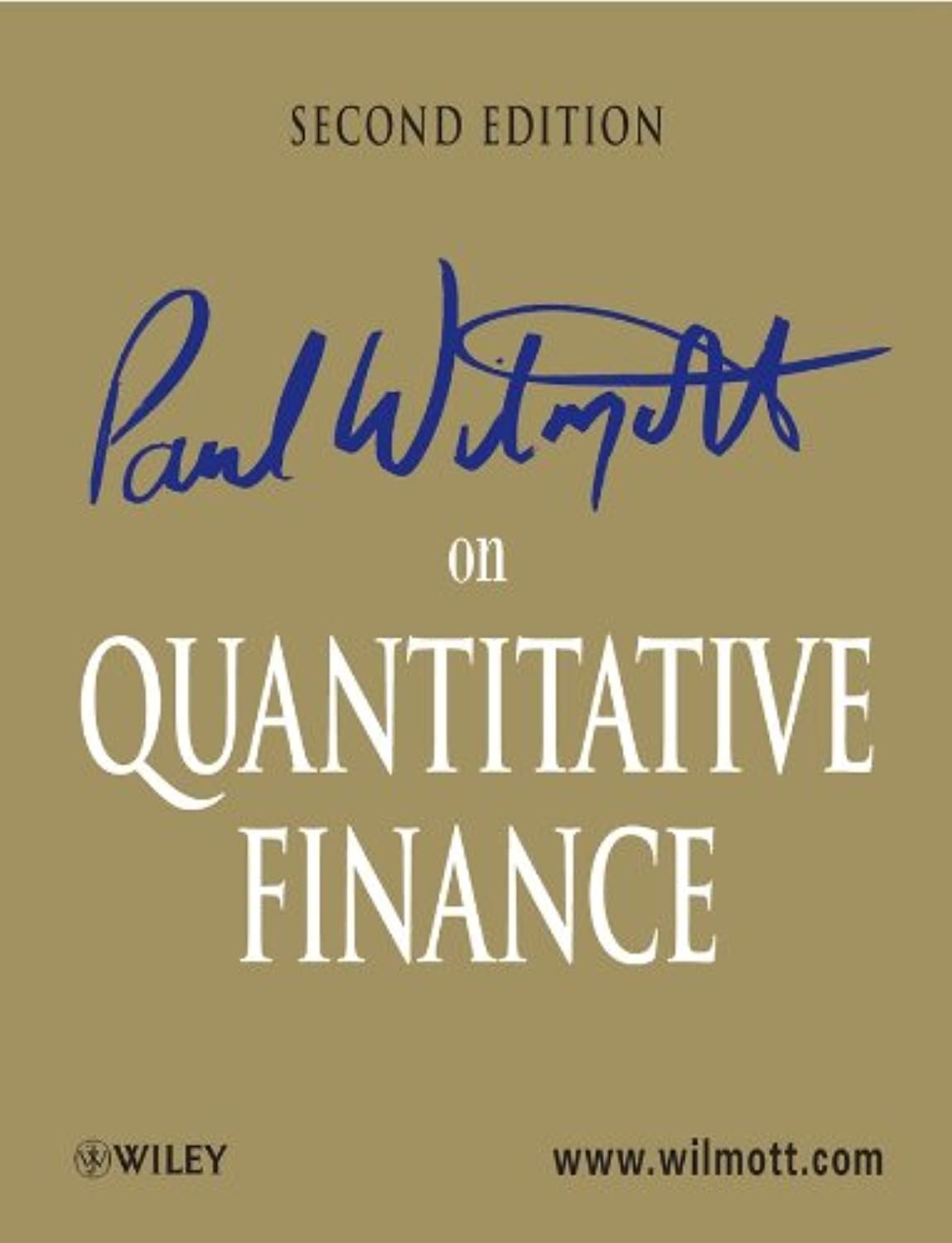
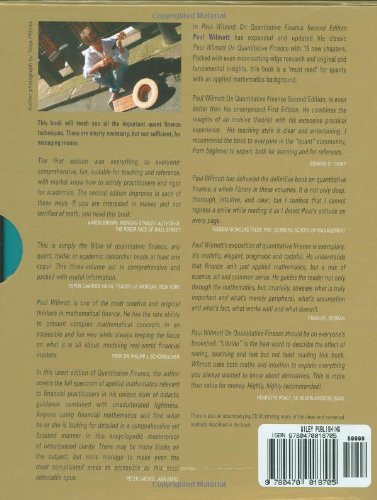
Full description not available
H**U
Excellent book!
I found this book quite interesting. Yes it may lack rigor in math but it gave me intuitions other books lack. As an engineer who has gone through rigorous derivations in graduate school and entered the work place finding that all these math isn't very useful and is easy to forget. The intuitions and deep understanding of the reasoning are the things that people remember forever. This is what this book is good at.
P**E
Overpriced and absolutely useless
I tried to put 0 stars. This is overpriced and absolutely useless book.Author has absolutely no experience in practical application of quantitative finance. His descriptions of the models are outdated, the book provides zero intuition about what's happening in the markets.It's hard to imagine why somebody would spent time and money on this book.
A**R
Four Stars
It was a gift, and he loves them.
S**K
A must have for anyone interested in finance
I'm only through the first book of the set, and already can't wait to start the second one. This is the best book I've read on quantitative finance (and I thought Hull was pretty good). The language is easy, the math is not cumbersome, everything is clear.If I had to make a suggestion, it would be in text references. They specify the author and publishing year, but often omit the name of the book (e.g. Wilmott refers to Neftci's 1996 book as the best on stochastic calculus for beginners, yet Amazon doesn't show anything by this author from that year)
Q**Y
The quality is perfect, as they promised
They said it will arrive in a month. Actually it arrived almost within a week. The quality is perfect, as they promised. I have no complaints at all.
D**O
Big disappointment
This book was a big disappointment for three reasons: 1) it doesn't have a proper focus. Author wanted to cover everything and that's why the book is making sloppy impression, i.e. too wide and not too deep when it is necessary; 2) it doesn't help you as a quant in the everyday quant life. It doesn't show you how to backtest models, it doesn't tell you how to use all this knowledge in the practical way, it doesn't even tell about the robustness and out of sample testing; 3) it is an arbitrary collection of known theories with some unexplained extracts from the different fields which are not connected with each other in the logical way.As the final accord: why the "quant bible" is based on the "normal" distribution. How long are we going to use all this useless in practice old concepts like Black-Scholes models etc?
F**H
Good. Transaction
As promised
B**R
We are better off with Wilmott's work than without it
Paul Wilmott has made quantitative finance his life's work, and this (now three volume) collection of his explications of his own fundamental work and the aggregation of the dispersed work of others is a welcome reference library in a field of increasing density.Here is the bad news; it doesn't contain everything.Here is the good news: it doesn't contain everything.And thank God, because if Wilmott had gone through each topic in the rigorous theorem-proof of yellow-spine Springer books we'd be old men before we got finished.Wilmott's critics usually center around three areas: tone, incompleteness (or sloppiness), and emphasis.On emphasis, Wilmott's strengths is his own material in partial differential equations (PDE approach), which makes sense as his earliest background was in the mathematics of fluid dynamics. Some readers, therefore, may detect that there is a heavier hand on PDEs over other analytic or numeric approaches, etc. But like any novel, any collection and textbook must have a "spine" on which to build and reference other topics in extension and contrast.On incompleteness, readers should consult the "Look Inside" feature for a list of topics, and recognize that quantitative finance is now a field so vast that no one volume can circumscribe the subject. Nevertheless, if there is one collection that covers the most interesting and common topics, it is this one (Hull's 6th edition leaves out some helpful chapters contained in the 5th edition, for example).On tone, colleagues complain Wilmott glosses over important dimensions and has a flippant engagement with the material. My view is this criticism is simply one of preference. Each author chooses how to express his subject, often injecting themselves into the explanation: this is an effective literary technique hollowed by time and results. Reading Hull is like reading a report from an audit committee: Hull's tone is lean and exact. Wilmott, on the other hand, holds that quantitative finance need not be pompous, needlessly abstract, self-important or dull. In fact, it should be fun. Hull isn't funny nor lively, while Wilmott tries to be both. Neither is wrong, just different approaches to the same goal: trying to get the reader to understand the material.The term "encyclopedia" (which Wilmott wisely does not use) may have as its root meaning "all knowledge" but even Voltaire's original encyclopediaists were aware of the hubris contained in the phrase. Anyone who whines "it doesn't cover (x)" or "it only glosses over (y)" or "the math isn't rigorous enough" is never going to be satisfied and misses entirely the purpose of this work. If you want to collect all these formulas and topics in the expression of academic journals and enjoy reading about them that way you are but a Google-Scholar search and three years of spare time away from satisfying your unique utility curve. Perhaps it is only for meatheads like me, but so be it. Wilmott's hefty contribution merits widespread use as a reference work, but like anything it is a condensed collection that for any single topic needs additional work by the reader.
Trustpilot
5 days ago
3 days ago
2 weeks ago
5 days ago