
DOWNLOAD THE APP


Customer Services
Copyright © 2025 Desertcart Holdings Limited
DOWNLOAD THE APP
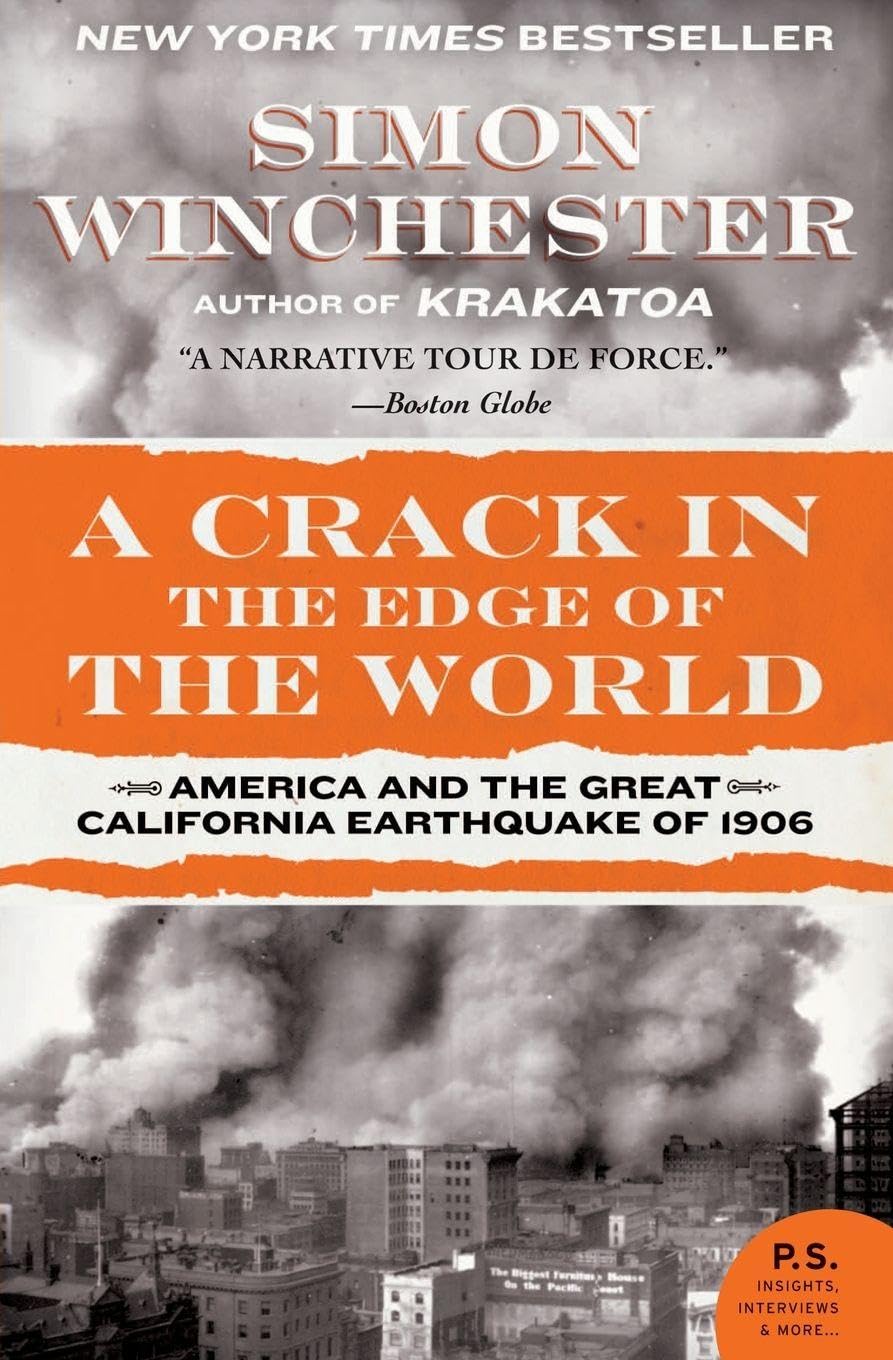
Buy A Crack in the Edge of the World: America and the Great California Earthquake of 1906 (P.S.) on desertcart.com ✓ FREE SHIPPING on qualified orders Review: San Andreas fault moved its fingers. Earth divided, plates collided, such an awful sound - Another fabulous story of man’s efforts and failures, this time in managing a major earthquake and subsequent devastating fire. Here Simon Winchester takes us to 1906 San Francisco, which is located on the western edge of the North American plate. San Francisco then was a new town, built hastily and not soundly, to soak up people and capital closely following the gold rush and statehood. As we know now, San Francisco never became the principal western US city, as it is located directly on the San Andreas fault whereas its competitors in SoCal are not. Winchester is a fine writer with an inquisitive and scientific mind, so we can luxuriate along with him, meeting the great and eccentric men living in the scientific and political realms. No bongo players in strip clubs, but several nudists, vegans, and sex crazed experts are identified in geology, physics, and chemistry. If you want to be forever associated with scientific devices, equations, or theorems, the key is brand management, as well practiced here by Richter. Good explanation and comparison with other major earthquakes like Lisbon, where the rebuilding process still proceeds slowly and carefully. Fascinating accounts of the people involved directly and those that provided aid. In the early 20th century much of the support was provided by the military directly who fortunately had people nearby in the Presidio and priority access to the transcontinental railroad which ensured more people, supplies, and tents were soon on the way. Note that like the 2025 LA fires, essentially no water was available to the firemen. Hence much of the city burned, especially Chinatown. Eventually the army controlled some of the fire using dynamite to create firebreaks where many nice buildings had once stood. As expected, the insurance companies did not have adequate funds, especially the Central European ones. Negotiations, refusals, fine print reading, and quick retreats to homelands were the typical response. Review: Another enthralling journey from Winchester. - Simon Winchester has written another insightful and satisfying book in "A Crack in the Edge of the World." I am still impressed with his ability to take subjects that many people would otherwise ignore and present them in a way that makes them accessible - and this is not done by oversimplifying the subject matter; Winchester doesn't reduce his material to "USA Today" levels or simply present a bunch of figures and statistics. Instead he tells a story, and much as he did in "Korea: A Walk through the Land of Miracles," "The Map that Changed the World" and "Krakatoa," Winchester takes the reader on a journey of discovery. As the San Francisco earthquake of 1906 has been covered in great detail more times than I can count, I was a bit skeptical of the book when I first heard of it. Yet the eruption of Krakatoa/Krakatau had been beaten to death, and that didn't stop Winchester from offering new perspectives, and the notoriety of the 1906 quake doesn't stop "A Crack in the Edge of the World" from being another winner. Winchester begins with various firsthand accounts of the 1906 earthquake, and from there Winchester diverts to the other side of the North American Plate -Iceland - and continues on through the history of North America. In fact, he goes all the way back to the days when Earth was nothing more than a ball of magma. Only Winchester goes from a road trip across America to the formation of the first wretched continents in the Earth's youth to the foundation of the village of Yerba Buena (now San Francisco) within a couple of chapters. Without a doubt, those readers whom Winchester frustrated in the past will be so again; Winchester takes his time before recounting the story of the quake itself. However, this method is what helped him turn the familiar story of Krakatoa into a remarkable combination of plate tectonics, Indonesian history and religion, biology, and the birth of the global news media that went far beyond the eruption itself. Patient readers will see a night on Mount Diablo lead into North America's geologic past and -most significantly- the portrait of the "Mischief Maker," the San Andreas Fault. Added to all this are plenty of Winchester's dry humor and anecdotes that have become his trademark. Each time Winchester discusses a new subject in the book, he often ties it into his drive across America and Canada, and specifically his stops in those places with a history of earthquakes. These include not only the usual suspects such as California and Alaska, but the Central Mississippi lands that unleashed the monstrous New Madrid quakes (which Winchester provides with some shocking geologic significance), and the unlikely home of a frighteningly active seismic past: Charleston, South Carolina. Eventually, Winchester reaches California with his outstanding chapter on the San Andreas Fault, and this is where he really earns his cover price. Winchester starts from its northern end off Cape Mendocino and follows it to the deserts of Southern California. Along the way he visits the features that distinguish the "SAF," from rugged hills to rich dot-com boomtowns and from torn highways to crumbling cliff mansions. In fact, Winchester's history of the San Andreas becomes so detailed in its records of its fits and tantrums that the killer fault begins to seem like just another personality in California's landscape of oddities. He suceeds completely in making the San Andreas Fault, so long a hosehold name but one shrouded in ominous mystery, easy to comprehend, and this is where his ability to bring science to the liberal arts major masses (like me!) is at its most impressive. Then Winchester focuses at last on San Francisco itself, a entertaining and uniquely Californian tale of the lawless crush of the 49ers, the perfect seaport and the coming of the railroads, the villians and entrepeneurs, the loss of the recogition as First City in the West to Los Angeles, and the modern, 'fragile' city of today. Inexorably linked to the city is the San Andreas. The violence it generated in 1906 is shown to be a sea change in the history of San Francisco itself, of California, and of America as a whole. Winchester also spends plenty of time with the personalities of 1906, from Mayor Schmitz to Ansel Adams. It is true though, as others have noted, that the story of San Francisco itself is not comprehensive: look to dedicated history books for that. Although Winchester's tendency to shift gears so often in this book can be bothersome to those who are unfamiliar with (or dislike) his style, its only real drawback is when it barely touches on so many things that could be (and have been) heavy books in their own right, such as the New Madrid quakes, the wacko geology of the Pacific Northwest, and the history of Los Angeles (For a similar perspective on LA, see Marc Reisner's must-read, "A Dangerous Place"). I also can't say I agree with Winchester's assertion that Vesuvio is the only volcano on the European mainland (hello, Campi Flegrei), nor do I think he spent enough time on the inaccuracies of the Richter Scale as compared to other seismic scales, but he has age and several degrees on me, so I won't press the subject. If you're a fan of Simon Winchester's previous books, especially "Krakatoa," this one's for you, too. If you found his stream-of-conciousness science bothersome in the past, then you won't like this any better, but for those who are merely curious when they see this on the shelf, "A Crack in the Edge of the World" is an excellent trip across America that brings new light to the stories of San Francisco, California, and the San Andreas.


| Best Sellers Rank | #422,619 in Books ( See Top 100 in Books ) #19 in Earthquakes & Volcanoes (Books) #173 in Natural Disasters (Books) #4,228 in U.S. State & Local History |
| Customer Reviews | 4.3 4.3 out of 5 stars (484) |
| Dimensions | 5.31 x 1.28 x 8 inches |
| Edition | Illustrated |
| ISBN-10 | 0060572000 |
| ISBN-13 | 978-0060572006 |
| Item Weight | 10.4 ounces |
| Language | English |
| Print length | 512 pages |
| Publication date | October 10, 2006 |
| Publisher | Harper Perennial |
J**L
San Andreas fault moved its fingers. Earth divided, plates collided, such an awful sound
Another fabulous story of man’s efforts and failures, this time in managing a major earthquake and subsequent devastating fire. Here Simon Winchester takes us to 1906 San Francisco, which is located on the western edge of the North American plate. San Francisco then was a new town, built hastily and not soundly, to soak up people and capital closely following the gold rush and statehood. As we know now, San Francisco never became the principal western US city, as it is located directly on the San Andreas fault whereas its competitors in SoCal are not. Winchester is a fine writer with an inquisitive and scientific mind, so we can luxuriate along with him, meeting the great and eccentric men living in the scientific and political realms. No bongo players in strip clubs, but several nudists, vegans, and sex crazed experts are identified in geology, physics, and chemistry. If you want to be forever associated with scientific devices, equations, or theorems, the key is brand management, as well practiced here by Richter. Good explanation and comparison with other major earthquakes like Lisbon, where the rebuilding process still proceeds slowly and carefully. Fascinating accounts of the people involved directly and those that provided aid. In the early 20th century much of the support was provided by the military directly who fortunately had people nearby in the Presidio and priority access to the transcontinental railroad which ensured more people, supplies, and tents were soon on the way. Note that like the 2025 LA fires, essentially no water was available to the firemen. Hence much of the city burned, especially Chinatown. Eventually the army controlled some of the fire using dynamite to create firebreaks where many nice buildings had once stood. As expected, the insurance companies did not have adequate funds, especially the Central European ones. Negotiations, refusals, fine print reading, and quick retreats to homelands were the typical response.
C**E
Another enthralling journey from Winchester.
Simon Winchester has written another insightful and satisfying book in "A Crack in the Edge of the World." I am still impressed with his ability to take subjects that many people would otherwise ignore and present them in a way that makes them accessible - and this is not done by oversimplifying the subject matter; Winchester doesn't reduce his material to "USA Today" levels or simply present a bunch of figures and statistics. Instead he tells a story, and much as he did in "Korea: A Walk through the Land of Miracles," "The Map that Changed the World" and "Krakatoa," Winchester takes the reader on a journey of discovery. As the San Francisco earthquake of 1906 has been covered in great detail more times than I can count, I was a bit skeptical of the book when I first heard of it. Yet the eruption of Krakatoa/Krakatau had been beaten to death, and that didn't stop Winchester from offering new perspectives, and the notoriety of the 1906 quake doesn't stop "A Crack in the Edge of the World" from being another winner. Winchester begins with various firsthand accounts of the 1906 earthquake, and from there Winchester diverts to the other side of the North American Plate -Iceland - and continues on through the history of North America. In fact, he goes all the way back to the days when Earth was nothing more than a ball of magma. Only Winchester goes from a road trip across America to the formation of the first wretched continents in the Earth's youth to the foundation of the village of Yerba Buena (now San Francisco) within a couple of chapters. Without a doubt, those readers whom Winchester frustrated in the past will be so again; Winchester takes his time before recounting the story of the quake itself. However, this method is what helped him turn the familiar story of Krakatoa into a remarkable combination of plate tectonics, Indonesian history and religion, biology, and the birth of the global news media that went far beyond the eruption itself. Patient readers will see a night on Mount Diablo lead into North America's geologic past and -most significantly- the portrait of the "Mischief Maker," the San Andreas Fault. Added to all this are plenty of Winchester's dry humor and anecdotes that have become his trademark. Each time Winchester discusses a new subject in the book, he often ties it into his drive across America and Canada, and specifically his stops in those places with a history of earthquakes. These include not only the usual suspects such as California and Alaska, but the Central Mississippi lands that unleashed the monstrous New Madrid quakes (which Winchester provides with some shocking geologic significance), and the unlikely home of a frighteningly active seismic past: Charleston, South Carolina. Eventually, Winchester reaches California with his outstanding chapter on the San Andreas Fault, and this is where he really earns his cover price. Winchester starts from its northern end off Cape Mendocino and follows it to the deserts of Southern California. Along the way he visits the features that distinguish the "SAF," from rugged hills to rich dot-com boomtowns and from torn highways to crumbling cliff mansions. In fact, Winchester's history of the San Andreas becomes so detailed in its records of its fits and tantrums that the killer fault begins to seem like just another personality in California's landscape of oddities. He suceeds completely in making the San Andreas Fault, so long a hosehold name but one shrouded in ominous mystery, easy to comprehend, and this is where his ability to bring science to the liberal arts major masses (like me!) is at its most impressive. Then Winchester focuses at last on San Francisco itself, a entertaining and uniquely Californian tale of the lawless crush of the 49ers, the perfect seaport and the coming of the railroads, the villians and entrepeneurs, the loss of the recogition as First City in the West to Los Angeles, and the modern, 'fragile' city of today. Inexorably linked to the city is the San Andreas. The violence it generated in 1906 is shown to be a sea change in the history of San Francisco itself, of California, and of America as a whole. Winchester also spends plenty of time with the personalities of 1906, from Mayor Schmitz to Ansel Adams. It is true though, as others have noted, that the story of San Francisco itself is not comprehensive: look to dedicated history books for that. Although Winchester's tendency to shift gears so often in this book can be bothersome to those who are unfamiliar with (or dislike) his style, its only real drawback is when it barely touches on so many things that could be (and have been) heavy books in their own right, such as the New Madrid quakes, the wacko geology of the Pacific Northwest, and the history of Los Angeles (For a similar perspective on LA, see Marc Reisner's must-read, "A Dangerous Place"). I also can't say I agree with Winchester's assertion that Vesuvio is the only volcano on the European mainland (hello, Campi Flegrei), nor do I think he spent enough time on the inaccuracies of the Richter Scale as compared to other seismic scales, but he has age and several degrees on me, so I won't press the subject. If you're a fan of Simon Winchester's previous books, especially "Krakatoa," this one's for you, too. If you found his stream-of-conciousness science bothersome in the past, then you won't like this any better, but for those who are merely curious when they see this on the shelf, "A Crack in the Edge of the World" is an excellent trip across America that brings new light to the stories of San Francisco, California, and the San Andreas.
T**A
The book itself is in good condition (this is topic unrelated) but the inner leaf is torn out. This bugs me somewhat that the price is not lower since the damage is not small.
K**N
An absorbing account of a timeless subject delivered in near perfect prose.
N**E
This book makes geology exciting! Past and present processes in plate tectonics are beautifully described here. I grew up in the foothills of Mount Diablo, California, which is a special example described in a chapter of the book. I had always wondered about how the rippling layers of rock could possibly have formed, and how fossils from the former sea floor made it up so high! I love this book and highly recommend it to anyone interested in California, general history, geology or the natural world. Winchester writes well and tells a good story. The book is gripping.
N**B
Un altro dei libri di Simon wintchester che torno a rileggere di tanto in tanto. Oltre ad un resoconto preciso del terremoto della città offre una pletora di informazioni e osservazioni sulla geologia e sociologia. Assolutamente consigliato
K**R
My wife bought this in PB and I read it. I was completely taken by Winchester (as I was in all his other books). A great read. I wanted it in HC.
Trustpilot
1 month ago
1 month ago