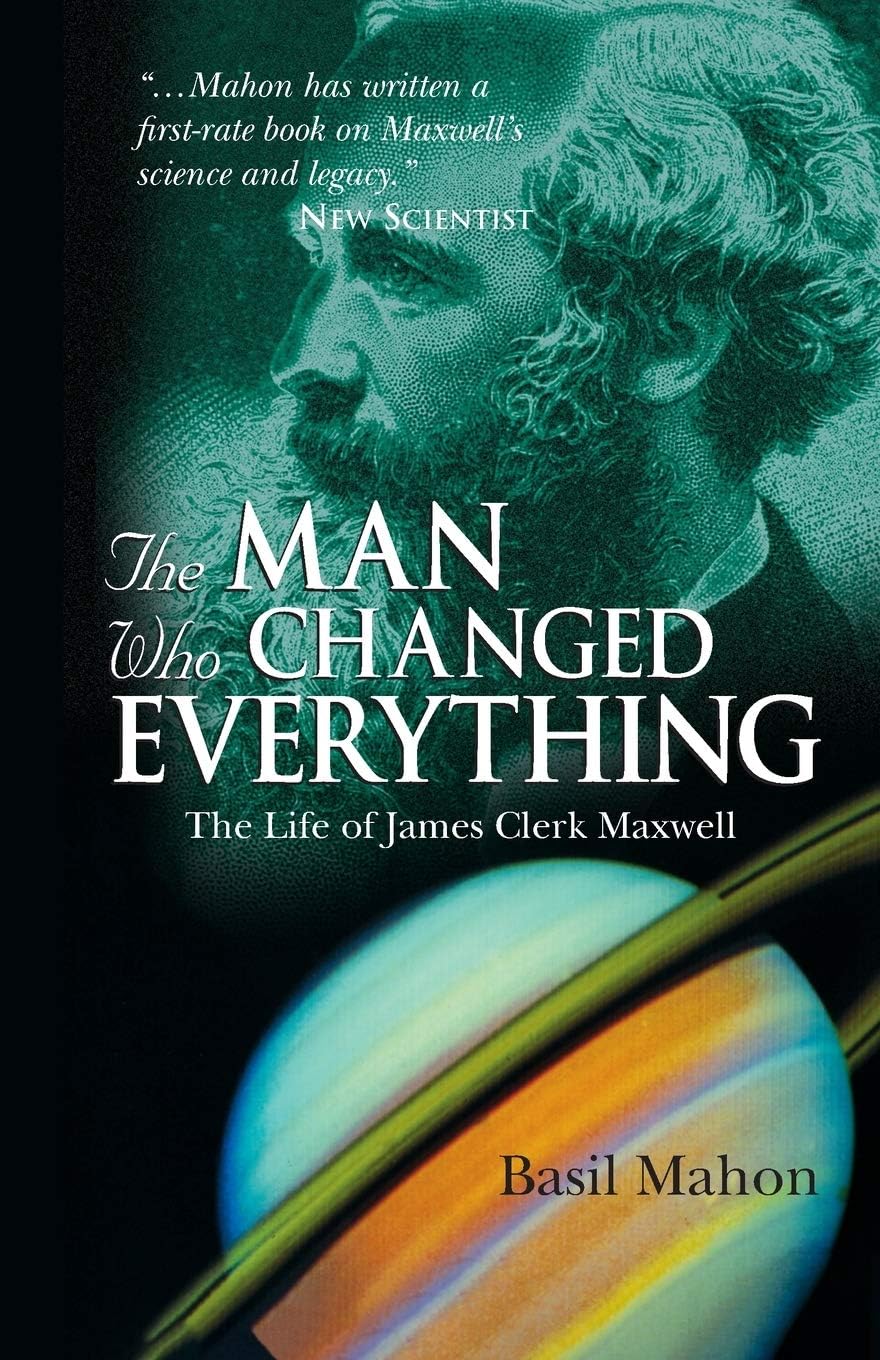
The Man Who Changed Everything: The Life of James Clerk Maxwell
Product ID: 59114050
⚡Electromagnetic theory focus
🌈First color photograph insights
📚Comprehensive biography
Buy anything from 5,000+ international stores. One checkout price. No surprise fees. Join 2M+ shoppers on Desertcart.
Desertcart purchases this item on your behalf and handles shipping, customs, and support to Vietnam.
⚡ The Man Who Changed Everything — Where Science Meets Storytelling
This compelling biography by Basil Mahon chronicles the life and monumental achievements of James Clerk Maxwell, the 19th-century physicist who unified electricity, magnetism, and light into the electromagnetic field theory. Beyond his scientific genius, the book reveals Maxwell’s personal journey, friendships, and pioneering contributions to color photography, statistical mechanics, and engineering. Highly rated and praised for its clarity, this book is essential for professionals eager to grasp the roots of modern physics and the man who transformed it.
| ASIN | 0470861711 |
| Best Sellers Rank | 39,594 in Books ( See Top 100 in Books ) 92 in Scientist Biographies 106 in History of Science (Books) 226 in Popular Science Physics |
| Customer reviews | 4.4 4.4 out of 5 stars (496) |
| Dimensions | 13.72 x 2.03 x 21.34 cm |
| Edition | 1st |
| ISBN-10 | 9780470861714 |
| ISBN-13 | 978-0470861714 |
| Item weight | 1.05 kg |
| Language | English |
| Print length | 256 pages |
| Publication date | 13 Aug. 2004 |
| Publisher | Wiley |
T**D
Superb biography and history of science
This book describes the life & achievements of James Clerk Maxwell, the man who first identified the relationship between electricity, magnetism & light. He was the first to demonstrate mathematically that electricity, magnetism and light are all manifestations of the same phenomenon; the electromagnetic field - with electromagnetic waves. This is regarded by many as one of the greatest scientific achievements of all time; ranking him with Newton, Faraday & Einstein. Mahon's book is extremely well written and is at times hard to put down; this despite his explanations of some very sophisticated physics & mathematics, which he achieves with clarity. Maxwell's life, personality, relationships and achievements are described chronologically; schooling in Scotland, university education in Edinburgh & Cambridge and academic posts beginning and ending at Cambridge. He was a lifelong friend of both William Thomson (Lord Kelvin) and P G Tait; the three regularly exchanging ideas. Maxwell was a gentle caring and religious man with a mischievous though never cruel sense of humour. Although the author devotes a good deal of his text to describing these endearing aspects of Maxwell's life, it is his enormous scientific and engineering achievements which shine through. In addition to his achievements in electromagnetism, Maxwell proposed the first ever statistical law in physics; that is the Maxwell distribution of molecular velocities, the first & perhaps the most inspired step towards the development of statistical thermodynamics and the Maxwell-Boltzmann distribution or molecular energies, which is so important in understanding for example the relationship between temperature and vapour pressure. This alone, without his electromagnetic theory, would be sufficient to mark him as `an all time great' of science. However, there was much more! James also determined the conditions under which Saturn's rings would be stable which won him Cambridge's Adams Prize and the accolade from the Astronomer Royal that his work was one of the most remarkable applications of mathematics to physics that he had ever seen. Maxwell demonstrated the principle by which we see colours and took the world's first colour photograph; he wrote a paper which became the basis of modern control theory; he used polarized light to reveal strain patterns in structure and invented a powerful graphical method for calculating the forces in any framework, techniques which became standard engineering practice. Perhaps most importantly, with the development of his theories on for example electromagnetic fields, perception of colour and statistical mechanics, Maxwell started a revolution in the way physicists look at the world. He began to think that the objects and forces that we see are only our limited perception of an underlying truth that we cannot understand but can describe mathematically. Our author claims that `It is sometimes said, with no more than slight overstatement that if you trace every line of modern physical research to its starting point you come back to Maxwell'. CA Coulson said of Maxwell, that `there is scarcely a single topic that he touched upon which he did not change almost beyond recognition.' Albert Einstein said `one scientific epoch ended and another began with James Clerk Maxwell'. James Clerk Maxwell really was `The man who changed everything'; at least in physics. Mahon's book is first rate as a biography, as a history of science and as a compelling read: five stars of course.
M**S
Good read about one of the greatest scientists that ever lived
Maxwell is probably the greatest scientist of the 19th century, yet few of heard of him as they have of Newton and Einstein. Perhaps that's because he wasn't much of a braggard, or perhaps because he lived a short life, but his life and achievements are well worth knowing. He was brilliant and kind, humane and of vast abilities and creativity. The author digs as deep as he can--there isn't a lot of input data--it is a short but well done review. The author does an excellent job of describing the science in terms the aquainted reader can understand, and he works hard to give the softer side of Maxwell's life, but I found the poems took up too much space and added too little value. If you can explain the science in the notes, the fuller poems could probably go there, too. All around, an excellent work on the most worthy subject.
J**E
Nice book about a nice man
I have read a number of biographies on Maxwell, starting from that of his school friend Lewis Campbell, which was written very soon after his death, and hence is reticent over some aspects of his life. However, it is one of the.primary sources for all the subsequent ones. Of these, in my opinion, this one is the best for the reader who can appreciate the importance of his work in many areas, without being able to follow the detailed technical arguments. Peter Higgs a while back summed Maxwell up with admirable conciseness: "there were Archimedes, Newton, Maxwell and Einstein". No need to say more about Maxwell's scientific status. However, there is a human story there as well: Maxwell seems to have been one of the nicest people ever to walk this earth, as well as one of the most brilliant. This book gets a good balance for the non-scientific reader (it almost persuaded me that I understood what a "curl" was). It also gives an excellent picture of the other workers at the time in the various fields in which Maxwell worked, and Maxwell's relationships with them.
F**K
Electric. Magnetic. Colourful. GENIUS. Read it.
One evening our lovely host berated the Scots as never having contributed a thing to the world on the basis that bagpipes are Greek and tartan of very dodgy provenance. Ignoring relatively easy wins of Alexander Graham Bell, John Logie Baird, Lord Kelvin, David Hume, Adam Smith, Thomas Carlisle, Joseph Lister, Robert and Robert Louis Stevenson, I went for James Maxwell Clerk. Not because he's Scottish in fact but because he was UNBELIEVABLY BRILLIANT. Like so many, I'm not sure he had ever heard of him. Basil Mahon seems to love JCM - this biography is an unbroken eulogy but perhaps justifiably so. Beautiful mind, beautiful soul. Einstein thought he was a GENIUS. I've read Einstein's short treatise on relativity for thick people and am convinced HE was either mad or a GENIUS.... This book is a great introduction to a man who contributed, in such a short life, so much, with such modesty. Should be a standard text in school, educating children what it is, to think.
W**Y
The Man Who Changed Everything: the life and times of James Clerk Maxwell by Basil Mahon This is a brilliant biography of one of the great physicists of the 19th Century. The author has produced a magnificent summary of the life and times of a leading figure in English science, his interconnectedness with Michael Faraday, and the evolution of electromagnetic theory and experimental tests that led to Max Planck’s discovery of quantum mechanics. Blending Maxwell’s work with advances by colleagues at Cambridge, Helmholz, Clausius and Boltzmann in Germany, and others far afield in America, all working against concerns about the practical use of theory and experimental results, it’s no wonder that advances came slowly. It is still a greater wonder about how many brilliant minds lie buried in the dismal poverty of 19th Century England and elsewhere, a situation that Maxwell strove to offset by his efforts to establish schools for trade people, Working Men’s Colleges, institutions he took over in Aberdeen and started at Cambridge. This is a well-deserved biography that highlights the importance of imagination and proof of theory in science, a link that underscores Maxwell’s accomplishments in physics and astronomy, and one that highlights the thinking of Einstein and others that followed him. I recommend this book as a runner up to Philip Ball’s ‘Beyond Weird’, a persuasive account of the merging of classical to quantum physics and the evolution of information theory. Bill Mahaney, author of ‘Ice on the Equator’, ‘Hannibal’s Odyssey: Environmental Background to the Alpine Invasion of Italia’ and ‘Atlas of Sand Grain Surface Textures and Applications’.
P**C
Resolvi adquirir o livro porque tenho a intenção de elaborar um pequeno trabalho biográfico sobre Maxwell. Ainda não concluí a leitura mas até agora considero-o satisfatório para os propósitos, embora ainda pretenda consultar outros volumes em futuro próximo. Apesar disso, sou de opinião que o autor poderia enriquecê-lo um pouco mais com figuras e ilustrações alusivas ao trabalho científico do grande físico.
K**.
マクスウェルの方程式で不滅の偉業を残したJ.C. Maxwellの伝記を読んでMaxwell-Boltzmannの分布関数とか熱統計物理の業績もすごかったなと改めて思い出した.私の勉強の主体が電気関係に偏っていた弊害である.マクスウェル方程式と切っても切れない電磁波,光についても家庭実験を妻と共同で行ったりしていてほほえましい.特に色覚に関するテストが彼の名前を冠してあることを知った.今度眼科に行ったとき医師に確認しようと思う.私の英語力不足から少年時代の電気部分とかやたらと時間を要し,内容も把握できていないかもしれない.それでも読んで楽しかった.一部著者の思い入れから業績が大げさに書かれているところもあるように思った.しかし,これはご愛敬である.
R**T
Perhaps one of the greatest physicists. What is surprising is how little we knew about him. He created the methods that are being used today and inspired Einstien and others.
P**R
Bought for my brother.
Trustpilot
1 month ago
1 month ago