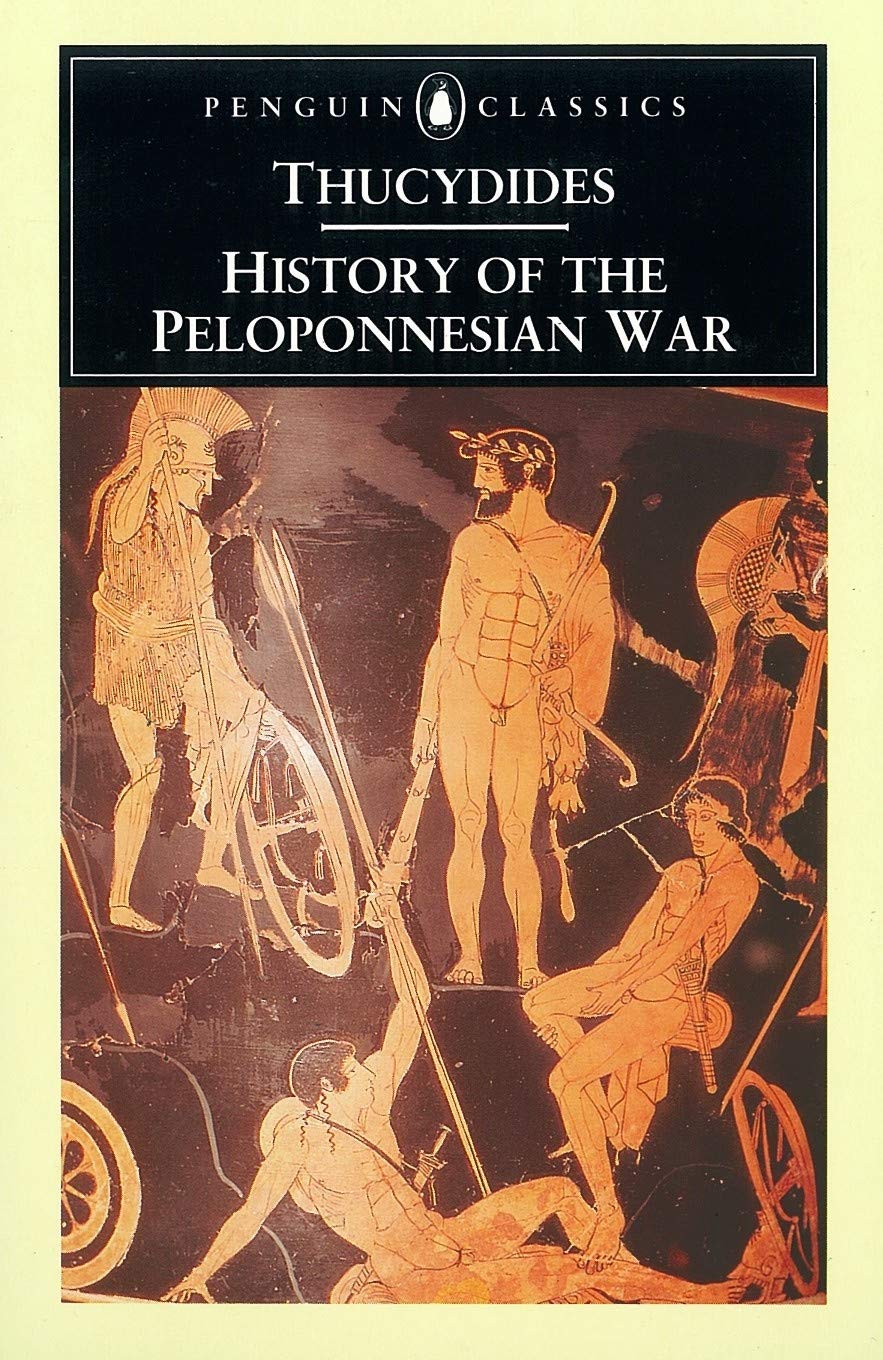
Buy History of the Peloponnesian War (Classics) Revised by Thucydides, M. I. Finley, Rex Warner (ISBN: 9780140440393) from desertcart's Book Store. Everyday low prices and free delivery on eligible orders. Review: apìsteftos (incredible) - Surprisingly readable for a record from the ancient era. Every page leaves you eager to learn more and if you are interested in learning this period of Greek history then it will absolutely keeped you hooked from beginning to end. Honestly one of the best books I have ever read but that is because I already have a great interest in Ancient Greek history and especially the Persian and Peloponnesian War eras. In short, an essential read for anybody desiring to learn more about classical history. This book briefly describes the rise of (arguably) the most influential metropolis in European history and spares no detail in it's eventual downfall. And that's just Athens. The fate of all other participants in Greece's greatest war, including Sparta, are given just as much respect in regards to why they chose to declare war and how they faired in the conflict. This is not really a review in all honesty. I just typed this up because I was looking at my bookshelf and remembered just how great this book is. Just looking at it reminded me of all I had learned from the book. Possibly my favourite historical book of all time from my favourite historical era of all time. Worth every penny. Review: Stunningly relevant to today's geopolitical conundrums - I had heard about Thucydides' History of the Peloponnesian War for decades and finally decided to read it. Wow. It wasn't as difficult to read as I expected, which may be due more to the translator's kindness than the difference in language over the last 2500 years. There are long-winded parts, too, and the endless list of names and places can be quite confusing, but the underlying essence is gold. Multiple state actors with various alliances and strengths. A land power and allies fighting a naval power and allies. A more monarchical oligarchy fighting a more democratic oligarchy. Internal politics, big personalities, betrayal, storms, plagues, financial difficulties, over-extended empire, willing and unwilling allies, this has it all. Anyone who want to understand history, politics, geopolitics, international relations, military conflict, leadership, political reasoning has to read this book and be amazed at how far the Greeks had come, and how little things have really changed since then on the humanities side. The technology and science has advanced immensley, the number of lives at stake are so much larger now, too, but the underlying essence is all there. I look forward to studying this and learning what other historians, political scientists and military experts can help me understand about this book and how it is still relevant today.
| Best Sellers Rank | 15,736 in Books ( See Top 100 in Books ) 362 in World History (Books) |
| Customer reviews | 4.6 4.6 out of 5 stars (852) |
| Dimensions | 19.56 x 12.7 x 2.79 cm |
| Edition | Revised |
| ISBN-10 | 0140440399 |
| ISBN-13 | 978-0140440393 |
| Item weight | 475 g |
| Language | English |
| Print length | 656 pages |
| Publication date | 31 Dec. 2000 |
| Publisher | Penguin Books |
A**N
apìsteftos (incredible)
Surprisingly readable for a record from the ancient era. Every page leaves you eager to learn more and if you are interested in learning this period of Greek history then it will absolutely keeped you hooked from beginning to end. Honestly one of the best books I have ever read but that is because I already have a great interest in Ancient Greek history and especially the Persian and Peloponnesian War eras. In short, an essential read for anybody desiring to learn more about classical history. This book briefly describes the rise of (arguably) the most influential metropolis in European history and spares no detail in it's eventual downfall. And that's just Athens. The fate of all other participants in Greece's greatest war, including Sparta, are given just as much respect in regards to why they chose to declare war and how they faired in the conflict. This is not really a review in all honesty. I just typed this up because I was looking at my bookshelf and remembered just how great this book is. Just looking at it reminded me of all I had learned from the book. Possibly my favourite historical book of all time from my favourite historical era of all time. Worth every penny.
M**S
Stunningly relevant to today's geopolitical conundrums
I had heard about Thucydides' History of the Peloponnesian War for decades and finally decided to read it. Wow. It wasn't as difficult to read as I expected, which may be due more to the translator's kindness than the difference in language over the last 2500 years. There are long-winded parts, too, and the endless list of names and places can be quite confusing, but the underlying essence is gold. Multiple state actors with various alliances and strengths. A land power and allies fighting a naval power and allies. A more monarchical oligarchy fighting a more democratic oligarchy. Internal politics, big personalities, betrayal, storms, plagues, financial difficulties, over-extended empire, willing and unwilling allies, this has it all. Anyone who want to understand history, politics, geopolitics, international relations, military conflict, leadership, political reasoning has to read this book and be amazed at how far the Greeks had come, and how little things have really changed since then on the humanities side. The technology and science has advanced immensley, the number of lives at stake are so much larger now, too, but the underlying essence is all there. I look forward to studying this and learning what other historians, political scientists and military experts can help me understand about this book and how it is still relevant today.
A**E
Just as pictured
Perfect just what I needed
L**L
must read to all
just classic on democracy and it mechanism.
T**S
Flawed package, but an invaluable guide to war, its causes, and its consequences
For all the problems Thucydides’s work poses for the contemporary reader – the dryness of the prose, the author’s own admission that the speeches are unlikely to be accurate reporting, his inability to transcend the particular for the universal – it is beyond churlish to criticise the man who may be seen as the first real historian, the first to consider history as a product of human agency, not as something predetermined by the whims of the gods. By his own admission, Thucydides’s account is short on literary merit. There are occasional references to human emotions, especially fear and panic, but in general the history presents us with little but a litany of events on a grand scale, free of any descriptions of the actions of individuals. Early on there are instances where the speeches in particular offer the potential for learning, but these are implicit rather than explicit. It has been left to his successors to generalise the lessons. But what lessons! The greatest, of course, is that succumbing to the apparent need to wage war on a challenger or incumbent has enormous and often unforeseen consequences. When Sparta and Athens allowed themselves to be sucked into conflict with each other they were both great nations. By the end of the war they were depleted almost to the point of no return, leaving a power vacuum for others to exploit. In the 20th Century, the parallels include Great Britain, Germany and the United States in that respect. On another level, there is the sheer brutality of the way war is waged. Even with individual suffering overlooked, it is difficult not to be horrified by the merciless and summary killings that take place, of soldiers and civilians alike; the calamities that befall both sides due to overreach, miscalculation, hubris, treachery, caprice, forces of nature such as earthquakes, plagues, volcanoes, storms and the tides, and sometimes pure stupidity; and the way in which some people, through no fault of their own, are caught in the middle with no viable means of escape. I lost count of the number of times one side or the other lay waste a region. This Penguin edition, it has to be said, has a few faults of its own. MI Finley’s Introduction is scholarly and informative but in a 1970s kind of way. (I found Graham Allison’s overview in Destined for War, which I have also reviewed, a useful, though by no means complete, supplement.) Rex Warner’s translation dates back to the 1950s, and it shows, and could at least do with an up-to-date commentary. There are numerous typos, problems with the tiny typeface, a number of examples of poor proofreading, including a few times where infinitives have “to” preceding them twice due to a line change, and at least one sentence which, no matter how many times I read it, made no sense at all. Additionally, having read about a quarter of the book wishing there were maps I found them, at the back. But they’re useless, not only committing all the cardinal sins of maps but also giving the appearance of having been printed on blotting paper. It’s impossible, however, to give Thucydides anything less than five stars, no matter how he’s packaged.
M**D
lots and lots and lots of fascinating detail
The next time I read this book - and it will have to be read again as there is a lot to absorb in one reading - I intend to set a room in my house aside and have a large map of the med to cover the floor. Then with the aid of lots of wooden model boats for the different triremes and blocks for the different armies I can move them around on a page by page basis (probably dressed appropriately in a horse haired helmet and metal greaves and pushing the markers with a wooden spear) and fully immerse myself in the experience. Maybe a few dioramas of the various battles which are explained in exhaustive detail, would also add to the effect. A book for armchair generals of all ages. It basically reads as most modern histories. The strong take from the weak and nations attack others if it it is in their self interest to do so. Some of the personalities of the combatants are also described, though this is almost in passing. And the leaders then seem to have been just as unscrupulous and deceitful as they are now. Totally fascinating.
Y**N
Low print quality and thin paper killed off any excitement I had upon recieving the package. I feel this price could have been used better elsewhere.
H**A
First of all, I find it close to impossible to rate such a book as this, as it is truly great as an insight into events that happened thousands of years ago, while the writing and accessibility of the work clearly could have been better. Nevertheless, in my opinion this is a 5-star book, as the detail and insight into a war that took place ~400bc is such a great read. Thucydides shows a himself as a great analyst of the conficts he relates, and instead of just relating the facts, he guides us through the actors motivations and the reasons for what takes place. THAT is the value of this book as far as I'm concerned, the strategic approach to conflict, and the massive amount of strategy in regards to alliances and battles that we get to share through this book. Being a student of political philosophy I read this book because of my fascination with Thomas Hobbes (Allthough not the Hobbes-translation). It will be hard for anyone to understand Hobbes through this though, and I must question the usefulness for most of such a linkage on the whole. There is also a lot of history in this book that will interest a lot of you (Those that are like me), rather little, but one gets through it, and when one is done with the book I truly feel I have gotten a great lecture in strategy and conflict!
M**L
Thucydides' "History of the Peloponnesian War" is an absolute triumph. From the very first page, I was captivated by the detailed and dramatic account of the conflict between Athens and Sparta. This isn't just a dry recounting of facts; it's a gripping narrative filled with political intrigue, military strategy, and profound human insights. Thucydides' writing style is remarkably modern and his analysis of power, alliances, and the nature of war is as relevant today as it was over two millennia ago. I highly recommend this book to anyone with an interest in history, political science, or simply a great story. It's a foundational text that has shaped our understanding of conflict and human nature.
S**A
Great choice.
S**H
The poorly formatted/presented text in this book makes it a chore to read. At 600+ pages, I'm tempted to just throw it in the paper recycling bin.
Trustpilot
1 day ago
3 weeks ago