
DOWNLOAD THE APP


Customer Services
Copyright © 2025 Desertcart Holdings Limited
DOWNLOAD THE APP
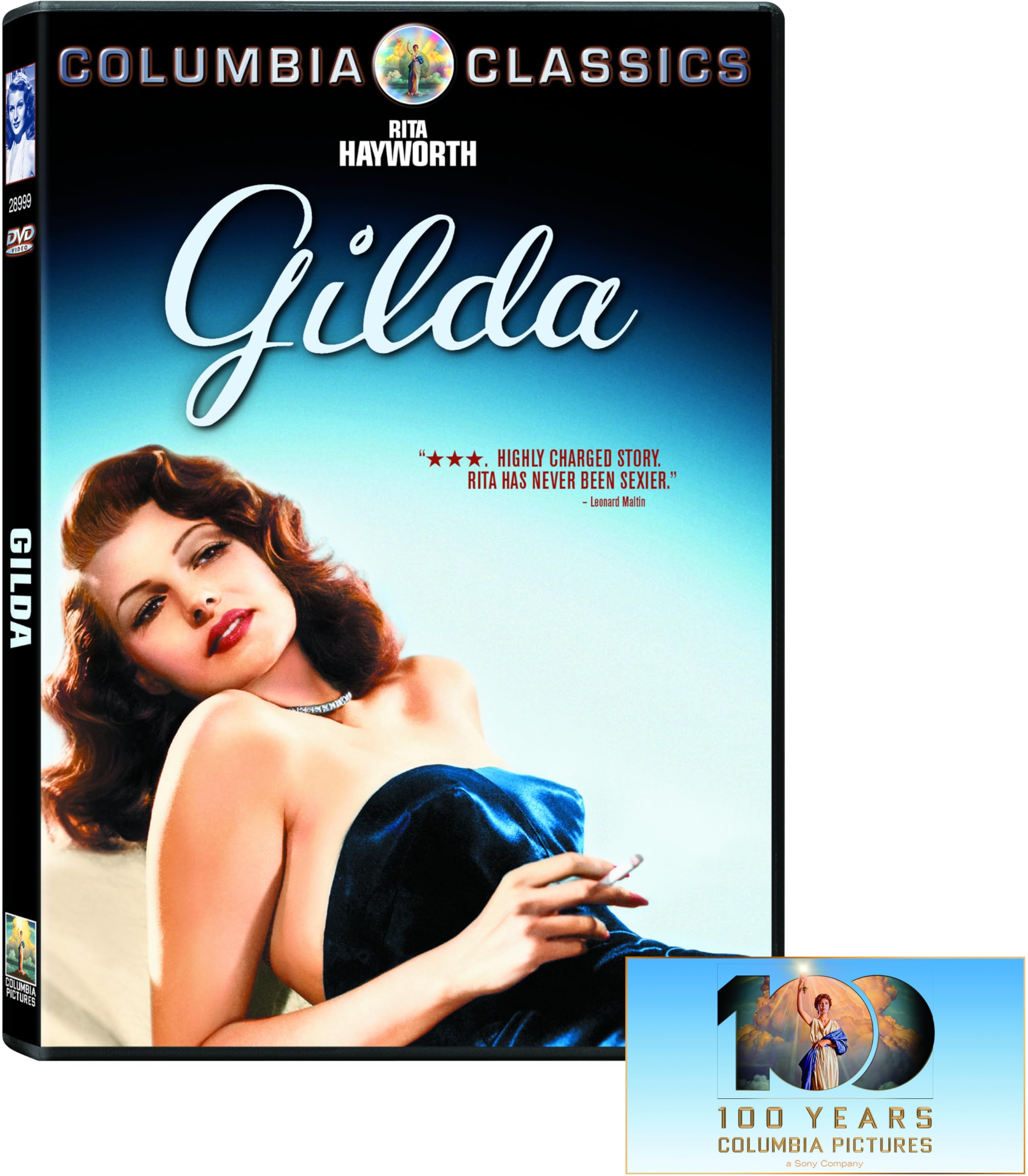
All film noirs need deceit, betrayal, dialogue hard as diamonds--and dames even harder than that. But Gilda is the only one with the dame front and center, and for good reason. Rita Hayworth shimmers in the 1946 classic, which spins on a tortured plot involving the title character (Hayworth); her imperious husband (George Macready), a ruthless casino owner and head of an Argentine tungsten cartel (!); and Johnny Farrell (Glenn Ford), Gilda's ex-lover and now her husband's go-fer. But no one watches Gilda for the plot, except to learn that all the characters have secrets--perhaps even ones they would kill for. Hayworth captures Gilda's vulnerability beneath her devil-may-care front ("If I'd been a ranch, they would have named me the Bar Nothing"). Not to be missed: Hayworth's slinky striptease to "Put the Blame on Mame." --Anne Hurley A beguiling femme fatale (Rita Hayworth) gets even with her bitter ex-boyfriend (Glenn Ford) by marrying his boss, a mysterious Buenos Aires casino owner. One of the great film noirs of the Forties (The Columbia Story). The legendary Rita Hayworth sizzles with sensuality and magnetism as she sings "Put the Blame on Mame" and delivers a dazzling performance as the enticing temptress Gilda. In the story of Gilda , Johnny Farrell (Glenn Ford) goes to work for Ballin Mundson (George Macready), the proprietor of an illegal gambling casino in a South American city, and quickly rises to become Mundson's "main man." All is well until Mundson returns from a trip with his new bride Gilda--a woman from Johnny's past. Mundson, unaware of their previous love affair, assigns Farrell the job of keeping Gilda a faithful wife. Fraught with hatred, Gilda does her best to antagonize, intimidate, and instill jealousy in Farrell--until circumstances allow him to get even. Review: Fascinating Gilda - “Gilda” is a fascinating, multi-faceted film that can be interpreted in multiple ways, all of which can be valid understandings of what’s going on with its complex characters. It’s considered one of the great noir classics by most, though some argue that it’s not a noir at all. I don’t get into debates like that because it basically comes down to people making their own rules then parsing a film to see if it follows them. Noir is a style, a view of life, an atmosphere and a mood and the concept wasn’t even known at the time of the film’s development. Noir is usually a tragedy and in that respect, “Gilda” is not but neither is “Laura”, a film with which it has some similarities. Its screenplay is taut, has a few genuinely surprising twists and turns and has one of the zingiest scripts in the genre. It was a nightmare for the Breen office, whose final solution was to insist that it all be set in a foreign country (it was originally set in America) as such goings on couldn’t possibly be happening here. Exactly who wrote what is a mystery in itself. It is credited as being based on a story by the very obscure E.A. Ellington and adapted by Jo Elsinger, who also adapted “Night and the City”, so I imagine he added much of the noir atmosphere. of the film. But the screenplay itself is attributed to Marion Parsonette, who was mostly a writer of B-movie comedies and mysteries. who had worked on “Cover Girl” with producer Virginia Van Upp, herself a talented writer. Van Upp had won the confidence of the studio and Rita Hayworth herself with “Cover Girl” and developed “Gilda” to move Hayworth into something besides musicals. Ben Hecht is added to the list as an uncredited writer and I would imagine that he was responsible for some of the really sharp dialog. In spite of the multiple inputs “Gilda” comes together like a work by a single writer and never gets muddled or confusing. Though it was conceived as a star vehicle for Hayworth, its three principals interact as equals. George Macready’s Ballin Mundson is one of the most memorable of noir villains, enhanced by his real facial scar, the result of an automobile accident. He’s an elegant villain, absolutely cold and calculating, intelligent, superior and a man who says he makes his own luck. He’s much like Waldo Lydecker in “Laura”, wealthy, important and quite possibly gay or bisexual - another of the complexities of “Gilda”. He is unlike Lydecker, who is hedonistically first viewed in his sumptuous overdecorated bath and who shows a soft and tender side toward Laura. Ballin seems more the ascetic type, unimpressed with his own palatial home which only exists to show his power, his real love. He also enjoys being cruel at times. He openly admits to Glenn Ford’s Johnny Farrell, “I bought Gilda like I bought you” and has an unusual “faithful and obedient” definition of friendship. He’s a man you don’t want to cross. His only redeeming quality is that he seems to really love Gilda. Ford was an up and coming actor who was made a star by this film, in a role that would be typical for him, a regular guy in unusual circumstances. He’s likeable but will cheat at gambling and has enough cunning to talk Ballin into taking him on. In fact, he’s even cheeky toward Ballin, a tough guy trait Ballin seems to like. Johnny shows talent for running the casino and can take charge when called upon to do so. He has his own cruel side which he shows in abundance toward Gilda, however deserved or undeserved - another of the film’s mysteries. Ballin declared that Johnny is like him, a man who makes his own luck, but is he really so lucky? After all, of all the women in New York, he brings back Gilda. Gilda’s entrance is one of Hollywood’s most surprising. She arises from below screen out of nowhere like Venus emerging from the sea, in a hair tossing closeup that was immediately and forever iconic. There are simply no words to describe the radiant beauty of Hayworth in this film. She was, of course, a studio creation in many ways from changing her name from Rita Cansino to her mother’s maiden name, Hayworth, thus freeing her from the B-movie hell of playing exotic vixens. Her hairline was slightly raised and her naturally brown hair, dyed black in the Cansino days, became red. But you could do this with many starlets and they would never be Rita Hayworth. Her magic was real and came from within and was able to be picked up by the camera. There’s a joy of life with her, especially when she’s dancing and of course, something intangible but real. Gilda and Johnny have a backstory but it’s never really revealed, which is a good thing, as every viewer can imagine their own. The story is better without the details. Her Gilda is a bit enigmatic. She is self-destructive at times, risking her reputation and Ballin’s wrath just to make Johnny jealous. This is established when she encourages the advances of Gabe Evans only after she notices Johnny is in the room. She’s aware of the power of her beauty over men, but it only leads from one prison to another. Throughout it she’s delightfully insouciant, as when she first re-meets Johnny, saying, “Johnny is such a hard name to remember. It’s so easy to forget”. Still, it’s all bravado, covering up her insecurity at having to depend entirely upon men.There’s no need to comment on her two famous songs, “Amado Mio” and “Put the Blame on Mame”, though they were dubbed, they come across as her. Her dresses for each are equally famous. There’s conflicting information about her singing with the acoustic guitar with some sources saying it is her voice and others saying not. The issue has been brought forth in recent years that there is a gay subtext to the film and I have to agree that it’s there if you want to see it. Why is the wealthy, impeccably dressed Mundson hanging around the docks? Even Johnny asks him this and he answers with a non answer. Is he looking for a tough young guy like Johnny? He gives Johnny the key to the club and makes him the manager, then a partner and heir. What should we make of Ballin’s statement, “This I must be sure of., that there’s no woman anywhere” or his toast, “To us, Johnny”.When Ballin returns from New York, Johnny runs over and shouts an almost too joyful “Hello Ballin” before being crushed by the fact that Ballin has a woman in his house, something about which Ballin himself comments.. But then, Ballin married Gilda, so the situation is full of dynamite for poor Johnny. When Johnny accuses Gilda of marrying Ballin for his money, saying, “That’s a great way to make a living”, making a moral judgment. She counters, “That wouldn’t be the big black pot calling the little kettle black, would it?” If she’s referring to his employment by Ballin, there’s no equivalent moral aspect to accepting employment. Does she suspect something else? In interviews later on, none of the cast said they saw it this way and certainly the audience didn’t. The relationship between the two men can be seen as quite normal. Balln sees in Johnny a man like himself, a younger version, and takes him on as a protege, a common thing for men in business and the arts to do. Then it’s the story of an older, childless man taking on a young apprentice as a kind of son. If Johnny was as taken aback by Ballin marrying an unknown woman that would add to a gay subtext, but the fact that it’s Gilda makes it perfectly normal that he’s so upset. Either way it’s a great film and the underlying story isn’t greatly affected by either interpretation. It’s the story of two flawed people who had once found love, falling out with each other. They somehow fall into the control of a cold, cruel man whose lust for power is so great that at one point he turns into a Bond-like villain, revealing a desire to “control the world”. At one point each of them has accepted Ballin’s bargain that whatever life they had before, it ended when they met him and from now on, say a new life had begun. Through this dark and treacherous journey they are almost destroyed, but when one character reveals a concealed truth to Johnny, they are set free to begin a new life together. Review: MOVIE: 4.5 • VIDEO: 4.1 • AUDIO: 2.5 - FORMAT: DVD UPC: 0-43396-28999-4 RELEASED: 2000-11-07 TITLE: Gilda (1946) • NR • 1:50:11 Rita Hayworth, Glenn Ford, George Macready, Joseph Calleia Charles Vidor (Director) The movie in which Rita Hayworth set the vast majority of male hearts aflutter in 1946 — and that also cemented the public's perception of her as an international sex symbol. And, this movie is also the most likely reason that her personal relationships with men and her marriages were all troubled and, ultimately, all failed — guys couldn't separate Rita Hayworth, the real-life woman, from "Gilda", the character she played in the movie. Now, setting aside all of the off-screen Rita Hayworth baggage: this is still a VERY good movie. It is a well-written, well-directed, well-acted (by everyone involved) example of a pitch-perfect psychological drama at its best — that also has a goodly number of film noir attributes. Most of the important noir staples are here: the loner "tough guy", with a dark past (Johnny Farrell [Glenn Ford]); the beautiful damsel-in-distress/femme-fatal, with an even darker dark past (Gilda [Rita Hayworth]); the menacing criminal figure, who threatens them both (Ballin Mundson [George Macready]); the collection of shady (but, colorful) characters (Maurice Obregon [Joseph Calleia], Uncle Pio [Steven Geray], Casey [Joe Sawyer], etc.); and, (probably the MOST important film noir staple of them ALL) the fact that NOTHING and NO ONE is as they seem. Take all of this and couple it with the neurotic love/hate relationship — and the palpable sexual tension — of the two main characters (Gilda and Johnny Farrell), and you have yourself a very good film, ladies and gentlemen! Highly recommended. See the other reviews for more detail and/or other opinions regarding the plot of the movie. VIDEO: 1.33:1 • B&W • 480p • MPEG-2 (5.3 Mbps) Within the confines of the DVD format, this film exhibits good, to — on some occasions — very good, picture quality. Also, sharpness and detail (for a DVD) are usually good (with the textures and patterns of most hair-styles, clothing and furnishings being readily discernible) — but, the movie did (in a limited number of scenes) present an image that was slightly soft. In addition, artifacts such as black specks and white dots (while no where near excessive) are visible in a few scenes. Lastly, contrast, gray scale and shadow-detail (while pretty good overall [for a DVD]) were downright "murky" in some scenes. Overall, this movie's presentation on DVD has mostly good, to sometimes very good, picture quality — and, should satisfy all but the pickiest of viewers AUDIO: Dolby Digital 2.0 (Dual-Mono, 48 KHz, 192 Kbps) The sound quality for this film's transfer fairs better than its picture quality, because there are no loud bumps nor objectionably high levels of hiss. Also, dialog is very clear and all voices are easily understood. However, dynamic range is very limited, and there is not much bottom-end nor any top-end to speak of (which makes the musical score, the nightclub numbers and the Foley work all sound a little 'thin', and somewhat less than realistic). Otherwise, considering the age of the source elements and the fact that this is a monophonic, dialog-driven movie from the mid 1940s, its audio presentation has more than acceptable sound quality. EXTRAS: Documentary: "Rita Hayworth: The Columbia Lady" Vintage Advertising Talent Files Trailers None of the extras were reviewed.
| Customer Reviews | 4.7 out of 5 stars 1,722 Reviews |
J**F
Fascinating Gilda
“Gilda” is a fascinating, multi-faceted film that can be interpreted in multiple ways, all of which can be valid understandings of what’s going on with its complex characters. It’s considered one of the great noir classics by most, though some argue that it’s not a noir at all. I don’t get into debates like that because it basically comes down to people making their own rules then parsing a film to see if it follows them. Noir is a style, a view of life, an atmosphere and a mood and the concept wasn’t even known at the time of the film’s development. Noir is usually a tragedy and in that respect, “Gilda” is not but neither is “Laura”, a film with which it has some similarities. Its screenplay is taut, has a few genuinely surprising twists and turns and has one of the zingiest scripts in the genre. It was a nightmare for the Breen office, whose final solution was to insist that it all be set in a foreign country (it was originally set in America) as such goings on couldn’t possibly be happening here. Exactly who wrote what is a mystery in itself. It is credited as being based on a story by the very obscure E.A. Ellington and adapted by Jo Elsinger, who also adapted “Night and the City”, so I imagine he added much of the noir atmosphere. of the film. But the screenplay itself is attributed to Marion Parsonette, who was mostly a writer of B-movie comedies and mysteries. who had worked on “Cover Girl” with producer Virginia Van Upp, herself a talented writer. Van Upp had won the confidence of the studio and Rita Hayworth herself with “Cover Girl” and developed “Gilda” to move Hayworth into something besides musicals. Ben Hecht is added to the list as an uncredited writer and I would imagine that he was responsible for some of the really sharp dialog. In spite of the multiple inputs “Gilda” comes together like a work by a single writer and never gets muddled or confusing. Though it was conceived as a star vehicle for Hayworth, its three principals interact as equals. George Macready’s Ballin Mundson is one of the most memorable of noir villains, enhanced by his real facial scar, the result of an automobile accident. He’s an elegant villain, absolutely cold and calculating, intelligent, superior and a man who says he makes his own luck. He’s much like Waldo Lydecker in “Laura”, wealthy, important and quite possibly gay or bisexual - another of the complexities of “Gilda”. He is unlike Lydecker, who is hedonistically first viewed in his sumptuous overdecorated bath and who shows a soft and tender side toward Laura. Ballin seems more the ascetic type, unimpressed with his own palatial home which only exists to show his power, his real love. He also enjoys being cruel at times. He openly admits to Glenn Ford’s Johnny Farrell, “I bought Gilda like I bought you” and has an unusual “faithful and obedient” definition of friendship. He’s a man you don’t want to cross. His only redeeming quality is that he seems to really love Gilda. Ford was an up and coming actor who was made a star by this film, in a role that would be typical for him, a regular guy in unusual circumstances. He’s likeable but will cheat at gambling and has enough cunning to talk Ballin into taking him on. In fact, he’s even cheeky toward Ballin, a tough guy trait Ballin seems to like. Johnny shows talent for running the casino and can take charge when called upon to do so. He has his own cruel side which he shows in abundance toward Gilda, however deserved or undeserved - another of the film’s mysteries. Ballin declared that Johnny is like him, a man who makes his own luck, but is he really so lucky? After all, of all the women in New York, he brings back Gilda. Gilda’s entrance is one of Hollywood’s most surprising. She arises from below screen out of nowhere like Venus emerging from the sea, in a hair tossing closeup that was immediately and forever iconic. There are simply no words to describe the radiant beauty of Hayworth in this film. She was, of course, a studio creation in many ways from changing her name from Rita Cansino to her mother’s maiden name, Hayworth, thus freeing her from the B-movie hell of playing exotic vixens. Her hairline was slightly raised and her naturally brown hair, dyed black in the Cansino days, became red. But you could do this with many starlets and they would never be Rita Hayworth. Her magic was real and came from within and was able to be picked up by the camera. There’s a joy of life with her, especially when she’s dancing and of course, something intangible but real. Gilda and Johnny have a backstory but it’s never really revealed, which is a good thing, as every viewer can imagine their own. The story is better without the details. Her Gilda is a bit enigmatic. She is self-destructive at times, risking her reputation and Ballin’s wrath just to make Johnny jealous. This is established when she encourages the advances of Gabe Evans only after she notices Johnny is in the room. She’s aware of the power of her beauty over men, but it only leads from one prison to another. Throughout it she’s delightfully insouciant, as when she first re-meets Johnny, saying, “Johnny is such a hard name to remember. It’s so easy to forget”. Still, it’s all bravado, covering up her insecurity at having to depend entirely upon men.There’s no need to comment on her two famous songs, “Amado Mio” and “Put the Blame on Mame”, though they were dubbed, they come across as her. Her dresses for each are equally famous. There’s conflicting information about her singing with the acoustic guitar with some sources saying it is her voice and others saying not. The issue has been brought forth in recent years that there is a gay subtext to the film and I have to agree that it’s there if you want to see it. Why is the wealthy, impeccably dressed Mundson hanging around the docks? Even Johnny asks him this and he answers with a non answer. Is he looking for a tough young guy like Johnny? He gives Johnny the key to the club and makes him the manager, then a partner and heir. What should we make of Ballin’s statement, “This I must be sure of., that there’s no woman anywhere” or his toast, “To us, Johnny”.When Ballin returns from New York, Johnny runs over and shouts an almost too joyful “Hello Ballin” before being crushed by the fact that Ballin has a woman in his house, something about which Ballin himself comments.. But then, Ballin married Gilda, so the situation is full of dynamite for poor Johnny. When Johnny accuses Gilda of marrying Ballin for his money, saying, “That’s a great way to make a living”, making a moral judgment. She counters, “That wouldn’t be the big black pot calling the little kettle black, would it?” If she’s referring to his employment by Ballin, there’s no equivalent moral aspect to accepting employment. Does she suspect something else? In interviews later on, none of the cast said they saw it this way and certainly the audience didn’t. The relationship between the two men can be seen as quite normal. Balln sees in Johnny a man like himself, a younger version, and takes him on as a protege, a common thing for men in business and the arts to do. Then it’s the story of an older, childless man taking on a young apprentice as a kind of son. If Johnny was as taken aback by Ballin marrying an unknown woman that would add to a gay subtext, but the fact that it’s Gilda makes it perfectly normal that he’s so upset. Either way it’s a great film and the underlying story isn’t greatly affected by either interpretation. It’s the story of two flawed people who had once found love, falling out with each other. They somehow fall into the control of a cold, cruel man whose lust for power is so great that at one point he turns into a Bond-like villain, revealing a desire to “control the world”. At one point each of them has accepted Ballin’s bargain that whatever life they had before, it ended when they met him and from now on, say a new life had begun. Through this dark and treacherous journey they are almost destroyed, but when one character reveals a concealed truth to Johnny, they are set free to begin a new life together.
C**K
MOVIE: 4.5 • VIDEO: 4.1 • AUDIO: 2.5
FORMAT: DVD UPC: 0-43396-28999-4 RELEASED: 2000-11-07 TITLE: Gilda (1946) • NR • 1:50:11 Rita Hayworth, Glenn Ford, George Macready, Joseph Calleia Charles Vidor (Director) The movie in which Rita Hayworth set the vast majority of male hearts aflutter in 1946 — and that also cemented the public's perception of her as an international sex symbol. And, this movie is also the most likely reason that her personal relationships with men and her marriages were all troubled and, ultimately, all failed — guys couldn't separate Rita Hayworth, the real-life woman, from "Gilda", the character she played in the movie. Now, setting aside all of the off-screen Rita Hayworth baggage: this is still a VERY good movie. It is a well-written, well-directed, well-acted (by everyone involved) example of a pitch-perfect psychological drama at its best — that also has a goodly number of film noir attributes. Most of the important noir staples are here: the loner "tough guy", with a dark past (Johnny Farrell [Glenn Ford]); the beautiful damsel-in-distress/femme-fatal, with an even darker dark past (Gilda [Rita Hayworth]); the menacing criminal figure, who threatens them both (Ballin Mundson [George Macready]); the collection of shady (but, colorful) characters (Maurice Obregon [Joseph Calleia], Uncle Pio [Steven Geray], Casey [Joe Sawyer], etc.); and, (probably the MOST important film noir staple of them ALL) the fact that NOTHING and NO ONE is as they seem. Take all of this and couple it with the neurotic love/hate relationship — and the palpable sexual tension — of the two main characters (Gilda and Johnny Farrell), and you have yourself a very good film, ladies and gentlemen! Highly recommended. See the other reviews for more detail and/or other opinions regarding the plot of the movie. VIDEO: 1.33:1 • B&W • 480p • MPEG-2 (5.3 Mbps) Within the confines of the DVD format, this film exhibits good, to — on some occasions — very good, picture quality. Also, sharpness and detail (for a DVD) are usually good (with the textures and patterns of most hair-styles, clothing and furnishings being readily discernible) — but, the movie did (in a limited number of scenes) present an image that was slightly soft. In addition, artifacts such as black specks and white dots (while no where near excessive) are visible in a few scenes. Lastly, contrast, gray scale and shadow-detail (while pretty good overall [for a DVD]) were downright "murky" in some scenes. Overall, this movie's presentation on DVD has mostly good, to sometimes very good, picture quality — and, should satisfy all but the pickiest of viewers AUDIO: Dolby Digital 2.0 (Dual-Mono, 48 KHz, 192 Kbps) The sound quality for this film's transfer fairs better than its picture quality, because there are no loud bumps nor objectionably high levels of hiss. Also, dialog is very clear and all voices are easily understood. However, dynamic range is very limited, and there is not much bottom-end nor any top-end to speak of (which makes the musical score, the nightclub numbers and the Foley work all sound a little 'thin', and somewhat less than realistic). Otherwise, considering the age of the source elements and the fact that this is a monophonic, dialog-driven movie from the mid 1940s, its audio presentation has more than acceptable sound quality. EXTRAS: Documentary: "Rita Hayworth: The Columbia Lady" Vintage Advertising Talent Files Trailers None of the extras were reviewed.
R**L
World War 2 ends…sexual battles begin….
Fantastic film. Great 40's snappy/sarcastic banter, Rita and the washroom attendant having the best lines. The B&W cinematography is some of Hollywood's best…rivaling even Greg Toland and Stanley Cortez at times. I'm not a great fan of the usual 30's-40's "song" sequence in many non-musical films BUT this is an exception. Rita's singing numbers steal the show and her performance is very easy on the eyes, even if it isn't her actual voice. Cast if great with the exception of Glenn Ford, who is the weakest link. It would be interesting to see what Monty Clift would have done in that role instead of Ford. The sexual tension between Rita and Clift would have made it an even better film in my humble opinion. Nice, clean, beautiful transfer. The blacks are sharp, deep and dark. Minimum film damage evident. The extras are pretty good as usual with Criterion. Great little paper fold-out booklet with disc info and a poster of Rita on the back side. New interviews (Scorsese & others) , trailer and a "lost" dug up 1964 episode of a "celebrity" TV show I had no idea even existed focusing on Rita's career. I like Richard Schickel's past commentaries on other films but this one is somewhat spotty through the film. Not only in interesting content but also in length. I never timed it but it seemed like only 50% of the film has running commentary. If you are going to do it, then go all out…sorry Richard, not your best work in this one.
A***
Hayworth's Second Best Film?
Rita Hayworth has to be the most under appreciated actor of all time! She made two amazing films that truly showed what she could do with a few lines of dialogue and facial expressions that could a room ablaze. "Gilda" and its equal "The Lady From Shanghai" show off her talent in top form! In this Noir Hayworth is Gilda a smart, sexy and devlish woman who marries for money but seduces for kicks. The plot is a love triangle at its best due to the fact that the main characters Haywoth, Ford and Mundson all want lust and money! When the unlucky Farrell played to perfection by Glenn Ford is saved in a sedy alley by a sinister and scarred Mundson (Macready as the devil himself) Farrell soon learns that Mudson owns the hottest night club in town and the hottest woman - Gilda! But thing are not as they seem and when the film goes into Noit overdrive the viewer is rewarded with master shots of kissing, over the shoulder slaps and just plain shoot outs! Gilda is the ultimate film about greed and how it controls not you bu the people around you. The films dialouge is so slick that you might want to bring some of the slang into your everyday venacular! If "The Lady From Shanghai" turned Hayworth into the ultimate ice queen then Gilda paints her as the utlimate piece of ice sculpture! Beautiful, clear but not clear enough that the you can see clearly through it but as with ice and as with the film's heroin Gilda and its chracters have the ultimate meltdown and just our luck its for our own pleasure to watch it happen!
B**S
Hayworth and Ford are DYNAMITE here
Director Charles Vigor appears to have appreciated the potential Hayworth had to express her sensuality, so under his Direction he set scene after scene where she flirts with the Cinematographer's Camera, her Cabaret audience and with we the viewers. Gilda and Johnny { Glen Ford} both unattached, had been in a previous relationship. Ballin Mundson { George Macready} appoints Johnny as Manager of his illegal Gambling Casino, unaware that he had been involved with Gilda .Deep down ,Johnny carries an emotion of hatred toward Gilda, which pervades his every move, but inwardly his love for her is so powerful it tears at his insides. IMAGINE THEN when Ballin turns-up having Married Gilda! Say no more. I have a Basket which reads Watch Again.Another which reads Watch Again AND AGAIN. One of my special Archive Titles. I love It Brian Stevens
P**A
After more than sixty years Gilda is still scorching her way across Buenos Aires....
In discussions about classic cinema "Gilda" is a movie that deserves to be mentioned in the same breath as Casablanca (Two-Disc Special Edition) . "Gilda" has a darker plot and the characters are not as noble, but story, cast, costumes, and music combine to create screen magic. Think of "Gilda" as a riveting Anti-Casablanca. Johnny Farrell (Glenn Ford) is an American drifter who has somehow landed in Buenos Aires, Argentina. He needs cash to survive and takes his chances using loaded dice to gamble with sailors. Quitting while he is ahead, Johnny leaves the dice game with a big bankroll and is accosted in the port by a gunman. To his surprise, the holdup is thwarted by a passerby, Ballin Mundson (George Macready). One thing leads to another and eventually Johnny becomes Mundson's devoted right hand man and the manager of his very lucrative casino business. After taking an extended overseas business trip, Mundson returns to Buenos Aires with a bride - Gilda (Rita Hayworth). Mundson introduces Johnny and Gilda, hoping these two important people in his life will like each other. He doesn't realize that Gilda and Johnny have known each other in the past, and both have been trying to escape their painful shared history together. Sparks fly between them as Gilda does everything in her power to torment Johnny, and Johnny is equally determined to make Gilda feel cheap and insignificant. After sixty years, the tension between Hayworth and Ford is still palpable. Rita Hayworth was at the height of her beauty and touted as the sexiest woman alive when "Gilda" was made in 1946. Even today she still scorches the screen as she tosses her hair and performs a clothed strip tease to the torchy song, "Put the Blame on Mame." This print of "Gilda" has been restored by UCLA with funding from Sony Pictures. The black and white video has been cleaned up beautifully. There are still some white spots that flash from time to time but overall this version looks very good. The sound track is clear with no dead spots or unexpected drops in volume. Rita Hayworth was a beautiful dancer, but she did not do her own singing. In "Gilda" she is lip syncing to the voice of Anita Ellis. The notable songs, "Put the Blame on Mame" and "Amado Mio" are available on both the Gilda soundtrack album or Anita Ellis Out in Front . The DVD includes a display of vintage advertising for "Gilda" as well as theatrical trailers. A section called "talent files" offers printed biography and filmography information about director, Charles Vidor, Rita Hayworth, Glenn Ford, and George Macready. The most prominent bonus is a featurette about the career of Rita Hayworth at Colombia Studios. Interesting to see how Rita looked before the studio changed her hairline with electrolysis, and turned her into a redhead. For those who may not be familiar with her background, Rita was the daughter and granddaughter of professional dancers who had been trained since early childhood to become a talented dancer. This is a classic film noir where everything works. Highly recommended.
M**I
Rita Hayworth is a movie STAR
My first Rita Hayworth movie. Fun movie with added pizzaz from the beautiful and talented Lady Hayworth.
P**.
Gilda and Johnny and Ballen's Blade
One of the most beautiful films in the Noir genre. They chose well when casting Glenn Ford opposite Rita Hayworth. The camera loves them both and though Ford plays the tough guy, he is told how beautiful he is. Johnny (Glenn Ford) and Gilda (Rita Hayworth) are two sides of a triangle with (George McCready) as Ballen being the third member in what has to be one of the best Love/Hate, heavily open to interpretation triangles to ever hit the big screen. There is a great plot with all the requisite film noir boxes checked. If you have never seen Gilda, and like film noir that's superbly shot in B&W, with a script that is both ambiguous and at times forensic in dealing with crime and morality, and obsessive desire.
Trustpilot
1 month ago
1 month ago