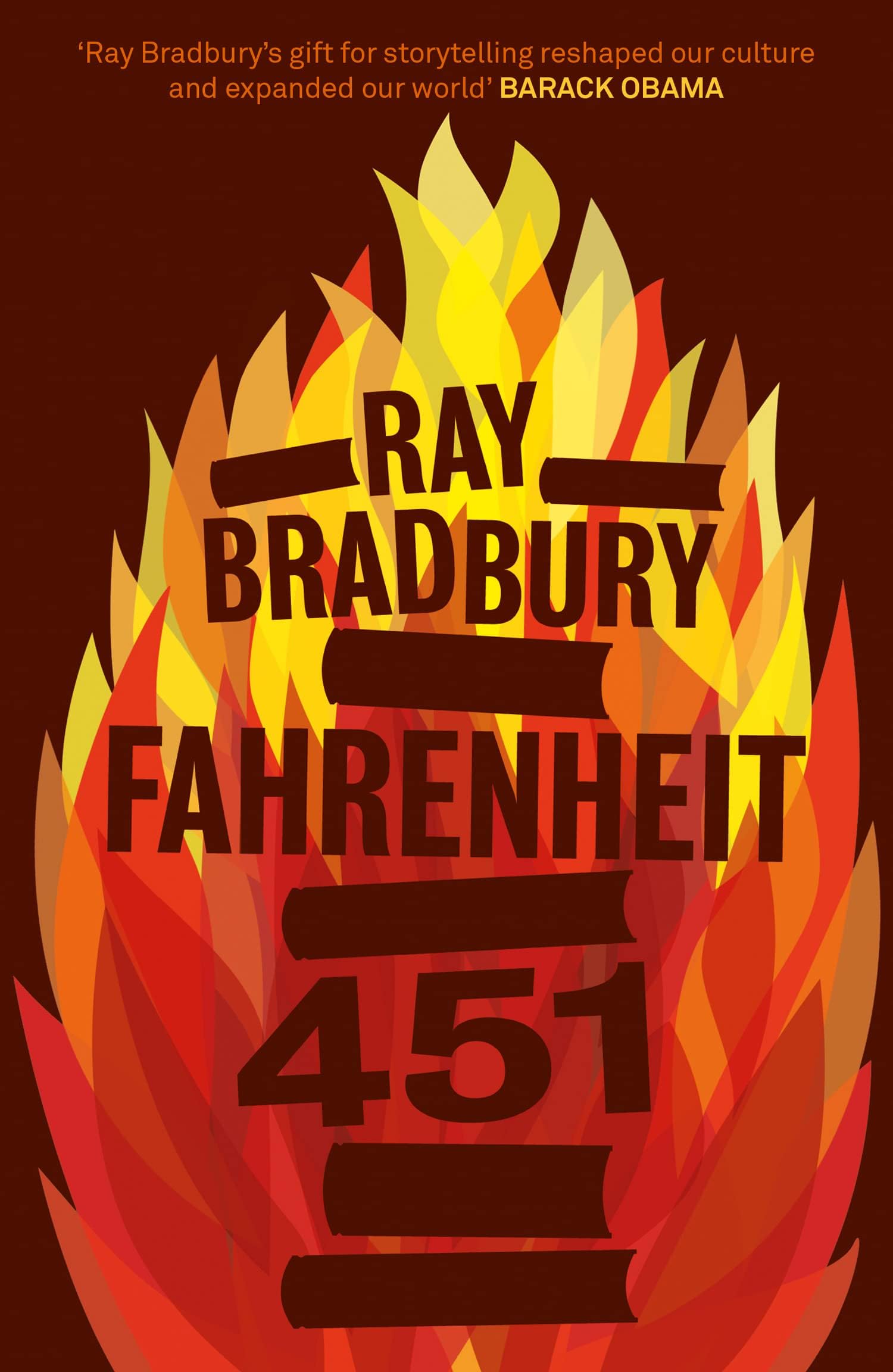


Fahrenheit 451 (Flamingo Modern Classics): The gripping and inspiring classic of dystopian science fiction : Bradbury, Ray: desertcart.co.uk: Books Review: A classic - Didn’t read this book in my early adulthood. A classic. Reading in 2026 and it’s in all there…inspiring me to read more this year. Review: Seen the film. Read the Book. - Fahrenheit 451by Ray Bradbury I have seen the acclaimed 1966 movie 'Fahrenheit 451' directed by Francois Truffaut many times. But this is the first time I have read the original novel by Ray Bradbury (August 22, 1920 - June 5, 2012),who was one of the most celebrated science fiction writers of the 20th century. His 1953 novel 'Fahrenhit 451', was set in a dystopian America, in which ignorance is enforced by law and firemen burn books. The title refers to the temperature at which paper burns. There are a number of surprising differences between the movie and the book. What was not a surprise was Bradbury's beautiful poetic prose. Here is the book's breath taking beginning. "It was a pleasure to burn. It was a special pleasure to see things eaten, to see things blackened and changed. With the brass nozzle in his fists, with this great python spitting its venomous kerosene upon the world, the blood pounded in his head, and his hands were the hands of some amazing conductor playing all the symphonies of blazing and burning to bring down the tatters and charcoal ruins of history. With his symbolic helmet numbered 451 on his stolid head, and his eyes all orange flame with the thought of what came next, he flicked the igniter and the house jumped up in a gorging fire that burned the evening sky red and yellow and black. He strode in a swarm of fireflies. He wanted above all, like the old joke, to shove a marshmallow on a stick in the furnace, while the flapping pigeon-winged books died on the porch and lawn of the house. While the books went up in sparkling whirls and blew away on a wind turned dark with burning." The most obvious differences between the film and the book are the least important. The movie is set in Britain and not America and there is no nuclear attack. And there is no robot for hound in the movie. They just end no have the special effects to make it look real then. A prop hound was made for the film, but the director thought it looked rubbish and it up to much time to get it ready for each shot, so it not used. Howeber, the big difference is the central problem. Which is why do firemen burn books. In the movie all books and all reading as been banned. No one seems to be able to read. Not so in the novel. The problem is people can still read certain things. "Comic books" "Technical scientific journals" and "trade papers" are still read. There are even rewritten history books. What is banned are novels, politics, philosophy, religion, and poetry. There are no books that will make people think. Any book that could possibly upset anyone for any reason must be burnt. Can you see where this is going. When Montag, the book's central character witnesses a women choose to go up in flames with her library, he has a crisis of conscience. The Fire Cheif Beatty, gives him a pep talk. And he tells Montag how they got to be where they are; "Magazines became a nice blend of vanilla tapioca. Books, so the damned snobbish critics said, were dishwater. No wonder books stopped selling, the critics said. But the public, knowing what it wanted, spinning happily, let the comic-books survive. And the three-dimensional sex-magazines, of course. There you have it, Montag. It didn’t come from the Government down. There was no dictum, no declaration, no censorship, to start with, no! Technology, mass exploitation, and minority pressure carried the trick, thank God. Today, thanks to them, you can stay happy all the time, you are allowed to read comics, the good old confessions, or trade-journals... Give the people contests they win by remembering the words to more popular songs or the names of state capitals or how much corn Iowa grew last year. Cram them full of non-combustible data, chock them so damned full of “facts” they feel stuffed, but absolutely “brilliant” with information. Then they’ll feel they’re thinking, they’ll get a sense of motion without moving. And they’ll be happy, because facts of that sort don’t change. Don’t give them any slippery stuff like philosophy or sociology to tie things up with. That way lies melancholy... I hope I’ve clarified things. The important thing for you to remember, Montag, is we’re the Happiness Boys, the Dixie Duo, you and I and the others. We stand against the small tide of those who want to make everyone unhappy with conflicting theory and thought. We have our fingers in the dyke. Hold steady. Don’t let the torrent of melancholy and drear philosophy drown our world. We depend on you. I don’t think you realize how important you are, to our happy world as it stands now.’ There you have it the road to dystopia was not hammered with a iron fist, but gently laid with the gloved hand of market forces, mindfulness, and the right to happiness. It sound all too plausible and prescient. After Montag breaks with his conditioning, he joins a group of social outcasts called "The Book People". In order to preserve the literature and wisdom of humanity each Book Person commi

| ASIN | 0006546064 |
| Best Sellers Rank | 1,401 in Books ( See Top 100 in Books ) 5 in Science Fiction History & Criticism 6 in Science Fiction Short Stories 9 in Post-Apocalyptic |
| Customer reviews | 4.2 4.2 out of 5 stars (56,861) |
| Dimensions | 12.9 x 1.6 x 19.7 cm |
| Edition | 1st |
| ISBN-10 | 9780006546061 |
| ISBN-13 | 978-0006546061 |
| Item weight | 294 g |
| Language | English |
| Print length | 240 pages |
| Publication date | 16 Aug. 1999 |
| Publisher | Flamingo |
| Reading age | 17+ years, from customers |
C**L
A classic
Didn’t read this book in my early adulthood. A classic. Reading in 2026 and it’s in all there…inspiring me to read more this year.
P**T
Seen the film. Read the Book.
Fahrenheit 451by Ray Bradbury I have seen the acclaimed 1966 movie 'Fahrenheit 451' directed by Francois Truffaut many times. But this is the first time I have read the original novel by Ray Bradbury (August 22, 1920 - June 5, 2012),who was one of the most celebrated science fiction writers of the 20th century. His 1953 novel 'Fahrenhit 451', was set in a dystopian America, in which ignorance is enforced by law and firemen burn books. The title refers to the temperature at which paper burns. There are a number of surprising differences between the movie and the book. What was not a surprise was Bradbury's beautiful poetic prose. Here is the book's breath taking beginning. "It was a pleasure to burn. It was a special pleasure to see things eaten, to see things blackened and changed. With the brass nozzle in his fists, with this great python spitting its venomous kerosene upon the world, the blood pounded in his head, and his hands were the hands of some amazing conductor playing all the symphonies of blazing and burning to bring down the tatters and charcoal ruins of history. With his symbolic helmet numbered 451 on his stolid head, and his eyes all orange flame with the thought of what came next, he flicked the igniter and the house jumped up in a gorging fire that burned the evening sky red and yellow and black. He strode in a swarm of fireflies. He wanted above all, like the old joke, to shove a marshmallow on a stick in the furnace, while the flapping pigeon-winged books died on the porch and lawn of the house. While the books went up in sparkling whirls and blew away on a wind turned dark with burning." The most obvious differences between the film and the book are the least important. The movie is set in Britain and not America and there is no nuclear attack. And there is no robot for hound in the movie. They just end no have the special effects to make it look real then. A prop hound was made for the film, but the director thought it looked rubbish and it up to much time to get it ready for each shot, so it not used. Howeber, the big difference is the central problem. Which is why do firemen burn books. In the movie all books and all reading as been banned. No one seems to be able to read. Not so in the novel. The problem is people can still read certain things. "Comic books" "Technical scientific journals" and "trade papers" are still read. There are even rewritten history books. What is banned are novels, politics, philosophy, religion, and poetry. There are no books that will make people think. Any book that could possibly upset anyone for any reason must be burnt. Can you see where this is going. When Montag, the book's central character witnesses a women choose to go up in flames with her library, he has a crisis of conscience. The Fire Cheif Beatty, gives him a pep talk. And he tells Montag how they got to be where they are; "Magazines became a nice blend of vanilla tapioca. Books, so the damned snobbish critics said, were dishwater. No wonder books stopped selling, the critics said. But the public, knowing what it wanted, spinning happily, let the comic-books survive. And the three-dimensional sex-magazines, of course. There you have it, Montag. It didn’t come from the Government down. There was no dictum, no declaration, no censorship, to start with, no! Technology, mass exploitation, and minority pressure carried the trick, thank God. Today, thanks to them, you can stay happy all the time, you are allowed to read comics, the good old confessions, or trade-journals... Give the people contests they win by remembering the words to more popular songs or the names of state capitals or how much corn Iowa grew last year. Cram them full of non-combustible data, chock them so damned full of “facts” they feel stuffed, but absolutely “brilliant” with information. Then they’ll feel they’re thinking, they’ll get a sense of motion without moving. And they’ll be happy, because facts of that sort don’t change. Don’t give them any slippery stuff like philosophy or sociology to tie things up with. That way lies melancholy... I hope I’ve clarified things. The important thing for you to remember, Montag, is we’re the Happiness Boys, the Dixie Duo, you and I and the others. We stand against the small tide of those who want to make everyone unhappy with conflicting theory and thought. We have our fingers in the dyke. Hold steady. Don’t let the torrent of melancholy and drear philosophy drown our world. We depend on you. I don’t think you realize how important you are, to our happy world as it stands now.’ There you have it the road to dystopia was not hammered with a iron fist, but gently laid with the gloved hand of market forces, mindfulness, and the right to happiness. It sound all too plausible and prescient. After Montag breaks with his conditioning, he joins a group of social outcasts called "The Book People". In order to preserve the literature and wisdom of humanity each Book Person commi
B**G
A flickering ember rather than a raging inferno.
Fahrenheit 451 is a book I would probably have said I'd read if you'd asked me. I could probably have told you the basic premise: a dystopian land where books are banned and 'Firemen' don't put out fires any more. I might well have read it and - rather counter to the spirit of the book - then pretty much forgotten it. And that's kind of sad because this book is one that most readers know about, a book that challenges the things we love, and yet it's also not really all that great. I hate to say it but it's a little bit forgettable. It's a short novel and a quick read and it lights the flicker of a flame of thinking about the power of books but it's all just so rushed, so fast to develop and accelerate, that a lot of the opportunities to explore deeper are missed. Montag the fireman - one of the elite who set fire to books, burn people's houses to punish them for the knowledge in their books - witnesses an old lady start a fire and kill herself because she can't be without her books, and meets a young girl who tells him there's so much more to books then just fuel for his fires. He takes a book and becomes part of the anti-establishment. In the foreword to the book, Ray Bradbury tells us he spent less than 10 dollars hiring the use of a typewriter to write Fahrenheit 451. Sadly sometimes it shows. This is just the bare bones of a story, lacking the meat to flesh it out into something more satisfying, more horrifying. It was written in the 1950s with the Nazi book burnings still fresh in people's minds but long before the wall-to-wall round the clock interactive television experiences that Bradbury envisions. For its time it must have been revolutionary. Today it just looks a bit tired and much too rushed.
B**.
Everyone who loves books should read this book. Every civilization's, every society's downfall is rooted in silencing critical thinking. One which develops only through reading and imbibing different ideas from books. History is a testament to this fact. Any dissent suppressed will only grow wilder and more intense which will eventually wreck havoc in its wake and perhaps the new society born out of it might be better. Not pure and perfect but better as long as we remember what caused it in the first place. "The good writers touch life often. The mediocre ones run a quick hand over her. The bad ones rape and leave her for the flies." The author Ray Bradbury, rightfully belongs to the good writers category. ❤️
C**E
Amazing read!
Ö**N
Ray Bradbury'nin yakın gelecekteki korkulara ilişkin kaleme aldığı baş yapıtı.
A**K
かなり昔に書かれた本であるが、内容は現代社会の問題にも非常に関連しており、作者の先見性には驚かされた。
N**�
I wasn’t sure what to expect going into Fahrenheit 451, but it turned out to be surprisingly relevant and thought-provoking. The themes of censorship, technology, and conformity still hit hard, and the idea of a world without books definitely makes you think. Some parts felt a little slow or abstract, but overall, it sparked good class discussions and gave us a lot to unpack. Montag’s journey is a bit wild, but it gets better as the story unfolds. Not my favorite book ever, but definitely worth reading — especially for how much it makes you think about society today.
Trustpilot
2 days ago
2 weeks ago