
DOWNLOAD THE APP


Customer Services
Copyright © 2025 Desertcart Holdings Limited
DOWNLOAD THE APP
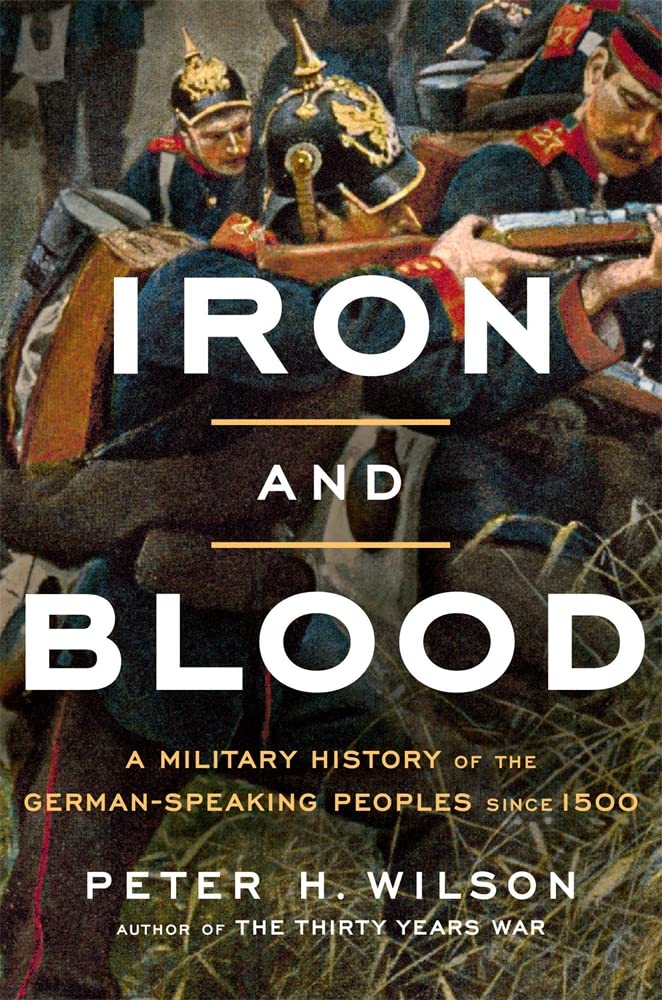
Iron and Blood: A Military History of the German-Speaking Peoples since 1500 [Wilson, Peter H.] on desertcart.com. *FREE* shipping on qualifying offers. Iron and Blood: A Military History of the German-Speaking Peoples since 1500 Review: Amazing Book - This is a tremendous book. It covers the military history of the German-speaking peoples (defined as Germany, Austria, and Switzerland) over the last approximately 500 years. It is not a narrow war/battle book. Each of the sections, which cover about 100 years, gives an overview of the conflicts during the period of interest, but then discusses governments and how military decisions are made, military technology, recruitment of forces, how finances were handled, and the sociology of the military forces and polities. There are subsection titles like "Welfare, Medical Care, and Mortality" and "The Politics of Recruitment." The book has 763 pages of text (including the Introduction), 20 excellent maps (which are not well integrated into the text), and 36 figures (which appear fairly random). I counted 1598 end notes spread over 73 pages. The end notes are almost, but not completely, references and citations. There are a very few clarifying/amplifying end notes. The end notes are not separated, but use a run on format. I have a few nits. The text seems to strongly imply that the fortress of Przemysl fell in a siege starting in September 1914, when it was relieved in October and then later rebesieged (not only did the Austrians not resupply the fortress, they took some of its its supplies for field forces). Wilson refers to US troops in the 1970s as occupiers, when occupation is usually considered to have ended in the 1950's. Finally, Wilson sometimes presents his conclusions was facts. Given the 1598 end notes, I suspect he is largely correct in his conclusions, but my personal preference is to be given facts (which he certainly does give) and be permitted to draw my own conclusions. This is a very valuable book, but be warned that is is extremely dense in information. Although very well written, this is not a quick and easy read. Review: Important resource for anyone interested in knowing more about the history of warfare. - Excellent academic discussion of military history of German speaking countries. This work provides an understandable history of how armies and war developed throughout Europe. The book also provides a wealth of associated historical topics. I first discovered this in the library of a Viking cruise ship; bought it when I returned and found it very engaging and informative.,


| Best Sellers Rank | #551,748 in Books ( See Top 100 in Books ) #87 in German History (Books) #2,054 in World War II History (Books) |
| Customer Reviews | 4.6 4.6 out of 5 stars (178) |
| Dimensions | 6.12 x 2.3 x 9.25 inches |
| ISBN-10 | 0674987624 |
| ISBN-13 | 978-0674987623 |
| Item Weight | 2.31 pounds |
| Language | English |
| Print length | 976 pages |
| Publication date | February 14, 2023 |
| Publisher | Belknap Press: An Imprint of Harvard University Press |
N**D
Amazing Book
This is a tremendous book. It covers the military history of the German-speaking peoples (defined as Germany, Austria, and Switzerland) over the last approximately 500 years. It is not a narrow war/battle book. Each of the sections, which cover about 100 years, gives an overview of the conflicts during the period of interest, but then discusses governments and how military decisions are made, military technology, recruitment of forces, how finances were handled, and the sociology of the military forces and polities. There are subsection titles like "Welfare, Medical Care, and Mortality" and "The Politics of Recruitment." The book has 763 pages of text (including the Introduction), 20 excellent maps (which are not well integrated into the text), and 36 figures (which appear fairly random). I counted 1598 end notes spread over 73 pages. The end notes are almost, but not completely, references and citations. There are a very few clarifying/amplifying end notes. The end notes are not separated, but use a run on format. I have a few nits. The text seems to strongly imply that the fortress of Przemysl fell in a siege starting in September 1914, when it was relieved in October and then later rebesieged (not only did the Austrians not resupply the fortress, they took some of its its supplies for field forces). Wilson refers to US troops in the 1970s as occupiers, when occupation is usually considered to have ended in the 1950's. Finally, Wilson sometimes presents his conclusions was facts. Given the 1598 end notes, I suspect he is largely correct in his conclusions, but my personal preference is to be given facts (which he certainly does give) and be permitted to draw my own conclusions. This is a very valuable book, but be warned that is is extremely dense in information. Although very well written, this is not a quick and easy read.
S**M
Important resource for anyone interested in knowing more about the history of warfare.
Excellent academic discussion of military history of German speaking countries. This work provides an understandable history of how armies and war developed throughout Europe. The book also provides a wealth of associated historical topics. I first discovered this in the library of a Viking cruise ship; bought it when I returned and found it very engaging and informative.,
R**N
Detailed and well researched
This is an extremely detailed and well researched survey of Germanic military history from the 1500s to the present. The only reason I gave it a four is because it's not particularly readable. It's an excellent reference after you wade through it the first time, but don't expect compelling novel-like reading.
U**S
Links several levels of chronological history; builds useful perspectives
Overall liked the book as it filled some historical holes for me with respect to my own family history. Not an easy read but a very worthwhile one. One line on page 717 with respect to Trümmerfrauen comment as myth caused me to take particular notice as my godmother told the stories of her own experiences being a Trümmerfrau. She also was specific as to how she was selected for the job and the specifics of the work. Bottom line, I strongly object to the term myth in this relationship as I know better. Would not surprise me if some editor took license with the term.
J**K
Iron- Blood
I bought this book for a gift to someone else. Yes he enjoyed it.
C**G
Lots of interesting information, but not easy to read.
I found the writing difficult. Style is not author’s forte. Information is plentiful but effort required to plow through the many pages. I read a great many books on history.
M**E
Stunning
Excellent book
K**R
Deailed
On page 670 (see attachment): 14 months from August 1942 would be October 1943. Paulus surrendered on 31 January 1943, 6 months. Didn't catch any other errors. But there were MANY statistics. Covered a big part of history from a different viewpoint than is usual for me.
C**S
Look like a great very good informed good book. Can't wait to read it.
J**E
I ordered my copy from the UK so I received it in November in Vicksburg Mississippi. This is an excellent & comprehensive book. Granted I am more of a Modern European History student, so the early material was largely new to me. I will shortly be sending this on to a close friend who will CERTAINLY enjoy it. The author has written a general study of a very long period. So, I was constantly looking up wars, battles, individuals etc. as much of what is in this book is new to me and for most readers I would hazard. Sometimes he writes in broad strokes and misses out on detailed nuances, such as why Imperial Germany built the battleship fleet that it did and how it was to be utilized (and NOT as resulted in 1914-18) - (p468-70). I particularly enjoyed his inclusion of Switzerland in his analysis as this is seldom covered. Their numerous Civil Wars are not well known. One minor point, and it is common for those focused on European History. Wilson does note the Taiping Rebellion and the millions who died there (in discussing how it contrasted with, say, the losses from the Franco-Prussian War or the War of the Triple Alliance). He fails to note the Dunghan Revolt of Muslims (and others) in China or the southern Panthay Rebellion which both also had a huge butcher's list (p364).
S**A
Have started reading . Good book indeed .
P**R
Är du intresserad av historia och vill fördjupa dig i ämnet- från europeisk medeltid och framåt så rekommenderas den. Inget för ovana läsare och eller nybörjare i ämnet.
D**D
It’s full of information. If you want to know about “structures,” “systems,” “government apparatuses,” and “the bureaucratic underpinnings of social cohesion,” then this text is for you. I prefer a woven narrative, but technical history has its place too.
Trustpilot
1 month ago
3 weeks ago