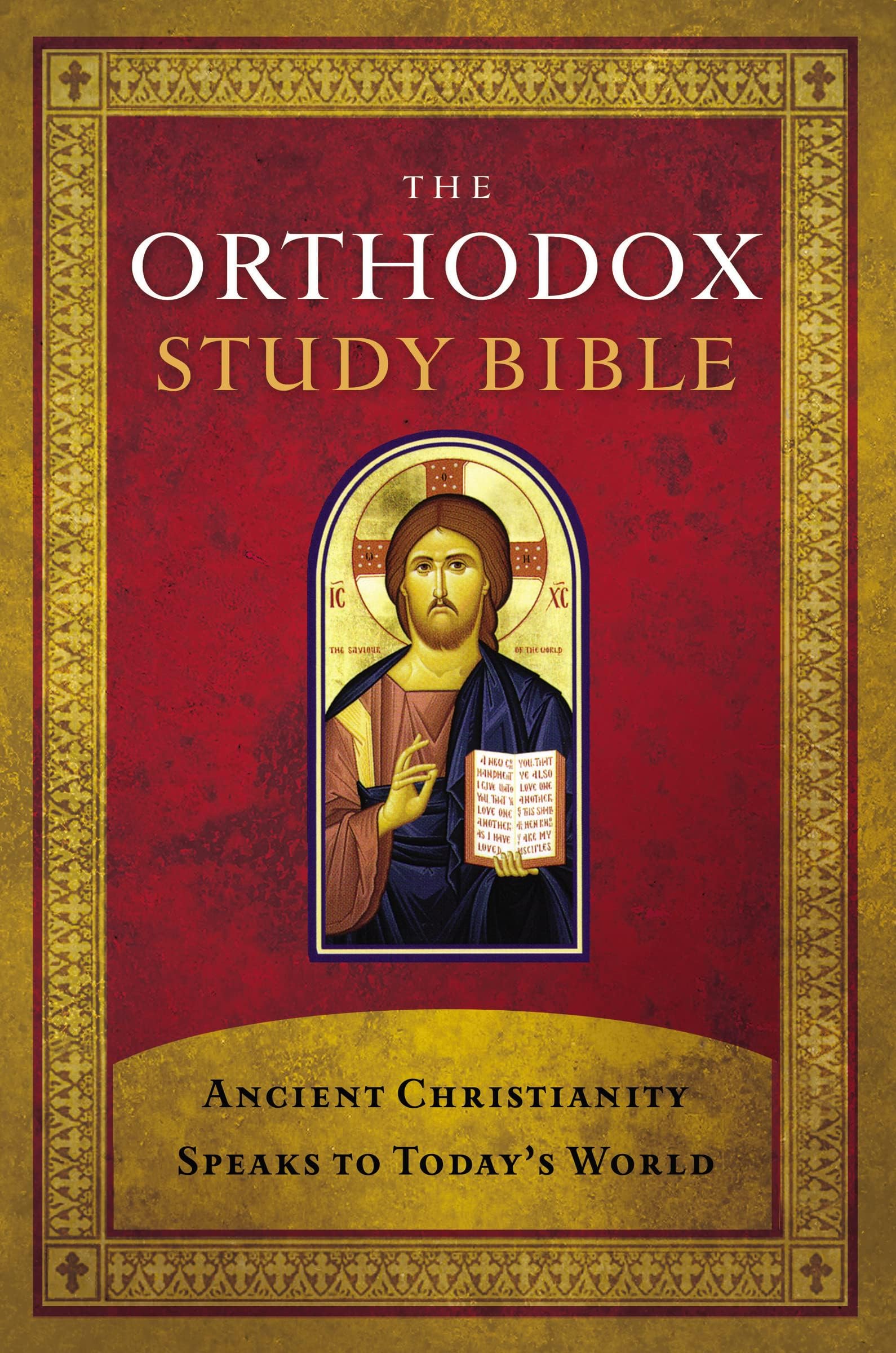
The Orthodox Study Bible, Hardcover: Ancient Christianity Speaks to Today's World
Product ID: 4161145
Buy anything from 5,000+ international stores. One checkout price. No surprise fees. Join 2M+ shoppers on Desertcart.
Desertcart purchases this item on your behalf and handles shipping, customs, and support to Vietnam.
The FIRST EVER Orthodox Study Bible presents the Bible of the early church and the church of the early Bible. Orthodox Christianity is the face of ancient Christianity to the modern world and embraces the second largest body of Christians in the world. In this first-of-its-kind study Bible, the Bible is presented with commentary from the ancient Christian perspective that speaks to those Christians who seek a deeper experience of the roots of their faith. Features Include: Old Testament newly translated from the Greek text of the Septuagint, including the Deuterocanon New Testament from the New King James Version Commentary drawn from the early Church Christians for a better understanding of Scripture Easy to Locate liturgical readings to align with what passages will be the focus of mass Book Introductions and Outlines provide an overview of the background and historical context of the book about to be read Subject Index to easily navigate to various topics Full color Icons Full color Maps provide a visual representation of meanings, themes, teachings, people, and places of Scripture Easy-to-read 9.5 point type size Review: Recovering rhw Christian Tradition for All Believers - If you want only one Study Bible to aid and inform your reading of the Bible, or want to have a real alternate to your currently favorite Study Bible, "The Orthodox Study Bible" is the one you need to buy -- not "want", you "need" it. Period. In my thirty years of preaching and teaching the Christian Bible, this is without condition the best, most useful and enlightening Study Bible I have ever used. I say this with such enthusiasm even though I am a life-long Lutheran, and at the same time because I am a committed Confessional, orthodox Lutheran. "The Orthodox Study Bible," though aimed at a target audience in the Eastern Orthodox Church, is the most thoroughly ecumenical Study Bible I know of. The reason for that is in the very nature of Eastern Orthodox theology and biblical interpretation. The Orthodox -- unlike Western Protestantism -- have not jettisoned from theology the wisdom and authority of the Fathers of the ancient church and the liturgical tradition of early Christianity, but rather turn to and look to them as the foundation of all Christian dogma and doctrine, and thus the foundation of the one source of dogma and doctrine, the Bible. In many ways the Orthodox Church is more biblical in its teaching and life than any Western Protestants, and a large part of the reason for this is that the Orthodox Church has an unbroken tradition of reading the Bible together with, in living dialogue with, those closest to its origins: the ancient Fathers of the Church and the ancient worship of the Church. THAT IS WHAT FORMS THE FOUNDATION AND METHOD OF "THE ORTHODOX STUDY BIBLE," and thus makes it THE MOST "BIBLICAL" Study Bible in terms of its notes, commentaries, and invaluable longer articles on points of doctrine. What you will NOT encounter is the prejudice of "modern" Western "historical-critical method" exegesis, with its rules of implicit skepticism and methodological doubt regarding the text of the Bible, which in two centuries have reduced Western biblical exegesis to a tangle of subjective and politically-correct "readings" of the Bible with no unity to them and no authority to support them except the opinion of the individual authors and their pet agendas. "THE ORTHODOX STUDY BIBLE" OFFERS FREEDOM FROM THE DEAD-END OF HISTORICAL-CRITICAL EXEGESIS, and restores how the Church in its first millennium unanimously interpreted and applied the Bible. The "OSB" is not a flat or rote reitteration of the Church Fathers, however. It is how Orthodox exegetes and theologians read the Bible in dialogue with the Fathers as the living voice of the Church throughout the ages, in conversation with the living voice of Scripture. The result cuts right to what the Bible means, how the Bible interprets itself as divine revelation, and the unity of Old Testament and New Testament as the one revelation of salvation in Jesus Christ. This brings with it striking parallels, allusions, typology and allegory -- the meat of Patristic exegesis -- that is far more fruitful for preaching and teaching the Bible than the obsession with socio-historical theories and minutiae that fill most Protestant Study Bibles. The proof is in the using of the OSB with an open mind to a whole new way of reading the Bible than Western Protestants have been trained (brainwashed?) to practice. If you have a long-time favorite Study Bible like the NIV Study Bible, the New Oxford Annotated Study Bible, or any of the many others on the market, certainly keep it and use it if it aids and helps you. But do not use it alone anymore; get The Orthodox Study Bible to compare with your favorite, and so expand deeper and further your reading and meditating on the Bible. The OSB is a "must have" not only for Eastern Orthodox Christians, but for all Christians. One oddity for Western readers that may require some adjustment is the text of the Old Testament used. The Eastern Orthodox Church has always used that version of the Old Testament called the "Septuagint" (abbreviated by the Roman numeral LXX). This is the ancient, pre-Christian (ca 200 BC) translation of the Jewish Scriptures from Hebrew into Greek, during the process of which a number of books written originally in Greek were judged to be inspired Scripture in unity with the witness of the Hewbrew/Israelite books. This is the version of the OT used in the OSB, as it is the official text of the OT in the Orthodox Church. Thus, it is translated from the Greek text of the LXX, not directly from the Hebrew texts, and contains sevral writings not found in Protestant versions of the OT. LXX names and order are retained in the canon as well. So there are the 4 Books of Kingdoms (= 1 & 2 Samuel/1 & 2 Kings); a book of 2nd Ezra (or Esdras); the books of Tobit, Judith, 1st, 2nd & 3rd Maccabees, the Wisdom of Solomon, the Wisdom of Sirach, the book of Baruch, and the Epistle of Jeremiah. There are 151 Psalms; and the books of Esther and Daniel are considerably longer than in modern Protestant Bibles. These are books of the OT and integrated into the canon of the OT. For a Protestant, that takes some getting used to. ON THE PLUS SIDE: all the writers of the NT read, used and quoted from the Septuagint (LXX), the OT version in the OSB, so it in fact provides an English translation of the "Scriptures" presupposed throughout the NT. "The Orthodox Study Bible" is written for interested laity, not specialized clergy; it is clear, easily understood, and full of helps. A final commendation: LUTHERANS IN PARTICULAR should get and used this as their main Study Bible -- laity and clergy alike. Classical Lutheran theology -- from Luther and Melanchthon to Chmenitz and Gerhard -- is founded on "Scripture Alone," but Scripture in living dialogue with the Fathers of the Church (whom the Lutheran writers often quote at great length to prove the point of their biblical exegesis). "The Orthodox Study Bible" -- as the so-called "Finnish School" of Luther research is increasingly demonstrating -- is equally as much the best "Lutheran Study Bible." Review: So happy with this Bible - I want to say, this is a beautiful & excellent Bible.. I LOVE the Word of God.. And to have access to other Scripture Books is wonderful. I have had it for a little over a month. And have been reading it consistently along side my Complete Jewish Bible-(A Messianic Jewish Bible- which I absolutely Love also) In the Orthodox I have read 3 books that I had never read or studied before.. Tobit, Judith, and the Wisdom of Solomon”. So many lessons & so beautiful. Opening up more understanding & Love for the Word of God. The Wisdom of Solomon is absolutely beautiful. The organizational layout of this Bible is great. It's not like the Protestant Bible.. It lays out the Torah, then the -i would call them the songs, poems, words of wisdom books. Then it lays out the books of minor & major prophets. The CJB basically does the same. The text is the perfect size, not to big or small, easy & comfortable to read. My only con would be the notes are pretty sparse. But that of I have other Bibles with great notes.. The Dake, the KjV study, the CJB, and other resources. The illustrations are gorgeous. It reminds me of my grandmothers huge white family Bible that just sat on the table in the living room, but no one touched it. I never knew why, I just had a feeling it was something very special. So as you can see I LOVE this Bible and I am very pleased with this purchase. For anyone who only has studied the Protestant Bible and would be interested in books that they took out this is a great option. I would not call these books apocrypha personally because the Orthodox never took them out of their Bible.


| Best Sellers Rank | #1,066 in Books ( See Top 100 in Books ) #1 in Christian Church History (Books) #3 in Christian Orthodoxy (Books) #31 in Christian Bibles (Books) |
| Customer Reviews | 4.8 out of 5 stars 5,488 Reviews |
M**.
Recovering rhw Christian Tradition for All Believers
If you want only one Study Bible to aid and inform your reading of the Bible, or want to have a real alternate to your currently favorite Study Bible, "The Orthodox Study Bible" is the one you need to buy -- not "want", you "need" it. Period. In my thirty years of preaching and teaching the Christian Bible, this is without condition the best, most useful and enlightening Study Bible I have ever used. I say this with such enthusiasm even though I am a life-long Lutheran, and at the same time because I am a committed Confessional, orthodox Lutheran. "The Orthodox Study Bible," though aimed at a target audience in the Eastern Orthodox Church, is the most thoroughly ecumenical Study Bible I know of. The reason for that is in the very nature of Eastern Orthodox theology and biblical interpretation. The Orthodox -- unlike Western Protestantism -- have not jettisoned from theology the wisdom and authority of the Fathers of the ancient church and the liturgical tradition of early Christianity, but rather turn to and look to them as the foundation of all Christian dogma and doctrine, and thus the foundation of the one source of dogma and doctrine, the Bible. In many ways the Orthodox Church is more biblical in its teaching and life than any Western Protestants, and a large part of the reason for this is that the Orthodox Church has an unbroken tradition of reading the Bible together with, in living dialogue with, those closest to its origins: the ancient Fathers of the Church and the ancient worship of the Church. THAT IS WHAT FORMS THE FOUNDATION AND METHOD OF "THE ORTHODOX STUDY BIBLE," and thus makes it THE MOST "BIBLICAL" Study Bible in terms of its notes, commentaries, and invaluable longer articles on points of doctrine. What you will NOT encounter is the prejudice of "modern" Western "historical-critical method" exegesis, with its rules of implicit skepticism and methodological doubt regarding the text of the Bible, which in two centuries have reduced Western biblical exegesis to a tangle of subjective and politically-correct "readings" of the Bible with no unity to them and no authority to support them except the opinion of the individual authors and their pet agendas. "THE ORTHODOX STUDY BIBLE" OFFERS FREEDOM FROM THE DEAD-END OF HISTORICAL-CRITICAL EXEGESIS, and restores how the Church in its first millennium unanimously interpreted and applied the Bible. The "OSB" is not a flat or rote reitteration of the Church Fathers, however. It is how Orthodox exegetes and theologians read the Bible in dialogue with the Fathers as the living voice of the Church throughout the ages, in conversation with the living voice of Scripture. The result cuts right to what the Bible means, how the Bible interprets itself as divine revelation, and the unity of Old Testament and New Testament as the one revelation of salvation in Jesus Christ. This brings with it striking parallels, allusions, typology and allegory -- the meat of Patristic exegesis -- that is far more fruitful for preaching and teaching the Bible than the obsession with socio-historical theories and minutiae that fill most Protestant Study Bibles. The proof is in the using of the OSB with an open mind to a whole new way of reading the Bible than Western Protestants have been trained (brainwashed?) to practice. If you have a long-time favorite Study Bible like the NIV Study Bible, the New Oxford Annotated Study Bible, or any of the many others on the market, certainly keep it and use it if it aids and helps you. But do not use it alone anymore; get The Orthodox Study Bible to compare with your favorite, and so expand deeper and further your reading and meditating on the Bible. The OSB is a "must have" not only for Eastern Orthodox Christians, but for all Christians. One oddity for Western readers that may require some adjustment is the text of the Old Testament used. The Eastern Orthodox Church has always used that version of the Old Testament called the "Septuagint" (abbreviated by the Roman numeral LXX). This is the ancient, pre-Christian (ca 200 BC) translation of the Jewish Scriptures from Hebrew into Greek, during the process of which a number of books written originally in Greek were judged to be inspired Scripture in unity with the witness of the Hewbrew/Israelite books. This is the version of the OT used in the OSB, as it is the official text of the OT in the Orthodox Church. Thus, it is translated from the Greek text of the LXX, not directly from the Hebrew texts, and contains sevral writings not found in Protestant versions of the OT. LXX names and order are retained in the canon as well. So there are the 4 Books of Kingdoms (= 1 & 2 Samuel/1 & 2 Kings); a book of 2nd Ezra (or Esdras); the books of Tobit, Judith, 1st, 2nd & 3rd Maccabees, the Wisdom of Solomon, the Wisdom of Sirach, the book of Baruch, and the Epistle of Jeremiah. There are 151 Psalms; and the books of Esther and Daniel are considerably longer than in modern Protestant Bibles. These are books of the OT and integrated into the canon of the OT. For a Protestant, that takes some getting used to. ON THE PLUS SIDE: all the writers of the NT read, used and quoted from the Septuagint (LXX), the OT version in the OSB, so it in fact provides an English translation of the "Scriptures" presupposed throughout the NT. "The Orthodox Study Bible" is written for interested laity, not specialized clergy; it is clear, easily understood, and full of helps. A final commendation: LUTHERANS IN PARTICULAR should get and used this as their main Study Bible -- laity and clergy alike. Classical Lutheran theology -- from Luther and Melanchthon to Chmenitz and Gerhard -- is founded on "Scripture Alone," but Scripture in living dialogue with the Fathers of the Church (whom the Lutheran writers often quote at great length to prove the point of their biblical exegesis). "The Orthodox Study Bible" -- as the so-called "Finnish School" of Luther research is increasingly demonstrating -- is equally as much the best "Lutheran Study Bible."
T**G
So happy with this Bible
I want to say, this is a beautiful & excellent Bible.. I LOVE the Word of God.. And to have access to other Scripture Books is wonderful. I have had it for a little over a month. And have been reading it consistently along side my Complete Jewish Bible-(A Messianic Jewish Bible- which I absolutely Love also) In the Orthodox I have read 3 books that I had never read or studied before.. Tobit, Judith, and the Wisdom of Solomon”. So many lessons & so beautiful. Opening up more understanding & Love for the Word of God. The Wisdom of Solomon is absolutely beautiful. The organizational layout of this Bible is great. It's not like the Protestant Bible.. It lays out the Torah, then the -i would call them the songs, poems, words of wisdom books. Then it lays out the books of minor & major prophets. The CJB basically does the same. The text is the perfect size, not to big or small, easy & comfortable to read. My only con would be the notes are pretty sparse. But that of I have other Bibles with great notes.. The Dake, the KjV study, the CJB, and other resources. The illustrations are gorgeous. It reminds me of my grandmothers huge white family Bible that just sat on the table in the living room, but no one touched it. I never knew why, I just had a feeling it was something very special. So as you can see I LOVE this Bible and I am very pleased with this purchase. For anyone who only has studied the Protestant Bible and would be interested in books that they took out this is a great option. I would not call these books apocrypha personally because the Orthodox never took them out of their Bible.
A**Y
Beautiful and spiritually enriching Bible
As a Coptic Orthodox Christian, I really appreciate this edition of the Orthodox Study Bible. It stays true to the spirit of the early Church and includes helpful notes that reflect the teachings of the Church Fathers. It’s been a great resource for both personal reading and deeper study. The layout is clear, the notes are insightful without being overwhelming (but it's really difficult to write notes in it if that's your goal), and the overall quality of the book feels very nice and durable. It has helped me understand Scripture in a more complete and traditional context. Highly recommended for anyone who wants to read the Bible with the mind of the early Church.
S**A
Excellent Resource and Great Value
The Orthodox Study Bible, Hardcover: Ancient Christianity Speaks to Today’s World is an outstanding resource for anyone wanting to deepen their understanding of Scripture from an Orthodox perspective. The notes and commentary are insightful, the layout is easy to read, and it covers both the Old and New Testaments thoroughly. High-quality, informative, and truly great value for the price.
S**K
Very good edition of the Bible for people interested in the Orthodox tradition and/or the early Church
As an evangelical curious about many conversions from evangelical camp to Orthodoxy, I received such a Bible with gratefulness, as a very helpful tool. I own both the paper edition and Kindle edition. Both are very well produced. The more I use that edition of the Bible, the more I become informed about the doctrine and practice of the Orthodox family of Churches. I find also many insightful commentaries both from the Church Fathers and from contemporary Orthodox scholars. As an open-minded man I admit that due to the reading of "The Orthodox Study Bible" my understanding of spiritual things increases and that many valuable spiritual counsels help me in my process of sanctification. I do not recommend that Bible to fundamentalist Protestants. But I strongly recommend that version to all people who already learned to honor other traditions in Christianity and want to learn from other theologians and Christians. As for the Bible translation itself, the Old Testament contains probably the best modern translation of the Greek Septuagint (LXX), the translation of the Old Testament made in the 3rd century before Christ. Many learned people believe that the Septuagint contains more reliable text of the Old Testament than the Masoretic text made by Jewish scribes long after Christianity appeared on the world scene. The Septuagint is somehow older version which was not preserved in the Hebrew language but as the translation of then available Hebrew text, which is now almost extinct. The Dead Sea Scrolls are a powerful proof for the reliability of the Septuagint. Moreover, Masoretic scribes did not believe in Christ, so they changed meaning of several Messianic prophecies available in the original text. Maybe it was not deliberate effort on their part, but the result of ignorance. You are always confused when you compare the New Testament quotations from the Old Testament with the Old Testament in Masoretic form, appearing in the prevailing number of today's Bibles. But here you have the Bible translation which does not make you confused, because the New Testament writers used mainly LXX as their Old Testament. So, the Orthodox Study Bible text is the Holy Scriptures almost similar to those used by the first Church. You should also know that the Church Fathers recognized much wider canon of the Old Testament Scripture than Protestants and Jews. As for the New Testament in that edition, it is simply the New King James Bible (NKJV), based on Textus Receptus, the Received Text of Erasmus, Roman Catholic scholar of the 16th Century. It is not identical with the Byzantine New Testament, but in many respects it is very close to that family of the Greek texts. I believe that the NKJV is one of the best English translations. It contains short and helpful notes showing differences between the Received Text and Critical Text. So, buy, take, and read and be blessed!
N**L
John 8:32
Seriously everyone should get this and read it thoughtfully and prayerfully. Beautiful art, affordable, and easy to read.
B**0
Orthodox Study Bible
I’m not orthodox but am growing more interest. I grew up Christian and feel more interest in learning more. Every time I read I feel there’s a spiritual harvest of more knowledge and understanding to help me grow in my faith. It’s a wonderful Bible with great pictures as well as the scriptures. The overview and introduction and commentary is helpful for me when I started to read it. I’m delighted to glean more understanding and read this book. I feel God chose us and we have a choice to seek him and choose him back. I feel the more drawn to Jesus the more you want to know and want to live a good life. Never forget John. 3:16 and God is the one that saves!
J**S
Not perfect, yet, but it accomplishes it's goal.
Not being Orthodox myself (although maybe orthodox), I became interested in this translation for two reasons: * It was a `new' translation of the Septuagint, which I have become a student of. * It was the first viable English bible to include both the Septuagint and the New Testament - both Greek Testaments into English in one bible Late last year, I received the New English Translation the Septuagint, but alas, it was difficult to carry two bibles to Church, so when I heard of this one coming out, I was excited, and I have not been disappointed. Not only did it have the distinction of having both (Greek) testaments in one bible, but it included the Deuterocanon along with notes that introduce people to various `Church Fathers' up to the Great Schism. Plus, unlike the NETS, the Orthodox Study Bible (published by Thomas Nelson) is publicly readable, with less stilted language. For the Septuagint, the Committee used Rahlf's critical edition of the Greek text, which is what the NETS used, however, they further used Brenton's 1851 translation and the New King James Translation as a backdrop. They readily used the NKJV in places where the Hebrew and the Greek matched. They did, however, use the canonical order of the Old Testament According to the Seventy, first published in 1928. Of course, using the Septuagint creates problems for those who have constantly read the English translation of the Hebrew, especially in the Psalms and Jeremiah. Few Christians outside of the Orthodox tradition, or scholarly field, know that at times there is, at times, a great difference between the text of the Septuagint (LXX) and the Hebrew (MT). The OSB helps by providing a chart of the differences in chapters and verses. It uses NKJV renderings where the Masoretic text of the Hebrew is the same as the LXX text, much like the NETS uses the NRSV for an air of familiarity. (It should be remembered the NKJV has faced criticism for the stilted language.) The introduction states that "[t]he Old Testament text presented in this volume does not claim to be a new or superior translation. The goal was to produce a text to meet the Bible-reading needs of English-speaking Orthodox Christians." The New Testament is taken from the New King James Version (NKJV), and like other NKJV's, the variant readings are listing in the footnotes. They have succeeded on this and in providing the LXX to English speaking Christians familiar with the language of the KJV, NKJV, and the RSV; however, the Orthodox may not be so forgiving. The use of the TR Greek is defended on the grounds that the underlying Greek text of the New Testament in the King James Version is closer to the traditional Byzantine text than that of modern critical editions. This is, for the most part, true. The editors attempt to use scientific methods in determining this, while ignoring that for the Orthodox, Scriptures come from the Church, so no explanation is needed. The section of the opening chapter, pages x and xi, which discusses the choice of text, is in fact nothing more than a slightly revised version of the preface to the Revised Authorized Version, pages vi and vii. This undercuts the Orthodox's position of the Church as the stay of the Scriptures. The inclusion of the Deuterocanon does not include, as the NETS does, the Psalms of Salomon which is actually referenced/contained in the Codex Alexandrinus. While I am not here to debate the canonicity of certain books, it would have been nice to have that book included in this Translation, as the representation of this book in the ancient Codex proves that someone once continued it at least near canonical, or readable. The Deuterocanon, unlike other bible versions, are printed in the canonical order of the East. Whereas the King James Version (KJV), and subsequent (Protestant) Bible versions places them in a separate section between the two Testaments. One of the issues that I have with the Greek used in the OSB is that it does not provide for the chance to compare the recensions. It appears that the Revised Standard Version was the boilerplate for the Deuterocanon; the RSV used the shorter text. The NETS - again, meant to be the scholarly translation of the LXX - actually provides translations of both texts in parallel, as it does for the case of all such divergent texts in the Septuagint tradition: in Iesous (Joshua), Judges, Esther (giving the Old Greek and the Alpha text,) Tobit (the GII and GI texts), Sousanna, Daniel, Bel and the Dragon (all three have both Old Greek and Theodotion). The Committee also offers a general overview of the books as well as an introduction to the Orthodox Church. I am not going to provide an answer to their assumption of continuation from the Apostles and Acts, but it is nice to have within this bible brief doctrines and explanations of the Orthodox Church. In their Introduction, the speak about Doctrine, Worship, Government, the disagreements between the West and the East, the Great Schism, Further Divisions and the modern Orthodox Church. This is not a slight against the Committee, but the history provided in these sections is often shallow and muddy; however, it is not the Committee's mission to provide Doctoral Thesis of Orthodox History, merely to peak the interest of the reader. And in this mission, this Bible serves well. The book overviews and is easy enough to follow, again, not giving deep insight, but pointing to the Traditions positions on the book. As with any Study Bible, the OSB have footnotes throughout, but more often than not, it refers to an ancient writer, such as John Chrysostom or Vincent of Lerins, and many others. This serves the purpose well of pointing to a long history of the Orthodox, filled with commentators on every subject and every book. Of course, like all other denominationally based Study Bibles, the doctrines of the Orthodox Church are held up throughout. From the very beginning, the Trinity is pointed out, which is their primary goal as listed on the cover flap. Interspersed throughout the translation are introduction to specific doctrines as held by the Orthodox Church. Of those doctrines that Protestants have a difficult time understanding, myself included, is Deification. According to many fundamentalist apologist, Orthodox Deification is the process of becoming a god. Instead, the OSB says that it the process of Christians becoming more like God, or as Peter says in 1.3, partaking in the divine nature. Although I am not in complete agreement with the terminology, I can understand the idea of a progression of the Christian to become more holy. This is just one example of the many areas in which the Study Bible serves to create a communication bridge with the Orthodox Church. The quality of the bible is fair, but may present a problem in the future. I am pretty rough with mine, because it gets a lot of use. I am almost afraid to touch the pages as they are extremely thin. Another thing is the lack of cross references. I don't really use them, but I do know of more than a few that do. This bible does not have any, which may be a turn off. Another issue with the Bible is the commentary - it provides a great deal, but equally lacks a great deal. John Chrysostom, who could bridge the East-West divide is sorely underused as is Augustine, who could provide a bridge to the Reformed protestants. Now, it is understandable that Patristic commentary on, several of the books may be scarce (Esther, Nehemiah, etc...) , but the lack of commentary on the theological passages (such as Baptism, Godhead, Mary, Church, Pre-destination) is nearly unforgivable. Let me note, however, that having a study Bible which is unapologetically Christological in the interpretation of the Old Testament makes for a nice change and suits me fine. Of the issues that an Orthodox might find with this bible is that although the Editors promise to use the voices of first Millenium, there are some notable excepts. We find Gregory Palamas (1296 - 1359) and Seraphim of Sarov (1759-1833) mentioned as voices, although Seraphim is not used in the notes. Further, we have to note the use of Theodore of Mopsuestia and Theordoret who were condemned as Nestorians at the Fifth Ecumenical Council. One of the goals of this bible is to introduce the Orthodox Church to Protestants, and it does that. If you take it in that light, then the OSB accomplished more than it set out to do; however, I can hardly imagine an Orthodox being soundly happy with this bible. Overall, the Orthodox Study Bible is a good choice; I can see it replacing several of my favorites as my bible of choice. It provides for a complete Greek to English translation of the Bible (even if flawed at places) as well as commentary from voices millennia in the past. For me, that is essential when it comes to reading the early Christian writers - Ignatius, Polycarp, Clement of Rome - who had nothing for the Old Greek. I hope that this is not the last edition of this bible that we see, with a hope that the editors and publishers work together to fix some of the flaws.
A**C
Exposition by Saints
This is a great Bible with exposition from Saints in the Orthodox tradition. A Bible to read with understanding the correct meaning of each passage, and with daily readings and morning and evening prayers.
A**X
Best bible ever !!!!!!
I am so happy with my purchase this bible has everything you need in it like icons maps etc 90000% reccomend if you are orthodox
R**N
A Good Bible for either Orthodox or Catholic
As a Roman Catholic this is a lovely Bible. So firstly I have to say there is an obvious bias towards Catholicism in the Introduction. But the general information on the early Church, Introduction to the books of the Bible and Additional notes is really good. Seeing that we were one Church pre-schism, I can honestly say that this Bible benefits any Christian.
E**O
Belle bible
Le livre est très beau et sobre, avec une couverture rigide, protégée par une couverture papier. Quant au contenu, c'est une Bible très complète, avec commentaires et illustrations jointes. Très satisfait de l'achat. Même s'il y a eu un léger retard, la communication avec le vendeur a été excellente. Merci!
A**R
Probably the best modern Bible available in English!
Beautifully engraved and leather-bound edition of the Bible, with an authoritative translation from the Septuagint Greek Bible for the Old Testament ( the very translation early Christians used as opposed to the later Masoretic text translated by Roman Catholics and Protestants) and very informative footnotes. It's a pleasure to read because of the large fonts which allow for greater clarity, although this volume is neither huge nor heavy. This Bible is primarily intended for Orthodox believers but should serve any Christian or any reader interested in the Holy Book well. It's a true gem for the price!
Trustpilot
2 days ago
2 weeks ago