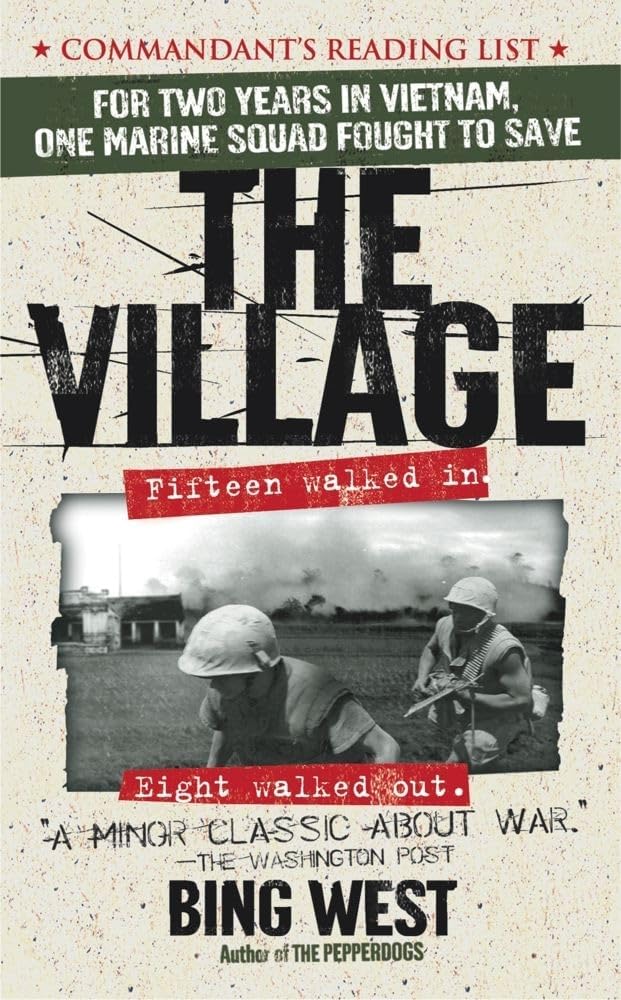
The Village Mass Market Paperback – January 1, 2003
Product ID: 4072002
Full description not available
A**R
The Story of the Combined Action Platoon in Vietnam
General West does an outstanding job describing the life of CAP Marines during the Vietnam. My old outfit and proud of it. When you read this book you won't be able to put it down.
C**L
Great Book
I had read about this book in another very good book by Max Boot. Anyone that is interested in military history or in insurgencies will find this book a great read. It is written in a matter of fact way and details a small group of American and South Vietnam troops living with the population of a Vietnamese community and trying to keep the enemy out. This book details another side of the Vietnam war, a war within a war and the peoples stories are personal and heart felt. When I picked this book up I just had the intention of reading a little bit and putting it away for another time, but I read straight through and could not put it down.
M**O
Now I know
Now I know after after all these years what made these Marines in CAP units so special to the village and fellow Marines who served with each other.At age 19 I was suddenly put into a CAP unit outside of DaNang, Quebec 4. The TET Offensive had just started, I and other Marines were installed there to help with extra security. We did not fit in with the regular CAP Marines.The book tells of the dedication and bond the Marines had with the village people and the Popular Forces. I had only contempt for the PF's because I was not trained or had the personal compassion for the Vietnamese as the Cap regulars had.The book goes into great detail of how extra ordinary a Marine must be living in an outpost with the shadow of death hanging continuously over them. Being responsible for the lives not only of their comrades but the people they are there to protect.So now I know what it takes to be a CAP unit Marine thanks to this wonderfully written book.Semper Fi
0**A
Vietnam, Marines
The book provides an historical review with specific individual accounts of Marines "embedded" with the population. As most from that era would recognize, the Marines had "jurisdiction" of the northern provinces of Vietnam, commonly known as I Corps. Although, 5th SFG worked the northern areas of Vietnam (MACV-North, their missions were focused on border operations (Brightlight, etc) of Laos and Vietnam. The book is an excellent read, especially as the focus of COIN today was reflected in the comments in this months (Feb/2012) Foreign Affairs magazine (as where I initially read Mr. West's comment on COIN.Make no doubt the invasion of Iraq on 19 March 2003 placed Afghanistan and what strategy at that time prevailed deeply in second place. As a direct hire/contractor for USAID standing up the 1st PRT in Gardez, Paktia, I witnessed military minimized due to the demands of Iraq. The only financial resource at that time for "hearts and minds" was the CERP (commander's emergency response program; USAID's only implementation partner (USAID is not a direct funding agency) was IOM (International Organization of Migration)..hardly an NGO with experience in "post war" infrastructure development. The last time a had experience IOM was in Haiti (Operation Uphold Democracy) with their mission moving people around from one IDP camp to another.Although, I spent very little time at the Embassy, there were instances when I sat in on meetings (toward the end of my tour) with USAID's implementing partners in education, health care, infrastructure development (Louis Berger..the singular infrastructure development USAID partner in Afghanistan..schools, clinics..and the Kandahar-Kabul Road thru Ghazni). Because the Embassy folks and USAID managers would never venture from the Embassy, the inflated "success" of the implementation partners (NGO's-IO's) became a show. In one case, the presenters did not know there was a field rep for USAID who had traveled to Ghazni, Khost, Logar and Paktia on a daily basis (PRT commander/5th SFG/LTC was a real road warrior). Their assertions of projects was in some cases simply false.Unfortunately, had some of the tenants of Mr. West's summaries in The Village combined with what we know from "all the talk" of COIN been implemented in early 2003, no doubt Afghanistan would be in much better strategic position than today...in short, we wasted perhaps seven (7) years..bleeding us financially and the tragic lost of alot of fine Soldiers, Marines, Air Force and Navy personnel.Lessons learned from The Village and from the Ten Thousand Day War-Vietnam seemed to of been lost within the Administration of that time..and for Afghanistan, what momentum won was quickly lost.Haiti/Bosnia/Croatia/Sudan/Afghanistan/Iraq/Sudan/Uganda/2010RH
M**5
About The Village
To some, the Vietnam War was a chance for medals, promotions, and one day a star on their shoulder. To most, serving in Vietnam was their duty—a patriotic chore to serve their country. Along the way, a student of the Vietnam War will find countless demonstrations of raw courage and heroism: servicemen of all of our Armed Forces, giving of themselves for a greater purpose. Of course, nearly sixty thousand of our young men gave the ultimate sacrifice. Many more gave up their limbs, or suffered debilitating wounds —and from a psychological perspective, everyone left a part of themselves in Vietnam. However, few gave more than a squad of Marines assigned to protect the Vietnamese people living in a small coastal village, then named Binh Nghia.This is a remarkable story told to us by former Marine Captain Francis J. “Bing” West, who later served as an assistant to the Secretary of Defense, and in the Reagan Administration as an Under-secretary of Defense. When Bing West returned to Binh Nghia 37 years later, he found an extraordinary thing: many of the villagers from 1966-1967 had died —particularly those who served alongside the Marines; some married and moved away from the village —and yet in spite of this, everyone living in the village in 2003 could recount stories about “their Marines.”You see, the villagers passed down the stories of what happened in Binh Nghia to their children, then they told the stories to their children. Everyone knew what these Marines did, and as Mr. West walked through the village in 2003, one old farmer came to him and asked, “Tell me Dai U’y where is Sergeant Mac? Do you know Bill ... Marines number one, what happened to Monty? What happened to Frill (Phil)?” Not far away Mr. Bing found a marker resting between two palm trees, and on it a small inscription to the Marines who had built their well and shrine in 1967.Herein lies the true pain of the Vietnam War. Young Americans went to Vietnam to fight a vicious and resourceful enemy. A few of these people ended up protecting a few thousand residents of a small village along the coast in Quang Ngai province. Most of the Marines cherished these simple people so much that they ended up dying for them. In return, the villagers ended up adopting these Marines; they remember their sacrifices even today. If only the American people had loved these Marines as much.The Village is a worthwhile book, on many different levels.
Trustpilot
1 week ago
3 weeks ago