

🔪 Sharpen like a pro, slice like a samurai!
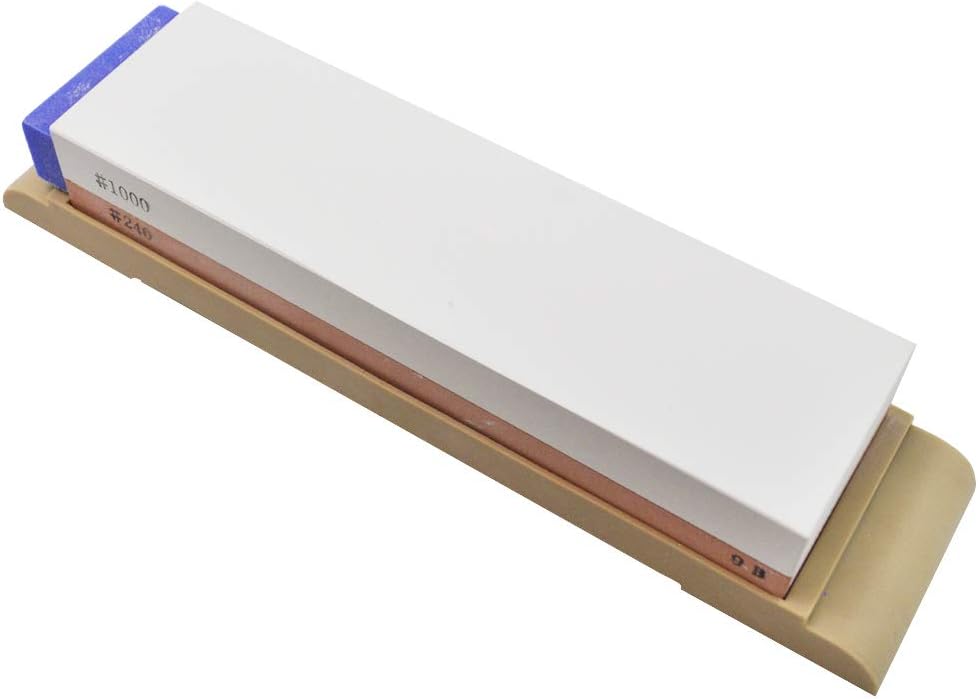
The Kai Japanese Professional Knife Sharpening Stone is a premium dual-sided whetstone featuring 240 grit for aggressive sharpening and 1000 grit for a polished edge. Made in Japan, this compact and lightweight stone is favored by chefs and knife enthusiasts for restoring and maintaining razor-sharp blades across a variety of knives and traditional blades. Easy to clean and built to last, it delivers professional-grade sharpness without the premium price tag.
| ASIN | B000UZET0M |
| Best Sellers Rank | #466,323 in Kitchen & Dining ( See Top 100 in Kitchen & Dining ) #1,565 in Knife Sharpeners |
| Brand | KAI |
| Color | Cream |
| Customer Reviews | 4.3 4.3 out of 5 stars (384) |
| Date First Available | May 11, 2004 |
| Global Trade Identification Number | 04901601524932 |
| Grit Type | Medium |
| Is Discontinued By Manufacturer | No |
| Item Weight | 1.2 pounds |
| Item model number | 3658 |
| Manufacturer | Kai |
| Material | Ceramic |
| Number of Items | 1 |
| Product Dimensions | 7"L x 2"W x 1.5"H |
J**T
Good price, good stone
So far I've been very happy with this stone. (I use this one and a 6000 grit stone). Good quality at a good price. Have had it for a few months and it is still nice and flat and even. Will update if time proves me wrong. Edit 6/15/09: I am now more familiar and experienced with stones, so I would like to add a few things. First and foremost, I still believe this is a good stone and at the listed price ($25), it's quite a bargain. I only wish they offered one that was a little wider. I've now tried some King waterstones - the standard for cheap but good Japanese waterstones. In comparison, this stone does not cut as fast as the kings at the 1000 grit level. The 240 side is fairly aggressive and cuts pretty fast, perhaps faster than king's offerings. Like most coarse stones (a notable exception being the bester 500 grit stone), the 240 side dishes quickly. The 1000 grit side dishes comparably at a more moderate pace. More importantly, I feel like this stone leaves a nicer finish than does a king stone at 1000 grit. As such, I recommend this stone in general, but I recommend it very highly if you are on a limited budget and don't want to buy any higher grit stones to finish on. The coarse side is probably one of the better stones in the 240 range on the market, but it is slowed down just a bit by it's narrowness. Neither stone individually is the best of its kind (though you'd have to leave amazon to find some of the best), but taken together and considering the price, it's a good combo stone that could easily be either your only stone or the first two in your progression. In either case don't waste money on stones sold by knife companies - shun, global, whatever. They charge a huge markup compared to other companies based on brand recognition and people assuming that a company's stone is best for their knives.
P**R
Worked well for me.
This stone may or may not be made by KAI as I don't know if they actually manufacture sintered abrasive bricks as that is not quite the same type of process as forging and machining steel). Kai certainly do brand it as their own. With that being the case I was willing to give this modestly priced stone a try. As with any stone technique and patience will have a great influence on the results. The 240 side is abrasive enough to smooth over the factory grind on Henckels Four Star and International Classic knives. My 5.5" Four Star santoku needed some work and the stone did a fantastic job of knocking down the rough burred baring a couple of tiny chips from ten years of frequent use. My santoku now has a fresh continuous edge without any burrs or chips. My most used knife is now sharper than new with many years of service ahead. My large santoku also Four Star wasn't as worn but it still had the factory edge from whatever coarse abrasive Henckels uses in their process. This stone is sufficient for removing this type of factory finished edge surface characterized by visible parallel striations in the steel. After using the 240 side the 1000 side will bring the edge to a very smooth edge. Beyond the 1000 side a 6000 stone can be used but is by no means necessary for anything I've ever cooked. The returns I've found beyond 1000 are quite diminished and more of an amusement than of any utility. When sharpening with wet fingers very sharp blades don't feel as sharp as they actually are against dry skin. There is a distinct difference between an edge of burr formed by using a steel vs the smoothness of an edge refined on an abrasive whetstone. I found that my knives were already very willing to cut paper with little effort without ever feeling as grabby or edgy against skin like I found with the results of using a sharpening steel. Stop working at the stone to dry and test the edge once in a while even if it doesn't feel sharp enough against a wet finger while you're working away at the stone.
N**G
Great Value!
Since buying this stone less than a month ago, I've ended up sharpening close to a dozen knives with it. I bought it on vacation, and before I got home to Toronto ended up sharpening a number of knives for my grandparents and relatives, many of which hadn't been sharpened in decades. I definitely appreciate the two different grits-- the coarse does a great job of removing any notches from the blade, and the 1000 grit side does a good job of honing the edge. My only complaints are that the stone seems a bit narrow. It would be a bit easier to use were it a little wider, like a King Whetstone. Additionally, it seemed fairly easy to score, and I've carved some of the edges off accidentally with my sloppy form-- though I can't compare it to other stones because I've only actually sharpened with this one. This stone also comes with a rubber holder for the stone that works well to secure the stone on a countertop. That being said, it only works when directly placed on a bare countertop. The first time I used the foot, I spent a half hour cleaning a mess of slurry off my countertop. I've thrown that bit in the garbage. Save yourself the pain, and use a wet rag to secure the stone instead-- it'll collect the slurry and save you the wash-up time. As a heads-up, the "instructions" are purely in Japanese-- but it makes little difference because there are a number of great instructional videos readily available on the internet. Without a doubt, this is a great stone for such a low price. You can't really go wrong.
I**X
Perfect once you know how to use it properly.
M**O
粗面と仕上げ面があるので便利です!
A**7
Great sharpening stone especially the 1000 grit side, high quality and quick sharpening.
Y**I
For professional use only, I like it
T**O
Me decido a escribir esta reseña el día de hoy, pues ya llevo un tiempo utilizando esta piedra de afilar. Antes de pasar a los pros y contras, he aquí información importante: - El uso que le he dado es principalmente afilar formones, junto a una guía de afilado, y solo ocasionalmente para cuchillos y hachas de cocina, navajas utilitarias y cuchillos de cacería. - La dejo sumergida en agua durante al menos 5 minutos antes de usar. - Como lubricante utilizo liquido limpia vidrios. - Para obtener un micro filo o el conocido como "super filo", se tienen que utilizar grados intermedios y finales de abrasivos. - Acostumbro a limpiar el objeto a afilar entre grados sumergiéndolo en agua y pasando papel o trapo. PROS: - La rectitud, firmeza y acabados de la piedra, me han dado resultado y la considero de muy buena calidad, aunque aclaro que no soy experto en el tema; a durado sin gran desgaste, no presenta zanjas o canales. - Es una piedra 3 en 1 (combo), aunque es menos el material de cada grado al que se puede encontrar en una piedra de un solo grado, imagino que sirve para mantener este costo, es conveniente para ahorrar espacio, no solo de almacenamiento, si no también en area de trabajo, esta muy bien adherido en cada grado, de manera pareja y limpia, también cuenta con un removedor de oxido. El lado 240 rebaja muy bien el material y el lado de grado 1000 deja muy buen brillo; el removedor de oxido tiene el poro muy abierto, y noto que es algo flexible, por lo que no deja surcos en el metal. - Incluye una base de plástico algo gomoso, que evita en cierto grado el deslizamiento, pero no es lo máximo, yo pegue un poco de corcho en las patas para que se moviera menos. CONTRAS: - El instructivo y características están escritas en japonés. - Los grados son muy distantes, de 240 pasamos a 1000. Imagino que es por costos más que por practicidad. - Es algo angosta y no muy larga. En conclusión, es una piedra de muy buena calidad, practica a buen precio que dará mejores resultados y durara mas que una piedra económica.
Trustpilot
2 months ago
1 month ago