
DOWNLOAD THE APP


Customer Services
Copyright © 2025 Desertcart Holdings Limited
DOWNLOAD THE APP
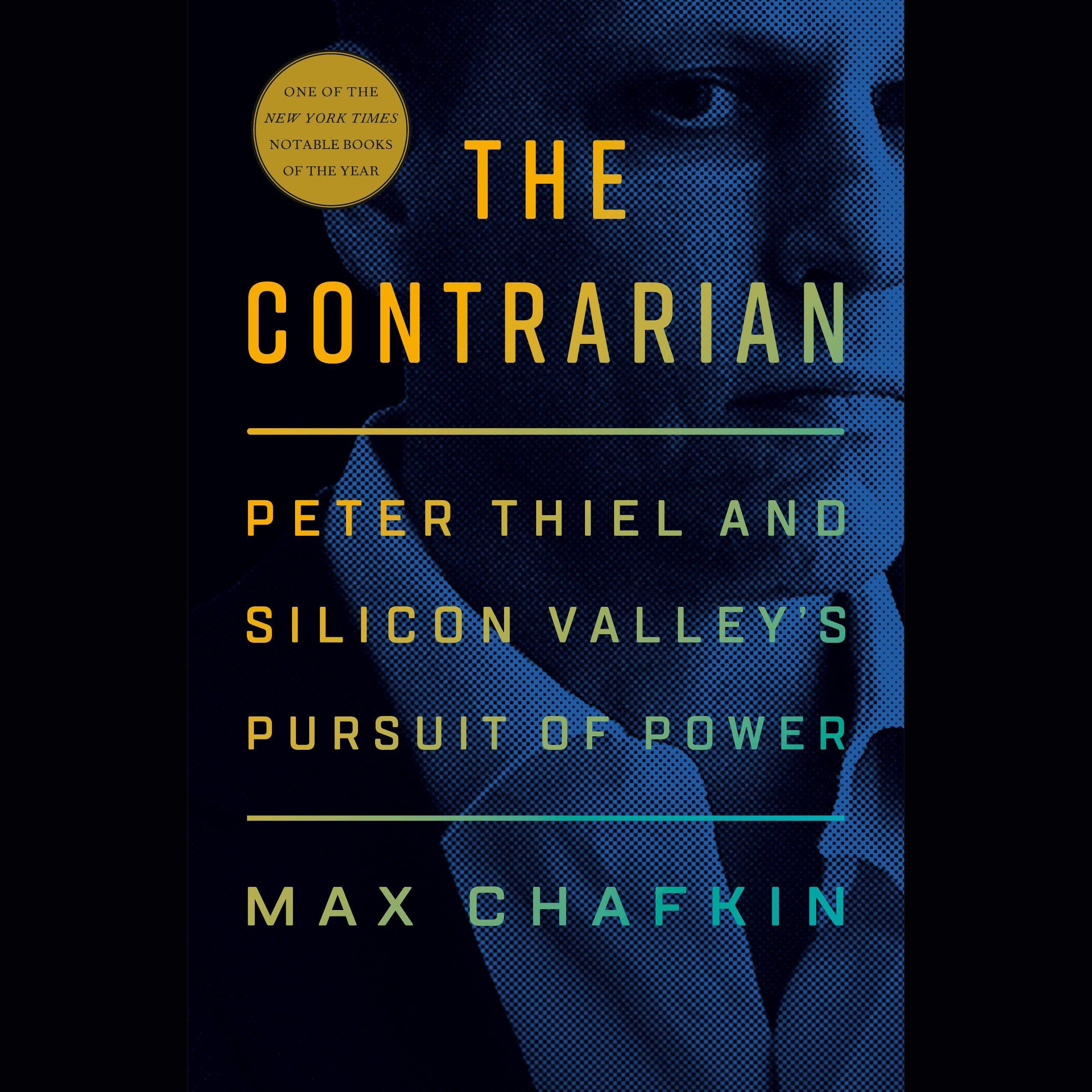
desertcart.com: The Contrarian: Peter Thiel and Silicon Valley's Pursuit of Power (Audible Audio Edition): Max Chafkin, Will Damron, Penguin Audio: Books Review: Peter Thiel bio excellent read - Excellent look into Peter Thiel and the influence of the new breed of oligarchs on our society and government. Review: Interesting book... - I haven't completed the book yet. It is written in a fluent style, although some facts about Thiel were already well known, including the interview by Weltwoche. Down to the detail, including his perfect SAT scores and junior chess achievements, the author describes Thiel's rise to power as a child of German immigrants. A few historical inaccuracies, however, are also part of this book. Germany is described as a country without critical, political movements in the 60's, but by 1968 the German left and other groups had put together an opposition movement. The author writes critically about Thiel but at the same time, he seems to be a secret admirer, which I find psychologically interesting. Finally, it is notable that Germany and many countries in Europe, with less monopolistic industries (and no Thiel) are doing far better when it comes to health care, education and equal opportunities at work...
R**T
Peter Thiel bio excellent read
Excellent look into Peter Thiel and the influence of the new breed of oligarchs on our society and government.
A**R
Interesting book...
I haven't completed the book yet. It is written in a fluent style, although some facts about Thiel were already well known, including the interview by Weltwoche. Down to the detail, including his perfect SAT scores and junior chess achievements, the author describes Thiel's rise to power as a child of German immigrants. A few historical inaccuracies, however, are also part of this book. Germany is described as a country without critical, political movements in the 60's, but by 1968 the German left and other groups had put together an opposition movement. The author writes critically about Thiel but at the same time, he seems to be a secret admirer, which I find psychologically interesting. Finally, it is notable that Germany and many countries in Europe, with less monopolistic industries (and no Thiel) are doing far better when it comes to health care, education and equal opportunities at work...
J**G
Successful sociopath
A week ago, I attended a bookstore event entitled "Thiel's Pursuit of Power," an interview of Max Chafkin by fellow Bloomberg reporter Emily Chang. One of the last questions she asked was about Peter Thiel's propensity to exact revenge on anyone who opposes him. Was Max worried? "Well, I am not selling any sex tapes," he said, an allusion to Thiel's destruction of Gawker via Hulk Hogan. Nervous laughter ensued. The one-star reviews here have Peter Thiel's fingerprints all over them, especially the 3,500 word diatribe that had hundreds of likes within a day of the book's release. (I suspect he wrote it; if he didn't, he provided most of the content.) I hope it doesn't get any worse than one-star reviews for Max Chafkin, as he's written a fascinating tale of a diabolical plotter who's achieved inordinate success -- partly because he has few scruples and seems to care about no one other than Peter Thiel. As a resident of the local area, I could not have been happier to hear that Palantir was leaving for Colorado. For years, the Palantir minions had dominated downtown Palo Alto, driving out dozens of businesses in their insatiable need for additional office space, the glassy-eyed millennials roaming the sidewalks. Were they spying on us? They didn't even seem to see us. It's entirely amusing that Palantir's farewell statement to Silicon Valley made snarky comments about Google and Facebook spying on people and selling their information. Sure they do, but they also offer other services. Palantir is only about spying, and its presence here made many residents uncomfortable. So I was fascinated to read that Palantir had been something of a bust -- its software didn't work that well -- and if not for the small investment that Thiel made in a former president's campaign, one that brought in billions of dollars in contracts, the company might not have survived. Similarly, PayPal had been a poorly-run enterprise under Thiel: the more customers it acquired, the more money it lost. Who knew? Meanwhile, Thiel has socked away billions of untaxable dollars thanks to major loopholes in the Roth IRA -- loopholes that most of us could never exploit -- and bought citizenship in New Zealand, a favorite doomsteader haven. My favorite part of the book describes Thiel's efforts to exert influence over the 45th president after backing his candidacy. In this situation, Thiel was out-manipulated, and by that point of the book, I was ready to root for anyone who managed to get the better of him. Thiel's style is domination through fear, and the former guy simply wasn't afraid. The Contrarian is far from perfect: it could have used better editing. At least twice, the author repeats the same story in a slightly different way. There are a few inaccuracies -- the school's legal name is in fact Leland Stanford Junior University (rarely used day-to-day, probably because the school got tired of explaining that it was not a "junior university"). Names are misspelled. That was offputting at times, but not enough to detract from the tales that made this book a riveting read.
I**A
Where is Walter Isaacson When You Need Him
I went into this book wanting to like it. Peter Thiel is nothing if not an extraordinarily complex figure, worth trying to understand—especially given the amount of influence (which Chafkin does a fairly convincing job convincing us of) that he seems to have. The writing is fine, the storytelling works; unfortunately, this book reads like a compilation of 10 years worth of gossip columns and pop psychology. Chafkin did a lot of research, but it appears he had almost no access to Thiel or anyone close to him—and I suspect that's because he wanted to make this book political, rather than actually try to understand his subject. By the end of the book, I was left feeling entirely unsatisfied that I understood the main character. I felt like I learned much more about Chafkin than about Thiel himself. To address some of the main points in the book: there is one paragraph dedicated to one of Thiel's most important intellectual influences, René Girard. This is a baffling choice. If you don't understand the concept of mimetic desire and rivalry, you'll have a hard time making sense of Thiel and some of the things he does and says. The author seems to have brushed this major influence of Thiel's completely aside. Girard is a serious philosophical thinker; Chafkin glosses right over him. He opted to focus on anything he considered some kind of salacious detail rather than the serious ideas that may have shaped Thiel's worldview. (Which I've spent some time looking into.) The book does make philosophical claims. He quotes one source as saying that Thiel is a "nihilist", and implies throughout the entire book that Thiel is some sort of Nietschzean nihilist with a will to power—a major philosophical claim that falls flat when you look at some of the basic things that Thiel has said and done over the years (like his insistence that there are objective truths worth discovering). He almost seems like the opposite of a nihilist! This kind of sweeping insinuation is typical of the book, and runs from beginning to end, as does the Palantir thread which runs through the book as some kind of moral tale—reducing this company to some kind of re-appropriation of PayPal technology and Thiel's sinister schemes. Nothing really adds up. Nor does the seemingly trivial incident of Thiel driving the Rabbit car and talking himself out of a ticket by claiming that he doesn't believe in speeding laws. First of all, it's hard to believe that this really happened. It's an account of more than 30 years ago, and Chafkin relies on some unknown source (he has a lot of unknown sources in the book) that is most likely remembered a funny conversation that the group of guys had after Thiel sped away, off the hook. Second—even if the story was true, and even if Thiel really argued that (which, again, is hard to believe), it's hard to fault a 20-year-old college kid. It's the police officer that comes away looking silly in that incident. The whole thing just doesn't hold up. It should be the first clue that something is wrong, and that any careful reader should be suspicious of the narrative shaping that the author is doing. Yet Chafkin uses this kind of incident to try to draw out some deep, inner, psychological thread in Thiel that he tries very unconvincely (at least to most) to thread through the whole book. There is just so much in this book that is either factual wrong, or—more often—has some kernel of truth, but is stretched to the maximum level of distortion so that it fits the narrative. Honestly, this book was such a hack that I carefully reviewed every single outlet and name that endorsed it because I'll never trust them again. I think that people genuinely would like to know something about the person of Peter Thiel; what this book provides was a cheap sale, and a marketing campaign that didn't fit the contents of the book at all. (Another point: I have a serious problem with the way the book was marketed (rigorous research, a 'biography', etc.) and what the ultimate product actually was. If you're going to write a speculative pop psychology about an entrepreneur, then call it what it is; don't call it a biography, please. I just wish Walter Isaacson had written this book—and I hope he considers it in the future. It's a story worth knowing. This book tells none of it.
K**L
The author obviously hates Peter Thiel. That is OK, but I was interested in learning about Thiel, not about the author’s agenda. I am sorry that I bought the book.
N**K
I have been watching Peter Thiel for some time and very much intrigued by his contradictory and contrarian ideas. And I picked up this book with an expectation to get an account of his life and world view. But much to my disappointment this is nothing more than a hit piece. The author clearly lacks objectivity and wants to get a quick buck bashing Peter Thiel; I’m all for the little guy making money bashing billionaires but have some objectivity for God’s sake. Don’t recommend this book. Save your time and money.
P**S
I'm about 20% through this and it is excellent - detailed, well-written, and easy to keep reading. Glad I bought it.
W**T
A biased hit job and this becomes clear very early on and becomes a constant refrain. Even one conservative Silicon Valley billionaire is too much for Chafkin to bear
A**R
High expectations of this book but fully destroyed by the lack of objectivity from the author… Not worth as too politically oriented
Trustpilot
1 month ago
1 month ago