Some deliveries may take a little longer than usual due to regional shipping conditions.

DOWNLOAD THE APP


Customer Services
Copyright © 2025 Desertcart Holdings Limited
DOWNLOAD THE APP
Full description not available
E**E
The eternal client
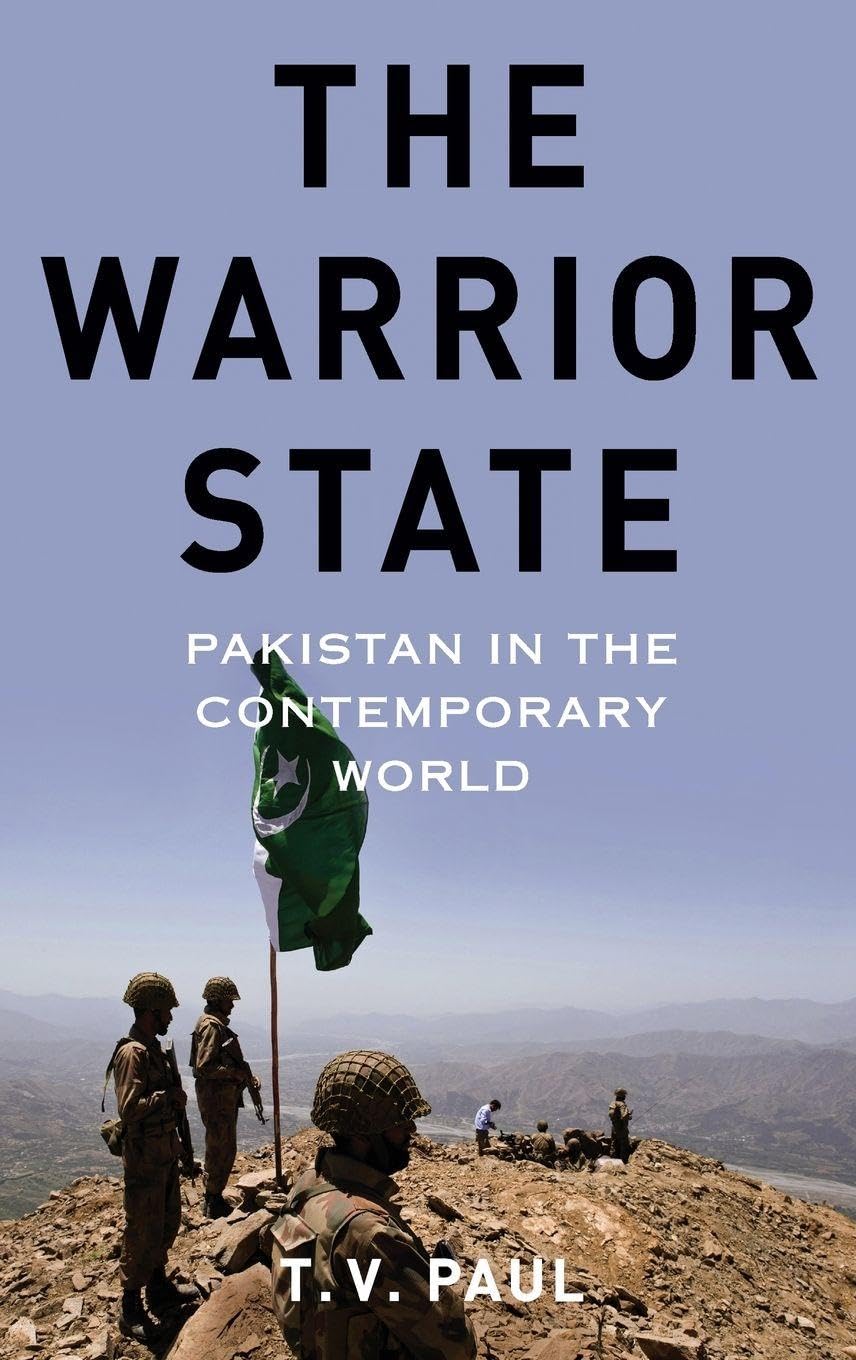
The resource curse is one of the most common reasons given for lack of development among countries in the global south, along with geographic isolation, a colonial legacy of legal and bureaucratic obstacles to economic and political competition and unchecked corruption of political elites. Pakistan doesn’t have (or isn’t cursed with) exploitable natural resources; you can look all you want and will not find vast pools of oil, endless seams of copper or forests stretching to the horizon. However in “The Warrior State” T.V. Paul finds that Pakistan has many of the characteristics of a nation whose economy is dependent on extracting and exporting non-renewable resources with little or no processing. Oil in Nigeria or copper in Zambia are examples of a single resource that overshadows the entire economy.So while not having the “resource” part of the resource curse, Pakistan suffers from what the author calls a geostrategic curse. It has made use of its pivotal position in South Asia to attract billions of dollars of aid money which it has funneled to its military and intelligence sectors, which led to continuous armed conflict, autocratic leaders with no accountability, endemic corruption, weak civil society and no real demand for the institutional reforms necessary to challenge the dreadful status quo. No matter how ineffective the regime, massive foreign aid keeps pouring in from major powers and their allies with a stake in South Asia. From the time of the “Great Game” when Great Britain and Russia confronted each other over control of Central Asia and the gateway to India to the Cold War to the post-9/11 “War on Terror”, Pakistan’s strategic position insured that the United States and, more recently, the People’s Republic of China will keep the payments flowing. The reliability of such aid defuses any pressure on political elites to launch the far-reaching domestic reforms necessary to promote sustained growth, higher standards of living, and more stable democratic institutions.Paul is a political scientist with knowledge both wide and deep of states with many of the same opportunities and challenges faced by Pakistan. He examines Turkey, Egypt, Indonesia, Taiwan, and South Korea and demonstrates how the presence of entrenched military and civilian elites, a divisive national narrative rooted in a narrow interpretation of Islam, and an inability to link national security to economic development, have prevented Pakistan from emulating successful developmental states as well as those that have, in recent years, managed to rein in powerful militaries.“The Warrior State” is not without some significant flaws particularly Paul’s description of the economy as “semi-feudal” without defining what this means. It is inaccurate since Pakistan is thoroughly capitalist and is no longer dominated by a landlord-tenant economic relationship. Urban interests have been and continue to merge with an increasingly capitalist agrarian economy, making fundamental changes in modes of production if not in ownership of the means of production. Quibbles aside, this an important book from a brilliant analyst, one that can be read by anyone with an interest in South Asia and that should be read by policymakers for that volatile area.
C**.
A Must Read for Anyone Interested in Central/South Asia or Pakistan Specifically
As the U.S. concludes its withdrawal from Afghanistan, Pakistan will once again assume a prominent role in the power struggles of Central and South Asia. Thus Mr. Paul's short but insightful book on Pakistan is a much needed addition to our knowledge of such crucial country and the many challenges it faces (and created). Mr. Paul argues that, like oil-rich countries facing a "natural resources curse," Pakistan faces a "Geostrategic Curse" that prevents Pakistan from focusing on democracy and economic development. Because of Pakistan's hyper-realpolitik views, it seeks some sort of military parity with its lifelong rival, India, by building nuclear weapons and aligning itself with radical Islamic groups, both of which have backfired on Pakistan. Although Mr. Paul's thoughts on Pakistan aren't necessarily new for anyone who has read Descent into Chaos or Pakistan On the Brink by Ahmed Rashid, he does do a marvelous job of examining Pakistan's challenges and weaving them into a discussion of Pakistan's history, focus on Islam as a unifying force, and all-consuming rivalry with India. The fact that his book is so insightful in such a short space (a little less than 200 pages) and such a readable way is an achievement in and of itself. The one downside to this book was chapter 7, where Mr. Paul compares Pakistan to other countries that have faced similar problems, but come out stronger. Although interesting, it felt a a little bit superfluous. Still, for anyone who is interested in Central/South Asia or Pakistan specifically this is a must read.
M**A
It took a great deal of time- but now eventually a book has arrived that addresses the core reasons why Pakistan is what it is !
TV Paul is an academic who has written extensively on a wide range of subjects in the security domain and "The Warrior State" is a masterpiece- a culmination of years of painstaking research on South Asia in general and Pakistan in particular. Paul narrates a gripping account of how the "Geostrategic Curse" has deeply affected the thinking and attitude of the Pakistani elite and has thus prevented them from seeing what is clearly visible to most of the world - its paranoid and excessive focus only on national security.What is indeed telling is how the massive amounts of aid that continues to flow into the country has failed to reinvigorate its economy or improve the quality of life of the ordinary majority of citizens (purposes for which most aid is actually disbursed) and the fact that the excessive emphasis on security has not only not made Pakistan safe for most Pakistanis, it has also seen an exacerbation in the violence that the country faces. This being a direct result of the geostrategic policies of creating and arming groups to operate across both its Eastern and Western borders, policies that have come back to haunt itself- what with extremists gaining ground within the country.As a law enforcement practitioner for the last 22 years, i feel the book will serve the community well both in understanding the complex dynamics at work and in developing broad policy responses. It will also provide inputs for scholars who are engaged in understanding Pakistan and assisting it to come out as a strong, balanced economy and nation. "The Warrior State" is an unputdownable, thought provoking contribution to the field of International Security.
D**T
Pakistan : A Garrison-Cum-Hybrid-Democratic State
" To say that without a resolution to the Kashmir - issue Pakistan cannot prosper is to say that India has a veto power over the future of Pakistan, that India must give permission before Pakistan can launch its projects of development. "- Walter Russell MeadThe warrior state, Pakistan in the contemporary world is a different kind of a book, and here the author talks about the notions and the ideas which the ruling class of Pakistan has had been feeding its people since its inception.But before we start discussing about this book, I wanna tell you that if you haven't read the history of Pakistan and the Af-Pak region, then read about it first, after that you can try this book.So, let's begin by asking some important questions about Pakistan.What is Pakistan? What is a Garrison state? And why Pakistan is called as a Garrison nation?Pakistan is an islamic state. It was created in 1947 by partitioning India. It's located at the North-West corner of the Indian subcontinent. Pakistan is the world's second largest muslim populated country. And also the world's fifth largest- nuclear-weapon-state.A state which is in a perpetual conflict with its neighbours, and suffering from internal rebellion(s) is termed as the 'Garrison State'.Another defination of a garrison state can be defined as, A state where the armed forces or those who have the 'specialization in violence' controls the levers of power either directly or indirectly.Pakistan is called as a Garrison state because half of its existence as an independent country, it has been ruled by the military. The latter in Pakistan dominates the social, economic and all the other important aspects of the life.And we can gauge the impact of the institution of military in Pakistan that since its creation in 1947, not even a single Prime Minister has ever completed a five-year term.I will end with these lines :-'Living in a 'La La land' is not going to help Pakistan and its people, it would be better if they accept the reality and start working on it otherwise the consequences will be disastrous'.My Ratings : ⭐⭐⭐⭐ (4/5)I hope you like this, Thanks for reading, Jai Hind.
S**T
The rentier state
The book provides an in depth analysis of the warrior state of Pakistan in the contemporary world. The author has unraveled the key reasons behind the country's economic crisis and dysfunctional democracy, as well as the role of the deep state in shaping the society and economy.
C**.
Two Stars
Nothing but a long essay.
Trustpilot
3 weeks ago
2 weeks ago