Some deliveries may take a little longer than usual due to regional shipping conditions.

DOWNLOAD THE APP


Customer Services
Copyright © 2025 Desertcart Holdings Limited
DOWNLOAD THE APP


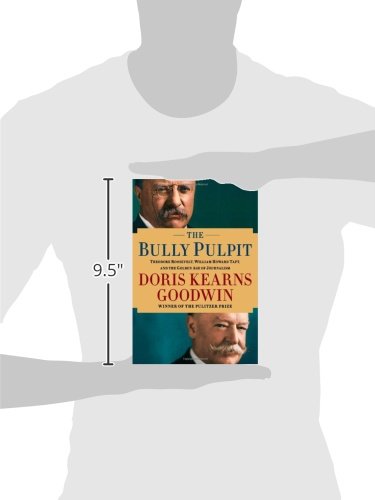
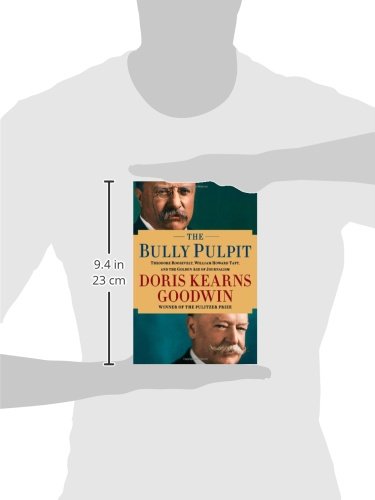
Full description not available
P**D
If you can survive the middle passage – There is a destination worth the trip
Bottom Line: In the Bully Pulpit, Professor Doris Goodwin has written a bloated but worthy read. Using the lives and presidencies of Theodore Roosevelt and Howard Taft as the center; she combines shorter biographies and a partial history of the Progressive movement in Republican politics. A second major theme is a biography of Samuel McClure, his magazine, the people he lead and how together they created the golden age of journalism. There is a lot of book, a lot to discuss and Prof. Goodwin needed a better editor in getting it into one volume. The Bully Pulpit is recommended, but are cautioned that this is a longer book than needed.New to me was that President Teddy Roosevelt had invented the term ‘Bully Pulpit”. His use of the slang word ‘Bully’ indicated that something was good, grander than a more modern person might say “Nifty”. To Roosevelt the Bully Pulpit was a very good place to be heard and thereby command public attention. He also coined the word ‘Muckraker’. From the beginning a harsh term to suggest that a journalist so employed was shoveling farm yard waste, to create scandal and distrust where it was not justifiable.Prof. Goodwin’s purpose is to compare how effectively President Roosevelt combined his use of the bully pulpit with his openness to certain of the muckrakers, specifically the McClure’s stable of investigative reporters. She contrasts this with President Taft’s more limited use of the bully pulpit and more traditional use of political discourse to forward their common cause: the Republican Progressive movement. The difference would be one of degree rather than absolute. Each would have to take some causes directly to the people and each would have to make some compromises. Indeed there is an unanswered question suggested by Roosevelt, that Taft had compromised too much.Had this book been focused more on this topic, it would have been a better book. Instead Professor Good win gives us a detailed biography of the two men, much of it available in purpose built biographies. The extensive backgrounds on the team behind McClure, particularly Ida Tarbell, Lincoln Steffens and William Allen White was interesting if over much. Roosevelt promoted close relationships with his favored journalists. Another example of how TR was a man of the future and is germane to the author’s larger questions.Goodwin’s certainly dares greatly. She does achieve her goals. She asks us to strive through too many pages.
A**T
Superb
The concept of this book is basically to present simultaneously (a) a biography of T.R.; (b) a biography of William Howard Taft; and (c) a general non-fiction book (like Simon Winchester might do) about McClure's magazine; and in fact (d) mini-bios of several McClure's writers. That seems both very audacious in scope, and difficult as far as tying all that together in a cohesive manner. Improbably, Goodwin makes it work brilliantly. Probably the key ingredient is her exposition of the access and relationships that the McClure's writers had to T.R., and the synergy thus created; plus contrasting how things changed under Taft.The book is extremely long, so if you're short of attention span, consider that. I prefer richly detailed narrative (as long as it's not aimless or wandering) rather than glossing over things to shorten a book up, so the fact that this took me 6 weeks to read was no problem for me. (It is exhaustively end-noted, by the way, for those interested. When you finish the book's main pages, you will be only at 56% through on the Kindle's progress meter.) Like many readers, I have previously read a T.R. biography or two, but I did not find this book repetitive or redundant to those, given its angle on T.R.'s career and given all the Taft and McClure's content. Really a master work, and a great read that lets you lose yourself in the turn-of-the-century era for quite awhile.
L**R
Provoked Great Discussion for Library Non-fiction Book Group
Our library non-fiction book group read and discussed this book over two months. It produced a great discussion on so many topics: Roosevelt & Taft, their wives, McClure's magazine, trust-busting, elections, political parties, Ida Tarbell, reformists etc. Some comments from the group:* although it wasn't an easy read, it was a worthwhile read and we were all glad to have read it* most liked Taft more than Roosevelt - we were dismayed by Roosevelt's actions over Taft's presidency* both had strong wives* loved the role of the press* author is great at conveying scenes - you feel you are there* we were blessed as a nation to have both men serve in office* Teddy was more visionary, Taft better at executing perhaps* Taft should be more well-known and respected - why isn't he? Because he just served one term? Wasn't as dynamic as Teddy? No wars or memorable events occurred during his Presidency?* Loved descriptions of Teddy by others - very colorful* Juxtaposition of two men with narrative on press created an original and interesting structure for the book* We are dealing with many of the same issues todayThere were lots more comments as we discussed the book for four hours, but this gives you the gist of it. We had also read Goodwin's book on Lincoln and her childhood in Brooklyn. Enjoyed both of those, too.
P**K
Four Stars
I love it!
M**K
A 900 page book that wets your appetite to read more about this period
This is an outstanding biography of Teddy Roosevelt, William Taft and the Muckraker journalist movement. At 900 pages, my main criticism of the book is that it is too short since it wets the appetite to learn about this period. That said, the book would have been helped by the addition of at least one chapter providing a critical appraisal of the main figures.
M**H
Two Presidents and the Era of Reform
This unusually long book (750 pages) never lost my interest, always kept me absorbed, was never tedious in spite of detailed descriptions of public and private life during Theodore Roosevelt's and William Howard Taft's presidencies. I had already read several books on Theodore Roosevelt who is such a colorful figure, but knew little about William Howard Taft who comes alive in these pages as a benign and friendly character almost pushed into a presidential role which he did not feel was suitable for him. As for the great friendship between the two men, like all political friendships, it was doomed to end when personal ambitions took over.Wives, children, brothers and friends are delineated to round out the portraits and actions of the two presidents and of course thepress also plays a big role in the book and is instrumental in rousing public opinion and pushing through legislation to overthrow the trusts, to attack the bosses and their political power and to try to rid the US of corruption at all levels of politics.Any reader interested in the politics of the United States and particularly in that period will not be disappointed on reading this book. Also, I couldn't help thinking how much light it also throws on the problems facing the United States today, problems of inequality, of the role of money in elections, the changing roles of women, problems of racism in the Philippines...To sum up: totally engrossing!
F**O
arrived as expected
great book reading
R**I
Splendid achievement
Kearns Goodwin writes about a period of American history, between the Civil War and WWI, about which I knew little and I have learned so much. And, as usual, she brought history to life. Great read.
Trustpilot
1 month ago
4 days ago