Desert Online General Trading LLC
Dubai, United Arab Emirates
Desert Online General Trading LLC
Dubai, United Arab Emirates

Full description not available
H**E
to be taken with a Granicus of salt
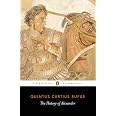
History has given us both shining heroes (Jesus, Socrates, Joan of Arc) and deep-dyed villains (Hitler, Stalin, Pol Pot), but perhaps most interesting are the morally ambiguous characters. Depending on your perspective, Alexander the Great was either an enlightened statesman and general or a drunken, power-mad sociopath. I suspect the truth is somewhere in between. Quintus Curtius Rufus, a Roman historian writing in the first century A.D., gives us perhaps the most rounded portrait of Alexander as a good man corrupted by success. Alexander's virtues were his own, his faults the result of his good fortune. Curtius is sometimes confused about names, dates, and places, and sometimes he plays fast and loose with the facts, but over all he wrote an exciting, fast-paced narrative full of gripping battle scenes, harrowing accounts of bravery and cruelty, and unforgettable characters. One feels that Curtius, living as he did during the time of the deranged Julio-Claudian emperors, uses Alexander's story to express truths about his own period that could not be openly stated. Most likely he wrote during the reign of Claudius, who in addition to being an alcoholic and a womanizer was also a sadist--all faults for which Curtius criticizes Alexander. He is especially troubled by Alexander's insistence on being worshipped as a god--this at a time when the emperor cult was in its early stages.One gets the impression that Alexander was losing it at the end, becoming increasingly reckless while falling under the spell of the eunuch Bagoas. Unfortunately, "The History of Alexander" is incomplete. The first two books and the beginning of the sixth are missing, and the later books all have lacunae of increasing severity. The whole drama of Alexander's return to Babylon, the death of Hephaestion, and Alexander's own final illness and death is missing. The work ends with the onset of the wars that broke out over the disputed succession to Alexander's throne, resulting in the splintering of the Macedonian empire.John Yardley has produced a readable translation with a helpful introduction and notes by Waldemar Heckel. Included are bibliography, list of abbreviations, appendices, maps, and an index to maps. Overall an exciting account of one of history's most legendary figures.
R**K
Rufus Rules
A really cool book. Rufus is quite critical of Alexander at times - he describes the darker moments of his history. Obviously, not all of these stories would be true, but after reading Arrian, Rufus just seems so much more logical and believable. Rufus doesn't make a villain out of Alexander or anything, he just points out that everybody has flaws. He gives some interesting descriptions of the Persian culture - giving a Roman perspective of eastern customs. If you're writing a paper on Alexander then Rufus is a perfect counterpoint to the traditional history that people like Arrian and many modern historians tend to favour. A fun read.
N**I
The History of Alexander
Another book written on Alexander the Great,but different from the others. So many have written books about Alexander and yet in this book so many things I read for the first time.The book is very easy to read, ofcourse it is about the wars,conquers,of Alexander.The details that are not written in Arrian for example and Plutarch are several.I will give a few examples.One of Alexander's speeches,outstandingly written to pursue the killer of Darius.The Amazon queen meeting Alexander and what she demands of him.The Caspian discovered by the soldiers, what they see and feel about the salted water.The speech of Coenus on behalf of the soldiers, and Alexander's speech.The fight of the Indus river.The Gedrosian desert,and the judgement of Philotas. All is strongly suggest that if you are an Alexander lover you should add this book to your reading. Enjoy.
J**R
Excellent read, book was as described
In depth examination of the character of Alexander of Macedon and his campaign's
E**N
Follow Where He Leads
Even when his material is questionable (see Arrian's "The Campaigns of Alexander"), Curtius' is a fascinating tale of one of the greatest conquerors of all time, a man of many curious quirks and actions. Well worth the time spent.
N**E
Must Read
For the historian in all of us, this is a must read on a man who conquered a good part of the world by age 33; more importantly, bring Greek influence into the Persian Empire.
A**T
Five Stars
super great for my history class
A**A
Sleep Aid
These is the book to read if you need something to help you fall asleep at night. The print is very small and it gave me eye strain. Not a very interesting read.
Trustpilot
5 days ago
3 weeks ago