

Desert Online General Trading LLC
Dubai, United Arab Emirates
Desert Online General Trading LLC
Dubai, United Arab Emirates

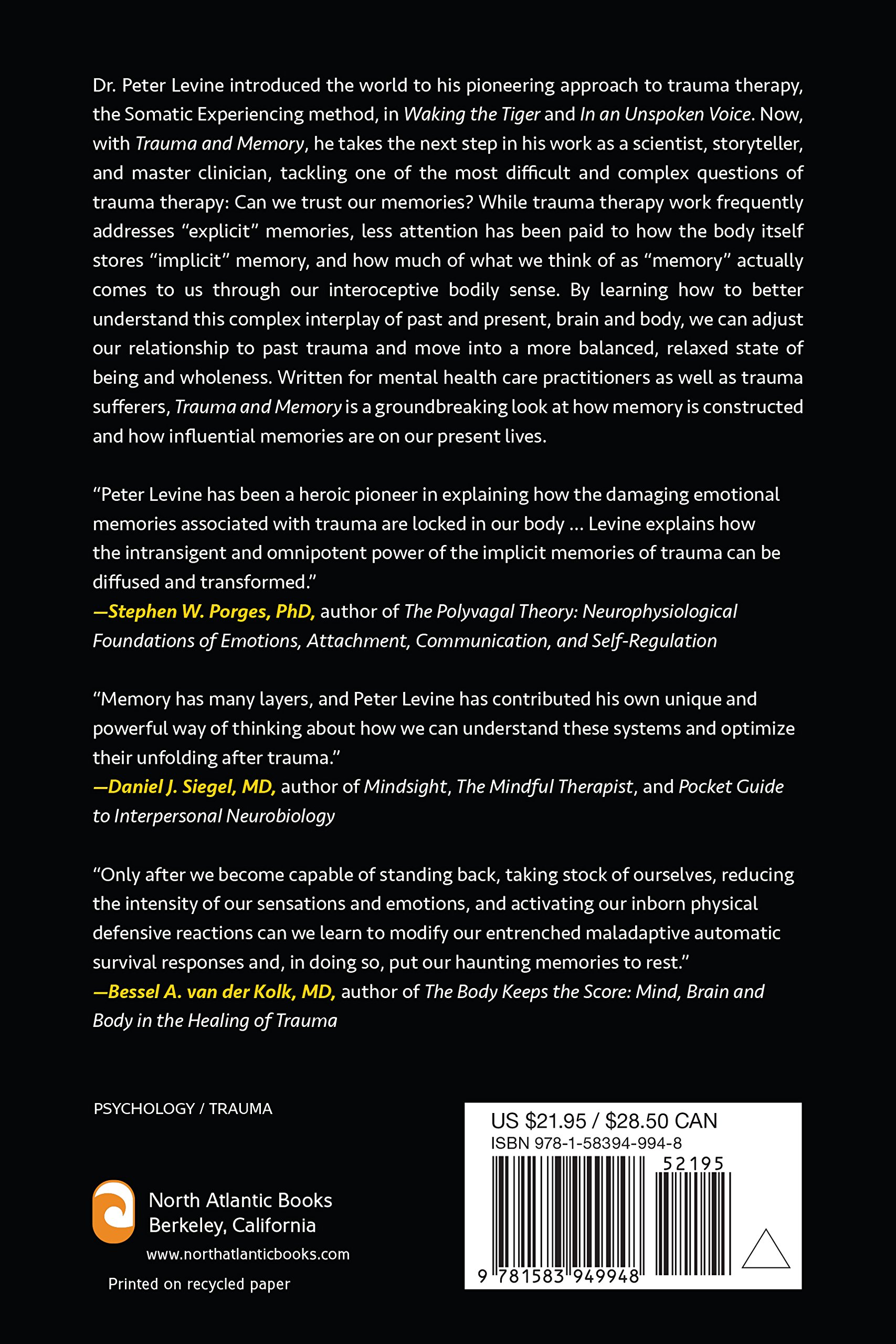
Full description not available
B**Y
Recommended for all trauma therapists and trauma survivors looking for more understanding of memory
As a survivor of severe trauma I cried my way through the first part of this book, as the way I experience life somehow felt so validated. Peter obviously truly understands the territory and helped me to understand my own reactions and memory challenges better. I would recommend this book to anybody working with trauma survivors and trauma survivors themselves. There is so much misinformation around out there with regard to memory processes, and Peter has written a really clear explanation of the different types of memory and the issues around whether or not they are reliable. This book also has a very clear explanation of how to use the SIBAM model and pendulation to help someone to complete thwarted survival and orienting responses from the past, and even just on a first quick read has better empowered me to be with the sensations in my body. Thank you Peter, for being the pioneer you are and for bringing what you have learnt so clearly into the world through your writings.
K**Y
Procedural Memory at Last
I am a therapist who has studied EMDR and Brainspotting (BSP), both excellent trauma therapies. Often I think I don't have anything left to learn and then I come across Peter Levine with the whole piece on procedural memory. I'm wondering if the "brain spot" that you find in BSP results from a disruption in the orienting response clearly described in TRAUMA AND MEMORY. Levine has the best explanation of how various types of memories work together that I've read thus far. I also loved his case examples. EMDR taught me how to activate calming acetylcholine with eye movements that reconsolidates memories to an adaptive level by dissolving the distress hormones--adrenalin and cortisol. BSP taught me how to pay attention to visceral sensations (coming from body organs), and Levine (FINALLY) taught me how to pay attention to and what to do with body movements (procedural memory) that happen during processing. Thank you Peter!
J**.
Excellent and Readable!
I am a clinical psychologist who read and thoroughly enjoyed (and learned from!) this book. I have read two of Levine's other books in the past (Waking the Tiger and In an Unspoken Voice), and still felt like I learned additional material about trauma and somatic experiencing from this book, Trauma and Memory. Levine writes in an interesting, easy to understand, and readable manner so that you're learning a lot without suffering through mind bending, dry, and textbook-like material. His way of explaining the different levels of memory and how traumatic memories are formed, stored, and healed was extremely clear and made a lot of sense. In fact, it was so clear, that I was able to outline the main concepts and present them to some of my clients and students without any problems. I would definitely recommend this book to others!
K**B
Okay, not great
This book is only about memory. Those looking for a more comprehensive look at somatic experiencing and how it can help treat trauma might be better off reading some of Levine's other books.
A**N
Balanced, modern, lucid and convincing
I liked the fact that Levine affirms the significance of trauma memories while recognizing that declarative memory is evolving and uncertain. There were sufficient examples to give a grasp of the author's clinical practice, while offering useful information for those with a different point of view. This was an easy, quick read for me.
A**R
Wonderfully Written Book
Thank you, Dr. Levine, for a book written in layman's language regarding how trauma is embedded and encoded in our physiology.As an EFT Practitioner and EFT Trainer, this book gives me another option for reading for my students who are just starting out on their healing journey.You, Dr. Scaer, and Dr. van der Kolk have all done a wonderful service writing books for those with early traumas.Sherrie Rice Smith, R.N. (Retired)EFTforChristians.com
K**R
The body remembers and speaks thru the language of sensation
Peter uses several examples of how the brain and body function as a survival mechanism. I appreciated his description and details of what is happening at a cellular level. It is helpful to follow and use the body and sensation as guide in healing traumatic memories.
J**S
Excellent presentation of Somatic Experiencing - less detailed and easier ...
Excellent presentation of Somatic Experiencing - less detailed and easier to read than the same author's earlier book, Outspoken Voice. If you want to dig as deep as possible, I would recommend Outspoken Voice, but this book is better for initially learning about it. Both books have great case examples, but Trauma and Memory has case examples with photos, which are very helpful in understanding how SE works.
Trustpilot
1 month ago
4 days ago