Desert Online General Trading LLC
Dubai, United Arab Emirates
Desert Online General Trading LLC
Dubai, United Arab Emirates


Full description not available
M**D
Entertaining and informative for any reader- from novice to market veteran
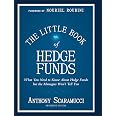
Scaramucci's 'Little Book' packs a lot into what amounts to a quick read. You don't have to really know anything about hedge funds or finance to enjoy the book, even initially- and if you're a novice, you'll certainly know a lot more about them when you're done. I actually had spent a year at a fund, and while I wasn't a novice (although I'm certainly no expert), I still learned a great deal. If you've read Barton Biggs 'Hedgehogging,' think of 'Little Book' as a slightly edgier and shorter, but just as entertaining, updated edition.Once again, those without limited or no prior knowledge of the industry will learn a great deal. Scaramucci approaches and simplifies the topic without the pretentious inside-baseball vernacular often associated with investment texts. He runs through the history of hedge funds- why they matter, their relative size, who invests in hedge funds, what strategies managers employ, and how these managers are picked. He also instills the reader with an idea of what constitutes success in the industry, making terms such as 'beta-adjusted return' and 'correlation' easy to discern through simple and then progressively (and appropriately) more complex real-life examples.However, perhaps `Little Book's' most significant contribution is providing context on funds' impact on those beyond the ultra-wealthy individuals commonly assumed to be the chief beneficiaries/losers from the industry's performance. Scaramucci describes the entrance of institutional investors, most powerfully spurred by David Swensen of the Yale Endowment in the mid 1990's. The entrance of institutional investors marked an important transition, one which has spread the impact of fund performance far beyond the `super-rich.' Actually, a lion's share of hedge fund assets are now held by pensions, foundations and endowments- Scaramucci explains the reasons (primarily diversification, as HF's, unlike mutual funds, are not forced to go `long only' and can protect pensions/endowments during down markets, ie; HF's significantly outperformed S&P during 2008 crisis), the impacts, and the possibilities of this transition in significant detail. The fact that the industry's performance has such wide-ranging implications further buttresses the importance of an articulate `how to' like `Little Book.'Additionally, Scaramucci is just an entertaining guy. You can feel the difference when the author is genuinely passionate about the subject at hand and when he's just going through the motions. It's like watching a baseball game called by Joe Buck or a football game called by John Madden- Scaramucci understands the topic well enough to be honest and funny, while still being informative. He's able to poke fun at himself, the indulgences of the industry, and some of the stereotypes that have surrounded hedge funds- this keeps things from getting dry as he packs a lot of information into a confined space.On a personal note, I found the history and context Scaramucci provides on the industry to be particularly compelling. It certainly helps to pull back the curtain on the industry, displaying that its founding father A.W. Jones was not a PHD economist or math genius, but an eccentric former journalist. Further, the book describes how the growth of the industry has corresponded with market movements and financial innovations- delineating the ebbs and flows that are often overlooked. For example, although hedge funds have grown at an exponential pace when considered over an extended period since the late 1960's, there were times when the industry's future was in doubt, most notably during the stagflation-laden early 1970's and during the tech bubble in the late 1990's, very early 2000's. In the former instance, hedgies were punished for following the herd and buying into the go-go stock market of the late 1960's, while in the latter instance they were punished for shorting persistently inflated, and at the time, still rising internet stocks, and for failing to match correspondingly inflated benchmark barometers. Interesting food for thought as we wait inevitably approach the next sector or asset class mania...
M**2
High Level Introduction to Hedge Funds
Scaramucci's book is ideal for those who know little about hedge funds. His book provides simple, easy-to-understand explanations of how hedge funds work, including:The history of hedge funds and what differentiates them from mutual fundsHedge fund fee structure, regulatory environment, and definitions of who can invest in a fundHedge fund strategies, including event-driven, relative value, L/S equity, and directionalShort interviews with prominent fund managers, including Daniel Loeb and Leon CoopermanUsing hedge fund of funds to invest in hedge funds even if you don't meet their minimum requirementsGeneral advice on finance and entering the hedge fund industry if you are a student / aspiring professionalMy only fault with Scaramucci's book is that it reads as a disguised advertisement for hedge fund of funds, which is the specialty of his firm, Skybridge. Overall though, Scaramucci's book is a quick introduction to hedge funds.
B**S
Hedge Funds Demystified
The Little Book of Hedge Funds is not your typical finance book. It lacks the abstract academic theories, insider jargon and chart-filled analysis that you might expect. In fact, the commentary is the furthest thing from dry. The author, Anthony Scaramucci, provides a refreshingly clear and approachable overview of the hedge fund industry in a uniquely engaging manner.An accomplished leader of the industry, Scaramucci's pragmatic entrepreneurial perspective gives the reader a truly informative look inside the secretive world of hedge funds. His use of real-life examples help to demystify subjects that are often misunderstood while conveying complex concepts in a simple, straightforward way. This is achieved not only through the author's own personal experience - which he shares quite candidly - but through interviews with some of the brightest minds in the industry. Scaramucci even manages to weave in some amusingly lighthearted humor throughout the story. In explaining fee structures, he recounts a conversation with celebrity chef Guy Fieri to illustrate the importance of a fund manager having skin in the game.More than anything, The Little Book of Hedge Funds does a great job of achieving precisely what Anthony Scaramucci himself has set out to accomplish through his firm - make investing in hedge funds accessible to the masses (or, as he puts it, "to every dentist in America"). Well, we're not there quite yet, but this book is a massive step in the right direction and certainly an important tool for all of the dentists out there looking to step up their investing game.
M**T
Not little enough.
About 230 pages counting the completely redundant introduction.Relentlessly repetitive, aimed at the rank beginner, peppered with humor too old and corny to be of use, and self-promotional.How many times do you need to be told that hedge funds seek absolute rather than relative returns? Will 25 suffice? How about 50?In some places, the material is just plain wrong. Most likely this is just due to bad editing, but it's still annoying.However, if you are a good skimmer and use a highlighter, this book is worth the money just for the references to names, places, other texts, etc.At 40 pages it could have been a little gem.
Trustpilot
2 months ago
1 month ago