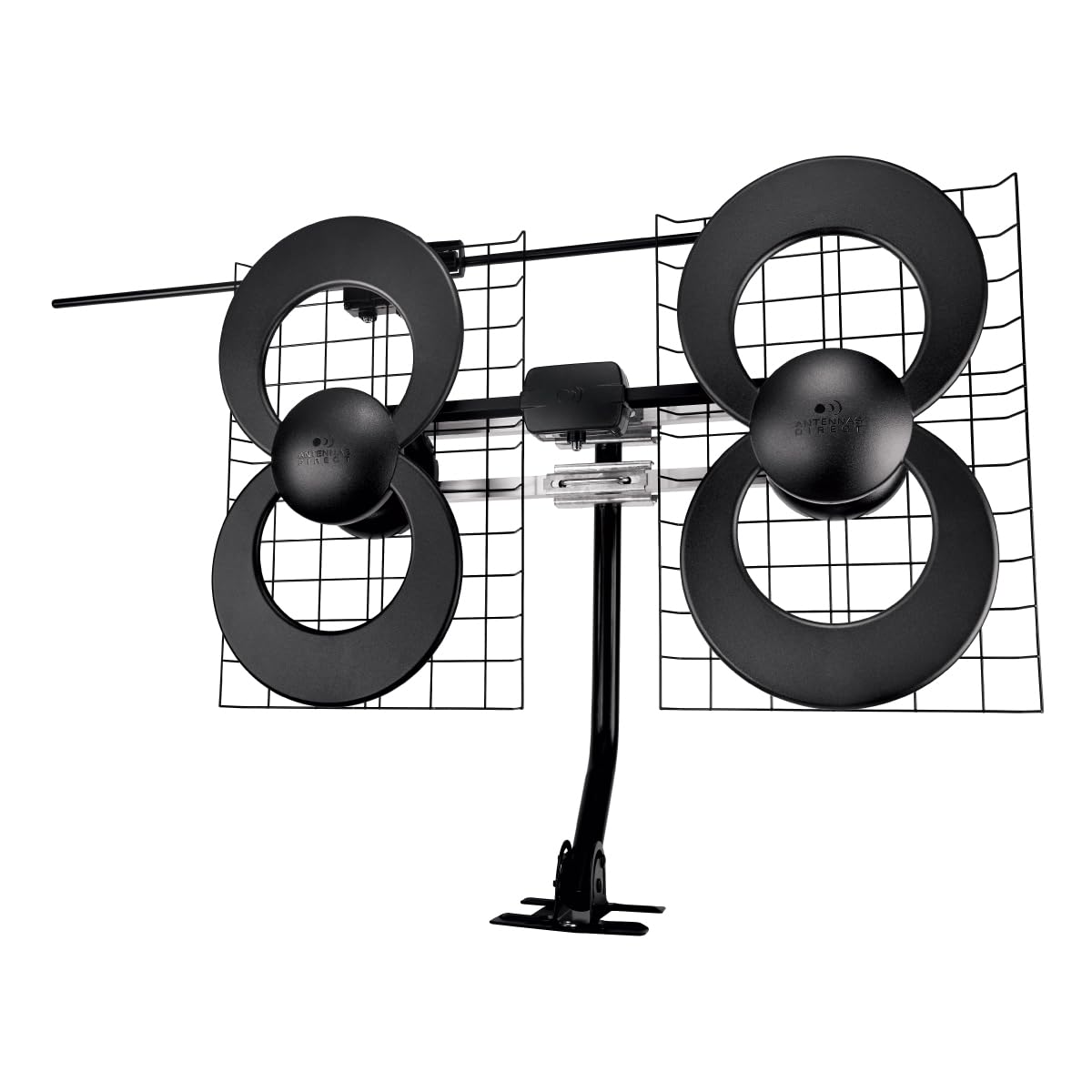
📡 Elevate your binge game with the antenna that’s miles ahead!
The Antennas Direct ClearStream 4V is a premium indoor/outdoor TV antenna engineered with four patented loops and advanced reflectors to deliver crystal-clear HDTV signals from over 70 miles away. Compatible with NEXTGEN TV, 4K, 8K UHD, and Full HD 1080p, it offers multi-directional reception and a durable design featuring a pivoting 20-inch mast for versatile installation. Ideal for professionals seeking a reliable, future-proof cord-cutting solution with interference-resistant performance and a lifetime manufacturer warranty.


| ASIN | B00SVNKT86 |
| Antenna | Television |
| AntennaDescription | Television |
| Best Sellers Rank | #32 in TV Antennas |
| Brand | Antennas Direct |
| Color | Black |
| Customer Reviews | 4.4 out of 5 stars 5,131 Reviews |
| Global Trade Identification Number | 00817848011118 |
| Impedance | 75 Ohms |
| Item Dimensions L x W x H | 27.8"L x 6"W x 17.4"H |
| Item Height | 17.4 inches |
| Item Weight | 4.1 Pounds |
| Manufacturer | Antennas Direct Inc. |
| Maximum Range | 70 Miles |
| Product Dimensions | 27.8"L x 6"W x 17.4"H |
| UPC | 817848011118 817848011354 |
| Unit Count | 1.0 Count |
| Warranty Description | Lifetime Manufacturer Warranty / 90-Day Manufacturer Accessory Warranty |
S**R
Great antenna, but make sure it is great for you first.
This antenna worked great for my location, and I was able to pick up 70 channels. I was able to mount in my attic and pick up the expected stations. In my area, the UHF channels are primarily in single direction, while the VHF stations are spread out. I was also lucky that the stations are located so I can point out the side of my house instead of through the roof. Rather than mounting the VHF antenna on the grid, I used some spare PVC pipe and zip ties to point it in a direction that worked best for the VHF stations. As you can see in the photo, I mounted the antenna upside down to get the more length out of the included coax between the the UHF and VHF antennas (I would not do this outside). All that said, this may not work in your situation. First check on the rabbitears.info website to see what stations and what power levels you have at your location. As noted, most of the UHF transmitters are in the same direction about 35 miles away, so it worked really well for me. The major stations have very strong signal strength/quality according to my TV tuner, and I do not see any drop outs. The website tells you the signal margin for the stations -- the lower the number, the less likely you are to pick it up. The lowest power station I picked up was 5dB signal margin, with the antenna pointed at it. There was another station listed in the same direction with the same signal margin, but I could not pick it up -- the rabbitears site, may be slightly out of date (but not as bad as TVfool). I may have been able to do better with a roof mount. If your area has poor signal margin and stations spread out in multiple directions, this may not be for you. If the signal margin is good, then you can use the direction on the website to help point the antenna towards the transmitters. (Note: I was looking at TVFool, but as of Sept 2022, the information in my area is out of date, with many stations listed on the wrong RF channel). With the stations, you'll want to note the difference between VHF (RF channel 2-13) and UHF (RF channel 14+), and the difference between RF channel (what the frequency the channel actually on) and display channel (what shows up on your TV). Your local NBC 8, might really be transmitting on RF channel 25. This is important for pointing your antennas and figuring out if this will work for you. The UHF channels use the round antennas with the grid, and the VHF antenna is the separate part with two horizontal elements. You can attach the VHF antenna to the grid behind the UHF antennas, or you can mount in separately. The VHF antenna will give the best reception perpendicular to the elements (both in front and out back). Depending on your location, you may need to point it between two transmitters to pick up both, or you may only be able to pick up one or the other. As far as stations go, you'll see a lot of reviews of people who get dozens of channels -- I picked up 70. However, you'll want to be realistic about what you are really getting. The major networks will typically transmit in HD and may look even better than the compressed version you get on cable. They will also have some extra sub-channels that are in standard definition. These can be hit or miss. Some of them look pretty good/sharp, while others are overly compressed and look like a blurry old VHS tape. This is on the TV station, not the transmitter -- with digital TV you either pick up the station or you don't (with a small part in between where it is blocky/jumpy). Beyond quality, there is content. Out of the 70 stations I pick up, many of them don't interest me personally -- I don't watch the 5 shopping channels I pick up. I also have several duplicate sub-channels, so those don't really count. So if you are thinking about cutting the cable cord, take a look through the websites of the channels you are likely to pick up and see if they are really of interest. You might really be left with PBS (plus a couple of subchannels), the major networks (ABC, NBC, CBS, FOX), then a bunch of things you may or may not watch depending on interest (ION, CW, ME-TV, GRIT, Bounce, Defy, COMET, LAFF, QVC, HSN).
Z**T
Quality made and a top performer
I've been playing with TV antennas for about 20 years and have always been skeptical of "new" designs. The physics of the broadcast haven't changed since Marconi figured it out 100 or so years ago. Even with the switch to ATSC from NTSC, the antenna physics are the same. That said, this antenna significantly changed my opinion on new vs old designs. We were using traditional styled antennas for years, but as the stations added more and more channels in the same frequency allotment, we started getting pixelation and stuttering. At first I thought it might be 5G interference since we had multiple new towners installed around us, but after playing with the 5G filters, the issues just kept showing up and getting worse as channels were added. I finally broke down and splurged on a Antennas Direct ClearStream 4V TV Antenna and mounted it on the exact same outside mast as our other antenna. Our problems immediately resolved. Our previous antenna was about $30 cheaper and it worked fine until they added five or six channels to each primary channel. Now we get them all rock solid. Even the lower power "off brand" local channels don't drop audio or pixelate anymore. In addition to the joy of more hours of mindless entertainment, I was thrilled to see how well the parts were made and finished. I've probably assembled and installed a few dozen different antennas for my own use and helping friends over the years. The overall quality and finish on this model are excellent. While my picture isn't super glamorous, you can tell the people who designed it had at least mounted a few antennas in their past. The open notch and longer slot on the brackets make assembling it on a ladder or hanging off a roof's ridge so much simpler. Really a nice touch. The elements mount with almost no effort and the combiners being rigid instead of sections of cable really make a slick and fast hookup. The wing nuts and bolts threaded without the normal twist and wiggle trying to get the initial bite on the threads. It was nice not to get junk hardware with a nice antenna. Great antenna at a reasonable price. I highly recommend it, especially if you are considering a slightly cheaper one. The quality and performance of this one are really top notch.
J**D
GREAT ANTENNA, DO YOUR HOMEWORK!!!
First a quick background. I cut the cord (cable & satellite) 10 years ago. At my old house, I put up a Winegard "Bat wing" antenna that you find on the roof of older RVs. It worked well and had a build in pre-amplifier & FM trap. It worked excellent at my old house mounted on my chimney in the open air about 30 feet up.. We moved 5 years ago and I purchased the same antenna because it worked so well and we moved only 4 miles away to our new house and I knew I could mount it higher up as well as the house has a higher elevation than my old house, so I figured I would have no problem at all. The Bat Wing Antenna didn't pull in my local NBC, CBS, or ABC. I know my local CBS is unique as it is broadcasting in the high band VHF band and they cannot transmit with much power due to the FCC not wanting them to bleed into the Detroit or Chicago markets where there is also a high VHF transmitter broadcasting on the same channel. I was OK to live without that channel, but to not get the ABC or NBC was not going to work for us. I purchased a Xtreme Signal HDB8X-NI 8-Bay VHF/UHF HDTV Bowtie Antenna. I put it on my roof and this antenna worked well and it would pull in all channels including my hard to get CBS if the conditions were right. I was fine living without that hard to pull in signal. I installed this antenna on my roof so it was nice and high up (about 35 feet) and in the open air. After a couple of wind storms I got frustrated because the wind would move the antenna around on the mast no matter how tight I tightened it down so it would get totally re-positioned and I would have to get on the roof and reposition the antenna. I ultimately wanted to get an antenna that I could put in my garage attic as I had easy access to it so it would not be exposed to the rough Michigan weather, and it would not be visible on the house (per wife's preference). I knew this would mean it would lose some signal because it would no longer be in the open air, and it would also be about 7 feet lower. I researched a bunch of antennas and decided to roll the dice on this Clear Stream 4V as it had great reviews from an antenna professional that has a YouTube channel. I already had a Channel Master CM-7778 Pre-amplifier which includes an FM Trap. I mounted the antenna in the attic, put the channel master pre-amp in line and mounted it on the mast as well. Lastly, I and ran new RG6 coax to my utility room from the antenna where the coax to the televisions run. Once I did a channel scan on my two televisions, wow! I was able to get all channels except that pesky CBS station by me that is notoriously hard for most folks to pull in unless you live within 20 miles from the broadcast tower. But... it was coming in slightly which was an improvement. I checked the signal meter on all the other channels and it improved greatly over my other antennas. A simple reposition of the antenna more towards the CBS broadcast tower brought the signal up to a stable signal. So, the bottom line is that this antenna is no joke! I had two other antennas mounted in the open air on my roof, and this Clear Stream antenna pulled in more channels while being mounted in my attic about 7 feet lower than my roof mounted antennas. I live about 40 miles from the farthest broadcast tower and most are within 35 miles, but again, my local CBS transmits at a lower power than what is normal so its hard to pull that in for anyone in my area and I am able to pull that in! When I say do your homework, go to antennaweb.org and understand your local area. This website will tell you how far you are from your local broadcast towers as what stations are broadcasting on UHF and VHF bands. This will help you to understand what antenna to get, and what direction to point it in. I can't recommend a pre-amplifier enough. I live less than a mile from a FM radio stations broadcast tower and FM broadcasts interfere with VHF signals, so I had to make sure to get a pre-amp with an FM trap. The FM trap filters out those FM signals in the pre-amplifier. Also, make sure to use good Coax. A lot of folks use cheap Coax which is not shielded well. Use RG6 coax for all your coax runs from the antenna to the Televisions in your house. This will make sure the signal is shielded well in the coax so it can be carried the distance it needs from the antenna to the splitter and to your television. Speaking of splitter, I have two televisions in my house so only need a two way splitter. Splitters weaken the signal a little for each split. Do your home work on signal loss in these cases. If you have more than two televisions you could need another amplifier to make sure the signal can make it to your telvisions.
J**L
A nice, easily installed antenna for local networks
Works good for getting local nbc and fox channels plus a handful of others. The kit i includes a splitter that didn't work for me. I was losing signal every 10 sec or so until i removed the splitter and then the signal was strong and steady.
D**N
Buy once, cry once and don't mess with the cheaper, smaller ones
Instructions are pretty clear and well-illustrated, assembly was fairly simple (only needed a Phillips screwdriver and a pair of pliers), and reception is ... WOW. Currently able to pick up 129 channels over the air now, coming in from both Phoenix and Tucson. Mounted outdoors on an existing antenna pole on top of my house, pointed at South Mountain with a clear, direct line-of-sight view from about 35 miles away. Not much else to say except, if you're looking at cheaper and smaller antennas to save money, don't expect the same amount of channels or quality of signal reception. The smaller versions of the same brand or others that only have the one pair of "hoops" on the antenna and a single reflector are okay, but this one outdoes even those by a significant margin. I still have one of those single-reflector/single pair of hoops style antennas installed for another TV in the house (been up there for 10 years), and it works well, but this one gets a LOT more channels, and the same channels the older antenna is able to pick up don't come in with as clear and solid a signal (lots of signal dropout/artifacts on the screen on some channels). In summary, buy once and cry once over the price tag, but at least you won't need to worry about poor reception and having to spend more money later on a bigger/better antenna. This one's about as good as it gets for a non-amplified antenna.
J**E
RESEARCHED EXTENSIVELY: READ THIS if you have HEAVY TREE COVER, HIGH PIXELATION or one antenna for MULTIPLE HDTVs!
I installed this outdoor antenna with amazing results! Assembly of the antenna was easy, but of course it is dependent on your handiness. Before with inside antennas of every possible type and configuration, I could detect only 20 channels and probably watch 4 (at most) without constant major pixelation. Watching sports became frustrating, and was the last straw to motivate me to get the best outdoor antenna I could find. I have heavy tree cover, and reception is better in the winter when the leaves are off the trees. I live about 35 miles from the TV transmitters too. After installation on the roof pointed to the right direction, I got 60 channels and all of the channels came in clearly! There are still tree tops in the way, but I can now watch football, baseball, and hockey from the local stations (when they are broadcast), with no freezes or pixelation at all! Some Notes: 1. It was important to use the "Antennas Direct transmitter locator" website to get the direction of the transmitters, and then line it up exactly with the digital compass on iPhone (bluetooth must be on to get the highest accuracy). 2. I also learned a lot about antennas and installation. Watching some YouTube videos, it was recommended to use conductive grease for all of the outdoor coax cable connections, to prevent moisture and provide longer life at the connections. This tube of conductive grease was less than $5, so it was well worth applying it to every connection outside. 3. The cheap cable splitters significantly reduce antenna signal strength and just don't work for antennas! When I placed the antenna, I went through a door to directly connect the cable to the TV to get 60 channels. After confirming direction and that the antenna worked as advertised, I connected to the inside of the house using the existing coax cables and splitters that were already installed. I lost significant antenna signal from even just one two-way splitter. Wow, this was a revelation to me, but then realized that these cheap cable splitters work better for cable TV than for antennas! I went from 60 channels down to 30, and the two stations I really wanted disappeared again. So if this antenna is going to multiple televisions or the coax cable to the TV is longer than 50 feet (mine was 125 feet), it is highly recommended to get the Channel Master amplified signal splitter (2-, 4-, or 8-way amplified splitter). I researched this too, and found that Channel Master had high ratings and good customer service. 4. I got the antenna with both the UHF and VHF antenna. The VHF antenna is the bar across the top, and for $50 less you can just get the UHF antenna. I'm not sure which stations get picked up by the VHF antenna (however I do have some just audio radio stations on TV now) but if the model number has the "V" in it, it probably has the VHF antenna (just look for the dark bar across the top of the figure "8" antennas). If the "V" is missing from the model number, it probably does not have the VHF antenna. That's why you may see some of these antennas that are $50 less expensive than others. This took some research to find this answer too, but I've documented it here to make it easier for others. It's clear viewing now on every channel! I'm really happy with this antenna, and after the initial investment, I'll save at least $100+ per month from cable TV. I can't say you'll get as good of results as I did, but it has greatly improved my viewing pleasure!
S**C
Good Compact Antenna
Update 3 May 2025: The Fox local channel 45 is in and out, not reliable. This is a change from previous experience. Reception of more distant channels is better with cloud cover. Channel 32 Howard University is more frequently coming in well. Channel 49 Lancaster (Lighthouse christian channel) is received at times with clouds or very late night. Channel 2 is pixelated at times, along with its subchannels. Channel Master filters (5G and FM) either singularly or both installed did not make a difference, so the problems are not electronic interference related. Channel 45 is received if a 2nd antenna is placed in the window at the ground floor level (go figure?). It could be we have multi-path interference in the attic antenna. Still overall a solution to the high priced cable channels but limited content. Savings are about $150/month if you include the FIOS internet bill. Too bad ATSC3 is not working out, it could solve some possible multi-path issues. Update 2 June 2023: Bought a second antenna. The intent is to receive stations in different directions using 2 antennas. Lengths of all coaxial cables were matched. Placing #2 perpendicular to #1 caused stations to drop out, assumed to be multi-path issues. Clearing obstacles in the attic helped reception for UHF channels, VHF is less sensitive to line of sight issues such as obstacles. Placing the antennas along the same line of sight but antiparallel did not create station dropouts, but did not pick up any additional stations with the possible exception of Channel 10 Philadelphia at 68 miles (so far just a hint). Channel 10 is approximately opposite in direction to the Baltimore towers but much further. When the 2nd antenna was perpendicular pointing SE, a few Salisbury, Maryland low power stations occasionally appeared. No Dover, Delaware stations showed up. Channel 7 DC at 56 miles will appear on occasion, as well as on occasion Channel 32 (Howard University). The usable range of this antenna in the attic (no insulation above the floor, siding and shingle roof) is about 40 miles but dependent on season (leaves), weather conditions, time of day, and day of the week. The variation is only evident on the channels beyond the Baltimore stations, so at 22 miles the antenna is now stable in the attic at all times so far for both VHF and UHF stations that are in the general direction of the antenna pointing. Update June 2023: With the trees now having leaves, the reception has been degraded a bit. Baltimore 2-1 is sometimes pixelated now. This is a UHF station, Baltimore 11-1 and 13-1 are VHF and do well, despite the single dipole attachment this antenna comes with. I may try to couple the antenna with a multi-dipole larger array. This antenna focuses on UHF and throws in a single dipole for VHF. UHF does need line of sight, so despite the 4 UHF loops of this antenna and the attenuation of the attic wall the UHF presents problems. I ordered another to place at 90 degrees from the first in the attic, will see how it goes with multi-path interference. The Lancaster channel 8-1 is usually not watchable now, but do not need it. I will try to lock in the Daystar channel, which is approximately perpendicular direction from the Baltimore towers. There is also Dover Delaware, but that will be a long shot. Leaves do make a difference. This antenna is fairly compact and relatively easy to install indoors in an attic. I attached it directly to a 1x5 which was then attached horizontally to 2x4 truss segments in the attic without a mast. I attached the VHS dipole to the cage as suggested. The house faces southeast, so the antenna ended up facing southwest in the direction of the primary Baltimore stations. In Bel Air, we are about 22 miles from that tower. The signal is good and stable for the big 4 stations and MPT 67. Lancaster PA 8 is ok but slightly unstable. According to rabbitears.info, that tower is about 40 miles. This is a bi-directional antenna, but Lancaster is not quite opposite the Baltimore tower direction. See rabbitears.info for stations and their strengths from Bel Air. The range of this antenna in the attic is about 40 miles for our location. Not sure this is fully weatherproof and rigid for outdoor use, given some of the steel and not so tightly secured wing nuts and paint that easily scraped off the cage. Overall, the stations available look very good so far, but we shall see when rain comes or when trees regain leaves this spring. We are at about 350 feet above sea level on relatively high ground for the local area. A list of available (free!) stations: Baltimore 2-1 WMAR (ABC), Grit (2-2), Bounce (2-3), Mystery (2-4), CourtTV (2-5), Newsy (2-6) 11-1 WBAL (NBC), MeTV (11-2), Story (11-3), Grio (11-4), QVC (11-5) 13-1 WJZ (CBS), StartTV (13-2), Dabl (13-3), FaveTV (13-4) 24-1 WUTB 45-1 WBFF (Fox), 45-2 (MyTV), 45-4 (Charge) 54-1 WNUV (CW), Antenna (54-2), Comet (54-3), Stadium (54-4), WNUV (54-11) Lancaster 8-1 WGAL (NBC), MeTV (8-2), Story (8-4), TruReal (8-5), QVC (8-6) Havre De Grace 49-1 WWDD (Daystar) Christian programming, shows up on channel 24-1 (24-1 WUTB is also picked up but never watched, the Samsung TV separates them despite the same channel number) Owings Mills 67-1 (MPT), 67-2 (MPT2), 67-3 (MPT Kids), 67-4 (NHK World from Japan) 22-1 MPT (Annapolis) a bit unstable but we have MPT 67 with a better signal Some of the channels are not very good but MeTV and AntennaTV are ok.
O**W
Best small antenna I’ve tried.
For me, this antenna worked better than the long range digital, motorized antenna I was using. I get perfect reception on 4 channels from 60 miles away, day or night. . I also get good reception at night from 11 other channels I couldn’t get before. I used a small indoor amplifier with this antenna.
Trustpilot
2 months ago
5 days ago