
DOWNLOAD THE APP


Customer Services
Copyright © 2025 Desertcart Holdings Limited
DOWNLOAD THE APP
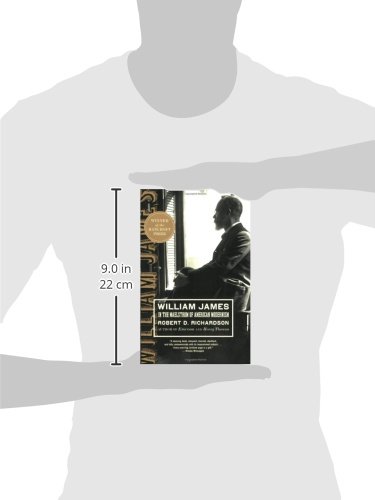
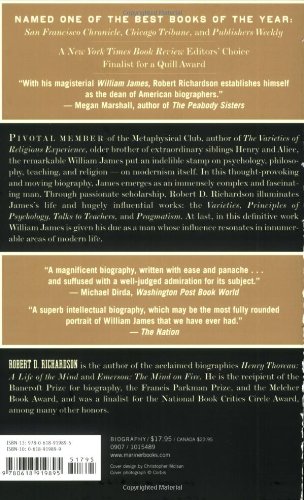

William James: In the Maelstrom of American Modernism [Richardson, Robert D.] on desertcart.com. *FREE* shipping on qualifying offers. William James: In the Maelstrom of American Modernism Review: The life and thought of an American original - Some potential readers may be put off by the subtitle of this book, “In the Maelstrom of American Modernism.” I suspect James himself might find it pretentious. But the subtitle is the only weakness of this beautifully written biography. Robert Richardson captures the mind and heart of William James, the man who more than anyone opened the door to what is called “pragmatism.” You may or may not agree with James’s philosophical perspective but this book will give you a portrait of an unforgettable human being. How much background in philosophy does a reader need for this book? A little but not much. Richardson lays out as clearly as anyone can the positions that James accepts or does not accept. What strikes the reader constantly in the book is James’s openness to “experience,” including experiences many educated people today would consider illusions or emotional assertions taken as facts. James had (and has) many good critics. The problem of conceptualizing our experience which, as James notes, leads people from mystical experiences to culture-dominated dogmatic religions, also applies to one’s personal judgment of truth. A sudden rush of positive insight or total oneness may not be as self-evidently true as we might like. Are such experiences completely self-verifying? Many say James is far too lenient in what he allows as “evidence.” But what I have always admired about William James, and what comes out clearly throughout his life and in this book, is his ability to push us past our preset ideas and our human arrogance to where we crack open our concepts to at least try to be open to new or unorthodox experiences. In the metaphor James uses more than once, we may well be like our pet dog who wanders around a library without the vaguest idea of the larger world it is in and only the most minimal and most limited idea of the world outside its consciousness. We may be only pecking away at the margins of what the universe holds and human consciousness could well be analogous to the dog’s when it comes to what is out there. Still, our best developed and best functioning concepts are all we have in practice. As James says in so many ways, these are stepping stones for our understanding of ourselves and the universe. We can stand on them – for a while – as long as they are productive and bear themselves out in practice. This is a mind-opening and heartfelt tribute to James’s life. His relationship to his famous brother Henry is laid out in detail as well as his marriage to Alice Gibbens. The English is clear and well-organized with excellent chapter divisions. The transitions are smooth and this is especially important when mixing the life and the ideas of an academic figure. I recommend this biography in the strongest terms as one of the finest examples around of engaging the reader in the life story of an original American thinker. Review: For A Popular Audience, Too - I need not repeat the summaries set forth below by other reviewers, since these explain both Richardson's method -- to tell the life story through the work -- and the essentials of James' theories. What I will say is that, even if you have no background in philosophy or psychology, you should read this brilliant, passionate biography. James wrote for a popular as well as a professional audience; he was open and curious to all experience, and wished to be inclusive rather than exclusive in disseminating his ideas. Richardson is clear and succinct in explaining James theories -- often in the man's own, crisp, evocative language and clarifying analogies. Moreover, the concepts that James developed have in many cases become part of our popular vocabulary, including through organizations such as Alcoholics Anonymous, which Richardson reports took inspiration from James' Gifford lectures, published in the U.S. as "The Varieties of Religious Experience." I had not read James for many years but, since reading this biography, have purchased a collection of his writings and am re-reading many of his works. You will come away from "In the Maelstrom of American Modernism" with a better understanding of both American values and ideals, and the history of U.S. higher education. Most importantly, however, you will come away with enormous admiration for the radiant personality that was William James, or as Richardson exclaims (using italics, not caps) at the end of this great work, for "the SPIRIT the man." When I finished reading, I not only wanted to read William James; I was sorry that I had not known him or had him as a teacher. That's how good this book is -- for every reader.
| Best Sellers Rank | #973,340 in Books ( See Top 100 in Books ) #474 in Philosopher Biographies |
| Customer Reviews | 4.6 4.6 out of 5 stars (164) |
| Dimensions | 6.25 x 1.75 x 9 inches |
| Edition | Reprint |
| ISBN-10 | 0618919899 |
| ISBN-13 | 978-0618919895 |
| Item Weight | 1.68 pounds |
| Language | English |
| Print length | 622 pages |
| Publication date | January 1, 2007 |
| Publisher | Mariner Books |
D**N
The life and thought of an American original
Some potential readers may be put off by the subtitle of this book, “In the Maelstrom of American Modernism.” I suspect James himself might find it pretentious. But the subtitle is the only weakness of this beautifully written biography. Robert Richardson captures the mind and heart of William James, the man who more than anyone opened the door to what is called “pragmatism.” You may or may not agree with James’s philosophical perspective but this book will give you a portrait of an unforgettable human being. How much background in philosophy does a reader need for this book? A little but not much. Richardson lays out as clearly as anyone can the positions that James accepts or does not accept. What strikes the reader constantly in the book is James’s openness to “experience,” including experiences many educated people today would consider illusions or emotional assertions taken as facts. James had (and has) many good critics. The problem of conceptualizing our experience which, as James notes, leads people from mystical experiences to culture-dominated dogmatic religions, also applies to one’s personal judgment of truth. A sudden rush of positive insight or total oneness may not be as self-evidently true as we might like. Are such experiences completely self-verifying? Many say James is far too lenient in what he allows as “evidence.” But what I have always admired about William James, and what comes out clearly throughout his life and in this book, is his ability to push us past our preset ideas and our human arrogance to where we crack open our concepts to at least try to be open to new or unorthodox experiences. In the metaphor James uses more than once, we may well be like our pet dog who wanders around a library without the vaguest idea of the larger world it is in and only the most minimal and most limited idea of the world outside its consciousness. We may be only pecking away at the margins of what the universe holds and human consciousness could well be analogous to the dog’s when it comes to what is out there. Still, our best developed and best functioning concepts are all we have in practice. As James says in so many ways, these are stepping stones for our understanding of ourselves and the universe. We can stand on them – for a while – as long as they are productive and bear themselves out in practice. This is a mind-opening and heartfelt tribute to James’s life. His relationship to his famous brother Henry is laid out in detail as well as his marriage to Alice Gibbens. The English is clear and well-organized with excellent chapter divisions. The transitions are smooth and this is especially important when mixing the life and the ideas of an academic figure. I recommend this biography in the strongest terms as one of the finest examples around of engaging the reader in the life story of an original American thinker.
R**C
For A Popular Audience, Too
I need not repeat the summaries set forth below by other reviewers, since these explain both Richardson's method -- to tell the life story through the work -- and the essentials of James' theories. What I will say is that, even if you have no background in philosophy or psychology, you should read this brilliant, passionate biography. James wrote for a popular as well as a professional audience; he was open and curious to all experience, and wished to be inclusive rather than exclusive in disseminating his ideas. Richardson is clear and succinct in explaining James theories -- often in the man's own, crisp, evocative language and clarifying analogies. Moreover, the concepts that James developed have in many cases become part of our popular vocabulary, including through organizations such as Alcoholics Anonymous, which Richardson reports took inspiration from James' Gifford lectures, published in the U.S. as "The Varieties of Religious Experience." I had not read James for many years but, since reading this biography, have purchased a collection of his writings and am re-reading many of his works. You will come away from "In the Maelstrom of American Modernism" with a better understanding of both American values and ideals, and the history of U.S. higher education. Most importantly, however, you will come away with enormous admiration for the radiant personality that was William James, or as Richardson exclaims (using italics, not caps) at the end of this great work, for "the SPIRIT the man." When I finished reading, I not only wanted to read William James; I was sorry that I had not known him or had him as a teacher. That's how good this book is -- for every reader.
B**.
Excellent for Scholars, Less Interest for Other Readers
This book will resonate perfectly with scholars trained in philosophy and psychology. Biographer Richardson traces William James' evolving thought patterns with a thoroughness no writer could exceed. For the average reader, though, I suggest the book will have value mostly because of the interesting lives of William James and his novelist brother Henry. Certainly I had been unaware of William's lifelong health problems. Too, the book provides fascinating tidbits about his courtship with his eventual wife Alice. Note his highly formal writing style in a love letter to her: "My duty is to win your hand if I can. . .What I beg of you now is that you should let me know categorically whether any absolute irrevocable obstacle already exist to that consummation." Another highlight for me--William James' rejection of "copied religion." He has no use for the person whose "religion has been made for him by others, communicated to him by tradition, determined to fixed forms by imitation and retained by habit." James noted that "the founders of every church owed their power originally to the fact of their direct personal communion with the divine." I enjoyed the book as a life story well told. The Complete Communicator: Change Your Communication-change Your Life!
D**S
Extraordinary man, complex and inspiring, a hero for any age. The book does justice as far as a book can.
B**N
A very rich and detailed book on William James, his family and his background, yet a delight to read. Very helpful for my research. The book came in time and as described.
T**E
Who knew one of the fathers of psychology could be so relatable?
Trustpilot
1 week ago
1 day ago