📸 Elevate your Nikon game with the lens that sees like you do!
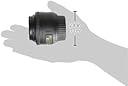
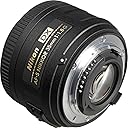
The Nikon AF-S DX NIKKOR 35mm f/1.8G is a compact, lightweight prime lens designed for Nikon DX-format DSLRs. Featuring a fast f/1.8 aperture, silent wave motor autofocus, and a 35mm focal length that approximates the natural human field of view, it excels in low-light conditions and delivers sharp images with beautiful bokeh. Its durable build includes a non-rotating filter mount compatible with 52mm filters, making it an essential, versatile lens for everyday photography and creative expression.


| ASIN | B001S2PPT0 |
| Batteries | 1 Lithium Ion batteries required. |
| Best Sellers Rank | #154 in SLR Camera Lenses |
| Customer Reviews | 4.7 4.7 out of 5 stars (15,829) |
| Date First Available | February 9, 2009 |
| Is Discontinued By Manufacturer | No |
| Item Weight | 7.1 ounces |
| Item model number | 2183 |
| Manufacturer | Nikon |
| Product Dimensions | 2.09 x 2.76 x 2.76 inches |
P**R
EBay the kit lens and buy this before you put batteries in your new camera
What a great price for a fast, prime lens that you'll use every day. I'm a nube to photography (good photography) and have caught the bug. I've got a Nikon D5200 and primarily take pictures of family and kids sporting events. The big zoom goes to the soccer games with us, but for almost everything else I use this little gem. With a max aperture of 1.8 you'll rarely need a flash for most of life's events indoors or out. The sharpness of the pictures I've taken with this is so good that you can really crop something down if you want to "zoom" in using Photoshop or Aperture with no graininess or degredation. At the risk of embarrassing myself to the more savvy photo enthusiasts I will try and explain why this and not the 18-55mm kit lens that you got with your camera. No it doesn't zoom (that's the prime lens part), but you'll find yourself in the 35mm range on that 18-55mm lens most times anyway. They say a 35mm lens is most representative of what the eye sees anyway. What it does do is let in a lot of light, a lot more than the kit lens does. This gives you a couple benefits first of which is speed (the fast lens or fast glass part) which means less blur on things moving and stationary. It also means that you can dial down your ISO settings. Higher ISO settings tend to add noise to the picture which gives you that pixelated look when you zoom in and crop a picture. Thirdly is something us point-and-shooters have never gotten to appreciate called depth of field. This lens will let you take those great looking photos where your subject is in perfect focus and the background is pleasantly blurred drawing your attention to what you intended the view to see. You can adjust your aperture setting to have a deep depth of field where everything is in focus, but you'll need a fast lens like the 1.8 to get a really striking shallow depth of field photo like the pros. For under $200 (maybe under $100 if you get a good price for your kit lens on Ebay), this is the single best thing you can buy to take great photos. You can pay more money for better cameras with larger sensors and more bells and whistles, but so far it appears to me that you're better off taking pictures with a great lens on a good camera, than a good lens on a great camera.
J**N
One truly excellent Nikon DX "normal" lens...
OK, just what is a "normal" lens? There are many definitions and points of view on this topic, and they go back years, but for argument's sake, let's just say that this Nikon 35mm f/1.8G AF-S DX Lens delivers a picture angle approximating the classic normal angle of view of a 50mm lens on a 35mm film camera or on Nikon FX-format DSLR or a 35mm film camera. That being said, this normal DX-format lens delivers surprisingly good results in a very affordable package. My very first Nikon SLR was a used Nikkormat FTn, bought when I was a college student. It came with a Nikkor 28mm f/2.8 lens, and I started immediately adding new Nikkor lenses, such as the classic 105mm f/2.5 lens, a 35mm f/2.0, a 24mm f/2.8 and others, but it took a couple of years for me to pick up a "normal" lens, a used Nikkor-S 50mm, f/1.4 lens. This was purchased at a Saturday yard sale, and from the first moment that I saw the results, I wondered why it had taken me so long. It was sharp when stopped down to about F/2.0, and it was perfect for lower light situations. I am a proponent of normal lenses, even though Nikon and others have been pushing the concept of using basic zooms as "kit lenses" for the last few years. I have no complaints about the overall versatility of my 18-55mm f/3.5-5.6G AF-S DX VR Nikkor Zoom Lens , which came standard with one of my cameras. But this new 35mm f/1.8G AF-S DX Nikkor lens really shines when it comes to sharpness and low-light capabilities... enough so that it's the one that stays on my camera most of the time. Pros: * Extremely affordable Nikkor prime lens for Nikon AF-S cameras * Perfect for low-light conditions, travel, & general photography * Uses familiar 52mm filters that Nikon has used for so many lenses * HB-46 bayonet lens hood comes standard * Excellent edge-to-edge sharpness * Very good bokeh for selective focus * Great color Cons: * Some color fringing and chromatic aberration when wide open at f/1.8 * A bit of barrel distortion First Impressions: Made some notes when I first received this lens some month back. It came boxed in typical Nikon fashion, and when opened one finds that the lens has a lightweight but solid feel. The construction is largely plastic, but has a metal mount. It's also nicely balanced to the rear, to the lens mount itself. The lens focuses internally by moving only the rear elements, and the filter mount and front elements don't move at all. It comes packaged with the following: * HB-46 Bayonet Lens Hood * LC-52 Snap-On Front Lens Cap * LF-1 Rear Lens Cap * CL-0913 Soft Case In Use: One of the first things that I noticed was just how well balanced this lens felt. It's lightweight, but with the bulk of its weight toward the lens mount, the feel was quite good. The focus switch on the lens barrel has two choices: M/A (manual/automatic) or M (manual). Found that if left in the M/A position it worked just fine either way. The HB-46 lens hood goes on easily in bayonet fashion, and can be reversed easily when it's time to put the camera away. Fortunately this lens uses the `standardized' Nikon s 52mm filters, helpful if you already have an investment in them. The filter ring is stationary; it doesn't rotate, and there was no vignetting problem with two filters stacked, such as the UV and a polarizer. The low-light performance of this lens is good, though at f/1.8 there is a bit of softness, which is to be expected. At f/2.0 there's not much difference, but at f/2.8 the image is obviously improved, with increased sharpness and contrast, and the details are more defined in the corners. At f/4.0 there is more sharpness, and at f/5.6, there is a slight lessening of contrast, but the corner details are slightly better. At f/8.0, the quality is still quite good, and the depth of field is excellent, but there's a decline into some diffraction, with a bit of lower contrast and somewhat reduced sharpness and contrast. Have learned that when shooting in aperture priority mode, it's best to leave it at a default between f/4 and f/5.6, and go from there. This Nikkor lens does produce beautiful colors and contrast, and it focuses extremely fast even under low light conditions. Its 7-blade rounded diaphragm helps to produces a nice bokeh effect. And the close focusing goes down to about twelve inches, so you can get very creative without having to fiddle around. Additional Thoughts: Just because this lens is so reasonably priced is no reason to put a cheap and possibly inferior filter on it. I fortunately have a small supply of the older Nikon 52mm L37C UV haze filters that have been in use for years, but the Nikon 52mm Screw-on NC Filter is its multi-coated replacement. It's a protective filter that also reduces glare for outdoor shooting. If you explore here, you'll find others, such as some from Hoya, Sigma and others. It's a subjective choice, but be sure to get a good one. If you're looking for a specialized portrait lens, forget this one. The 50mm f/1.8G AF-S Nikkor Lens lens has a field of view of a 75mm on DX-series bodies, and it has a fast maximum aperture. It's excellent in low lighting situations and great for producing images with beautiful bokeh. The 85mm f/1.8G AF-S Nikkor Lens is more costly, but when mounted on a DX-format DSLR, it has an effective field of view of 127mm. Summary: If you own a DX-format Nikon DSLR this lens is a great choice. It's compact, very lightweight, balances beautifully on your body, and is a true joy to use. It's an excellent complement to any zoom, and one that most will find being used in preference for general shooting, along with being a perfect choice for low-light situations. It doesn't take long to appreciate the way you can handle your camera in comparison with heavier, longer zooms. This Nikon 35mm f/1.8G AF-S DX lens is quite affordable and a surprisingly good value, and is highly recommended as a 5-star choice. 5/16/2012
N**L
I gave 1 star for "image stabilization" as this lens does not have that feature. TBH you don't need it on a lens like this. If your pictures are blurry, you need to look at your camera technique! So what's good about it? The picture quality from this lens is comparable to much more expensive lenses. It is significantly better than most kit lenses that come with DX nikon cameras. It has very low distortion and has a field of view comparable to what you see, so perfect for reportage, travel, landscapes etc. It's also really fast - i.e. it goes down to f1.8 which means you can shoot with a lower ISO and still have a good shutter speed in lower lighting. It also means you can shoot really professional looking portraits with a lovely blurry background or beautiful bokeh if you have christmas lights or such like about 20 feet or more behind the subject. The final comment is that this lens is very small and light, and is now my preferred 'default' lens if i'm out and about with the camera without a specific shot in mind. Being a prime lens, you can't zoom in or out, so you need to position yourself to get the best shot, and that encourages more creative photography I think. Great little lens for the money!
D**X
Nikon 35mm AF-S DX lens Once upon a time in the days of film ALL film SLR cameras came with a “fast” 50mm lens – usually f1.8 ( or more rarely f1.4) giving the same angle of view as human vision. Wide aperture allowed slower, sharper film and the ability to focus closely and provide shallow “depth of focus” to highlight the subject. Zoom lenses were expensive and less sharp than “prime” or single focal length lenses. Most modern digital (D)SLR’s now come with excellent zooms but only moderate apertures across the zoom range ( except for megabucks f2.8 professional lenses) Whilst the zoom lens gives great flexibility in framing a subject it is easy to become sloppy by not moving to fill the frame with this human vision perspective. This “standard” perspective lens makes you think more about your compositions (but also works well as simple point and shoots) This 35mm (52.5mm equivalent on a DX sensor like my Nikon D3100/D5100 – or modern equivalents) dual type autofocus lens is a total cracker .Very lightweight (yet sturdy) it is nice to get back to a “standard” lens again. Even better, when creating movies (or getting “differential focus on stills), this fast lens allows both a shallow focus and enhances the sensitivity of the camera at full aperture at lower. ISO values (reducing electronic noise).It also covers a full aperture range from f1.8 – f22 The f1.8 speed allows many photographs to be taken indoors (or dull outdoors) without flash. - Or video without additional lighting. The standard 18-55mm zoom lens is only f4 at the 35mm DX ( 50mm standard) so there is at least 2 stops gain and a corresponding reduction in shutter speed with this prime lens - i.e. faster shutter speeds can be used and sharper pictures result. The ability to tweak the manual focus whilst still in auto is great as any off centre subject missed by the auto focussing can be rapidly corrected The lens takes a 52mm diameter filter – either as protection, minor colour correction or effect filters. Relatively cheap close up lenses also seem to work extremely well giving a genuine super macro lens with minimal softness at the edges of the image NOTE – you could get the cheaper non DX, manual focus f1.8 Nikkor but this will be 75mm equivalent (and possibly of interest as a portrait lens although a 105mm prime lens is usually used for this.)
A**A
Bra för sitt pris, enkelt att ta fina bilder i vardagsmiljöer.
K**A
Voulant s'entraîner avec objectif fixe pour portrait et prise en faible luminosité c'est un bon achat au vu de son prix.
S**N
Pour cet ordre de prix, voilà un super objectif qui change vraiment de ceux livré avec les appareils reflex Nikon, je pense qu'il ne décevra personne: 35 mm (soit 50 mm en équivalent 24X36) c'est très bien. J'ai préféré prendre ce modèle plutôt que le 50 mm (équivalent 75 mm en 24X36) qui à mon avis peut être un peu trop "serrant" pour les photos en intérieur. Les photos prises à grande ouverture en faible luminosité ont vraiment du "cachet", arrière plan magnifiquement flouté, contraste important entre les zones éclairées et les zones sombres qui sont bien noires. Attention néanmoins: La grande ouverture autorise des photos en intérieur sans flash, oui MAIS: le temps de pose dans ce cas peut être relativement long (plus de 1/40è de s) ce qui induit tout de même un risque de flou de bougé. De plus la profondeur de champ à grande ouverture étant extrêmement réduite, il faut faire très attention à l'endroit choisi pour la mise au point. Un exemple sur un visage, vous visez l'oreille et la face est floue... A savoir quand même, ce n'est pas l'objectif qui fera le photographe... Autre bémol, sur le mien le pare-soleil ne se verrouille pas franchement, comme sur mes autres objectifs Nikon.
Trustpilot
5 days ago
4 days ago