🎶 Elevate your sound game with Yamaha’s powerhouse precision!
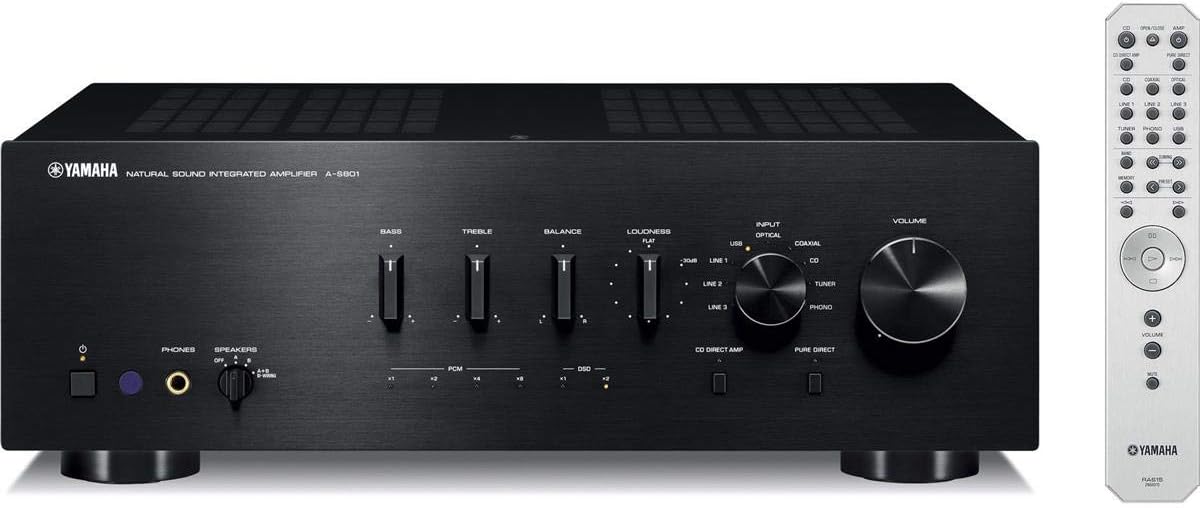
The Yamaha A-S801BL is a high-performance integrated stereo amplifier delivering 100 watts per channel with ultra-low distortion. It features advanced ToP-ART circuitry, a USB DAC supporting high-resolution audio formats including DSD and PCM, and gold-plated analog and digital inputs for superior connectivity. Designed with premium components like a custom power transformer and large block capacitors, it offers natural, powerful sound with excellent detail and dynamic range, making it a top choice for discerning audiophiles and professionals.

| Best Sellers Rank | #18,297 in Electronics ( See Top 100 in Electronics ) #78 in Audio Component Amplifiers |
| Customer Reviews | 4.5 out of 5 stars 1,207 Reviews |
A**Y
The Yamaha A-S801SL is a fantastic integrated stereo amplifier
The Yamaha A-S801SL is a fantastic integrated stereo amplifier. I am not exaggerating when I say that you will need to spend 2-3x more to get something better due to Hi-Fi diminishing returns. Clean, powerful, pretty linear/neutral, excellent sound-stage and separation, with good detail retrieval. Plenty of input options, the silver unit looks great, and has a nice build quality. The real gem here is the USB connection for a PC or streamer. I've read some of the other reviews about low loudness/SPL and lack of bass. I can assure you that the A-S801 has plenty of power (the power ratings are conservative, it's actually about 105 watts/channel into 8-ohms, and 150+ into 4-ohms) and it has tight/punchy bass, so I have a few thoughts... 1. Make sure that your streamer or source device is at 100% output volume. 2. Double-check your speaker wire/connection polarities and subwoofer phase if you're using a sub. 3. Many people are used to compressed music and over-emphasized, bloated bass. Use CD-quality or higher music and then allow some time to get used to how music should sound. Overall, I'm extremely happy that I got this unit for $799 during Black Friday, it's a steal at that price. I'm going back and playing my CD collection as well as streaming hi-res music from Qobuz via my Wiim Ultra, which is a superb combination. Curiously, USPS was chosen for the last mile of delivery, and that was a disaster. The package was dropped off by Amazon on-time with USPS in my city and was to be delivered later that day. But it was not delivered. Three days elapsed and USPS sent it to another city, then they sent it back to Denver (from which it had already transited), at which point it seemed like it was lost, before it found its way back to my city a second time. I cannot say anything positive for USPS. Amazon customer service was great though.
M**.
A Great Integrated Amplifier
This is a superb integrated amplifier, unfortunately the rec out selector was removed, still is of a high quality and of excellent performance. Supernatural sound and a lot of power that makes your neighbors complain. It handles very well your analog and digital sources in a way that will satisfy both tastes of music. Two thumbs down for those who gave this amp a lower review than 5 stars, there is no reason for that. Yamaha has built a great reputation through time and this machine is a legacy of this. Great, great, great and it comes with the highest recommendation.
H**É
All the amp I need.
This Yamaha A-S501 amplifier replaced an Onkyo AV receiver I’ve had since the mid-90’s. This amp doesn’t “sound” different per se, as sonic differences between properly functioning solid state amps are virtually nonexistent, but it blows the old receiver out of the water with regard to technical performance and aesthetics. Its noise and distortion levels are inaudible, including the noise floor of the phono input. I listen to a lot of records and can attest to the quality of this amp’s phono section. I have to turn the volume up a bit higher on this input even though I use a standard MM cartridge with 5mV output, which leads me to conclude that there’s not a ton of gain in the circuit. That doesn’t bother me, but people with fussy cartridge requirements are likely using standalone phono preamps anyway. If you’re running a “standard” turntable setup, this amp’s phono stage will treat you very well. The digital inputs are a nice touch on a classic-minded amp like this. DAC chips don’t really sound different from each other, so I won’t entertain subjective analysis of these inputs’ “sound,” but the inputs function like they should and let me connect my TV and Airport Express digitally, which is nice. Everything sounds crystal clear and problem-free. There are a host of analog inputs and outputs, as well as a decent headphone output. I say “decent” because it does have high output impedance, which means it will cause some frequency response issues with certain headphones. It gives my Sennheiser 58x headphones a bit of a bass boost as a result, which I don’t mind, but people who fuss over headphones will want to use a standalone headphone amp via the amp’s analog outs. I find it odd that plugging headphones into the port shuts off audio to the speakers, and I wish I could leave my headphones connected to the amp at all times. Oh well. The amp has plenty of power and current, driving my relatively inefficient C-Note bookshelf speakers to very loud levels with ease and without distorting. In a time where many integrated amps are forgoing tone controls in the name of passing an audiophile purity test, Yamaha have gracefully included them here, along with an adjustable loudness contour. This knob is a godsend, allowing the user to compensate for the shortcomings of the human ear’s natural frequency response at lower listening levels by filling out the low and high end, so that even if you’re keeping things quiet, you’ll hear a full, pleasing balance of sound that’s adjustable to your needs. And, should you want to take all of those nasty enjoyment-enhancing impurities out of the signal path, just press the “Pure Direct” button. Aesthetically, the amp is very handsome, especially in the silver finish. It was a major factor in my purchasing decision, as I find so many amps and receivers to be hideous black boxes. The remote is very functional, though I just use my Fire TV remote to control the amp’s power and volume, and select input by hand. The lack of a screen and menus is perfect, as I’d much rather control things with knobs and buttons. The knobs and buttons do feel a tad cheap, which is my only minor gripe with this amp. I wish the tone knobs had a bit more weight behind their movement. Since that has no impact on performance, it doesn’t really bother me. Overall, if 85wpc is enough for your speakers and you like this style of amp, it’s a great buy!
A**A
and LOVE it. What a difference
This review is for Yamaha A-S801 model. Got it yesterday, and LOVE it. What a difference! This Yamaha is meant to replace my old TEAC AH-300, which was purchased 15 years ago as part of the TEAC mini-system. Came highly recommended by What Hi-Fi magazine at the time, and considered entry-level audiophile quality. I used it with Mission 700 speakers, also highly recommended by What Hi-Fi. Speakers are still the same, but the difference is stunning! Now, TEAC was much less powerful, at 35W per channel at 8Ohms, whereis Yamaha produces 100W at the same level. But if you would assume it got "louder" you would be wrong. The difference is not in loudness, it is in the detail. Yamaha opened a whole new sound-stage, several new dimensions in the music field. Everything sounds different now! Music got volume, and same old speakers produce quality I did not know they were capable of. To say I am "please" is not to say anything. Night and day. Highly recommended for all true music lovers! UPDATE: After a month of use I love this amp even more. In fact, I have updated my entire system, and tried different connections, so there is some new info I wanted to share. First of all, in addition to my good old Mission 700s I got two new floorstanding speakers, Dali Zensor 7, and a sub, B&W ASW610. Missions now serve as a back speakers, Dalis are in the front. Second, I have tried three types of sources for music: CD player (Marantz CD 6005, which has raving reviews), internet stream from Tidal (comes via USB cable from my computer) and playing CD's on the computer drive (also connected via the same USB cable). Here are the results: 1) Best sound by FAR comes from using computer drive for CDs via USB cable. 2.) Almost as good, but not quite, is streaming from Tidal (FLAC files, lossless quality) using Yamaha Steinberg USB driver and USB cable. 3) CD player, when connected via analogue cables, is inferior to the above. Why? Simple answer is - DA conversion. Not only Yamaha has a great DA converter (what they say here is true - SABRE Premier Audio DAC from ESS Technology, Inc is one of the best on the market today), but when you transfer data via USB cable it virtually eliminates jitter. And jitter is the MAJOR source of problems. Simply put, when you send raw data via USB it makes no difference what the source is - as long as data is not compressed, it is all the same. Problems begin when DA begins the conversion from Digital to Analogue. Most cheap CD players to poor job; computers do even worse job. SO when you get analogue out, it carries crappy signal and amp simply amplifies it. Amp itself cannot "clean up" the analogue signal; it can make it worse, but not better. The best it can do is to preserve it. For internal converter situation is different. Yamaha uses internal master clock, which "times" data correctly for the DA, and then DA transfers data from digital to analogue with beauty and clarity which is truly amazing. Can it be done by the CD player? Perhaps, if you spend 10000 dollars on the machine, it will have the same result. Do you want to? Its not that signal coming from a CD player via analogue connection is "bad", its just that it is not as good, not for a true audiophile. For anyone who wants to experience truly amazing sound, I would highly advise to AVOID analogue connections (RCA) at all costs. Simply forget about them. What about digital coax and optical? Well, it is better, but still there is a problem. If you use them, you do take advantage of Yamaha's SABRE DA converter, which is, again, great. BUT, you do not have advantage of using the internal master clock. Digital signal transferred via optical or digital coax has its own timing, which may be jittery. Now here it depends on the source: if you are using high quality CD player, timing may be precise and quality just as good. If not, - you will have problems. Question is - why bother, if your computer can work better and most likely will not cost you extra? In conclusion, I will highly recommend not just any model, but Yamaha A-S 801. This is the only model with built in USB DA converter, and the value of this small addition is ENORMOUS: when connected via USB it truly gives you the quality of 10 000 dollar CD player. I am not even mentioning the advantages of streaming, with its instant access to millions of CDs at a click of a mouse. Good job, Yamaha!
S**B
Give It Time
I preface this review letting everyone know to give this amplifier a week to open up from a sound perspective. That has been my experience before making an assessment: Aesthetics: 4/5. I like the minimalistic look of this amplifier. However, I dislike Yamaha's decision to make tone controls rectangular. That decision baffles me actually, because many people who are critical of their audio sources tend to have OCD, like myself. Round tone controls would have made more sense. I purchased a black amplifier in order to avoid the asymmetrical look of the tone controls while in use. Build Quality: 5/5. At this price point, considering it is the 21st century, I find the build quality acceptable. It's on par with the Technics sl-100c. This means that even though this Yamaha may not be built as sturdy as in the past, it's still pretty good considering the price point and the century we live in. If one is looking for build quality from the days of yore, one will have to pay many times as much for a new amplifier. Note that if one is expecting an fm radio/tuner, they will have to buy it separately. Sound Quality: 4/5. This portion of a review will always be subjective. Normally, I have always enjoyed an open, lively sound. This amplifier doesn't meet that criteria. However, it has it's own unique sound, which when paired with the right equipment, can become addictive. This amplifier may not present all the sound details that one may be used to, but it manages to accentuate the details that matter. The sound is very clean, and I have heard details on occasion that I haven't noticed before. I must note that I don't use this amplifier for digital music. I only use it for vinyl playback and optical on occasion. The internal phono preamp is not that bad. Vocals sound fantastic. It definitely is not noisy, and records in worse condition can sound better through this unit. Perhaps that is why it may not sound lively at times; in order to produce less static and noise, Yamaha may have done this on purpose. I think Yamaha could have produced this amplifier without a phono preamp, and let folks decide on which one to purchase in order to better suit their tastes. In conclusion, I think this amplifier may appeal to those who are interested in a good, but different sound. I think Yamaha could have hit it out of the park with this product, if for a lower price the tone controls were round, and an internal phono preamp was not included. Still, I am enjoying the different sound that this amplifier produces.
K**N
Very clean sound
First off, I've been using vintage equipment for a while. The problem is the constant breakdown of 40 year old equipment so i decided to go modern. I didn't want another BPC receiver, I've had two, a pioneer and a Sony, neither of which had any any real output, I had to turn them way up to get loud but was never satisfied with the sound quality, but then I found the Yamaha integrated amp with the silver face. Very clean lines, not cluttered with multiple switches. Its paired with a set of Klipsch R26FA speakers. The amp has only an A, B and A+B selection. A is hooked to the front speakers while the B is hooked to the top firing Atmos speakers. It has a subwoofer output which I attached to a Klipsch K100SW powered subwoofer. I have a large listening room and this set up fills the room with sound that you can feel as well as hear. I still use a vintage turntable and tape deck but I have an Echo Link hooked up as well. The sound is awesome, but then I said that already. I also have a top of the line modern Panasonic Blu-ray hooked up, when I watch a concert video it's almost like being there. A vintage Pioneer tuner completes the package however I have ordered the tuner from Yamaha so I can utilize the presets which can be accessed from the remote. With 100WPC at 8 ohms, it's got plenty of room, I barely turn it half way up and thats loud enough especially since i added the subwoofer. I rarely have to move the bass/treble control from neutral to get astonishing sound. Yamaha also has a "pure" CD and all input selector that bypasses all the internal filters if you want to hear exactly what the component signal sounds like. This becomes in handy if you have adjusted the bass/treble controls and want to revert back to the neutral setting without having to adjust the controls afterwards. There are three additional inputs as well as inputs for phono, cd, tuner and optic cable. Another plus of modern equipment is remote control. My Pioneer and Sony receivers had incredibly complicated remotes that usually required reading the instructions whenever i wanted to do anything with it other than powering on/off or adjusting volume. The remote with this model is like the amp, simple clean lines/controls and doesn't require a rocket science degree to comprehend. This amp also has an analog volume control which moves when you access it via the remote. Cons: no outlets on the amp. Not a big deal but I like having my turntable hooked up to an amp switched outlet so it can't turn on unless the amp is turned on. It would also be nice if it had the ability to run 3 channels simultaneously so I could bi-wire the front speakers but honestly my sound is impressive. Also no tape monitor which limits what I can do with my vintage equalizer. Another lack is a low volume bass boost, but since the bass is usually at neutral I've found I can turn it up a smidgen to get improved bass at low volume. By doing this and utilizing the Pure Input it is almost like having the bass boost option. Another improvment Yamaha could have added is a mute function on the amp control face. It does have one on the remote. There is "Loudness" control on the panel. This control can variably lower the volume without adjusting the main volume control. It is useful when I want to change the music selection on Alexa since she can't hear me talking when I have the volume pumped up. Afterwards i can resume at the volume I had previously dialed in. No HDMI input but then this isn't meant for a home theater. On the other hand it does have an optic input. It does have a USB output to power something, i don't use it yet, maybe I can power my echo dot with it or perhaps dress up the rack with an led tape to add a little color...or not The control and power on indicator lights could be a little bigger or brighter. From across the room I cant see them at all Overall impression...I'm very happy with this amp. Yamaha signature "natural sound". It plays my music clearly and loud enough to piss off the neighborhood if I wanted to. I wouldn't recommend it for a home theater system since it only has two speaker channels but that isn't what I wanted it for. If you want a clean sound and a silver vintage look without breaking the bank you couldn't go wrong with this amp. Just be sure to get a set of speakers with the legs to run the horsepower and you won't be disappointed
L**K
The Yamaha A-S701BL is, in My Opinion, as Superb an Integrated Amplifier as There Is On the Market!
For many years I have owned two stereo audio systems. My 'secondary' one had, as its amplification equipment, an NAD-7020 receiver. After over 30 years, it 'died' and, rather than trying to have it repaired, I decided to replace it with a Yamaha A-S300 integrated amplifier. I was (and am) immensely pleased with this amplifier. (I have had some experience with Yamaha products. Prior to buying this one in 2013, I had owned two Yamaha home theater amplification units, one of which I still own and use. I also own a Yamaha Clavinova. So it was natural for me to buy another Yamaha product.) In my 'main' audio system the amplification equipment was a Hafler DH-101 preamplifier and a Hafler DH-200 power amplifier, both of which I had assembled from kits in 1980. These have served well for over 36 years. However some of the circuitry was starting to degrade: I could hear more and more 'hiss' through my loudspeakers (a pair of Klipschorns) and, especially, the balance was going off badly. Not owning (or even knowing how to use) the very sophisticated electronic test equipment necessary to determine the cause and the necessary repairs/replacements (nor the cost for such obviously necessary repairs/replacements), I thought it prudent to replace these devices (though I had a special place in my heart for them). I chose this Yamaha A-S701BL Natural Sound Integrated Stereo Amplifier (Black) . I placed this unit in my Amazon Wish List when the model was first introduced in 2014 and I started tracking its price which was $799.95. That price was consistently kept - until November 29, 2016 when the price suddenly dropped to $511.14 (plus sales tax). I didn't wait - I ordered it immediately! (The next day the price was back up to $799.95 where it has remained.) Now don't get me wrong - this amplifier is well-worth its standard price. It's just that, being what they are, my finances necessitate caution in what I buy. (And I wouldn't even consider buying such an expensive unit any place other than Amazon.) Plus, after all, the Haflers were still working so a 'good price' was a major consideration for me. But I have to tell you that I am as immensely pleased with this integrated stereo amplifier, the A-S701BL, as I am with my earlier one, the A-S300. I'll tell you why I was interested more in the '701 than the '801. The '801, which costs $100.00 more, comes with a built-in USB DAC (Digital-to-Analog Converter) connection. As I already have a couple of DACs, I really had no need for the one in the Yamaha. Plus DACs are evolving all the time; a built-in one cannot be upgraded but external ones can be changed. Everything else on the '701, including the sound specifications, is exactly the same. So I am glad that I purchased the '701 rather than the '801. Now how is the sound quality? In a word, superb. It is EASILY the equal of my Haflers (when they were new, not as they are now). Especially from LPs, the reproduced sound is full and rich, with no obvious attenuations or exaggerations in any frequency bands. I find the phono section in the amplifier to be fine. However, there is only one phono input and I have two turntables. The solution to that 'problem' is an external phono amplifier, the BEHRINGER MICROPHONO PP400 which, despite its very low price, is as superb a phono section I as have ever heard. (Some reviewers have complained that it's noisy. Unless these reviewers got a defective unit which should be exchanged, this is nonsense. I cannot hear ANY hum or noise through my Klipschorns, the most sensitive speakers on the market and if there is no hum or noise audible via those speakers, there will be none through any speaker!) I have this second turntable connected via the Line 1 input. There are many other connections on the back of this amplifier. I am using all of them with the exception of the second speaker set binding posts. I have even added a Bluetooth receiver via the optical input. I have a CD player attached to the Coaxial input, an SACD player attached to the CD input, two cassette tape decks, and, as noted above, an external DAC running through the Tuner input. I suppose I could go on and on but, as this review is already far too long, I shall just say that if you are in the market for a positively superb stereo integrated amplifier, at a reasonable price (or even at an unreasonable price), you cannot buy anything better than this one. Over the years I have heard many esoteric (and ridiculously expensive) amplifiers and I can tell you that none sound better than this one. Technically an amplifier should have no 'sound' of its own - but they all do! At least that statement is from my own experience and is my own opinion. (You and some others may differ of course.) Anyway, and in conclusion, I am as pleased with this amplifier as I could possibly be and I HIGHLY recommend it. Thank you for reading my opinions and for considering them. Lawrence H Bulk
A**R
Yamaha vs. Fosi ZA3 w/ Emotiva B2+ & Klipsch RP-600M II
I compared the Yamaha A-S301 with the Fosi ZA3, pairing them with Emotiva B2+, T1+, and Klipsch RP-600M II speakers. Starting with power, Yamaha outclasses the ZA3. Whether the Yamaha’s power rating is conservative or the ZA3’s is overstated, the difference is unmistakable. Tracks like Enter Sandman and Thunderstruck showcase Yamaha’s ability to deliver distortion-free power, pushing the speakers to their limits and filling the room with strong bass even at moderate volume (around 55%). The ZA3, though powerful for its compact size, lacks the same oomph but is still sufficient for most setups. The experience varies by speaker in terms of sound. Emotiva B2+ shines with the Yamaha A-S301. The pairing produces open, balanced sound, tight bass, a wide soundstage, and detailed highs. The Fosi ZA3 performs admirably with Emotiva B2+ and T1+, though the bass lacks the Yamaha’s punch. Klipsch RP-600M II fares better with the Fosi ZA3, which emphasizes detail in the highs and slightly improves the muddy bass. However, I find the Klipsch underwhelming overall, regardless of the amp. The Yamaha A-S301 consistently makes speakers sound fuller and more dynamic than the ZA3. While the differences are most apparent during A/B testing, Yamaha’s ability to make sound feel "bigger" is immediately noticeable. I use a WiiM streamer, and Yamaha’s optical and digital coax inputs are a big plus. Contrary to some reviews, I don’t notice any significant differences between Yamaha’s internal DAC and external DACs S.M.S.L. SU-1 and Schiit Modi+, which I also A/B tested with. This saves cost and complexity since I can connect my WiiM directly to the amp. The Yamaha A-S301 outperforms the Fosi ZA3 in almost every aspect, except for its larger size and higher price. If space or budget is a concern, the ZA3 is still an excellent option. But if you can stretch your budget, the Yamaha A-S301 offers a superior listening experience and is worth the investment.
Trustpilot
5 days ago
2 weeks ago