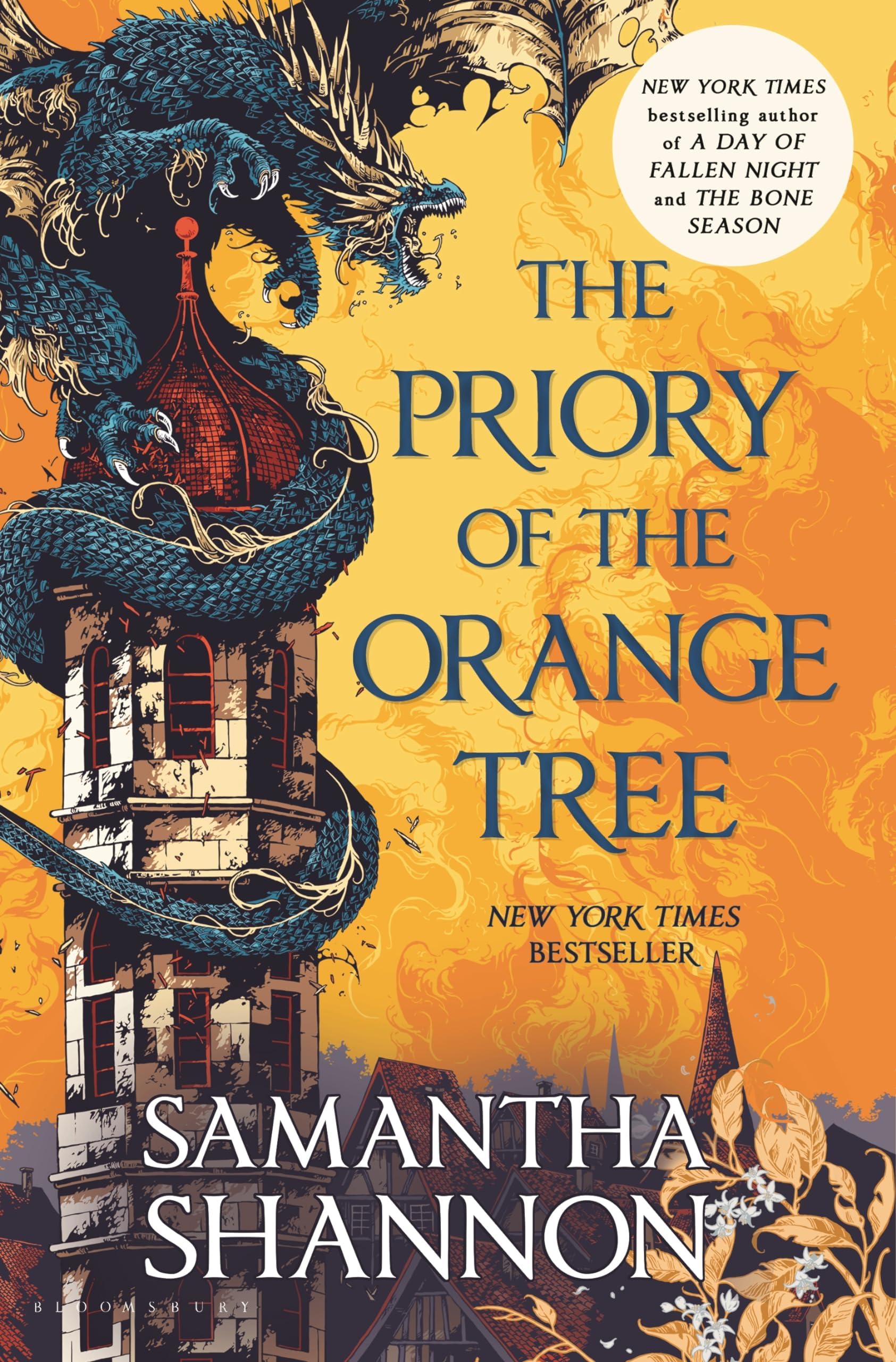
The Priory of the Orange Tree (The Roots of Chaos)
Product ID: 89936189
Buy anything from 5,000+ international stores. One checkout price. No surprise fees. Join 2M+ shoppers on Desertcart.
Desertcart purchases this item on your behalf and handles shipping, customs, and support to Vietnam.
desertcart.com: The Priory of the Orange Tree (The Roots of Chaos): 9781635570298: Shannon, Samantha: Books Review: Orchard of Enchanted Fruit - “That is the problem with stories, child. The truth in them cannot be weighed.” As a stand-alone, epic fantasy novel this is fairly unique amongst book markets at the moment. Moreover, it follows three female protagonists with interesting and complex narratives that are woven together with intriguing world building and, of course, dragons. The primary narrative thread follows Sabran Berethnet, a queen of a matriarchal nation who needs to marry and have a child, because the continuation of her bloodline that keeps a monstrous dragon trapped beneath the earth. A secondary thread follows her maid, Ead Duryran, a spy with strange powers who was sent to ensure Sabran’s safety in an unstable time. And finally, Tané, who, on the other side of the world, has just completed her training and initiation into a corps of dragon riders. 🐉The narrative itself is not revolutionary, clearly the large dragon and his horde comes back and can only be killed with the Macguffin at a certain time and place. Additionally, I have to say I didn’t enjoy the main romantic plot line. It felt somewhat forced, and the two characters progressed too quickly from not knowing each other to being intimate. In fact, I found the secondary reminiscent romance, of Niclays Roos and his long dead lover was far more interesting, and actually impacted the storyline and the motivations of his character. However, the romantic plot line is very minor in the grand scheme of things and doesn’t really ruin the enjoyment of this book. The real strength of this novel is the world-building. The way the world is created, the mythos, the creatures and the cultural differences between places actually make an impact on the narrative. There is no world-building for world-buildings sake. The first aspect of this world building that I love is the dragons. As a fantasy enthusiast I have seen a lot of dragons, and this novel had all of them. There are two broad types: the mainly western idea of a dragon which is scaly, monstrous, dangerous and can’t be reasoned with, and the more eastern idea which is wise, powerful, helpful on occasion and mysterious. Of course there are dragons that fit between these, Smaug being an obvious choice, but even he falls more under the western than eastern idea. In The Priory of the Orange Tree one of the main narrative themes is cultural difference/similarity; the idea that we all have similar ideas and mythos and emotions, but are separated by invisible lines of culture and geography. Shannon then weaves this idea explicitly into the dragons, distinctly separating west and east with the types of dragons that they encounter in the wild. The east worship their dragons because they are wise, they help them and they can ride them and they provide magic and security. Those in the west despise dragons because the ‘wyverns’ that they come across are destructive and deadly. The west hates the east for being ‘dragon-lovers’, not knowing that the dragons there are distinctly different beings. There is a deep cultural divide over this misunderstanding. It is a nice touch. Not only does it make sense narratively, but it means the dragons can be made more interesting and textured. Too often there is only one type or even just one dragon, and you don’t get the sense that they are a real aspect of the world. There are no dragons for dragons sake in this book and if you love the big fire breathing ones or the wise, parental ones there are dragons for you in this book. The next aspect I love is the magic system. Now, I could talk about soft and hard magic systems until the cows come home, but all I shall say is that hard magic systems have clearly defined rules, limits and consequences to the practice of magic (see The Magicians, Fullmetal Alchemist and The Name of the Wind), soft magic systems are a bit more lose weave and much more mysterious, you are never really sure what someone is capable of (Lord of the Rings, Game of Thrones). Shannon utilises a soft magic system really well. While there are no hard and fast rules to the magic she introduces into the plot and it is never explained what the real capabilities of the magic is, you are still aware of the consequences of its use, as she establishes that those who practice must replenish it by eating from a specific orange tree. Shannon uses the traits of a soft magic system really well, creating intrigue and a fascination/wonder over its use. The characters, and therefore you, discover more and more about this magic system as the narrative moves forward in a fairly organic manner. Through this process we discover that this magic system follows Shannon’s thematic system of the duality in the world, as there are two types of dragons and two connected founding myths, there are two types of magic. It makes the world feel very… concise and thematically coherant. This brings me to the aspect of this novel that excited me the most; the discourse on mythos, storytelling and the importance on the way a story is told. Essentially, the main plot points and aspects of world building centers around a founding myth of Sabran’s nation. They believe a hero killed the dragon with a sword and married the princess. The south believe that the ‘princess’ killed the dragon and never married the ‘hero’ and he went away in shame. This discord creates a rift between the two places and creates a lot of the tension in the world. This founding myth also creates the identity of the two places. Those who believe the woman is the hero focus on her magic and skill. Those who believe in the male hero have founded their system of state on his bloodline, and their religion on his code of ethics. The founding myth is relevant to not just the world building but also the plot. As the discrepancies in this myth are slowly uncovered and revealed it gives them the tools to defeat the ‘big evil’. It is important to know and understand fully. Where many fantasy books allow the myths to take up a lot of the story for no narrative gain, Shannon manages to weave it into the plot seamlessly, and make it integral to the novel as a whole. Basically, I liked this book! I think it is a really nice riff on some typical fantasy tropes while using some others to their full extent and really enjoying them. There were some iffy bits in the sub plots and some characterisation but overall it really impressed me and is thoroughly enjoyable even to those for whom fantasy isn’t a key genre. Review: Amazing, vast dragon-centered fantasy standalone! - A world divided for over a thousand years: the west fears dragons, the east reveres dragons, yet their common enemy is about to rise again. In the west, it is believed that the great evil wyrm called the Nameless One will remain at bay as long as an heir of Berethnet rules Inys, as has been the case for the past millennium since he was vanquished, but the current Queen Sabran has rejected all her suitors and the people are worried she won’t marry, which will thus release the Nameless One to wreak havoc once again. In the east, they believe differently, and they have dragons of their own that are not at all like the fire-breathers of the west. I love the juxtaposition between the dragons from the east, dragons of water, and dragons from the west, dragons of fire. I saw a similar connection to the dragons in our world, the traditional Chinese dragon and the European dragon. This story follows four perspectives. In the west we have Ead, who is a lady-in-waiting in the court of Inys, sent there to protect Queen Sabran; and Loth, best friend of Sabran and who has been sent away on a mission to a foreign land. In the east we have Tané, a girl who has spent her whole life training to be a dragon rider but who harbors a secret that could cost her everything; and Niclays Roos, an alchemist who was banished from Queen Sabran’s court seven years ago and is now living in exile. It is easy to keep straight the four main perspectives, and it’s easy to keep track of the secondary characters, but there are a lot of tertiary characters that I kept getting mixed up, especially the people of the court and who held which positions. Ultimately it didn’t matter too much and it didn’t hinder my enjoyment of the story, but just know that there are a lot of characters in this book, especially when you take into account all the historical and mythological figures that play an important role in the religion and politics of the world. That is one thing I loved about The Priory of the Orange Tree though, is that it is a highly detailed world with a very rich history. The history of this world plays a huge part in the founding of all of the religions, and you can see where they each divided over time. There are also distinct cultures and landscapes described in the different nations of the world, and each nation has its own language that is consistently referenced. I cannot communicate how in-depth this story is, like there had to have been so much research and time put into constructing the world because of how utterly expansive it is, and I love that. The world-building here is some of the best I’ve ever seen. I also love how everything connects. Some characters are related to certain historical figures, of which some of these were the cause for the creation of the religion in Inys, and the present-day religious beliefs in Inys completely drive their politics, which in turn affects the political climate of the surrounding nations, and the list goes on and on. So many threads weave together to form a beautiful story. I love all the political intrigue discussed as well. Despite the size of this tome, Priory is actually very readable, and it’s easy to get right into the story. I was intimidated to start it but after a few chapters, I knew I was in for a good ride. I will say that the beginning is much more drawn out than the end, but I think that’s because we are being introduced to the vast world and cast of characters, plus I was constantly referencing the maps, the timeline, the glossary, and the comprehensive character list while I was getting used to the story. I like knowing everything when I start a book so I will spend time getting to know the world and the characters at the beginning, even if it takes extra time. It’s not a slow-moving or boring story, but it does require time and patience to read, so just know that before starting it. Speaking of the maps, I am so grateful they were included. I really don’t think I would have made it through this book otherwise. They were beautifully drawn across three pages and were very helpful in pinpointing all the locations mentioned throughout the story. I do wish, however, that we had an even broader map. There were vague references to locations beyond the borders of the map and I wished I could see them and see even more of this world. I think a fold-out map would be perfect for this book. I also wish we would have learned more about Hróth and the Empire of the Twelve Lakes. We see so much of the other nations but we know next to nothing about those two. The Empire of the Twelve Lakes is the biggest nation on the map and it has a very detailed landscape, yet we learn very little about it during most of the book, and Hróth literally has only one city on the map because most of the nation is beyond the page. I would love to see this world expanded in every direction because I just can’t get enough of it and there’s so much more to explore. We spend a great deal of our time in Inys, seeing as it’s the influence for the primary religion of the west and three of our four main characters have lived in Inys at some point. I love the idea of the queendom in Inys, where the queen is expected to produce a female heir. That’s a complete flip on the traditional patriarchy where the king is expected to produce a male heir, and it was great. This book has a lot of feminist undertones, and I thought it was wonderful. Also, there is very little romance in this book, but what little is there is beautiful. This was one of the first books where I didn’t mind reading about pirates. Normally—and I don’t know why—I don’t like stories set on boats or involving pirates, but I actually enjoyed the small part of this book that included pirates. The last 150-ish pages went a lot quicker than the rest of the book. Not that the beginning and middle were slow, but the ending seemed a lot faster in comparison. And the climax of the book felt a bit rushed, to the point that I was slightly disappointed because I expected the final battle to take longer and be more difficult. We have nearly 800 pages of buildup and 1000 years of preparation for this final moment, and then...it’s over like that. Maybe that’s just me, and this isn’t a huge complaint because the rest of the book was so extraordinary, but I would have liked to see a bit more. Also, I think the finding of Ascalon was too easy. It’s been lost for centuries and all of the sudden a character is like, oh I think it’s in this place, and it is, and I wish there had been more behind that. There are some great twists and unexpected reveals in this story, but sometimes the path to get there was so convoluted that the outcomes felt a bit too easy for all the trouble the characters had to go through. Overall, I really enjoyed The Priory of the Orange Tree, and I would recommend it to high fantasy fans who love dragons. It’s long and takes patience to read, but the world is so beautiful and the characters are so wonderful that every second spent in this book is worth it. And although this is marketed as a standalone fantasy, I want more, I really do. I can see so many openings for a sequel, like which directions it could take, because each character’s future is left open, and I need more details. I hope one day we get to see more in this world, even if it’s set another thousand years in the future and involves different characters. Here are some SPOILERY questions I had about the ending: What can we learn from the ending? Who was Ead’s real father? What was the blood on Tané’s side? I expected Niclays and Nayimuthun to be dead and was surprised when they came back, especially the dragon. The Nameless One tells Sabran, “Beware the sweet water.” What does that mean? Do not say things unless they are important to the future of the story. The emperor of the Empire of the Twelve Lakes told us about his lover who he spurned and she said that she was coming for him. Will we see what this really means? What will become of the celestial jewels? Will Tané and Ead become friends? What will Sabran do in the next decade, and who will she elect to rule Inys once she abdicates the throne and moves to Lasia to be with Ead? Also, Fýredel is still out there and therefore could be the villain of the next installment. Even though the story wraps up nicely, there are still so many questions left unanswered. I need more.


| Best Sellers Rank | #29,280 in Books ( See Top 100 in Books ) #108 in Sword & Sorcery Fantasy (Books) #155 in Epic Fantasy (Books) #227 in Coming of Age Fantasy (Books) |
| Customer Reviews | 4.5 out of 5 stars 24,401 Reviews |
L**N
Orchard of Enchanted Fruit
“That is the problem with stories, child. The truth in them cannot be weighed.” As a stand-alone, epic fantasy novel this is fairly unique amongst book markets at the moment. Moreover, it follows three female protagonists with interesting and complex narratives that are woven together with intriguing world building and, of course, dragons. The primary narrative thread follows Sabran Berethnet, a queen of a matriarchal nation who needs to marry and have a child, because the continuation of her bloodline that keeps a monstrous dragon trapped beneath the earth. A secondary thread follows her maid, Ead Duryran, a spy with strange powers who was sent to ensure Sabran’s safety in an unstable time. And finally, Tané, who, on the other side of the world, has just completed her training and initiation into a corps of dragon riders. 🐉The narrative itself is not revolutionary, clearly the large dragon and his horde comes back and can only be killed with the Macguffin at a certain time and place. Additionally, I have to say I didn’t enjoy the main romantic plot line. It felt somewhat forced, and the two characters progressed too quickly from not knowing each other to being intimate. In fact, I found the secondary reminiscent romance, of Niclays Roos and his long dead lover was far more interesting, and actually impacted the storyline and the motivations of his character. However, the romantic plot line is very minor in the grand scheme of things and doesn’t really ruin the enjoyment of this book. The real strength of this novel is the world-building. The way the world is created, the mythos, the creatures and the cultural differences between places actually make an impact on the narrative. There is no world-building for world-buildings sake. The first aspect of this world building that I love is the dragons. As a fantasy enthusiast I have seen a lot of dragons, and this novel had all of them. There are two broad types: the mainly western idea of a dragon which is scaly, monstrous, dangerous and can’t be reasoned with, and the more eastern idea which is wise, powerful, helpful on occasion and mysterious. Of course there are dragons that fit between these, Smaug being an obvious choice, but even he falls more under the western than eastern idea. In The Priory of the Orange Tree one of the main narrative themes is cultural difference/similarity; the idea that we all have similar ideas and mythos and emotions, but are separated by invisible lines of culture and geography. Shannon then weaves this idea explicitly into the dragons, distinctly separating west and east with the types of dragons that they encounter in the wild. The east worship their dragons because they are wise, they help them and they can ride them and they provide magic and security. Those in the west despise dragons because the ‘wyverns’ that they come across are destructive and deadly. The west hates the east for being ‘dragon-lovers’, not knowing that the dragons there are distinctly different beings. There is a deep cultural divide over this misunderstanding. It is a nice touch. Not only does it make sense narratively, but it means the dragons can be made more interesting and textured. Too often there is only one type or even just one dragon, and you don’t get the sense that they are a real aspect of the world. There are no dragons for dragons sake in this book and if you love the big fire breathing ones or the wise, parental ones there are dragons for you in this book. The next aspect I love is the magic system. Now, I could talk about soft and hard magic systems until the cows come home, but all I shall say is that hard magic systems have clearly defined rules, limits and consequences to the practice of magic (see The Magicians, Fullmetal Alchemist and The Name of the Wind), soft magic systems are a bit more lose weave and much more mysterious, you are never really sure what someone is capable of (Lord of the Rings, Game of Thrones). Shannon utilises a soft magic system really well. While there are no hard and fast rules to the magic she introduces into the plot and it is never explained what the real capabilities of the magic is, you are still aware of the consequences of its use, as she establishes that those who practice must replenish it by eating from a specific orange tree. Shannon uses the traits of a soft magic system really well, creating intrigue and a fascination/wonder over its use. The characters, and therefore you, discover more and more about this magic system as the narrative moves forward in a fairly organic manner. Through this process we discover that this magic system follows Shannon’s thematic system of the duality in the world, as there are two types of dragons and two connected founding myths, there are two types of magic. It makes the world feel very… concise and thematically coherant. This brings me to the aspect of this novel that excited me the most; the discourse on mythos, storytelling and the importance on the way a story is told. Essentially, the main plot points and aspects of world building centers around a founding myth of Sabran’s nation. They believe a hero killed the dragon with a sword and married the princess. The south believe that the ‘princess’ killed the dragon and never married the ‘hero’ and he went away in shame. This discord creates a rift between the two places and creates a lot of the tension in the world. This founding myth also creates the identity of the two places. Those who believe the woman is the hero focus on her magic and skill. Those who believe in the male hero have founded their system of state on his bloodline, and their religion on his code of ethics. The founding myth is relevant to not just the world building but also the plot. As the discrepancies in this myth are slowly uncovered and revealed it gives them the tools to defeat the ‘big evil’. It is important to know and understand fully. Where many fantasy books allow the myths to take up a lot of the story for no narrative gain, Shannon manages to weave it into the plot seamlessly, and make it integral to the novel as a whole. Basically, I liked this book! I think it is a really nice riff on some typical fantasy tropes while using some others to their full extent and really enjoying them. There were some iffy bits in the sub plots and some characterisation but overall it really impressed me and is thoroughly enjoyable even to those for whom fantasy isn’t a key genre.
K**E
Amazing, vast dragon-centered fantasy standalone!
A world divided for over a thousand years: the west fears dragons, the east reveres dragons, yet their common enemy is about to rise again. In the west, it is believed that the great evil wyrm called the Nameless One will remain at bay as long as an heir of Berethnet rules Inys, as has been the case for the past millennium since he was vanquished, but the current Queen Sabran has rejected all her suitors and the people are worried she won’t marry, which will thus release the Nameless One to wreak havoc once again. In the east, they believe differently, and they have dragons of their own that are not at all like the fire-breathers of the west. I love the juxtaposition between the dragons from the east, dragons of water, and dragons from the west, dragons of fire. I saw a similar connection to the dragons in our world, the traditional Chinese dragon and the European dragon. This story follows four perspectives. In the west we have Ead, who is a lady-in-waiting in the court of Inys, sent there to protect Queen Sabran; and Loth, best friend of Sabran and who has been sent away on a mission to a foreign land. In the east we have Tané, a girl who has spent her whole life training to be a dragon rider but who harbors a secret that could cost her everything; and Niclays Roos, an alchemist who was banished from Queen Sabran’s court seven years ago and is now living in exile. It is easy to keep straight the four main perspectives, and it’s easy to keep track of the secondary characters, but there are a lot of tertiary characters that I kept getting mixed up, especially the people of the court and who held which positions. Ultimately it didn’t matter too much and it didn’t hinder my enjoyment of the story, but just know that there are a lot of characters in this book, especially when you take into account all the historical and mythological figures that play an important role in the religion and politics of the world. That is one thing I loved about The Priory of the Orange Tree though, is that it is a highly detailed world with a very rich history. The history of this world plays a huge part in the founding of all of the religions, and you can see where they each divided over time. There are also distinct cultures and landscapes described in the different nations of the world, and each nation has its own language that is consistently referenced. I cannot communicate how in-depth this story is, like there had to have been so much research and time put into constructing the world because of how utterly expansive it is, and I love that. The world-building here is some of the best I’ve ever seen. I also love how everything connects. Some characters are related to certain historical figures, of which some of these were the cause for the creation of the religion in Inys, and the present-day religious beliefs in Inys completely drive their politics, which in turn affects the political climate of the surrounding nations, and the list goes on and on. So many threads weave together to form a beautiful story. I love all the political intrigue discussed as well. Despite the size of this tome, Priory is actually very readable, and it’s easy to get right into the story. I was intimidated to start it but after a few chapters, I knew I was in for a good ride. I will say that the beginning is much more drawn out than the end, but I think that’s because we are being introduced to the vast world and cast of characters, plus I was constantly referencing the maps, the timeline, the glossary, and the comprehensive character list while I was getting used to the story. I like knowing everything when I start a book so I will spend time getting to know the world and the characters at the beginning, even if it takes extra time. It’s not a slow-moving or boring story, but it does require time and patience to read, so just know that before starting it. Speaking of the maps, I am so grateful they were included. I really don’t think I would have made it through this book otherwise. They were beautifully drawn across three pages and were very helpful in pinpointing all the locations mentioned throughout the story. I do wish, however, that we had an even broader map. There were vague references to locations beyond the borders of the map and I wished I could see them and see even more of this world. I think a fold-out map would be perfect for this book. I also wish we would have learned more about Hróth and the Empire of the Twelve Lakes. We see so much of the other nations but we know next to nothing about those two. The Empire of the Twelve Lakes is the biggest nation on the map and it has a very detailed landscape, yet we learn very little about it during most of the book, and Hróth literally has only one city on the map because most of the nation is beyond the page. I would love to see this world expanded in every direction because I just can’t get enough of it and there’s so much more to explore. We spend a great deal of our time in Inys, seeing as it’s the influence for the primary religion of the west and three of our four main characters have lived in Inys at some point. I love the idea of the queendom in Inys, where the queen is expected to produce a female heir. That’s a complete flip on the traditional patriarchy where the king is expected to produce a male heir, and it was great. This book has a lot of feminist undertones, and I thought it was wonderful. Also, there is very little romance in this book, but what little is there is beautiful. This was one of the first books where I didn’t mind reading about pirates. Normally—and I don’t know why—I don’t like stories set on boats or involving pirates, but I actually enjoyed the small part of this book that included pirates. The last 150-ish pages went a lot quicker than the rest of the book. Not that the beginning and middle were slow, but the ending seemed a lot faster in comparison. And the climax of the book felt a bit rushed, to the point that I was slightly disappointed because I expected the final battle to take longer and be more difficult. We have nearly 800 pages of buildup and 1000 years of preparation for this final moment, and then...it’s over like that. Maybe that’s just me, and this isn’t a huge complaint because the rest of the book was so extraordinary, but I would have liked to see a bit more. Also, I think the finding of Ascalon was too easy. It’s been lost for centuries and all of the sudden a character is like, oh I think it’s in this place, and it is, and I wish there had been more behind that. There are some great twists and unexpected reveals in this story, but sometimes the path to get there was so convoluted that the outcomes felt a bit too easy for all the trouble the characters had to go through. Overall, I really enjoyed The Priory of the Orange Tree, and I would recommend it to high fantasy fans who love dragons. It’s long and takes patience to read, but the world is so beautiful and the characters are so wonderful that every second spent in this book is worth it. And although this is marketed as a standalone fantasy, I want more, I really do. I can see so many openings for a sequel, like which directions it could take, because each character’s future is left open, and I need more details. I hope one day we get to see more in this world, even if it’s set another thousand years in the future and involves different characters. Here are some SPOILERY questions I had about the ending: What can we learn from the ending? Who was Ead’s real father? What was the blood on Tané’s side? I expected Niclays and Nayimuthun to be dead and was surprised when they came back, especially the dragon. The Nameless One tells Sabran, “Beware the sweet water.” What does that mean? Do not say things unless they are important to the future of the story. The emperor of the Empire of the Twelve Lakes told us about his lover who he spurned and she said that she was coming for him. Will we see what this really means? What will become of the celestial jewels? Will Tané and Ead become friends? What will Sabran do in the next decade, and who will she elect to rule Inys once she abdicates the throne and moves to Lasia to be with Ead? Also, Fýredel is still out there and therefore could be the villain of the next installment. Even though the story wraps up nicely, there are still so many questions left unanswered. I need more.
L**R
Epic
My cousin recommended this book to me before she herself even got to read it! We are both avid book readers and have soft spots for epic fantasy stories. Lord of the Rings, Pern, A Song of Ice and Fire, etc... So when she found out about this book, she immediately texted me and told me to give it a shot! I have to say, when i first saw the book on the shelf i was intimidated. the sheer volume of this book made me think "this better start out really good else i won't get through half and end up stuck with this unfinished business on my shelf. which i hate. I was in a reading slump and as fate would have it, Amazon just happened to have this book on their kindle daily deals for $1.99! i thought that i could spare that cash for a chance to try out this book, and i am so glad i did! 5***** because this book not only looks beautiful, but utterly compelling and well written. What I liked: 1. The over all story, a world where people live by an incident that happened thousands of years ago but each region has its own beliefs on how it actually went down (religion) some say a woman stopped the ancient evil Wyrm (not dragon) from rising and leveling the world to dust. some say it was her lover that stopped the evil and won the fair maidens hand and started a magical bloodline that as long as an heir exists, the evil will forever be bound. cool 2. The Prince Sabran was wed to. This dude wasn't in the book much but he shined to me. He was the most real of all the side characters in the book. he was genuinely a good guy! in a world where everyone has ulterior motives, he simply wanted Sabran to be happy. i loved him. i think he was my favorite character. 3. Tane- she was my favorite point of view, and it has everything to do with the fact that she was a dragon rider. (Eragon done right!) 4. how the entire story was in this one book. thats right! this book starts and finishes all in this near 900 page book! no waiting for the sequel! like a said before, the size of this book intimidated me. and it did take me longer than usual to finish for a book i was really enjoying... but life for me has changed. I work long hours, i have a apartment to clean and the love of my life that wants attention every once in a while ( and i want to give it) it took me about 4 days to read, a long time by my standards, but when i wasn't reading- i wanted to be! What i didn't like: this list is Much shorter; even though i gave this book 5stars i still had a few minor issues with it 1. it was just a tad too feminist for me. meaning that the female point of views were all the heroes and the one male POV was the most dislikable character of all. I don't know if that's just my opinion or if it was done on purpose... at least he got his redemption in the end. 2. the book had great pacing until the end. the final fight that we've been lead up to felt so rushed. a book this size, i think if another 20 or so pages were added to flush out the climax a bit wouldn't have even been noticed. if you're a fan of fantasy i recommend this book! just set aside the time to read! :)
E**Y
A master class in how you write a feminist high fantasy novel
The Priory of the Orange Tree by Samantha Shannon was a master class in how you write a feminist high fantasy. Any time a fantasy fan claims that a misogynist aspect of their favorite book by a male author makes sense because of the genre, I will point them in the direction of this book. Here, there be dragons. This story examines fear, xenophobia, the differences and similarities that bring people together, and how truth and history are manipulated by those in power. One half of the world worships water dragons as gods, while the other half believes all dragons (what they call wyrms) are evil and must be destroyed. The truth is that the whole world has a common enemy - the fire breathers. This book, in its essence, is also a story about balance. Priory is a story told by four unique perspectives. Ead, a southerner with secrets who was placed with Queen Sabran to keep her safe (unbeknownst to the queen). Lord Arteloth, a westerner who is dear friends with Queen Sabran and was exiled because of this friendship. Tané, an easterner who is training to become part of the High Sea Guard, with the goal of becoming a dragon rider. And finally, Niclays Roos, an anatomist and alchemist living in the east because he was exiled from the west. At first, it felt slightly jarring to have to jump between these different points of view. After a short while, these perspectives slowly began to weave together and only got better as the book went on. I, like so many, waited to read Priory because I was intimidated. Granted, it was released in the middle of completing my master's thesis, and then I had a major reading slump--so that contributed to my delay, too. I digress--the point I am trying to make is, do not be intimidated by this book if you are a fantasy lover. It is divided into six small parts, if that helps you feel less intimidated! The prose is beautiful. I paused occasionally to savor some of the lines. I freely admit that it was a slow start, but what high fantasy book isn't? There's a lot of world building that Shannon had to put in place before the plot began to go full speed ahead. If you find yourself struggling with the first 250-or so pages, fear not--it gets easier and faster to read the deeper you get into the book. To the point where it's difficult to put down. If you are searching for a high fantasy novel featuring a diverse cast of characters, LGBT+ characters and relationships, and incredible world building, this is the book for you!
C**I
long story with good world building but anticlimactic
Shannon builds this big world with many characters. I enjoyed the diversity, but it lacked enough explaining of the different cultures. You only truly see the West’s culture and religion. The East is never fully explained outside the fact that they are able to live with the “good” dragons. One of the main characters, Tane had a whole trial to become a dragon rider, but the author skips right past it. So I wasn’t able to connect with the character. Tane’s dragon riding isn’t fully developed either. They never show us her first ride or how she bonded with her dragon. Ead’s magic isn’t used to its full potential. She never describes her training and what it took for her to become a mage. I didn’t really connect with her falling in love with the queen. It didn’t seem like they were very close most of the time before they became lovers. Loth’s reason for being a main character isn’t explained. Roos seems to be the only character that was well thought out and he didn’t lack anything. The ending battle seemed so rushed and they go on about a battle on two fronts but we only see one front. It was over so quickly and I didn’t have any feelings about it. In all, it was a big world and a long book but we only got a peek of it.
H**R
Beautiful book
⭐⭐⭐⭐.75 (rounded up to 5) I loved this book. The dragons, the magic, the world, the quests and journeys the main characters go on (both internally and externally), the relationships between the various characters... it was beautifully done and I very much enjoyed it. I was super intimidated by the size of this book and it sat on my shelf for a while before I finally picked it up, but I'm happy I finally did. The loss of .25 stars is purely because this book was written to be a standalone and it shows in some of the scenes. This world is massive and the story is so in depth which I loved, but I wanted more sometimes -- more room to grieve with the characters, more room to celebrate with them, things moved so quickly at times that I didn't know how I felt in those moments. I am looking forward to reading the other book that's published in this world and the next one I saw was planned.
C**.
A Very Good Read; intricate plot, interesting world
There are already a lot of great reviews out here about this book. I’ll just say that while I don’t think it is as perfect as some, it is certainly much better than the haters make it out to be. It’s a very solid, good read. The world is interesting, with enough connections to places in our world that we can relate to it easily, while still reveling in the wonderful differences created with magic and fantastical creatures. I loved that it covered such different parts of this world, and fully realized their differences in most cases. The plot was very engaging. The pace is a bit slower in the first third of the book, and some of the action takes place off-stage, but I didn’t find that to be off-putting. There was enough meat as you begin to understand the complexities of this world and the motivations and desires of the people who inhabit it. I do think that the pacing was off, as some others have said, in the last third of the book, where a lot of major events and confrontations take place very quickly and are over almost before you have felt any tension from the situations. It felt like Ms. Shannon may have been rushing to finish to keep this Novel to a manageable length. But it’s impossible to complain about the scope and scale of the action. I also wish that there were fewer moments of “deus ex machina”, where near certain doom is avoided only by the sudden random appearance of a dragon, or an ichneumon, or a witch. These were the couple of things that kept this from being a 5 star book in my opinion. I was honestly touched by the primary romantic relationship in the book. At first I didn’t completely get the attraction (at least on one side), but I did feel that it was later explained, and I could totally empathize. I didn’t care that it was non-heterosexual relationship, though I get how that would have been quite meaningful for some readers. It could have been a male-female relationship and I would have felt the same about it. The importance to me was that they were two people in difficult situations who each found love and comfort and eventual acceptance in each other. I wish Loth could have been a more fully fleshed out character rather than just a convenient POV to follow plot developments away from the other main characters. Overall, though, the characters were well developed. I cringed at some of the things that some of them did, but I was still able to empathize with them, and believe them when they repented. I liked that they didn’t do the kinds of idiotic things that make me so frustrated with most books. Bottom line, this book is definitely worth your time, and I wish there was more of it to read.
M**M
Absolutely Stunning!
The Priory of the Orange Tree has been one of my favourite reads of the year thus far! The book *looks* super imposing so I put off picking it up for a few weeks and then ended up absolutely devouring it over the course of three days! It has everything one could possibly want-- strong character arcs, religious zealots, cultural clashes, magic, DRAGONS (which, Clan Miduchi will have you know, are NOT the same as wyrms) and writing that literally transports you elsewhere. The premise of The Priory of the Orange Tree is a bit hard to describe because it tracks the perspectives of multiple characters from East and West, but essentially: Ead has been a transplant at a foreign court and is meant to protect Queen Sabran, who is the current ruler of the Virtudom and claims descent from the supposed defeater of the Nameless One (a big scary fire-breathing wyrm). She protects the queen using forbidden magic, which comes from her training as a mage in the Priory of the Orange Tree. In the West, a girl training as a dragon rider is trying to overcome her lack of pedigree in a fiercely competitive struggle to be named as one of the warriors in the most prestitious dragon rider clan of all time, the Miduchi. There are two other POVs that come from less major characters that sketch in some of the gaps around the world, but the book basically threads together disparate pieces of heritage, us vs them mentality, religious fanaticism, developing romantic interests, and the history of three magical trees and women they made powerful into one epic, lush fantasy with world-building for days. What I Loved: - Ead was an incredibly interesting character. Her ambition, thoughtfulness, and protective nature make her one of the fiercest characters I've ever read without the typical sass and aggression that we might see in one of those characters. She doesn't have a problem speaking her mind, but she isn't hot-headed or explosive. - The world building was just.... intensely lush. It was so richly detailed, and while I spent a lot of time in the beginning having to double check where I was, the chapter headings with "East" and "West" simplified a lot for me (which is saying something because I am TERRIBLE with geography). - Dragons and wyrms. Just... dragons and wyrms. - The kind of ongoing commentary on historical manipulation and the lies our ancestors tell us was really incredible and I think very, very fitting when we think about history today. (This is just a little nugget that really made an impression on me, even if it wasn't something we were beaten over the head with.) - The descriptions of scenery. WHOOOSH. This book was descriptive AF without clogging up the pages with unnecessary prose. - The backstory was so well done and so clever. There were so many amazing elements of the story-- three trees, the stars and the earth, and so on. I still find myself daydreaming about the intricacy of everything Samantha strung together. LOVE. What I Liked: - It was immersive, rather than full of info-dumps, which is great. It does have its drawbacks, because there was stuff I wanted more information on, but stuff generally came together neatly. - The pacing was very well done and kept me engaged in almost all of the storylines at once, though sometimes I was impatient to pop back to another storyline I liked more. What I Didn't Like: - At times, I did get a little bit lost with the epicness of it all-- there were so many tiny cultural details and the words used to describe clothing or certain scents were things that I was completely unfamiliar with (and were often unique to the world) BUT I FOUND A GLOSSARY IN THE BACK AFTER. So make use of that! - There were a couple times that I got very frustrated by the same character, again and again. It was not a main POV character, but because of all of the contact between these characters, we saw a lot of her. I came to appreciate her in the end, which I feel like is a testament to the beauty of Samantha's writing.... she made me convinced I should love a character I originally wanted to punch in the nose. - I have conflicting feelings (still) about the way that Tane was treated in the middle of the book by the people who claimed her as family. Won't say anything else because spoilers, but I felt like Tane was a better person than I am if she still felt such intense love and respect for them. - There was one character who I low-key shipped with Tane for a enemies-to-lovers relationship and it didn't pan out, which was fine... but it seemed like this character just literally ghosted after the antagonistic bit of their relationship was over and it served her character development, which was kind of a bummer. There weren't too many loose threads like that, but this one was fairly memorable for me. (Really though, all of these are tiny gripes.) Overall, I absolutely love this book and would highly recommend it. If you enjoy epic high fantasy, then this would be a great choice. If you like feminist books with empowered female characters, then Priory of the Orange Tree might be your new favourite. If you like multiple POVS, intense world building, F/F relationships, or to be dropped into a new world and left to explore, then this book is definitely for you. But if epic fantasy isn't your thing or if you get confused by multiple POV, then this book could be a bit much to handle... though I'd definitely give it a go anyway! 5/5 stars!
Trustpilot
2 weeks ago
2 weeks ago