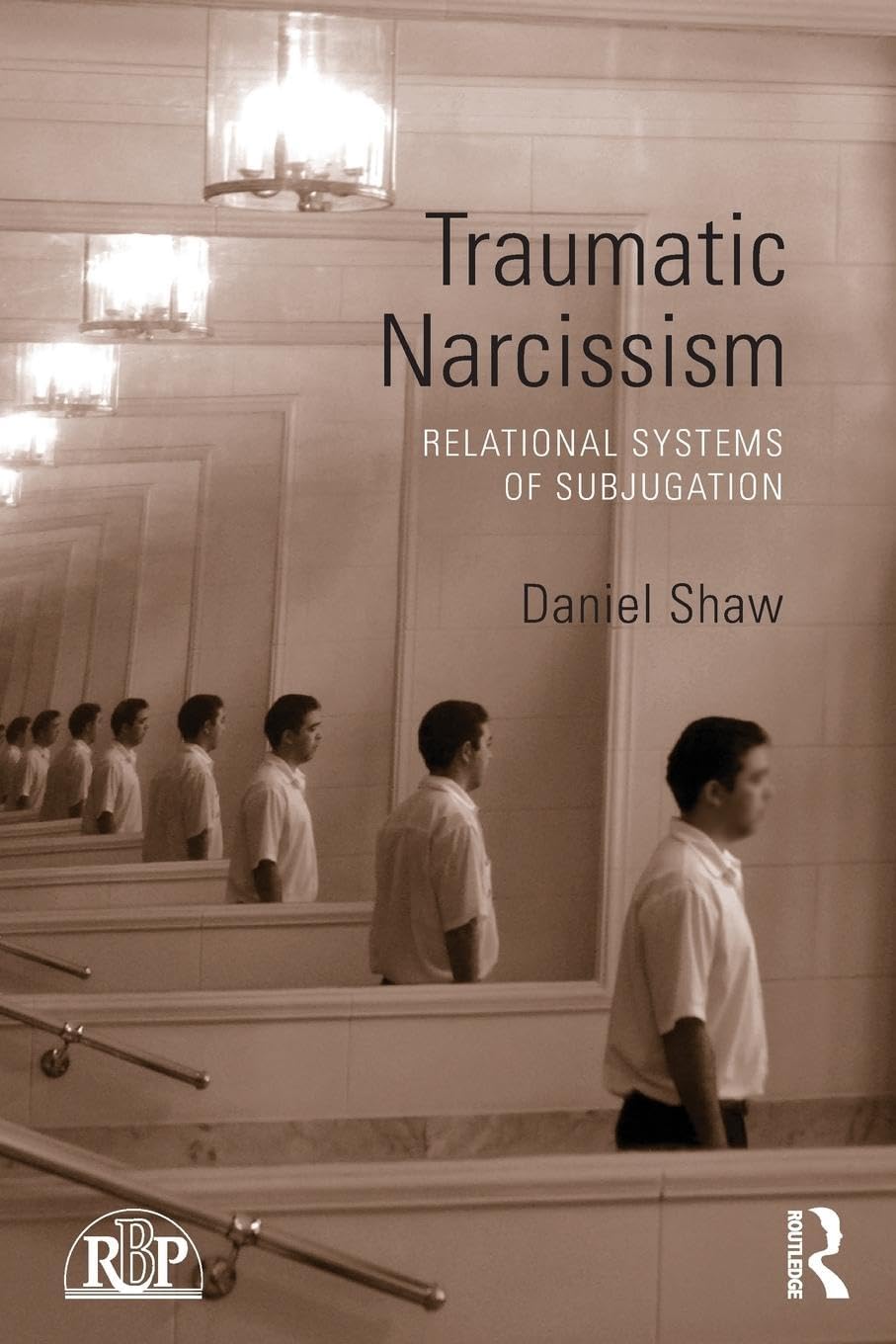
Traumatic Narcissism (Relational Perspectives Book Series)
Product ID: 8391377
Buy anything from 5,000+ international stores. One checkout price. No surprise fees. Join 2M+ shoppers on Desertcart.
Desertcart purchases this item on your behalf and handles shipping, customs, and support to Vietnam.
Traumatic Narcissism (Relational Perspectives Book Series) [Shaw, Daniel] on desertcart.com. *FREE* shipping on qualifying offers. Traumatic Narcissism (Relational Perspectives Book Series) Review: A Rare Find and Must Read for All psychotherapists - In my 40 years as a practicing psychologist, I have not come across a professional book that has had as much impact on the breadth of my understanding of the dynamics of narcissism, on the depth of my relational work with clients suffering from having experienced traumatizing narcissism at the hands of those upon whom they depended on for care, and on the clients themselves to whom I gave the book at some point in the course of treatment. With eloquence, and in language that is meaningful to professionals, and accessible to the layperson who might be in search of greater understanding of their suffering, Daniel Shaw clearly, and empathically lays out the intergenerational transmission of narcissism and its devastating effects on those who have experienced it in various relational contexts. He brings in knowledge and theory from many other current experts on narcissism and dissociation, such as Kalsched, Howell and Bromberg, and going back historically, Winnicott, Fairbairn, and the early psychoanalysts. He integrates their contributions into his own elegant formulations, and brings in examples from literature and theatre to illustrate some of his ideas. Also included are illuminating, and deeply moving case examples from his own clinical practice. Clients of mine who have read the book consistently describe being “seen” by Shaw in an unprecedented way, often bringing me excerpts that are particularly touching to them. What an enormous gift to those who have experienced such suffering in life. The understanding patients receive from Shaw’s attuned and caring descriptions of what have been the core dilemmas that have shaped their adaptations to developmental adversity throughout their lives, has enhanced their therapeutic process significantly Daniel Shaw is a gifted writer and theoretician, as well as an extraordinarily compassionate and attuned human being. His emphasis on the necessity for the analyst to fully engage from an intersubjective perspective with clients, showing up with authenticity and appropriate transparency in the analytic process is woven throughout the book, and has become a guiding light to me in my own work. I have given Shaw’s book to numerous colleagues who share my enthusiasm and it has become a centerpiece in the Master’s level curriculum of professional trainings I collaborate in teaching. I am grateful beyond words for his contribution, and look forward to his further publications. Review: Excellent, well-written, worthwhile read! - I purchased this book after hearing the author speak at a conference, and to contribute to my studies of abusive churches/cults. Daniel Shaw present two ideas that I found particularly powerful and enlightening in this book. 1. There is a type of narcissist rightly called a "traumatizing narcissist"; one who transfers his/her shame/inadequacy/fear, etc., out of himself/herself, and onto those whom he/she relates to. Shaw's perspective is primarily shaped through his observations as a psychoanalyst, but readily applies to the more severe instances of pastoral/spiritual abuse found in some churches. The book contributed greatly to my studies of false teachers/false prophets in Christian churches. 2. A worthy goal in people-helping is to seek a healthy expression of what Shaw terms "analytic love." This is a relationship goal in which both the client and the analyst relate as equals in a mutually respectful relationship marked by consideration, kindness, empathy, and equality. Shaw's primary focus is to address and criticize the coldness of a professional relationship in the counseling environment, in which the counseled is de facto "under" the care and authority of the counselor. The counselor (in this defective system) may express superiority, lack of love/concern, etc., in any number of subtle (and not so subtle) ways, perpetuating the distance between the "helper" and the one being helped. In doing so, the counselor often creates the same conditions of which the client/patient is seeking to recover from: an absence of love and protection from care-givers. I did not expect to find what is (to me) such a clear indictment of the tendency to relate as an authority figure in pastoral counseling, in such a way that creates distance between the member and the pastor, and prohibits a genuine, relational, therapeutic engagement that best expresses the Christian goal of edification and agape love. While this is not a Christian book, and the author's beliefs regarding faith are not revealed--it is a clear and insightful (though unintended) presentation of a healthy, Christ-like model of pastoral care. Highly recommended.


| Best Sellers Rank | #360,107 in Books ( See Top 100 in Books ) #10 in Trauma Surgery #252 in Personality Disorders (Books) #719 in Post-Traumatic Stress |
| Customer Reviews | 4.8 4.8 out of 5 stars (188) |
| Dimensions | 6.14 x 0.44 x 9.21 inches |
| Edition | 1st |
| ISBN-10 | 0415510252 |
| ISBN-13 | 978-0415510257 |
| Item Weight | 2.31 pounds |
| Language | English |
| Part of series | Relational Perspectives |
| Print length | 192 pages |
| Publication date | September 10, 2013 |
| Publisher | Routledge |
M**.
A Rare Find and Must Read for All psychotherapists
In my 40 years as a practicing psychologist, I have not come across a professional book that has had as much impact on the breadth of my understanding of the dynamics of narcissism, on the depth of my relational work with clients suffering from having experienced traumatizing narcissism at the hands of those upon whom they depended on for care, and on the clients themselves to whom I gave the book at some point in the course of treatment. With eloquence, and in language that is meaningful to professionals, and accessible to the layperson who might be in search of greater understanding of their suffering, Daniel Shaw clearly, and empathically lays out the intergenerational transmission of narcissism and its devastating effects on those who have experienced it in various relational contexts. He brings in knowledge and theory from many other current experts on narcissism and dissociation, such as Kalsched, Howell and Bromberg, and going back historically, Winnicott, Fairbairn, and the early psychoanalysts. He integrates their contributions into his own elegant formulations, and brings in examples from literature and theatre to illustrate some of his ideas. Also included are illuminating, and deeply moving case examples from his own clinical practice. Clients of mine who have read the book consistently describe being “seen” by Shaw in an unprecedented way, often bringing me excerpts that are particularly touching to them. What an enormous gift to those who have experienced such suffering in life. The understanding patients receive from Shaw’s attuned and caring descriptions of what have been the core dilemmas that have shaped their adaptations to developmental adversity throughout their lives, has enhanced their therapeutic process significantly Daniel Shaw is a gifted writer and theoretician, as well as an extraordinarily compassionate and attuned human being. His emphasis on the necessity for the analyst to fully engage from an intersubjective perspective with clients, showing up with authenticity and appropriate transparency in the analytic process is woven throughout the book, and has become a guiding light to me in my own work. I have given Shaw’s book to numerous colleagues who share my enthusiasm and it has become a centerpiece in the Master’s level curriculum of professional trainings I collaborate in teaching. I am grateful beyond words for his contribution, and look forward to his further publications.
K**T
Excellent, well-written, worthwhile read!
I purchased this book after hearing the author speak at a conference, and to contribute to my studies of abusive churches/cults. Daniel Shaw present two ideas that I found particularly powerful and enlightening in this book. 1. There is a type of narcissist rightly called a "traumatizing narcissist"; one who transfers his/her shame/inadequacy/fear, etc., out of himself/herself, and onto those whom he/she relates to. Shaw's perspective is primarily shaped through his observations as a psychoanalyst, but readily applies to the more severe instances of pastoral/spiritual abuse found in some churches. The book contributed greatly to my studies of false teachers/false prophets in Christian churches. 2. A worthy goal in people-helping is to seek a healthy expression of what Shaw terms "analytic love." This is a relationship goal in which both the client and the analyst relate as equals in a mutually respectful relationship marked by consideration, kindness, empathy, and equality. Shaw's primary focus is to address and criticize the coldness of a professional relationship in the counseling environment, in which the counseled is de facto "under" the care and authority of the counselor. The counselor (in this defective system) may express superiority, lack of love/concern, etc., in any number of subtle (and not so subtle) ways, perpetuating the distance between the "helper" and the one being helped. In doing so, the counselor often creates the same conditions of which the client/patient is seeking to recover from: an absence of love and protection from care-givers. I did not expect to find what is (to me) such a clear indictment of the tendency to relate as an authority figure in pastoral counseling, in such a way that creates distance between the member and the pastor, and prohibits a genuine, relational, therapeutic engagement that best expresses the Christian goal of edification and agape love. While this is not a Christian book, and the author's beliefs regarding faith are not revealed--it is a clear and insightful (though unintended) presentation of a healthy, Christ-like model of pastoral care. Highly recommended.
S**N
A Clear Vision, A Book of Hope
The Author: Here is a voice so articulate, open, honest, so insightful that the tangle of an intricate issue, encountered and/or lived by us all, is combed into an accessible flow of information. The author has the heart and mind to blend clinical observation, personal experience, self awareness and love. Content: The subject of this book is one of life-long fascination for me. Before this reading, I had come to think of narcissism as an aberration of the survival instinct. The delight for me was that the book both expanded and nuanced the patchwork of my observations and experience, much as finding a cache of missing pieces when working a jigsaw puzzle. As a non-professional, it was but a short time before I gained fluency enough with the vernacular to fully appreciate the skillful outlining of what traumatizing narcissism is, how it originates, how it manifests itself, and how it might be addressed. The use of case histories was compelling, enlightening and shared with such obvious caring that the paper on analytic love was almost superfluous. Of particular interest to me were the exploration of forgiveness, the differentiation of indifference and detachment, the relational approach, and the global application. Most important for me is that the book is one of hope. While acknowledging the difficulties of treating the traumatizing narcissist, the author offers real guidance for the victims in navigating a way through to a fully realized life. This is big. Well done. (Review by Marilyn Pfeiffer Vaughan)
H**N
This is a must have book. I hugely enjoyed reading this well wriiten short, discursive at times, rich book. I was impressed by Daniel Shaw's grasp and explanation of traumatic narcissism, especially as it manifests in what he insightfully describes in Chapter 4 as narcissistic authoriatarianism in pschoanalysis. Yes. The part I found most interesting was the chapter on traumatic narcissism in cults. This chapter was thought provoking, very astute and helpful: an area I don't think enough attention is paid to in the field and sometimes dismissed by people who should know better. Take a bow Mr Shaw.
É**E
Worth the price!
D**N
Outstanding treatment of the subject
A**R
Being neither an academic nor a therapy professional, I was initially put off by the price of the e-book and told both the author and the publishing company so. After watching an interview with the author, I decided to purchase it anyway, and it is absolutely worth every penny. A very in-depth and clear read, and enjoyable. Very informative on many different aspects of narcissism, without the demonising aspect that you so often come across in popular literature on the subject.
R**X
I read this as a non professional because I wanted to understand narcissistic authoritarian dynamics and this clear elegant book was full of insight. Though definitely technical it is beautifully written and I highly recommend it.
Trustpilot
1 month ago
1 month ago