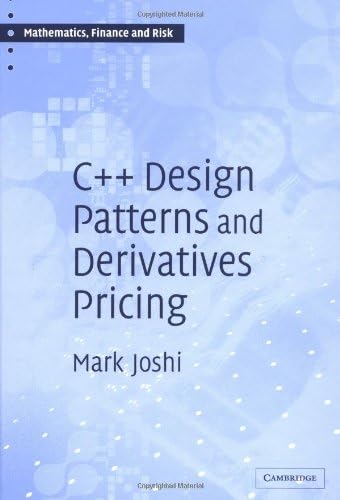
C++ Design Patterns and Derivatives Pricing (Mathematics, Finance and Risk, Series Number 2)
Product ID: 805831275
Desertcart purchases this item on your behalf and handles shipping, customs, and support to Vietnam.
Buy C++ Design Patterns and Derivatives Pricing (Mathematics, Finance and Risk, Series Number 2) by Joshi, Mark S. (ISBN: 9780521832359) from desertcart's Book Store. Everyday low prices and free delivery on eligible orders. Review: Where are the pictures? - This book tries to enforce good C++ programming practices, in particular design patterns, for options pricing, with a hands-on approach, concisely and clearly. The main drawback is the lack of diagrams: when designing object oriented programs, you draw a lot of doodles (learned people call them "UML diagrams", but they are just doodles), that are useful to clarify your ideas and to communicate them. Why is there none? I checked other C++ finance books, and they all had the same problem -- if you plan to write yet another C++ finance book, you know what not to forget... You are probably better off with a more general book about "good programming practices" (including, but not limited to, design patterns: Design Patterns, by E. Gamma et al., is the classical reference, but there might be newer books), a book about C++ programming quirks (such as S. Meyers's Effective C++), together with a more mathematically-oriented options book -- only come back to M. Joshi's book afterwards and consider it as an application of those practices. Review: A Superb, Practical Introduction to Quant Programming - This book stands out because it has clearly been written by a quant practitioner rather than a pure theorist. It regularly focuses on the real life challenge of producing a performant, maintainable system which can be enhanced over time with minimal impact. Though it does not claim to be an introduction to C++ or Mathematical Finance, its onion-skin approach is effective in guiding those with a very basic knowledge in these two areas into some reasonably advanced terrain.
| Best Sellers Rank | 2,656,739 in Books ( See Top 100 in Books ) 2,692 in Programming Languages & Tools 3,864 in Introduction to Programming 3,870 in Applied Mathematics (Books) |
| Customer reviews | 4.8 4.8 out of 5 stars (7) |
| Dimensions | 17.78 x 1.91 x 25.4 cm |
| ISBN-10 | 0521832357 |
| ISBN-13 | 978-0521832359 |
| Item weight | 626 g |
| Language | English |
| Print length | 214 pages |
| Publication date | 5 Aug. 2004 |
| Publisher | Cambridge University Press |
V**D
Where are the pictures?
This book tries to enforce good C++ programming practices, in particular design patterns, for options pricing, with a hands-on approach, concisely and clearly. The main drawback is the lack of diagrams: when designing object oriented programs, you draw a lot of doodles (learned people call them "UML diagrams", but they are just doodles), that are useful to clarify your ideas and to communicate them. Why is there none? I checked other C++ finance books, and they all had the same problem -- if you plan to write yet another C++ finance book, you know what not to forget... You are probably better off with a more general book about "good programming practices" (including, but not limited to, design patterns: Design Patterns, by E. Gamma et al., is the classical reference, but there might be newer books), a book about C++ programming quirks (such as S. Meyers's Effective C++), together with a more mathematically-oriented options book -- only come back to M. Joshi's book afterwards and consider it as an application of those practices.
J**H
A Superb, Practical Introduction to Quant Programming
This book stands out because it has clearly been written by a quant practitioner rather than a pure theorist. It regularly focuses on the real life challenge of producing a performant, maintainable system which can be enhanced over time with minimal impact. Though it does not claim to be an introduction to C++ or Mathematical Finance, its onion-skin approach is effective in guiding those with a very basic knowledge in these two areas into some reasonably advanced terrain.
P**R
This book is easy to read and hands on. Although there are a lot of excellent books which will give you an introduction to C++ for general purposes, I will still recommend this book to people who want to learn C++ for derivatives pricing.
D**C
A useful reference on C++ implementation of most common derivative models. Mostly good on details. Can be useful for an entry- to intermediate level quant. Generally recommended.
P**P
I like this book
Trustpilot
2 weeks ago
1 week ago