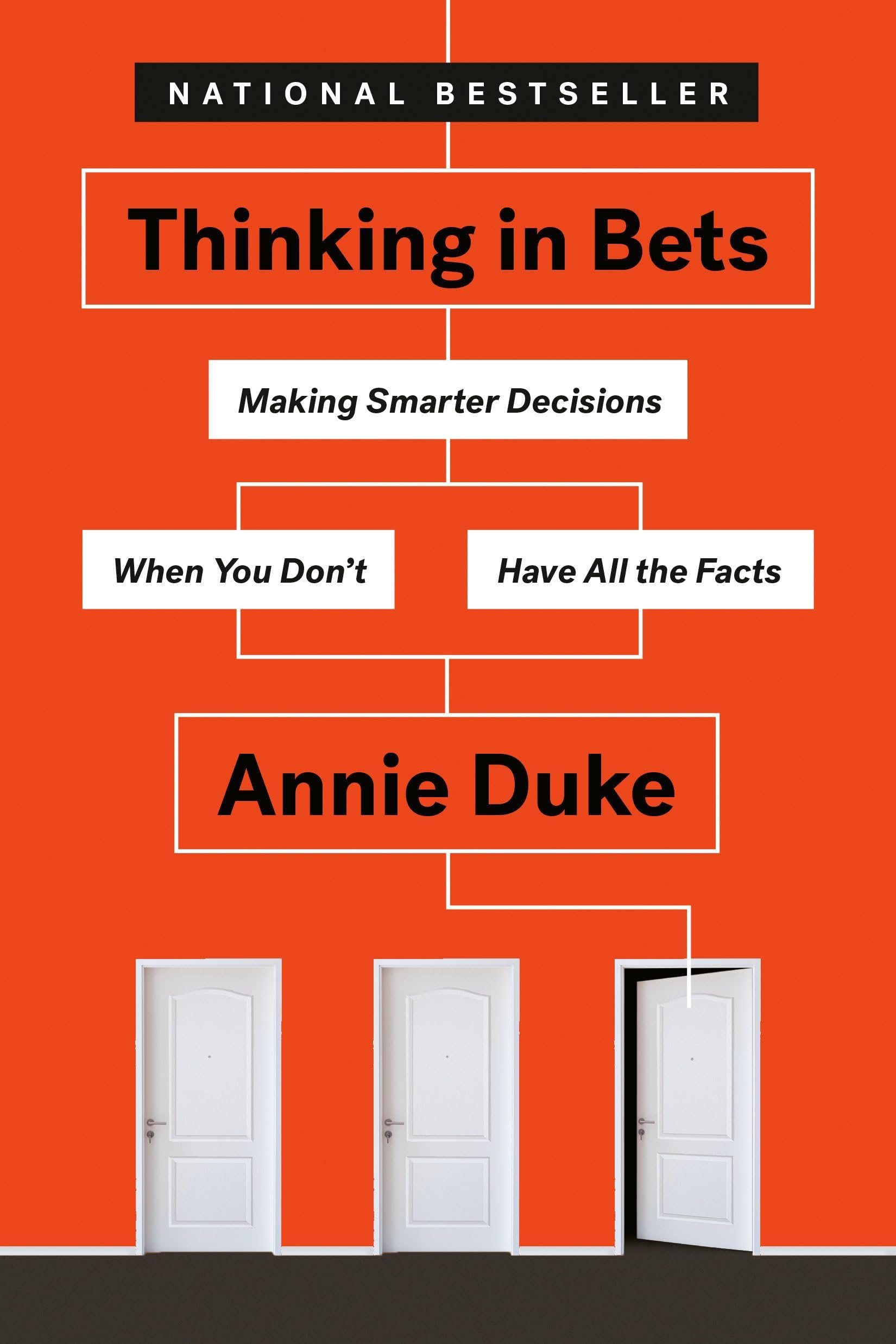
Thinking in Bets: Making Smarter Decisions When You Don't Have All the Facts
Product ID: 770883049
Desertcart purchases this item on your behalf and handles shipping, customs, and support to Vietnam.
NATIONAL BESTSELLER • Poker champion turned business consultant Annie Duke teaches you how to get comfortable with uncertainty and make better decisions as a result in “the ultimate guide to thinking about risk” (Charles Duhigg, author of The Power of Habit ). “A big favorite among investors these days.”— The New York Times “Outstanding.”—Jason Zweig, The Wall Street Journal In Super Bowl XLIX, Seahawks coach Pete Carroll made one of the most controversial calls in football history: With 26 seconds remaining, and trailing by four at the Patriots' one-yard line, he called for a pass instead of a hand off to his star running back. The pass was intercepted and the Seahawks lost. Critics called it the dumbest play in history. But was the call really that bad? Or did Carroll actually make a great move that was ruined by bad luck? Even the best decision doesn't yield the best outcome every time. There's always an element of luck that you can't control, and there is always information that is hidden from view. So the key to long-term success (and avoiding worrying yourself to death) is to think in bets: How sure am I? What are the possible ways things could turn out? What decision has the highest odds of success? Did I land in the unlucky 10% on the strategy that works 90% of the time? Or is my success attributable to dumb luck rather than great decision making? Annie Duke, a former World Series of Poker champion turned business consultant, draws on examples from business, sports, politics, and (of course) poker to share tools anyone can use to embrace uncertainty and make better decisions. For most people, it's difficult to say "I'm not sure" in a world that values and, even, rewards the appearance of certainty. But professional poker players are comfortable with the fact that great decisions don't always lead to great outcomes and bad decisions don't always lead to bad outcomes. By shifting your thinking from a need for certainty to a goal of accurately assessing what you know and what you don't, you'll be less vulnerable to reactive emotions, knee-jerk biases, and destructive habits in your decision making. You'll become more confident, calm, compassionate and successful in the long run. Review: Not a poker book, and that’s good.... - I’m not finished yet but this is not a pure poker book and I’m glad it’s not. Good advice inside with practical examples. It’s an interesting look at decision making. Review: 賭けを冷静にみつめる為の本です - 賭けとは何なのか? また、賭けに対する必要な心構えとは何なのか? そういったものにフォーカスした一冊です ただ英語版なので、一部分からない単語などがあった為、日本語版の個人的には良かったと思いました


| Amazon 売れ筋ランキング | 洋書 - 567位 ( 洋書の売れ筋ランキングを見る ) Systems & Planning - 4位 Decision-Making & Problem Solving - 4位 Behavioral Sciences (洋書) - 9位 |
| おすすめ度 | 5つ星のうち4.3 5,181 レビュー |
C**R
Not a poker book, and that’s good....
I’m not finished yet but this is not a pure poker book and I’m glad it’s not. Good advice inside with practical examples. It’s an interesting look at decision making.
K**ー
賭けを冷静にみつめる為の本です
賭けとは何なのか? また、賭けに対する必要な心構えとは何なのか? そういったものにフォーカスした一冊です ただ英語版なので、一部分からない単語などがあった為、日本語版の個人的には良かったと思いました
神**音
Redundancy
I only ready first 3 chapters, but the book is mentioning the same thing over and over, such a redundancy. The examples and stories of human decision making (miss judgement, undervalued results, etc.) are interesting, but the book refers to the same example repetitively. With this content, I believe you can squish the book into 30 pages, or make a 10 min Youtube video, instead of 250 pages long book.
A**ー
good book but too long and too repetitive
the point of this book is do not evaluate the quality of your decision based on the quality of result . that's it . it's a great message but she could write much shorter . it's too repetitive
S**R
Yes!
I enjoyed this as it's a lens widening read.
C**L
Decision Making For Everyone's Long Run Betterment
This book is about how to make better decisions, from the trivial to the most consequential, in all endeavors of life: personal, business, political/economic forecasting, gambling, etc. It explains how to think about potential decision options, given that most entail varying degrees of risky or uncertain outcomes. Without attempting to bog the reader down in the mathematics of probability theory, the core of most textbook approaches to decision making, it clearly demonstrates how to incorporate probabilistic uncertainty into our decision-making thought processes. Since most decisions we make lead to outcomes which have an element of probabilistic uncertainty, the book's approach is relevant to all walks of life. Although Duke does not frame it this way, I think a brief explanation of two fundamentally different types of situations captured by the tool of probabilistic reasoning may be helpful. This dichotomy leads to what have been termed Objective and Subjective probabilities. Objective probabilities are those associated with outcomes that are truly random with specific known numerical probabilities governing various occurrences. For these, no amount of thinking or information on the part of those of us observing the situation can improve on understanding inherent randomness of the underlying activity leading to some outcome, i.e., the known probabilities are the best we can do in anticipating the ultimate outcome of the event. In other words, we can't improve on the odds of various outcomes however smart we may be. The best examples for this type of probability are things happening in the world of quantum mechanics, e.g., predicting the time at which a radioactive element or a neutron will decay. A close second for most practical purposes would be the outcome of the spin of a roulette wheel or the outcome of a fair roll of a pair of dice. Objective probabilities are set by the laws of nature, and, once known, the actual outcomes of a large number of repetitive observations of the same situation will lead to a predictable distribution of outcomes. Subjective probabilities, on the other hand, are probabilities we assign to various outcomes when faced with decisions leading to uncertain outcomes. They are not fixed or absolute numbers driven by the laws of nature. We may assign a numerical value to a particular outcome, e.g., a 70% chance the Patriots will win the Super Bowl against the Eagles, or, they may be qualitative rankings of possible outcomes, e.g., highly likely, pretty likely, not sure, very unlikely, etc. Three key things about Subjective probabilities are: 1. Different people thinking about the same event will usually have different estimates of the probabilistic outcomes. Subjective probabilities are not facts. They are opinions. 2. The information/knowledge the decision maker has about the situation will affect their probability estimates of different outcomes. 3. Good decision makers in many particular endeavors like poker or investing will usually, i.e., more frequently but not always, have better success in predicting uncertain outcomes than will poor decision makers. During the first couple of hundred years that mathematicians tried to develop the field of probability, they were generally focused on thinking about things they believed were governed by Objective probabilities. Even the game of poker was thought of in this way for years. Early in the 20th century, thinkers began to crystallize the idea of Subjective probabilities as distinctly different from Objective probabilities. John Maynard Keynes attempted to develop a full blown theory with his 1921 book "A Treatise On Probability". Although it had some excellent ideas, it did not succeed in laying out a firm mathematical basis for Subjective probability. This took the Italian mathematician, Bruno de Finetti, to define a mathematically rigorous treatment of Subjective probability in his 1937 book. And, thinking in bets was core to his approach. By the 1950's, de Finetti's approach became the basis for aspects of economics , game theory, and decision making under uncertainty. The latter pertains to virtually all decision making we encounter in daily life. So, what does Subjective probability have to do with bets. In short, everything. When we make a bet, we do so with a view of the chances of winning, either a qualitative view, or a quantitative view, i.e., a probability. A bet is the manifestation of one's personal estimate of the Subjective probability of the outcome you are favoring. The beauty of Duke's book is that it explains with lots of examples of how to apply Subjective probabilistic thinking in all sorts of situations without having to worry about the sound basis of the underlying mathematics. Poker is a great example of a situation in which a Subjective probabilistic assessment is critical, since trying to gauge how others will behave in playing a hand is truly a subjective, rather than objective, assessment. Thus her poker and human psychology background really do mark her as expert in teaching smart decision making for a broad audience. Since information and knowledge are key to making sound estimates of Subjective probabilities, Duke spends a lot of time on how to build a broad information base pertaining to prospective decisions, and how to guard against biases we naturally have that can cause us to resist relevant information that may rub us wrong. She implies that for lots of decisions, one can do better simply by stepping back and thinking about the pro's and con's, rather than just going on an impulse. Oftentimes we have relevant information in our head, if only we would think about it. Get external inputs as well, e.g., friends or Google. Information is key and being open to inputs that may conflict with your beliefs will improve your decision quality in the long run. Thus,the book is suitable for both the mathematically inclined and the mathematically averse. Although the math is absent, some may find some of the concepts a bit difficult or, on the surface, repetitive, as evidenced by some of the reviews posted here on Amazon. Stated differently, it may be difficult sometimes to appreciate the applicability of the advice to settings that go beyond the specific example used preceding her current point, but a little thought brings it home. No doubt, a few readers of the book will 'get it' and some won't, though they may still find some of the stories entertaining. None-the-less, I highly recommend it as worthwhile for both personal improvement, as well as supplemental reading in almost any graduate school curriculum.
M**O
Thinking in bets
One of the greatest book I have ever read about thinking in probabilities. MUST read
K**A
Insightful
One of the best books I’ve ever read. Very insightful and had to be read
@**S
Did you know that great decisions can create bad outcomes?
Annie Duke, the author of “thinking in bets” is a former World Series of Poker champion, turned business consultant. In the book, Annie discusses the importance of the different types of decisions. Good decisions can generate, bad outcomes and bad decisions can generate great outcomes. This is something she has learned from playing poker. She also discusses the difference between “skill” and “luck”, often in life if we had a good outcome we put that down to skill and a bad outcome, we put down to bad luck. Surely everything is about skill? Annie discusses that if you say to people “will you take a bet on that?” people will start unpacking their belief systems and the knowledge we have which we assume to be true. Once pushed, to put our money where our belief systems are will we really do it? Finally she discusses the need to have an open mind in life and a lifelong learner. I certainly enjoyed the book and it’s worth adding to the reading list.
Trustpilot
1 month ago
1 week ago