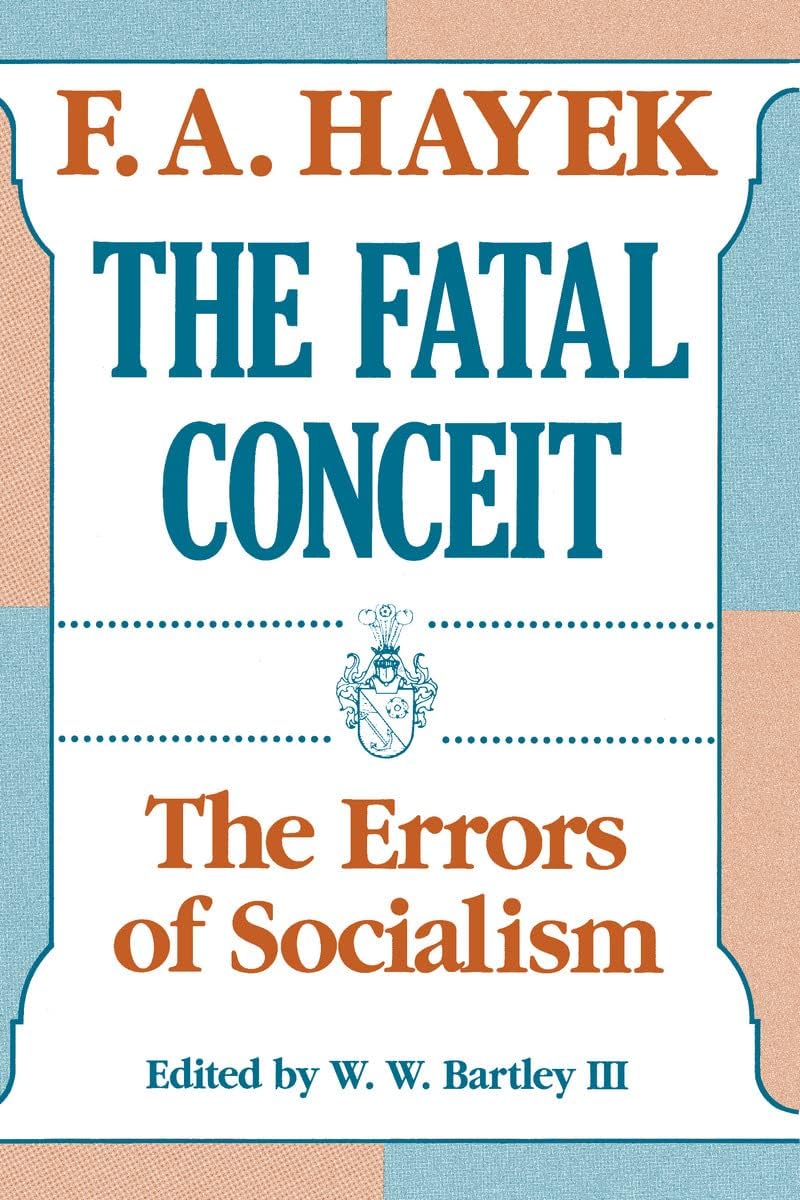
The Fatal Conceit: The Errors of Socialism (Volume 1) (The Collected Works of F. A. Hayek)
Product ID: 7175397
Buy anything from 5,000+ international stores. One checkout price. No surprise fees. Join 2M+ shoppers on Desertcart.
Desertcart purchases this item on your behalf and handles shipping, customs, and support to Vietnam.
Hayek gives the main arguments for the free-market case and presents his manifesto on the "errors of socialism." Hayek argues that socialism has, from its origins, been mistaken on factual, and even on logical, grounds and that its repeated failures in the many different practical applications of socialist ideas that this century has witnessed were the direct outcome of these errors. He labels as the "fatal conceit" the idea that "man is able to shape the world around him according to his wishes." "The achievement of The Fatal Conceit is that it freshly shows why socialism must be refuted rather than merely dismissed—then refutes it again."—David R. Henderson, Fortune . "Fascinating. . . . The energy and precision with which Mr. Hayek sweeps away his opposition is impressive."—Edward H. Crane, Wall Street Journal F. A. Hayek is considered a pioneer in monetary theory, the preeminent proponent of the libertarian philosophy, and the ideological mentor of the Reagan and Thatcher "revolutions." Review: In Defense of Liberty and Classical Liberalism - The Fatal Conceit, by F.A. Hayek, is an economics book but does not dig into detailed economic theory or examine economic principles as such. Published when Hayek was 89, it summarizes what Hayek learned in a lifetime of study of the science of economics and the creation of human wealth. It is a justification and theoretical defense of classical liberalism, thereby providing an explanation of the assumptions and analysis underlying the free-market economic thinking of Ludwig von Mises, Milton Friedman, Thomas Sowell, Walter E. Williams, and Hayek himself. Hayek was an excellent writer and this 150-page book covers a lot of ground while being easy to follow. Yet, I found it to be a slow read; it provides much to ponder. Economics might be described as the study of how humans behave when changes happen to things they value and trade: changes in quality, availability, demand, or price. It might more accurately be described as the study of the effects of all the humans behaving, as and after they behave, and the effort to model and predict these effects. Actual human behavior can be inferred but is less important than the aggregate effects. Economics is less concerned with how people react when the price of steel goes up than in what changes in the quantity of steel purchased, the quantity of steel produced and the effects on price and demand for aluminium and other substitutes for steel. Hayek’s The Fatal Conceit takes a step back farther still, examining aggregate human nature and what happens to those things we value and exchange (buy and sell) when humans have liberty to make their own decisions and security in their persons and their property. The result of this liberty and security is what Hayek calls “the extended order” (or more precisely, the extended order of voluntary human interaction, aka the free market), a self-organizing ecosystem that automatically provides more of something when need or demand goes up and, overall, has advanced our standard of living (wealth) beyond that of the hunter-gatherer societies of the first 90% of our species existence. No charts, no graphs, no equations, no tables of numbers. Easily read prose that explains Hayek’s conclusions about how human wealth is created and how the extended order operates. In the process Hayek explores our instinctive responses, the communal “micro morality” that enabled small troops of hunter-gatherers to survive, and how these instincts gave way to a “macro morality” based not on instincts but on traditions – the learned results of trial-and-error – as humans began to trade and increase our wealth over the last 10,000 years or so. Though guided by instincts and reason, this macro-morality exists between instinct and reason as the evolving form of what humans have discovered works. The “Fatal Conceit” is the ancient belief that reason, particularly the reasoning of powerful or educated elites, can manage and operate the human economy (and the creation of wealth and wellbeing) more efficiently and more effectively than the extended order will operate on its own. Much like the discredited idea that modern biological and agricultural expertise can be utilized to manage the Serengeti better than it operates, and has operated for perhaps millions of years, on its own, progressivism and modern socialism update this millennia-old conceit by asserting that modern science and the rationality of the Enlightenment enable humans to intentionally control the details of creation, production, and distribution of human goods and services better than the self-organizing and self-regulating extended order of the free market. In the 1960s, the Ecology Movement explained that natural ecosystems were far too complex for human science and reason to control and that any artificial actions should be undertaken with humility, the expectation of unforeseeable consequences, and the very likely possibilities that those actions would have to be reversed. Hayek asserts that the ecology of human economics, the extended order, is vastly more complex, more dynamic, and more changeable than any natural ecosystem, hence even less amenable to rational control than nature. Limits and boundary conditions, yes, but control no. Whether you agree or disagree with Hayek’s conclusions, this is an excellent summary of the overall thinking of the leading free-market economists. Review: Difficult, simple, thrilling, terrifying, inspiring. - I first read this book about 20 years ago. This time I decided to listen to it. Hayek's style and intelligence demands a lot from any reader. Kudos to the Audible performer for his truly excellent job of making this difficult book accessible. The book itself is the most important single book I have ever read (I swear I have never said that about any other book). It explains clearly and convincingly that our civilization and its ability support multiple billions of lives depends completely on the laws and customs concerning private property that have evolved over millennia, that no one is smart enough to have designed this self-organizing system, let alone a better one, and that socialism is founded on a challenge to both of these. Even now that it is clear that all big socialism experiments have both failed and created only misery, people cling to the idea that some form of socialism can work. In this book's introduction, Hayek acknowledges the power and even the beauty of the socialist idea. Indeed, Hayek's biographer says Hayek himself was a socialist as a young man. If socialism appeals to you, read this book and you will see that Hayek and you share common ground. You can feel the good will toward humanity's billions that underlies Hayek's most urgent message (essentially, don't kill the goose...). Hayek's words on diversity will impress you that systems depending on evolution create and demonstrate the value of diversity. In today's identity culture wars, Hayek is neither on the right nor the left in any sense I can appreciate. To the extent he speaks to it, identity politics on both the right and the left are mistaken. The self-organizing complex system of laws and customs that has evolved is truly blind to race, color, creed, gender, orientation ... to everything except one thing. You live by the laws and customs that work and you may thrive (still no guarantee). You don't do that and you are more likely not to thrive. Is he saying we cannot do better? No. Just as in biological evolution, we can and should continue to experiment. But as with any experiment, we should be careful with the ones we choose. We may or may not know how to make it fatter, but we know how to kill the goose.
| Best Sellers Rank | #82,613 in Books ( See Top 100 in Books ) #37 in Theory of Economics #51 in Political Economy #105 in Economic Conditions (Books) |
| Customer Reviews | 4.6 out of 5 stars 584 Reviews |
G**N
In Defense of Liberty and Classical Liberalism
The Fatal Conceit, by F.A. Hayek, is an economics book but does not dig into detailed economic theory or examine economic principles as such. Published when Hayek was 89, it summarizes what Hayek learned in a lifetime of study of the science of economics and the creation of human wealth. It is a justification and theoretical defense of classical liberalism, thereby providing an explanation of the assumptions and analysis underlying the free-market economic thinking of Ludwig von Mises, Milton Friedman, Thomas Sowell, Walter E. Williams, and Hayek himself. Hayek was an excellent writer and this 150-page book covers a lot of ground while being easy to follow. Yet, I found it to be a slow read; it provides much to ponder. Economics might be described as the study of how humans behave when changes happen to things they value and trade: changes in quality, availability, demand, or price. It might more accurately be described as the study of the effects of all the humans behaving, as and after they behave, and the effort to model and predict these effects. Actual human behavior can be inferred but is less important than the aggregate effects. Economics is less concerned with how people react when the price of steel goes up than in what changes in the quantity of steel purchased, the quantity of steel produced and the effects on price and demand for aluminium and other substitutes for steel. Hayek’s The Fatal Conceit takes a step back farther still, examining aggregate human nature and what happens to those things we value and exchange (buy and sell) when humans have liberty to make their own decisions and security in their persons and their property. The result of this liberty and security is what Hayek calls “the extended order” (or more precisely, the extended order of voluntary human interaction, aka the free market), a self-organizing ecosystem that automatically provides more of something when need or demand goes up and, overall, has advanced our standard of living (wealth) beyond that of the hunter-gatherer societies of the first 90% of our species existence. No charts, no graphs, no equations, no tables of numbers. Easily read prose that explains Hayek’s conclusions about how human wealth is created and how the extended order operates. In the process Hayek explores our instinctive responses, the communal “micro morality” that enabled small troops of hunter-gatherers to survive, and how these instincts gave way to a “macro morality” based not on instincts but on traditions – the learned results of trial-and-error – as humans began to trade and increase our wealth over the last 10,000 years or so. Though guided by instincts and reason, this macro-morality exists between instinct and reason as the evolving form of what humans have discovered works. The “Fatal Conceit” is the ancient belief that reason, particularly the reasoning of powerful or educated elites, can manage and operate the human economy (and the creation of wealth and wellbeing) more efficiently and more effectively than the extended order will operate on its own. Much like the discredited idea that modern biological and agricultural expertise can be utilized to manage the Serengeti better than it operates, and has operated for perhaps millions of years, on its own, progressivism and modern socialism update this millennia-old conceit by asserting that modern science and the rationality of the Enlightenment enable humans to intentionally control the details of creation, production, and distribution of human goods and services better than the self-organizing and self-regulating extended order of the free market. In the 1960s, the Ecology Movement explained that natural ecosystems were far too complex for human science and reason to control and that any artificial actions should be undertaken with humility, the expectation of unforeseeable consequences, and the very likely possibilities that those actions would have to be reversed. Hayek asserts that the ecology of human economics, the extended order, is vastly more complex, more dynamic, and more changeable than any natural ecosystem, hence even less amenable to rational control than nature. Limits and boundary conditions, yes, but control no. Whether you agree or disagree with Hayek’s conclusions, this is an excellent summary of the overall thinking of the leading free-market economists.
J**N
Difficult, simple, thrilling, terrifying, inspiring.
I first read this book about 20 years ago. This time I decided to listen to it. Hayek's style and intelligence demands a lot from any reader. Kudos to the Audible performer for his truly excellent job of making this difficult book accessible. The book itself is the most important single book I have ever read (I swear I have never said that about any other book). It explains clearly and convincingly that our civilization and its ability support multiple billions of lives depends completely on the laws and customs concerning private property that have evolved over millennia, that no one is smart enough to have designed this self-organizing system, let alone a better one, and that socialism is founded on a challenge to both of these. Even now that it is clear that all big socialism experiments have both failed and created only misery, people cling to the idea that some form of socialism can work. In this book's introduction, Hayek acknowledges the power and even the beauty of the socialist idea. Indeed, Hayek's biographer says Hayek himself was a socialist as a young man. If socialism appeals to you, read this book and you will see that Hayek and you share common ground. You can feel the good will toward humanity's billions that underlies Hayek's most urgent message (essentially, don't kill the goose...). Hayek's words on diversity will impress you that systems depending on evolution create and demonstrate the value of diversity. In today's identity culture wars, Hayek is neither on the right nor the left in any sense I can appreciate. To the extent he speaks to it, identity politics on both the right and the left are mistaken. The self-organizing complex system of laws and customs that has evolved is truly blind to race, color, creed, gender, orientation ... to everything except one thing. You live by the laws and customs that work and you may thrive (still no guarantee). You don't do that and you are more likely not to thrive. Is he saying we cannot do better? No. Just as in biological evolution, we can and should continue to experiment. But as with any experiment, we should be careful with the ones we choose. We may or may not know how to make it fatter, but we know how to kill the goose.
K**H
Profound Perspective on Civilization and Economies
As for quality of product: No issues with this copy. Not a classy cover design, but no flaws in the transcription. As for the work itself: Great book. Would highly recommend for everyone to read. A rational work highlighting civilization's natural ordering as evolved "between instinct and reason".
F**N
Highly Intellectual, and Prescient
A tough read, and well worth it. Hayek has tried on a few occasions to get us to use other big and little used words, and this book is no exception (catallaxy?). Yet, he explains in great detail the appeal, why this pernicious, dangerous, and even deadly belief system (which initialed is BS). Why it won't go away. Tends to recur (as if it were a demon vampire). It's methods. And how we must be on the lookout for the tell tale signs, especially of the "camel's nose under the tent". Wish I had read this in college along with his excellent Road To Serfdom. Tough it out and read it. Please.
C**N
Hayek se adelantó varias décadas al la era crypto
Un libro poco conocido, más relevante que nunca, cuando losngobiernos quieren centralizar y controlar crypto y las finanzas descentralizadas.
S**R
This information has been, is, available to decision makers, academia, and they ignore it?
Socialism must be "hard-wired" into our psyche. It keeps getting recycled, often with a new name, or a new spin. It just does not go away. It appeals to our good intentions, and sense of fair play. Problem is, it does not work, and the explanations for why, is in this book. The failures of socialism are so consistent, that the only way to "sell" it, are by erasing accurate knowledge of history, and destroying reminders by becoming iconoclastic. After all, "It is not the system that failed, the execution was faulty". Faulty consistently over the last 28 regimes. It may be that the system is not the problem, but ignoring human nature is a certain problem. Don't waste any more time reading this. Buy the book, borrow a copy, whatever. Then read the book, and pass it on.
G**S
a vital read!
Hayek is not an easy read read. You need to chew over the ideas in his book and consider them seriously. If you do, your thinking will mature.
C**E
Irreplaceable traditional morals - the foundation of civilization
This might be the most profound look at civilization I've ever encountered. The traditional values passed down through the ages evolved because people who observed them prospered, and those who didn't, died. These values include honesty, committment, family, etc, and they enabled mankind to multiply around the earth and to prosper. Evolved traditional values lie between instinct and reason. Socialism has always been popular with intellectuals, as highly intelligent people often believe reason can provide better rules for society. That belief is the fatal conceit, as it has proven time and again throughout history to destroy the bonds of civilized people. If you've read Hayek's works, you know that he strives for exactitude, and his sentence structure is therefore complex, requiring me to concentrate and make an effort. The effort is worth the time, because what is in this book is deeply insightful and based on research into thousands of years of history. It is highly applicable to today's world.
C**N
bom
bom
A**R
profound vitally important book
not always easy to read but helps one to understand the flaw at the heart of the argument of those who seek more state control.
C**.
Free Market Explanation
I bought this book for a friend who is an admirer of Socialism. Not sure if it worked, but it was good to see he told me he read it. Lying politely is the first step to recovery. A good explanation of free market thinking... whether you agree or not it's well written and will make you think.
D**R
Ein großartiges Werk des Nobelpreisträgers Hayek
Das Buch „The fatal conceit“ (die fatale Einbildung) des österreichischen Wirtschaftsnobelpreisträgers Friedrich August von Hayek wurde 1988 - vier Jahre vor seinem Tod - veröffentlicht und ist ein Kondensat seines Lebenswerkes, seiner Erkenntnisse und Überzeugungen. Leider ist das Werk nicht in Deutsch erhältlich. In neun Kapiteln beschreibt Hayek auf 180 Seiten die wesentlichen Antworten auf die Eingangsfrage: „Ist Sozialismus ein Fehler?“: 1. Zwischen Instinkt und Vernunft; 2. Die Herkunft der Freiheit, des Eigentums und der Gerechtigkeit; 3. Die Evolution des Marktes: Handel und Zivilisation; 4. Die Revolte des Instinkts und der Vernunft; 5. Die fatale Einbildung; 6. Die mysteriöse Welt des Handels und des Geldes; 7. Unsere vergiftete Sprache; 8. Die erweiterte Ordnung; 9. Religion und die Wächter der Tradition. Die Lektüre jedes Kapitels zeigt ein unglaublich tiefes und ein in einem langen Leben erarbeiteten Verständnis. Hayek war nicht nur Ökonom, sondern auch ein Philosoph mit einer tiefen Kenntnis vieler Autoren der klassischen Literatur und Ökonomen, Philosophen, Naturwissenschaftler und vielen weiteren Spezialgebieten. Er pflegte eine innige Freundschaft mit John Maynard Keynes, lehnte jedoch seine Sicht zur Steuerung der Wirtschaft ab. Keynes war sozusagen der große Gegenspieler von Hayek. Hayek kritisierte beispielsweise die zynische Bemerkung Keynes, wonach er meinte „in the long run we are all dead“. Bei einer solchen Sichtweise ist es offensichtlich weniger schlimm, wenn hinter den keyneschen Maßnahmen die Sintflut kommt. Nach Hayek ist Eigentum die wesentliche Voraussetzung einer entwickelten Wirtschaft. Ohne Eigentum wäre es unmöglich Wohlstand zu schaffen und zu mehren. Vor der neolithischen Revolution war das Schicksal des Menschen zu jagen und zu sammeln. Das Eigentum der Menschen war begrenzt auf ihre Kleider, Werkzeuge, Waffen etc. Im Laufe der neolithischen Revolution, als die Menschen sukzessive sesshaft wurden, entwickelte sich das Eigentum weiter. Auch das Haus, das Vieh, das Land etc. waren nun in der Verantwortung des Individuums und der Familie und löste sich von der Verfügungsgewalt der Gruppe ab. Dieser Prozess war mit großen gesellschaftlichen Veränderungen verbunden. Die Menschen mussten lernen miteinander zu leben und Regeln zu bilden. Dieser evolutionäre Prozess optimierte sozusagen das Zusammenleben, führte zur Arbeitsteilung, zur Spezialisierung und damit zu Wohlstand, zum heutigen Menschen und zur heutigen Gesellschaft. Hayek spricht neben der biologischen Evolution vor allem von der kulturellen Evolution. Man müsse unterscheiden zwischen den Regeln einer kleinen Gruppe und der einer Gesellschaft. Es ist unmöglich, die Regeln einer kleinen Gruppe auf die der Gesellschaft zu übertragen. Dieses Missverständnis ist daher immer wieder Ursache für Meinungsverschiedenheiten von Solidarität, Gleichheit, Gemeinwohl, Eigentum etc. Nach Hayek erfordert Freiheit nicht zwangsläufig, dass alle Menschen, aber dass viele Menschen Eigentum besitzen. Er würde lieber ohne jegliches Eigentum in einem freien Land leben, in dem alle anderen Menschen Eigentum besitzen als in einem Land, in dem das gesamte Eigentum einer Kollektive gehört. Eigentum ist nach Hayek Grundvoraussetzung für die optimale Allokation von Ressourcen. Ohne Eigentum kann es keine Gerechtigkeit geben. Eigentum bedeutet auch Kapital, und mit Kapital können Ressourcen eingesetzt werden, um Produkte und damit Nutzen zu erzeugen. Der Satz von Karl Marx, wonach der Kapitalismus ein Proletariat geschaffen hat lässt er nicht gelten. Im Gegenteil hat der Kapitalismus erst ermöglicht, dass diese Menschen überhaupt leben konnten, sie wären sonst schlicht verhungert. Hayek zeigt diese Zusammenhänge sehr gut auf und belegt sie mit Daten und Fakten. Vor der industriellen Revolution gab es immer wieder Hungersnöte. Die Menschen lebten in bitterer Armut, meistens auf dem Land. Viele starben durch Seuchen, Hunger und Gewalt. Durch die Entwicklung der Arbeitsteilung, durch Innovation und Spezialisierung wurden Maschinen und Fähigkeiten entwickelt, die in der Lage waren Produkte viel effizienter herzustellen. Die Arbeitskräfte, die massenweise vom Land in die Industriestädte zogen wollten arbeiten. Natürlich waren die Bedingungen zu Beginn der industriellen Revolution katastrophal, und niemand möchte solche Verhältnisse sehen. Aber eines passierte, nämlich dass die Menschen Geld verdienten und somit überlebten. Im Laufe der weiteren Entwicklung der Industrie stieg auch der Wohlstand deutlich an. Kleider, Nahrungsmittel und Wohnungen waren plötzlich auch für einfache Arbeiter leistbar, wenn auch in einem erbärmlichen Zustand. Aber sie überlebten. Ich fragte mich stets, warum Karl Marx sein Werk „Das Kapital“ nicht vollendete. Auf der Seite 150 fand ich endlich eine Antwort. Marx las die Werke von Jevons und vor allem Carl Menger, einem 22 Jahre jüngeren Zeitgenossen von Marx und Gründer der Österreichischen Schule der Nationalökonomie. Nachdem Marx das Werk Mengers gelesen hatte, stellte er alle Arbeiten an seinem Werk ein. Die Erkenntnisse Mengers standen diametral zu den Erkenntnissen von Marx. Heute, 150 Jahre später, ist klar, dass die Theorie von Marx sowohl theoretisch als auch praktisch widerlegt und die von Menger bestätigt ist. Vielleicht ist Marx bei der Lektüre ein Licht aufgegangen. Er hätte seinen Irrtum eingestehen sollen. Der Welt wären mehrere Katastrophen erspart geblieben.
F**S
Super important book
Oh boy, and I'm used to reading these type of books. I'm only giving it 4 stars because it took me ages to read it and I think it could have been written in a slightly easier way, more direct and clear. But that being said, the information here is invaluable, setting some of the bases for democracy, tradition, evolution, the role of intellectuals, etc. It's definitely worth the time it took me to read it!
Trustpilot
2 days ago
1 month ago