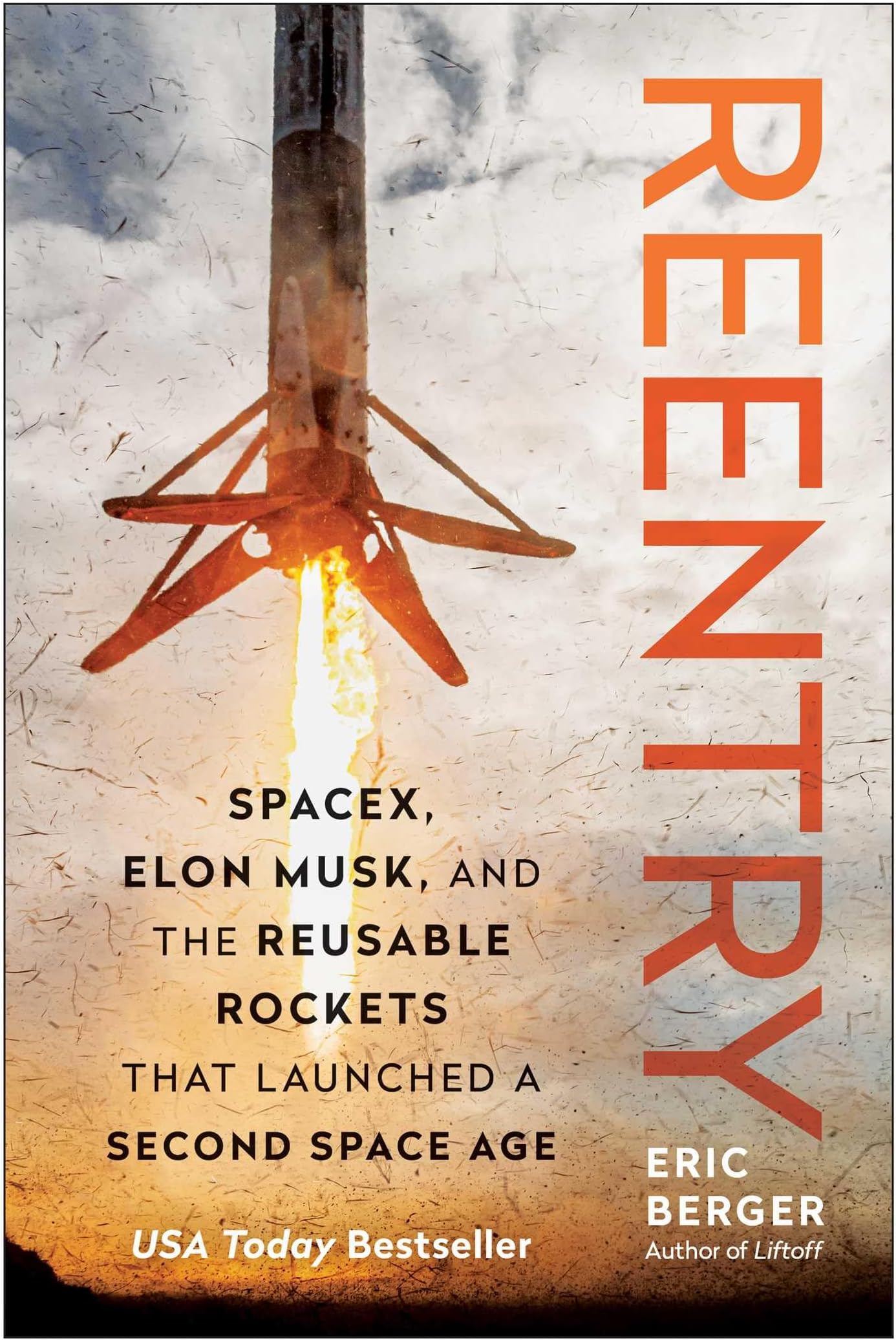
Reentry: SpaceX, Elon Musk, and the Reusable Rockets that Launched a Second Space Age
Product ID: 626165534
Buy anything from 5,000+ international stores. One checkout price. No surprise fees. Join 2M+ shoppers on Desertcart.
Desertcart purchases this item on your behalf and handles shipping, customs, and support to Vietnam.
National Indie Excellence Awards Winner in Technology Featured in The Economist ’s Best Books of 2024 USA Today Bestseller How did a shaky startup defy expectations and become the world’s leading spaceflight company? Get the untold story of the team of game-changers, led by a well-known billionaire, who are sending NASA astronauts to space—and just might carry the human race to Mars. One company dominates the modern space industry: SpaceX, founded by controversial entrepreneur Elon Musk in 2002, now sending more payloads into orbit than the rest of the world combined. But Musk didn’t do it alone—the saga of SpaceX is the story of a diverse cadre of true believers in the limitless potential of space travel. For the first time, Reentry relates the definitive chronicle of how this daring team was able to redefine what it takes to reach the stars. With Pulitzer Prize–nominated journalist Eric Berger, author of Liftoff , as your guide, you’ll accompany SpaceX’s innovative thinkers during their toughest trials and most audacious moments, including: Creating the first orbital rockets that land by themselves and fly again Transporting a 120-foot rocket from Texas to Florida Recovering from a “Hell’s Bells” accident before the first Falcon Heavy launch Frantically searching the ocean for the first rocket that splashed down intact Identifying the $20 part that led to a rocket exploding in flight Slicing up an engine days before it launched into space From launchpad explosions to a pernicious cricket infestation to the demanding management style of Musk himself, the rise of SpaceX was beset with challenges and far from inevitable. Find out how the startup beat the odds and flew high enough to outpace their rivals . . . and where they’re going next. Review: A Brilliant Story About How Falcon 9 Came Into Existence - I want to continue talking about space travel. I have a great book recommendation for you this morning. First, I want to introduce the author to you. Like me, in his childhood, Eric Berger was fascinated with space travel. He decided to become an astronomer. He went to the University of Texas. He earned a B.S. degree in astronomy. His next steps would have been an M.S. and a Ph. D in astronomy. He decided to take a radically different course in life. He chose a career in writing. He decided to attend the prestigious University of Missouri School of Journalism. He earned an M.A. degree. For the past 17 years, he has been the science writer for The Houston Chronicle. I first got to know Eric through his first book "Liftoff." It was the history of how Space X went from a startup to the success of the Falcon 1 rocket. I found Eric to be a great storyteller. When you pick up a book he has written, you will be entertained and enlightened. With his background in science, he was able to take very complicated technical matters and explain them in such a way that non-technical people could understand them. He also has this marvelous talent to get people to completely relax and "tell all" during the interview process. Eric has written a new book that I just finished reading. Its title is "Reentry." Here is a summary of the book: Reentry: SpaceX, Elon Musk, and the Reusable Rockets that Launched a Second Space Age Hardcover – September 24, 2024 by Eric Berger (Author) 4.8 4.8 out of 5 stars 125 ratings 4.7 on Goodreads 129 ratings #1 Best Seller in Astronautics & Space Flight See all formats and editions ________________________________________ USA Today Bestseller How did a shaky startup defy expectations and become the world’s leading spaceflight company? Get the untold story of the team of game-changers, led by a well-known billionaire, who are sending NASA astronauts to space—and just might carry the human race to Mars. One company dominates the modern space industry: SpaceX, founded by controversial entrepreneur Elon Musk in 2002, now sending more payloads into orbit than the rest of the world combined. But Musk didn’t do it alone—the saga of SpaceX is the story of a diverse cadre of true believers in the limitless potential of space travel. For the first time, Reentry relates the definitive chronicle of how this daring team was able to redefine what it takes to reach the stars. With Pulitzer Prize–nominated journalist Eric Berger, author of Liftoff, as your guide, you’ll accompany SpaceX’s innovative thinkers during their toughest trials and most audacious moments, including: • Creating the first orbital rockets that land by themselves and fly again • Transporting a 120-foot rocket from Texas to Florida • Recovering from a “Hell’s Bells” accident before the first Falcon Heavy launch • Frantically searching the ocean for the first rocket that splashed down intact • Identifying the $20 part that led to a rocket exploding in flight • Slicing up an engine days before it launched into space From launchpad explosions to a pernicious cricket infestation to the demanding management style of Musk himself, the rise of SpaceX was beset with challenges and far from inevitable. Find out how the startup beat the odds and flew high enough to outpace their rivals . . . and where they’re going next. This book is the fascinating history of how the Falcon 9 rocket went from being an idea in Elon Musk's head to one of the most incredible launch vehicles on planet Earth. It is the first major booster system to be reusable. NASA, Roscosmos, the European Space Agency, and the China National Space Agency (CNSA) have not been able to equal yet. This book is a page-turner that you will not be able to put down. Review: Fascinating history of the company that reinvented space launch - In this second book on SpaceX, Berger’s focus is not so much on Elon Musk as on how the launch company developed and succeeded, with emphasis on its relationship with NASA. Berger’s prose is clear and crisp throughout the book. He knows his stuff, technically, and explains it in terms suitable for smart high schoolers on up. I didn’t see any errors in the technology sections, though I thought there were points that needed elaboration. The media narrative of SpaceX’s sometimes-difficult partnership with NASA is clarified here. NASA contracts, some of them awarded before the space agency could be certain the company could deliver, saved SpaceX from bankruptcy at least twice. Berger recounts incidents when SpaceX’s speed-first approach came back to take very expensive bites out of the company’s collective butt, also he also tells the lesser-known story of how accommodating NASA could be. NASA officials, especially Kathy Leuders, did everything possible to meld SpaceX’s way of doing things to NASA’s, maintaining the critical requirements and making re-interpretations or exceptions when warranted. SpaceX is most famous for making boosters reusable. Berger details how this wasn’t part of Musk’s original vision but was added as he and his people wrestled with long-term cost reduction. The investment cost of making a launcher reusable was not something NASA or DoD felt was worth dedicated funding. Berger writes the biggest NASA crisis came when SpaceX’s desire to “load and go” – to load the densified propellants once the astronauts were already in the Dragon to speed the process and lengthen the launch window – drew instant and near-universal negative response from NASA experts. It took dozens of safe uncrewed Falcon 9 flights and a mountain of studies and test results to get NASA to declare the concept safe. Berger explains how Musk’s greatest strength – his ability to lay out ever-grander visions and inspire people to work insane hours to make them come true – was also a weakness when dealing with NASA. Musk’s vision of a civilization on Mars was one thing: devoting SpaceX to two huge projects, the Starship vehicle to make Mars possible and the Starlink constellation to pay for it, while he had NASA work on contract, led to criticism because the company was behind on delivering the Dragon capsule for the Commercial Crew program. This after NASA Commercial Crew head Phil McAlister just barely convinced a skeptical committee that wanted to rely on Boeing that they should also give the newcomer a chance. Once Crew Dragon was flying, Musk had to sell NASA and DoD on his next vehicle, the Falcon Heavy. NASA declined to put a payload on the first flight of such a massive, innovative rocket, even for free, so Musk’s Tesla roadster went up instead. NASA was convinced, moving its Europa probe from SLS to FH at what Berger estimates was $2B in savings. The success of the NASA-SpaceX partnership helped the latter win the 2021 Artemis contract for the lunar lander. Now, Berger points out, NASA can only afford Artemis and other exploration programs because of the cost savings SpaceX provides for its non-SLS launches. The ever-dominant issue of cost will likely keep SpaceX’s leading position with NASA and military launches for a long time despite rivals like Blue Origin. Berger closes by musing on SpaceX’s indispensable strength and its biggest weakness – Musk. Musk is, to some American politicians, radioactive, and having the more diplomatic Gwynne Shotwell run SpaceX only goes so far. Musk’s image as a man singularly focused on moving humanity into the technological future and taking us to Mars was gone once he bought Twitter/X, which does none of those things and is enmeshed in a storm of controversy. The one thing Berger does not do is explore the details about how NASA/DoD and SpaceX work together on the front lines: he keeps it to the major players. The day-to-day workings of the partnership in the many locations they take place, between workers at low and mid levels, could at least have a chapter or two here. In summary, the story Berger tells about Space X and the government is one of sometimes-fractious partners who made it work. There’s no question the partnership will continue, for decades at least. It may even take us to Mars. Berger’s first-rate book is indispensable to anyone who wants to understand how that partnership was born and nurtured along with the technology to make it worth pursuing. A good photo section and an index round out the book.


| Best Sellers Rank | #46,104 in Books ( See Top 100 in Books ) #5 in Astronautics & Space Flight #21 in Aeronautics & Astronautics (Books) #53 in Astrophysics & Space Science (Books) |
| Customer Reviews | 4.8 out of 5 stars 821 Reviews |
J**R
A Brilliant Story About How Falcon 9 Came Into Existence
I want to continue talking about space travel. I have a great book recommendation for you this morning. First, I want to introduce the author to you. Like me, in his childhood, Eric Berger was fascinated with space travel. He decided to become an astronomer. He went to the University of Texas. He earned a B.S. degree in astronomy. His next steps would have been an M.S. and a Ph. D in astronomy. He decided to take a radically different course in life. He chose a career in writing. He decided to attend the prestigious University of Missouri School of Journalism. He earned an M.A. degree. For the past 17 years, he has been the science writer for The Houston Chronicle. I first got to know Eric through his first book "Liftoff." It was the history of how Space X went from a startup to the success of the Falcon 1 rocket. I found Eric to be a great storyteller. When you pick up a book he has written, you will be entertained and enlightened. With his background in science, he was able to take very complicated technical matters and explain them in such a way that non-technical people could understand them. He also has this marvelous talent to get people to completely relax and "tell all" during the interview process. Eric has written a new book that I just finished reading. Its title is "Reentry." Here is a summary of the book: Reentry: SpaceX, Elon Musk, and the Reusable Rockets that Launched a Second Space Age Hardcover – September 24, 2024 by Eric Berger (Author) 4.8 4.8 out of 5 stars 125 ratings 4.7 on Goodreads 129 ratings #1 Best Seller in Astronautics & Space Flight See all formats and editions ________________________________________ USA Today Bestseller How did a shaky startup defy expectations and become the world’s leading spaceflight company? Get the untold story of the team of game-changers, led by a well-known billionaire, who are sending NASA astronauts to space—and just might carry the human race to Mars. One company dominates the modern space industry: SpaceX, founded by controversial entrepreneur Elon Musk in 2002, now sending more payloads into orbit than the rest of the world combined. But Musk didn’t do it alone—the saga of SpaceX is the story of a diverse cadre of true believers in the limitless potential of space travel. For the first time, Reentry relates the definitive chronicle of how this daring team was able to redefine what it takes to reach the stars. With Pulitzer Prize–nominated journalist Eric Berger, author of Liftoff, as your guide, you’ll accompany SpaceX’s innovative thinkers during their toughest trials and most audacious moments, including: • Creating the first orbital rockets that land by themselves and fly again • Transporting a 120-foot rocket from Texas to Florida • Recovering from a “Hell’s Bells” accident before the first Falcon Heavy launch • Frantically searching the ocean for the first rocket that splashed down intact • Identifying the $20 part that led to a rocket exploding in flight • Slicing up an engine days before it launched into space From launchpad explosions to a pernicious cricket infestation to the demanding management style of Musk himself, the rise of SpaceX was beset with challenges and far from inevitable. Find out how the startup beat the odds and flew high enough to outpace their rivals . . . and where they’re going next. This book is the fascinating history of how the Falcon 9 rocket went from being an idea in Elon Musk's head to one of the most incredible launch vehicles on planet Earth. It is the first major booster system to be reusable. NASA, Roscosmos, the European Space Agency, and the China National Space Agency (CNSA) have not been able to equal yet. This book is a page-turner that you will not be able to put down.
M**E
Fascinating history of the company that reinvented space launch
In this second book on SpaceX, Berger’s focus is not so much on Elon Musk as on how the launch company developed and succeeded, with emphasis on its relationship with NASA. Berger’s prose is clear and crisp throughout the book. He knows his stuff, technically, and explains it in terms suitable for smart high schoolers on up. I didn’t see any errors in the technology sections, though I thought there were points that needed elaboration. The media narrative of SpaceX’s sometimes-difficult partnership with NASA is clarified here. NASA contracts, some of them awarded before the space agency could be certain the company could deliver, saved SpaceX from bankruptcy at least twice. Berger recounts incidents when SpaceX’s speed-first approach came back to take very expensive bites out of the company’s collective butt, also he also tells the lesser-known story of how accommodating NASA could be. NASA officials, especially Kathy Leuders, did everything possible to meld SpaceX’s way of doing things to NASA’s, maintaining the critical requirements and making re-interpretations or exceptions when warranted. SpaceX is most famous for making boosters reusable. Berger details how this wasn’t part of Musk’s original vision but was added as he and his people wrestled with long-term cost reduction. The investment cost of making a launcher reusable was not something NASA or DoD felt was worth dedicated funding. Berger writes the biggest NASA crisis came when SpaceX’s desire to “load and go” – to load the densified propellants once the astronauts were already in the Dragon to speed the process and lengthen the launch window – drew instant and near-universal negative response from NASA experts. It took dozens of safe uncrewed Falcon 9 flights and a mountain of studies and test results to get NASA to declare the concept safe. Berger explains how Musk’s greatest strength – his ability to lay out ever-grander visions and inspire people to work insane hours to make them come true – was also a weakness when dealing with NASA. Musk’s vision of a civilization on Mars was one thing: devoting SpaceX to two huge projects, the Starship vehicle to make Mars possible and the Starlink constellation to pay for it, while he had NASA work on contract, led to criticism because the company was behind on delivering the Dragon capsule for the Commercial Crew program. This after NASA Commercial Crew head Phil McAlister just barely convinced a skeptical committee that wanted to rely on Boeing that they should also give the newcomer a chance. Once Crew Dragon was flying, Musk had to sell NASA and DoD on his next vehicle, the Falcon Heavy. NASA declined to put a payload on the first flight of such a massive, innovative rocket, even for free, so Musk’s Tesla roadster went up instead. NASA was convinced, moving its Europa probe from SLS to FH at what Berger estimates was $2B in savings. The success of the NASA-SpaceX partnership helped the latter win the 2021 Artemis contract for the lunar lander. Now, Berger points out, NASA can only afford Artemis and other exploration programs because of the cost savings SpaceX provides for its non-SLS launches. The ever-dominant issue of cost will likely keep SpaceX’s leading position with NASA and military launches for a long time despite rivals like Blue Origin. Berger closes by musing on SpaceX’s indispensable strength and its biggest weakness – Musk. Musk is, to some American politicians, radioactive, and having the more diplomatic Gwynne Shotwell run SpaceX only goes so far. Musk’s image as a man singularly focused on moving humanity into the technological future and taking us to Mars was gone once he bought Twitter/X, which does none of those things and is enmeshed in a storm of controversy. The one thing Berger does not do is explore the details about how NASA/DoD and SpaceX work together on the front lines: he keeps it to the major players. The day-to-day workings of the partnership in the many locations they take place, between workers at low and mid levels, could at least have a chapter or two here. In summary, the story Berger tells about Space X and the government is one of sometimes-fractious partners who made it work. There’s no question the partnership will continue, for decades at least. It may even take us to Mars. Berger’s first-rate book is indispensable to anyone who wants to understand how that partnership was born and nurtured along with the technology to make it worth pursuing. A good photo section and an index round out the book.
C**T
SpaceX Success Story
This book effectively picks up where Liftoff left off. Plus, it covers Elon Musk's, how to put this, mental decline over the last several years. But ultimately what this book does is tells the story of the hard work that a lot of people put in to make a private company successful and the future of human spaceflight a little brighter. I'm going to start off with something I complained about in Liftoff and that's the non-linear storytelling the author uses here. Now, he addresses it somewhat at the end of this book - the difficulty of telling so many converging stories with one greater overarching theme. I still prefer non-fiction to be as linear as possible, but I will table that complaint here. This is only Eric Berger's second book, but he has solidified himself as THE person to report on and write about SpaceX. He does an amazing job balancing telling the story of numerous people not named Elon Musk who had the tenacity and hard-work ethic to make human spaceflight and space exploration more affordable. He doesn't mince words when it comes to writing about failures during the process of making reusable rockets. And SpaceX certainly is no stranger to failure. In fact, as Berger pointed out in this book and its predecessor, SpaceX was built upon the ideology that failure leads to success. The main reason SpaceX has been able to succeed where it has is that it hasn't shied away from failure. Now, Berger also does a good job of getting across that SpaceX is most certainly not cavalier with human lives. Let's be clear about that. Again Berger pulled no punches when talking about Musk. He gives praise where praise is due to be sure. Without Musk, there would be no SpaceX, no Falcon rockets, and quite possibly no US transportation to the International Space Station. Boeing is failing all the time and Blue Origin just does seem to have the drive that SpaceX has. And that SpaceX drive is due to the culture that Musk cultivated when the company started. But, and this may come as a shock to you (it won't), Musk can be quite divisive. To put it about as diplomatically as possible. Berger touches in the book on how Musk single-handedly ruined Twitter when he acquired the company. Well, maybe not single-handedly. That platform is a toilet bowl if I've ever seen one. And Berger also talks about Musk's switcheroos in political positions. Somehow ($$$) he convinced Trump to take him under his wing and essentially create a position for Musk. A lot of people think this is a conflict of interest given Musk's ownership of SpaceX. But currently SpaceX is the US's only real option for launching satellites, supplies, and people into space. Being able to whisper in the President's ear to move along space policy isn't really going to help SpaceX any more than the mere fact that there just isn't competition at this point for SpaceX. The biggest issue with Musk, like the President he buddies around with, is his mouth. That's enough politics for this review. And with that, I gave this book 4.5 out of 5 stars. I'm eager to see how SpaceX continues to push the envelope and get the US into space over the next few years. As soon as Berger writes a new book about it, I'll be here to read it!
K**A
Informative and Emotionally Powerful
Full disclosure, I've been a passionate space nerd since childhood. I've gone to Edwards for Space Shuttle landings and Cape Canaveral for Shuttle launches. Until recently I watched every single SpaceX launch via YouTube, since the early Falcon 1 days. For me, Eric Berger's "Reentry" was both a chance to relive those amazing years where SpaceX exceeded every possible expectation, but also to get insight into the passionate and inspirational people that made it all happen. My job involves writing software for complex devices so I have a little insight into the true challenges faced by the engineers at SpaceX. "Reentry" was a true page turner. I burned through it like a Raptor burns through propellant. Berger has done a great job of capturing the true emotions of the triumphs and disappointments, the dedication and disillusionment. There are so many examples where his writing elicits strong emotions. It is why this book demands attention and keeps the reader anxious for the next page. This is perhaps best illustrated by the Dragon Crew One mission with Doug Hurley and Bob Behnken. These NASA astronauts are amazing people in their own right, but we also learn about the SpaceX and NASA people that accomplished something never done before -- a private company creating the large and complex infrastructure to launch astronauts to the space station and get them safely back home again. Each moment in that first Crew Dragon flight had drama and intensity. I'll add one more comment. Other Amazon reviewers are upset about the Epilogue because Berger expresses concern about Elon Musk's recent behavior. I take issue with reviewers who claim this to be liberal bias. There is no evidence for bias here. The truth is that Berger has shown himself to be an outstanding observer of events, with a talent for reporting the facts clearly and without undue bias. When he offers an opinion as he did in the Epilogue, he calls it out as opinion. It's my view that his bias is nothing more than a personal desire to see SpaceX continue to succeed. I found the comparison of Musk to Howard Hughes to be insightful. Many of you will disagree and that's fine with me. In my experience it is totally normal for people to have different views of the world, no agenda or bias required.
G**L
Dynamite book! Keeper Set for space knowledge
I have both books: Liftoff and Reentry. This is a must set of books for SpaceX and Elon Musk fans. Everything you want to know… the beginnings of SpaceX. Awesome keeper set!
T**.
Great Book!
Tracks development of landing of SpaceX rockets. Great read
R**R
An inspirational story
I bought this right after I finished Liftoff. The story behind SpaceX and the people involved and the challenges that they faced and solved were amazing. Great job, Eric!
O**R
"Reentry: SpaceX" Great Read
Book Review: "Reentry: SpaceX", Elon Musk, and the Reusable Rockets that Launched a Second Space Age by Eric Berger In Reentry, Eric Berger provides a captivating look into the high-stakes world of SpaceX and its visionary leader, Elon Musk. The narrative is charged with energy as Berger details Musk's relentless drive for innovation, pushing his team to develop rockets that are not only faster but also more cost-effective and reusable.Key Highlights: Insightful Portrait of Elon Musk: Berger delves into Musk’s complex personality, showcasing both his brilliance and the challenges his leadership style presents. Behind-the-Scenes Access: The book offers a rare glimpse into the inner workings of SpaceX, highlighting the intense culture and commitment of its employees. Future Prospects: Berger provides thought-provoking insights on the potential and pitfalls that lie ahead for SpaceX, creating a nuanced view of its impact on the future of space exploration. Overall, Reentry is a compelling read that combines technical details with personal stories, making it accessible for both space enthusiasts and general readers alike. It’s a fascinating exploration of how one company is reshaping the boundaries of space travel.
F**N
Space enthusiasts must read
Excellent book, with great insights on space X challenges and success, wonderfully based on employees statements. It makes you feel part of the Space X team while going through the amazing adventure of spaceflight.
J**G
Excellent book about engineering and work motivation
Brilliantly written, well researched and entertaining to read.
D**T
Très bonne suite à Liftoff, on attend la suite!
Très bon livre, qui fait suite à Liftoff et qui est aussi bien.
C**O
Es blanco y negro de pasta dura
Excelente libro y de pasta dura que ya casi no los hay pero es blanco y negro pero la información es lo que vale.
M**C
Excellent
Excellent. Well written and informative. Musks strengths are highlighted
Trustpilot
2 weeks ago
1 month ago