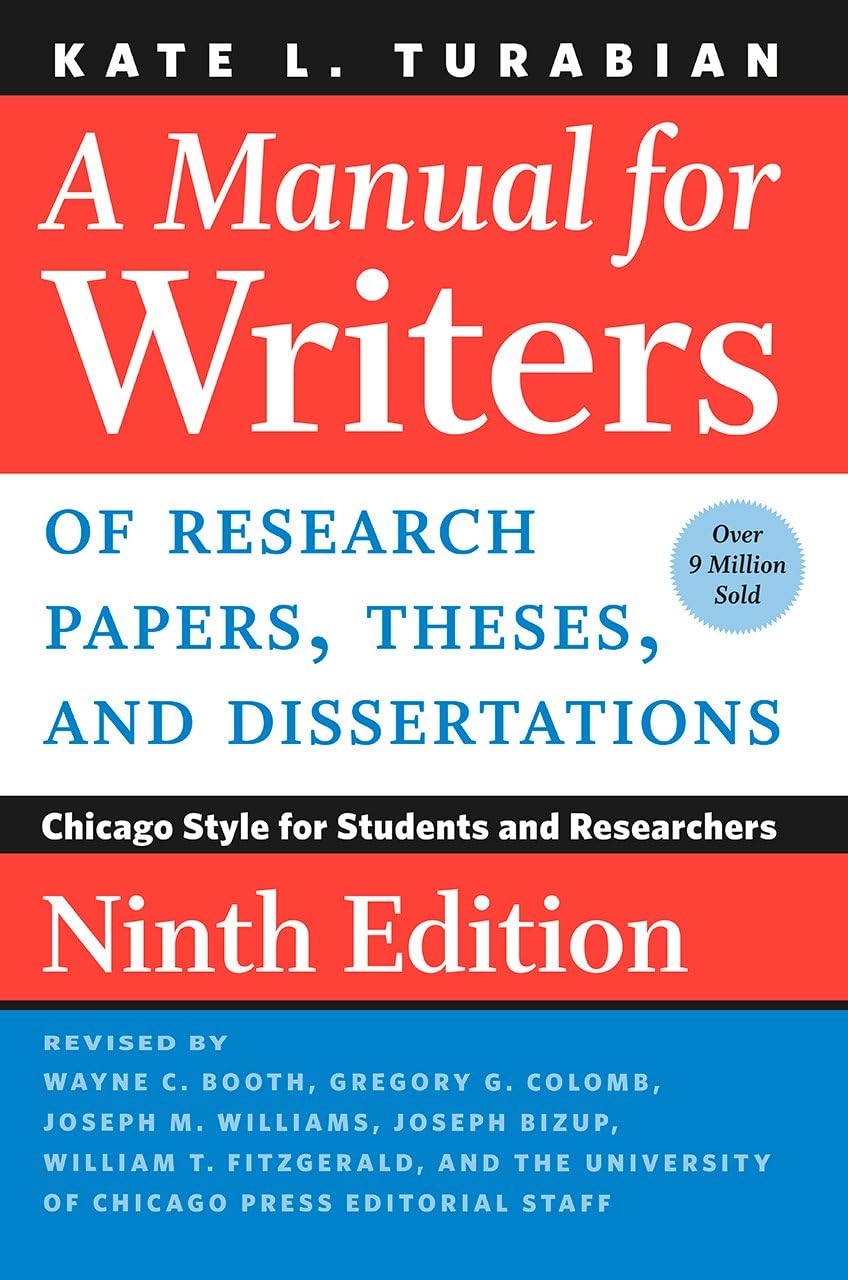
A Manual for Writers of Research Papers, Theses, and Dissertations, Ninth Edition: Chicago Style for Students and Researchers (Chicago Guides to Writing, Editing, and Publishing)
Product ID: 61794629
Buy anything from 5,000+ international stores. One checkout price. No surprise fees. Join 2M+ shoppers on Desertcart.
Desertcart purchases this item on your behalf and handles shipping, customs, and support to Vietnam.
When Kate L. Turabian first put her famous guidelines to paper, she could hardly have imagined the world in which today’s students would be conducting research. Yet while the ways in which we research and compose papers may have changed, the fundamentals remain the same: writers need to have a strong research question, construct an evidence-based argument, cite their sources, and structure their work in a logical way. A Manual for Writers of Research Papers, Theses, and Dissertations—also known as “Turabian”—remains one of the most popular books for writers because of its timeless focus on achieving these goals. This new edition filters decades of expertise into modern standards. While previous editions incorporated digital forms of research and writing, this edition goes even further to build information literacy, recognizing that most students will be doing their work largely or entirely online and on screens. Chapters include updated advice on finding, evaluating, and citing a wide range of digital sources and also recognize the evolving use of software for citation management, graphics, and paper format and submission. The ninth edition is fully aligned with the recently released Chicago Manual of Style, 17th edition, as well as with the latest edition of The Craft of Research. Teachers and users of the previous editions will recognize the familiar three-part structure. Part 1 covers every step of the research and writing process, including drafting and revising. Part 2 offers a comprehensive guide to Chicago’s two methods of source citation: notes-bibliography and author-date. Part 3 gets into matters of editorial style and the correct way to present quotations and visual material. A Manual for Writers also covers an issue familiar to writers of all levels: how to conquer the fear of tackling a major writing project. Through eight decades and millions of copies, A Manual for Writers has helped generations shape their ideas into compelling research papers. This new edition will continue to be the gold standard for college and graduate students in virtually all academic disciplines. Bestselling, trusted, and time-tested advice for writing research papers The best interpretation of Chicago style for higher education students and researchers Definitive, clear, and easy to read, with plenty of examples Shows how to compose a strong research question, construct an evidence-based argument, cite sources, and structure work in a logical way Essential for anyone interested in learning about research Everything any student or teacher needs to know concerning paper writing Review: Essential Manual! - When I began my master’s degree in education with a focus on history, every one of my professors pointed me toward A Manual for Writers of Research Papers, Theses, and Dissertations, Ninth Edition. That alone should tell you something—this isn’t optional reading; it’s the standard. Working in Chicago/Turabian style can feel overwhelming at first, especially if you’re coming from MLA or APA. This book exists to solve that problem. It’s comprehensive, detailed, and very much a step-by-step guide to structuring research, citations, and academic writing the right way. That said, it’s not a light read. This is a dense, reference-heavy manual—more something you use than sit down and read cover to cover. But like the saying goes, “How do you eat an elephant? One piece at a time.” Taken in sections, it becomes far more manageable, and over time, indispensable. If you’re serious about writing in Chicago style—especially in history or related fields—this book does exactly what it’s supposed to do. It takes a complicated standard and makes it usable. A Manual for Writers - it’s something you rely on. Not ideal for casual writers, but essential for academic work. Review: Guide to style - My wife is starting a doctoral program, and this is the book used for the format of papers. It is clear, concise, and extremely helpful.


| Best Sellers Rank | #7,954 in Books ( See Top 100 in Books ) #2 in Grammar Reference (Books) #2 in Research Reference Books #8 in Words, Language & Grammar Reference |
| Customer Reviews | 4.7 out of 5 stars 4,374 Reviews |
R**T
Essential Manual!
When I began my master’s degree in education with a focus on history, every one of my professors pointed me toward A Manual for Writers of Research Papers, Theses, and Dissertations, Ninth Edition. That alone should tell you something—this isn’t optional reading; it’s the standard. Working in Chicago/Turabian style can feel overwhelming at first, especially if you’re coming from MLA or APA. This book exists to solve that problem. It’s comprehensive, detailed, and very much a step-by-step guide to structuring research, citations, and academic writing the right way. That said, it’s not a light read. This is a dense, reference-heavy manual—more something you use than sit down and read cover to cover. But like the saying goes, “How do you eat an elephant? One piece at a time.” Taken in sections, it becomes far more manageable, and over time, indispensable. If you’re serious about writing in Chicago style—especially in history or related fields—this book does exactly what it’s supposed to do. It takes a complicated standard and makes it usable. A Manual for Writers - it’s something you rely on. Not ideal for casual writers, but essential for academic work.
D**M
Guide to style
My wife is starting a doctoral program, and this is the book used for the format of papers. It is clear, concise, and extremely helpful.
G**T
Great Resource
I had to get this for a class and hated the price. Then it saved me when I entered the publication process for a journal, now that book has been accepted for publication. Thanks for the required reading prof! Excellent for students and researchers a like, I never knew there were so many ways to cite one source.
D**E
Necessary Research Tool
"A Manual for Writers of Research Papers, Theses, and Dissertations," often referred to simply as "Turabian," is the essential guide for academic writing, research, and formatting in the humanities and social sciences. The ninth edition, updated by Wayne C. Booth, Gregory G. Colomb, Joseph M. Williams, and the University of Chicago Press editorial staff, continues its tradition of providing practical advice for writing clearly and properly citing sources, ensuring the reader can produce high-quality academic work. Key Features: 1. Comprehensive Research and Writing Guide: The book guides readers through every phase of writing a research paper, from choosing a topic to revising the final draft. It explains how to conduct research, manage sources, and organize ideas effectively. 2. Citation Styles: It provides detailed instructions on using both the notes-bibliography style (popular in history and some humanities fields) and the author-date style (often used in the sciences and social sciences). This flexibility makes it applicable to a broad range of academic disciplines. 3. Clear Structure and Layout: The book is structured logically, beginning with general principles of research and writing and progressing into more specific guidance, including citation rules, grammar, and formatting. It also includes sections that cover modern digital sources, which is important for today’s research environment. 4. User-Friendly for Students and Professionals: The manual is written in an accessible style, making it a useful reference not only for students writing their first research paper but also for experienced scholars seeking clarification on complex citation rules. Strengths: - Comprehensive yet Practical: The manual covers everything from the mechanics of writing to advanced research techniques. The clear examples and explanations make it highly usable for those unfamiliar with research writing. - Focus on Clarity and Argumentation: Turabian places a strong emphasis on developing a coherent thesis and supporting it with well-organized arguments, which is invaluable for crafting effective academic papers. - Adaptability: It accommodates a wide range of research disciplines and academic levels. Whether a graduate student writing a thesis or a seasoned researcher drafting a dissertation, the manual provides relevant guidance. Weaknesses: - Dense for Beginners: While thorough, the book may feel overwhelming for students unfamiliar with academic research. The sheer amount of detail can be daunting for those not accustomed to formal research and writing processes. - Focus on Traditional Sources: Though updated to include some discussion of digital sources, the manual is still somewhat centered on traditional academic materials. Researchers who rely heavily on digital tools or unconventional sources might find this a bit limiting. Conclusion: The ninth edition of "A Manual for Writers of Research Papers, Theses, and Dissertations" remains a foundational resource for anyone involved in academic writing. Its emphasis on clear communication, structured argumentation, and proper citation makes it an essential tool for students, scholars, and researchers. While it may seem dense to newcomers, the wealth of information provided ensures that it can be used as a long-term reference throughout one’s academic career.
B**X
Book
Helpful info for papers.
A**R
Informative
Good book.
B**R
The classic guide, invaluable for research writing
The classic guide, invaluable for research writing, each chapter has its own index.
T**N
A Manual for Writers of Research Papers, Theses and Dissertations
This is the one to get
M**.
Very Useful
Great value
R**N
Based on the quality of the cover, I think it is a good book:)
Based on the quality of the cover, I think it is a good book:)
P**L
Book
Received in good condition.
J**N
Clear, Concise Easy To Understand - But A Bit Long...
A Benchmark for researchers and writers. None better! John
E**K
Manual para escribir como científico social
Un texto especializado, único en su estilo. Como investigador científico, tenerlo en la biblioteca garantiza construir pensamiento crítico. Es didáctico y con ejemplos ampliamente ilustrativos.
Trustpilot
1 month ago
1 month ago