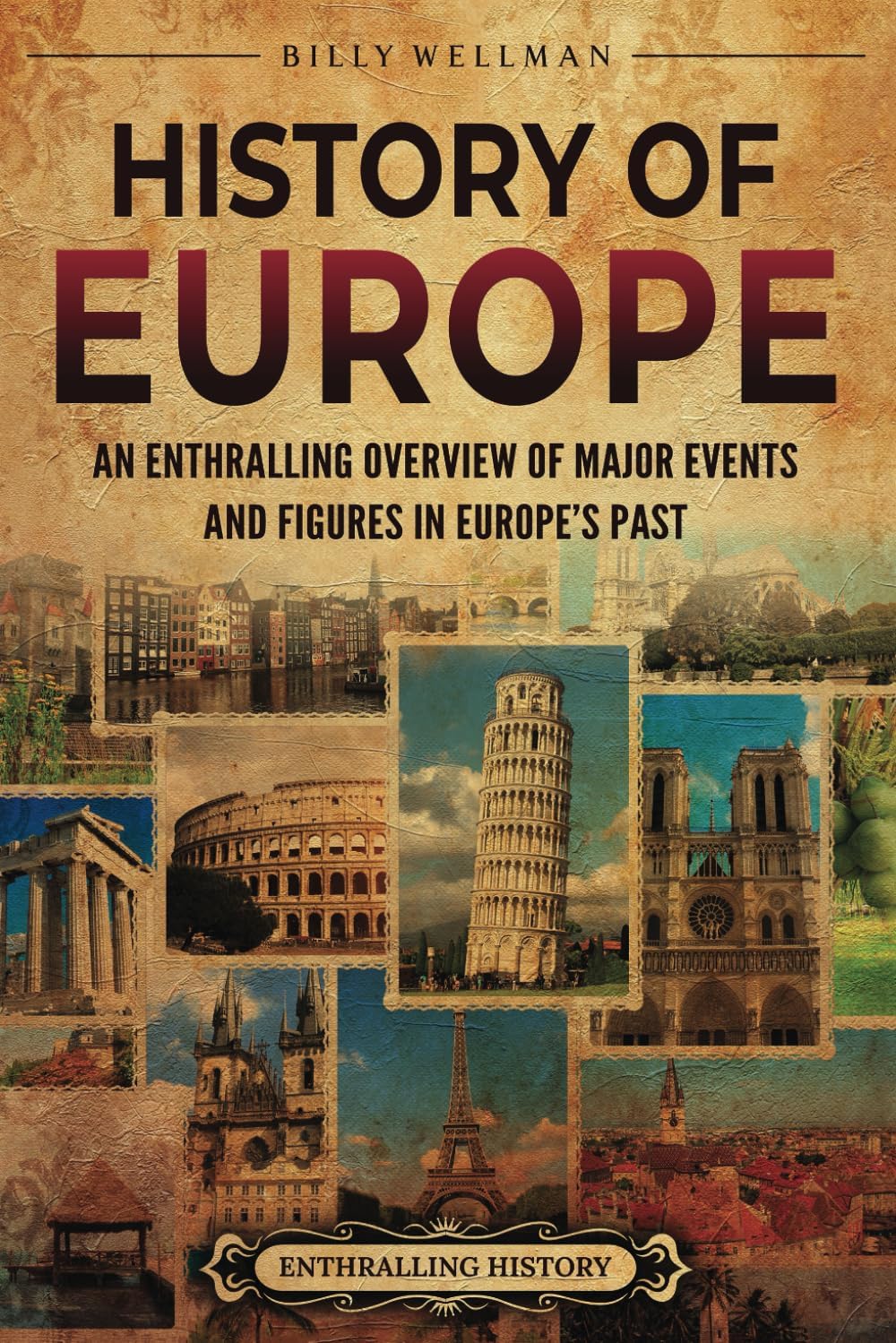
– History of Europe: An Enthralling Overview of Major Events and Figures in Europe’s Past
Product ID: 616724877
Buy anything from 5,000+ international stores. One checkout price. No surprise fees. Join 2M+ shoppers on Desertcart.
Desertcart purchases this item on your behalf and handles shipping, customs, and support to Vietnam.
Buy History of Europe: An Enthralling Overview of Major Events and Figures in Europe’s Past by Wellman, Billy (ISBN: 9798887653365) from desertcart's Book Store. Everyday low prices and free delivery on eligible orders. Review: Extremely informative - A well worth read for those wanting to know more about the effects of the past on current day Europe Review: A long and turgid history - Liked the connections made - some a little novel. Chronology sometimes a bit skewed though. Overall worth a read


| ASIN | B0CYLS8C1X |
| Best Sellers Rank | 316,854 in Books ( See Top 100 in Books ) 467 in Historical Study & Teaching |
| Customer reviews | 4.4 4.4 out of 5 stars (108) |
| Dimensions | 15.24 x 1.17 x 22.86 cm |
| ISBN-13 | 979-8887653365 |
| Item weight | 367 g |
| Language | English |
| Part of series | Europe |
| Print length | 204 pages |
| Publication date | 19 Mar. 2024 |
| Publisher | Billy Wellman |
G**N
Extremely informative
A well worth read for those wanting to know more about the effects of the past on current day Europe
K**R
A long and turgid history
Liked the connections made - some a little novel. Chronology sometimes a bit skewed though. Overall worth a read
N**L
A detailed but accessible guide to European history
This book traces and evaluates the history of Europe. It is a well-written and well-researched book. For those seeking a detailed yet accessible guide to European history then "History of Europe" is for them. It covers multiple aspects necessary for a complete understanding of Europe and its place in our world today. This work has an engaging writing style and an accessible format which means everyone can enjoy and learn from it regardless of any prior knowledge. I enjoyed reading it. I received a free copy of this book via Booksprout and am voluntarily leaving a review.
D**D
Waste of money .very poor printing inside
Very bad printing inside not very good quality.
C**D
Ambitious romp through European history.
This book tries to tell you the history of Europe and its influence starting from the time of hominids through to the present day. Several events are mentioned, but only superficially, and I thought a biased assessment of their significance was given. Omissions of other events, influences and factors in development also show a selection bias. At times, there was repetition of information or personal stories which made me wonder if the text was written by one person or several. Several editing errors changed the meaning or significance of the story to be the opposite of what happened or what the author may have intended. The lens of religious beliefs or adherence is used to tell the story of the continent, but was incomplete in the follow-through of persecution of sections within religion and their consequences. For example, the persecution of the Quakers leading to some leaving England for the American continent. Another omission is the inter-relatedness of the heads of state in many of the countries involved in World War 1. I felt the effects of scientific advances and intellectual development were underplayed. The effect of resources and their exploitation is mentioned only briefly and not given sufficient weight, in my opinion. There are some illustrations which amplify and support the text, but most don't work so well on a black and white only e-reader. 12 sources are quoted at the end of the book. The writing style is mostly engaging and there were interesting sections, but I was not enthralled. I received a free copy of this book via Booksprout and am voluntarily leaving a review.
D**J
European History is really excellent, which surprised me very much. I started reading it wondering how it would be possible to say anything meaningful about such a large topic in such a small volume. But the author more than meets the job. In a most readable text, he provides a very good summary. I highly recommend this book for people that have little or no background in history, for people that have a fair amount of background but want to review it, and for people who know bits and pieces of history and want to find out how they link up.
C**E
Not Easy to concentrate so long story in few Pages, but writer did It .It s very Easy to read but It underlines the most important event and delve many important topic. A very interesting book, worth to read
J**N
I probably know more European history than the average American, since my husband studied it for his undergraduate degree and it often came up in conversation. But, there is a lot that I do not know. This book, 200 pages written to be easy to read, cannot provide a thorough knowledge of the topic. However, it can provide a good overview. The first chapter begins with a description of what geographically Europe entails. A map would have been useful. Then it briefly gives some information on the early Homo sapiens and Neanderthals in the area, and continues with the development of agriculture, the migration of the Indo-Europeans into Europe, and the megalithic structures like Stonehenge. After that, it focuses on early Aegean civilization. There were some tidbits I didn’t know, which I thought were fun to learn. The next two chapters cover Ancient Greece and Ancient Rome. Ancient history is my favorite time period. The author says he is unable to give Ancient Greece the detailed attention it deserves in this book. I agree with him on both points - it deserves more attention, but that it can’t be included in a book about the entirety of Europe. (Enthralling History does have separate books with more in-depth coverage of the topics in this one, such as Ancient Greece, for those interested.) A map of the Greek and Phoenician colonies at 550 BCE is shown, which is helpful, but the free map he used has the Greek (Hellas) colonies in blue, labeled with black letters that is a little difficult to read. The Phoenician ones on their red background are still not as easy as the labels on lighter colors. Regardless, I was very appreciative of the map. The history of Ancient Greece covers the invasions by the Persian Empire, followed by the Peloponnesian War. The next part of the chapter discusses the cultural contributions, such as the scientific method, philosophy, and their literary works. The final part of the chapter is about Phillip of Macedon and his son Alexander the Great. When I was in 7th grade, I read a book on Alexander the Great, which made him seem very impressive to me. That didn’t come through as well in this limited space, but just a list of his achievements would make him stand out. Of course, there is a lot more included about Ancient Greece in the chapter than I list here, covering key points in its history and how they came about. We continue to the next chapter on Ancient Rome, which mentions the pre-Roman Etruscans before covering the myth on the origin of Rome. They had a short series of kings before the Roman Republic. The Romans did not want to be ruled by a single authority but would appoint dictators for six-month terms in times of emergencies, such as wars. Rome and Carthage battled each other in the Punic Wars, and eventually Rome destroyed Carthage. Then Rome started expanding in North Africa and into more areas of Europe, covering Greece, Spain, France, and the other regions of Italy. Julius Caesar took control of Rome, and afterward his heir Octavian essentially became the first emperor of the Roman Empire. After several emperors, we reach the Pax Romana and many technological advances for that time. Next comes the rise of Christianity and how things changed when Constantine converted. Afterwards, we move on to the Middle Ages, another time period that I enjoy reading about. The first of these chapters includes several areas in Europe: the Byzantine Empire, the Holy Roman Empire, Scandinavia, and Eastern Europe. The author covers how the Western Roman Empire had collapsed, and various peoples spread through Europe and smaller states developed. These different peoples include the Saxons, Angles, Franks, Jutes, Burgundians, Visigoths, and Ostrogoths. The development and effects of the Byzantine Empire are described. Christianity spread through Europe, and Islam spread to the Near East and North Africa into some places that had been Christian. Christianity itself split into the Catholic Church and the Eastern Orthodox Church. Christianity had major effects on Europe. Then, we have Charlemagne who conquered much of Europe. I thought this book was effective in briefly showing his influence in Europe. The next chapter on the Middle Ages describes the changes in society (and why), such as the feudal system, the power of the Church, and urban growth. The book all that with more details and more events before the Black Plague and the Crusades are reached. Then comes the Renaissance, during which time we had the Protestant Reformation that had a significant impact in history. The advances in science and technology allowed more maritime exploration which led to Columbus reaching the Americas which had valuable resources. The book goes through, among other events, the Counter-Reformation, the Spanish Inquisition, the Thirty-Years’ War, the Enlightenment, the French Revolution, the Franco-Prussian War, the Industrial Revolution, and Social Darwinism, before reaching the 20th century. Then comes World War I, for which the events that led up to it are well-covered, and the same with World War II and the Cold War. This book does a good job of presenting how one thing leads to another. I received a free copy of this book via Booksprout and am voluntarily leaving a review.
H**.
Those seeking a detailed yet comprehensible guide to European history can enjoy the fact "History of Europe" is this exact item. It covers numerous details necessary for a complete understanding both of this content and how it applies to our world today. That this work contains dedicated research, engaging writing, and an accessible format means everyone can enjoy and learn from it regardless of any prior knowledge.
R**E
The casual narrative style made this a really fun read for a novice like me. My perspective of the world is broader now, and I'm grateful!
Trustpilot
3 weeks ago
2 weeks ago