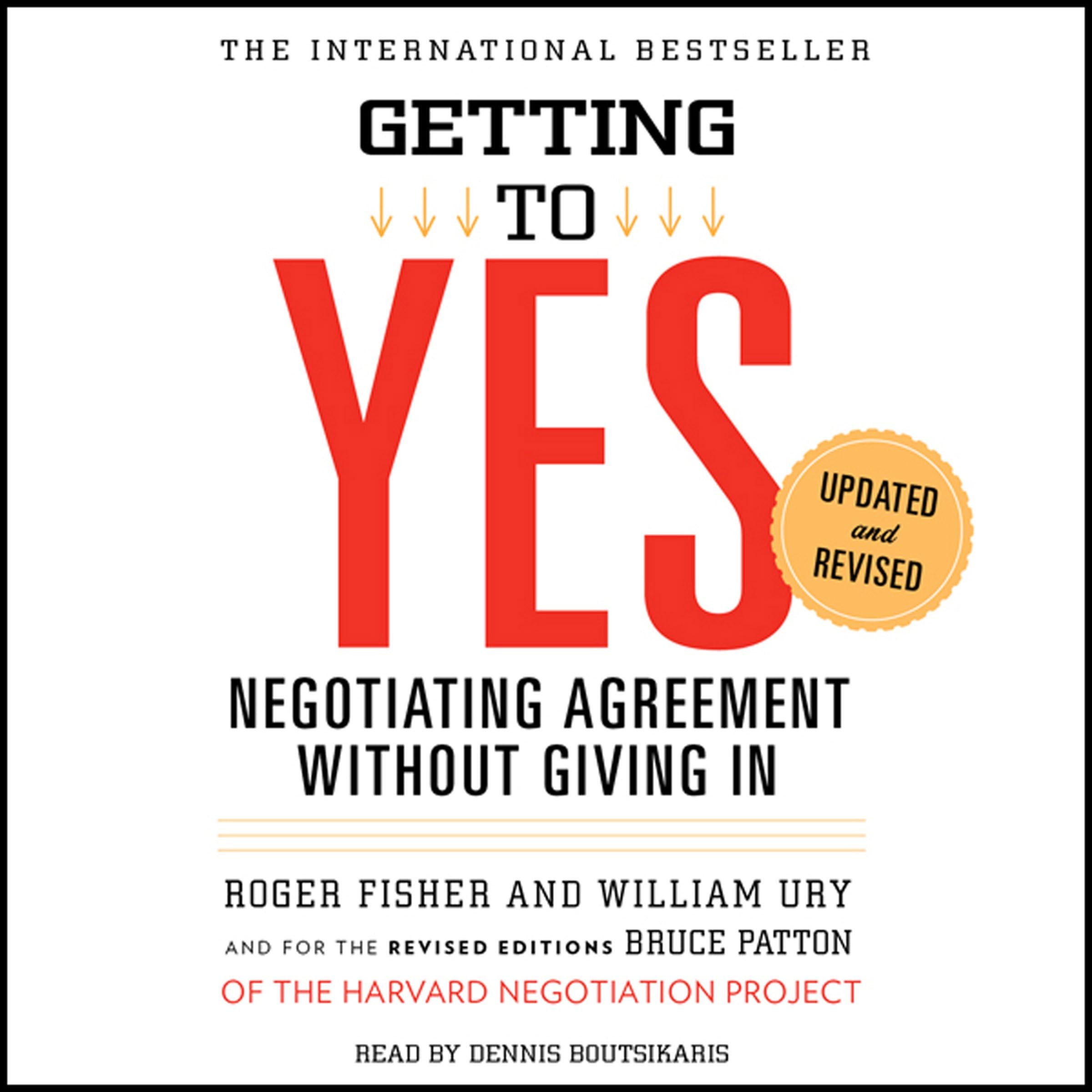
Getting to Yes: Negotiating Agreement Without Giving In
Product ID: 5608425
Buy anything from 5,000+ international stores. One checkout price. No surprise fees. Join 2M+ shoppers on Desertcart.
Desertcart purchases this item on your behalf and handles shipping, customs, and support to Vietnam.
desertcart.com: Getting to Yes: Negotiating Agreement Without Giving In (Audible Audio Edition): Roger Fisher, William Ury, Dennis Boutsikaris, Simon & Schuster Audio: Audible Books & Originals Review: The authors offer great insight into the groundbreaking work of the Harvard Negotiation ... - Negotiations don't have to be hard nor soft, but rather both hard and soft. And so begins a journey into improved negotiations that starts with Getting to Yes by Roger Fisher and William Ury. This is one of the cornerstone books in the areas of negotiation, mediation, and conflict management. The authors offer great insight into the groundbreaking work of the Harvard Negotiation Project. The group developed an alternative to positional bargaining called principled negotiation (or negotiation on the merits). This is a method of negotiation explicitly designed to produce wise outcomes efficiently and amicably. The goal of this method is to decide issues on their merits and to look for mutual gains whenever possible. The concept of principled negotiation is based on four basic points: 1. Separate the people from the problem 2. Focus on interests, not positions 3. Invent options for mutual gain 4. Insist on using objective criteria The authors offer wonderful strategies and techniques for you to look for ways to make all of your negotiations a principled negotiation. Besides explaining the four basic points along with examples, they also tackle ideas like imbalance of power, dirty tricks, and dealing with someone who won’t negotiate. We all have opportunities to negotiate at some time, so you need to have Getting To Yes on your bookshelf. Review: A Classic that has been superceded. - Getting to Yes started a revolution in negotiation, both by stressing principled negotiation and in making the material accessible to a very wide audience. It is still a good read, is still taught in universities and continuing education, and is an excellent starting point for people who are new to negotiation but intend a deep study because of its historical significance and its content. However, having taught Getting to Yes and having used principled bargaining in practice, I think there are a few shortcomings that are dealt with in other books. While Fischer and Ury do make the point that principled bargaining includes sticking to your priciples and not being a pushover, it is not emphasized enough. I have even found myself being too cooperative after reviewing this text because the emphasis is on being cooperative. I think this is a partcular danger for new/lay negotiators, especially if this is the first text they're exposed to or they intend to practice these concepts in daily life. The tone of the book is just a bit too friendly. As a result, there has been a backlash (wrongly, in my opinion) against this text in some quarters. The verbal judo section at the end is excellent, giving techniques for dealing with unreasonable people that are great. I would've liked more of these very practical tips and examples to go along with them, but the book as a whole is already a lot to digest. Newer versions of GTY do add more material here. Newer texts take these problems into account. The best, in my opinion, is the follow-on by Ury, "Getting Past No." It can be read without having read "Getting to Yes," although it is very interesting as a follow-on, too. In it, Ury is clearly taking into account the criticism that GTY was too soft and he presents a more robust vision of principled bargaining.
K**N
The authors offer great insight into the groundbreaking work of the Harvard Negotiation ...
Negotiations don't have to be hard nor soft, but rather both hard and soft. And so begins a journey into improved negotiations that starts with Getting to Yes by Roger Fisher and William Ury. This is one of the cornerstone books in the areas of negotiation, mediation, and conflict management. The authors offer great insight into the groundbreaking work of the Harvard Negotiation Project. The group developed an alternative to positional bargaining called principled negotiation (or negotiation on the merits). This is a method of negotiation explicitly designed to produce wise outcomes efficiently and amicably. The goal of this method is to decide issues on their merits and to look for mutual gains whenever possible. The concept of principled negotiation is based on four basic points: 1. Separate the people from the problem 2. Focus on interests, not positions 3. Invent options for mutual gain 4. Insist on using objective criteria The authors offer wonderful strategies and techniques for you to look for ways to make all of your negotiations a principled negotiation. Besides explaining the four basic points along with examples, they also tackle ideas like imbalance of power, dirty tricks, and dealing with someone who won’t negotiate. We all have opportunities to negotiate at some time, so you need to have Getting To Yes on your bookshelf.
B**E
A Classic that has been superceded.
Getting to Yes started a revolution in negotiation, both by stressing principled negotiation and in making the material accessible to a very wide audience. It is still a good read, is still taught in universities and continuing education, and is an excellent starting point for people who are new to negotiation but intend a deep study because of its historical significance and its content. However, having taught Getting to Yes and having used principled bargaining in practice, I think there are a few shortcomings that are dealt with in other books. While Fischer and Ury do make the point that principled bargaining includes sticking to your priciples and not being a pushover, it is not emphasized enough. I have even found myself being too cooperative after reviewing this text because the emphasis is on being cooperative. I think this is a partcular danger for new/lay negotiators, especially if this is the first text they're exposed to or they intend to practice these concepts in daily life. The tone of the book is just a bit too friendly. As a result, there has been a backlash (wrongly, in my opinion) against this text in some quarters. The verbal judo section at the end is excellent, giving techniques for dealing with unreasonable people that are great. I would've liked more of these very practical tips and examples to go along with them, but the book as a whole is already a lot to digest. Newer versions of GTY do add more material here. Newer texts take these problems into account. The best, in my opinion, is the follow-on by Ury, "Getting Past No." It can be read without having read "Getting to Yes," although it is very interesting as a follow-on, too. In it, Ury is clearly taking into account the criticism that GTY was too soft and he presents a more robust vision of principled bargaining.
M**A
Yes, this is a "must read"
Reviewing a book 15 years after its publication might seem a bit pointless. But that depends on the book. In this case, we're talking about a book that has near cult status in the business community. Over the past 15 years, this book has been referred to and revered in thousands--if not millions--of articles, seminars, college course, and training programs. In fact, as of the date of this review over 100 published books cite Getting to Yes. If you're in business and haven't read this book, you are operating with less than full power. But the book has value well beyond the business world. If you've ever had a disagreement end in a way that left you or the other party feeling cheated or manipulated, that ending probably came about because you were either bargaining about position or confusing the people with the problem. Either strategy guarantees at least one loser. Unfortunately, most disagreements follow one or both of these losing strategies. With discipline and practice, you can apply the knowledge in this book so that you: * Preserve relationships without giving in (go along to get along). * Can satisfy the interests of both parties. * Ensure both parties are motivated to uphold their end of the bargain. * Feel good about the agreement reached and the people who reached it. The strategies have nothing to do with tricking other people or playing games. The strategies have everything to do with respecting other people and refusing to play games. In the publishing world, "thud factor" is a major consideration. Many readers expect filler, in the form of anecdotes and stories (as if they want the author to assume they are too daft to understand assertions made directly in plain English). Getting to Yes is 200 pages long, with the last 50 pages or so being basically a review and a "Cliff Notes" of the first 150. So, you have the book followed by a summary of the book. What you don't have is 150 pages stretched to 300 pages with stories that a busy executive would rather skip. The concise writing is a huge plus to many people, but some reviewers see it as a minus. So, you may also read reviews saying that other books are "better" because they are thicker. I have two proposed solutions to that: 1. Read the first 150 pages of Getting to Yes twice. This will equal 300 pages. 2. Read the book, then practice it. Take 150 pages of notes regarding your experiences. You now have the stories and filler you wanted. The authors wrote this book not to entertain, but to educate. It gets to the point. There is no obfuscation, meandering, or distraction. That same communication style is required in a negotiation. The occasional anecdote may be helpful, but to lead a negotiation to a successful conclusion you must focus on the real issues. That is what this book does. And that's why it's a classic in the classroom and in the boardroom, and in executive suites and staterooms throughout the world. Be sure to read Getting Past No and The Power of a Positive No, as well.
A**O
Un libro interessante, chiaro e ricco di spunti pratici. Perfetto per chi desidera migliorare le proprie competenze nella vendita e nella negoziazione, sia in ambito professionale che nella vita di tutti i giorni.
9**9
This book may change the way I negotiate. Most of what the authors say in the book could fall under the category of “common wisdom”. The good thing about this book is that it organizes such common wisdom in a way that a negotiator can use it to his benefit. One of the classic books on negotiation worth reading.
T**I
very well structured to the point and all practical advice
J**T
Bought this to help with one of my modules at university. Most law degrees only teach substantive law and the philosophical side of it, but mine teaches you how to be a lawyer too. As such, we spent a lot of time studying the mechanics of negotiations. I can safely say that this book is fantastic. Since I've read it, I've been able to use some of the techniques it covers in day-to-day life - this is not an exclusively specialist text (it's written in easy to understand Plain English) and is relevant to resolving any form of conflict. The best thing is that the techniques actually work! A lot of the content is transferable to other areas too, so it's great value for the price. It also made for very interesting reading, and considered the psychological effects of different negotiation styles - it doesn't just give you a list of what to do, but it explains WHY the points being made will work. This is one of the key assets to this text. Buy this book now! Tip: if you're a student, buy the Kindle version like I did. That way when you're making notes, you don't need to keep wrestling with the binding to keep the book open.
P**N
This my first book on negotiation and it should place the fundamental. I may use these skills before but this book just provides a very detail approach to it and make everything more concrete and easy to remember.
Trustpilot
1 month ago
5 days ago