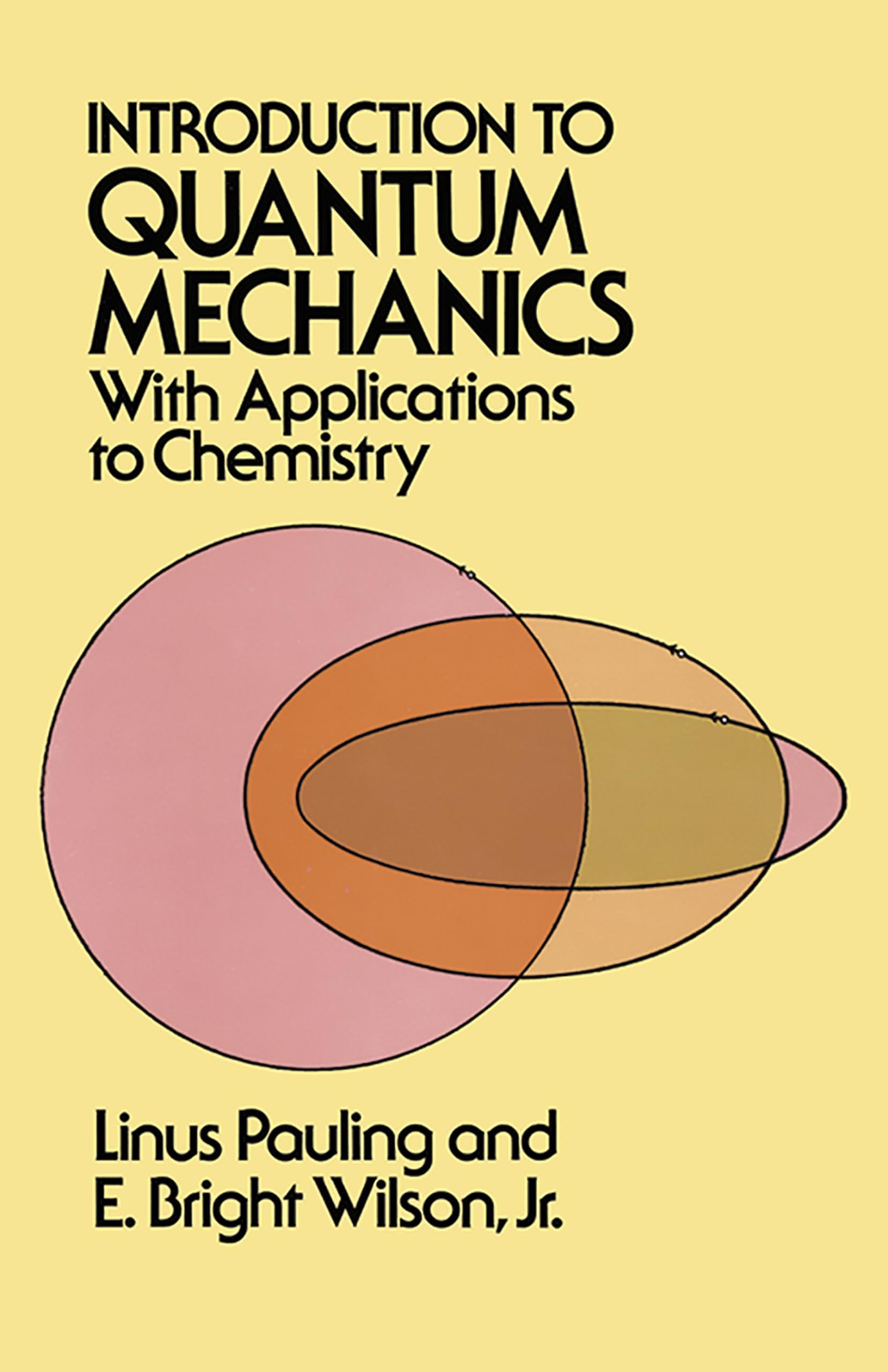
Introduction to Quantum Mechanics with Applications to Chemistry (Dover Books on Physics)
Product ID: 5495204
Buy anything from 5,000+ international stores. One checkout price. No surprise fees. Join 2M+ shoppers on Desertcart.
Desertcart purchases this item on your behalf and handles shipping, customs, and support to Vietnam.
When this classic text was first published in 1935, it fulfilled the goal of its authors "to produce a textbook of practical quantum mechanics for the chemist, the experimental physicist, and the beginning student of theoretical physics." Although many who are teachers today once worked with the book as students, the text is still as valuable for the same undergraduate audience. Two-time Nobel Prize winner Linus Pauling, Research Professor at the Linus Pauling Institute of Science and Medicine, Palo Alto, California, and E. Bright Wilson, Jr., Professor Emeritus of Chemistry at Harvard University, provide a readily understandable study of "wave mechanics," discussing the Schrodinger wave equation and the problems which can be solved with it. Extensive knowledge of mathematics is not required, although the student must have a grasp of elementary mathematics through the calculus. Pauling and Wilson begin with a survey of classical mechanics, including Newton's equations of motion in the Lagrangian form, and then move on to the "old" quantum theory, developed through the work of Planck, Einstein and Bohr. This analysis leads to the heart of the book ― an explanation of quantum mechanics which, as Schrodinger formulated it, "involves the renunciation of the hope of describing in exact detail the behavior of a system." Physics had created a new realm in which classical, Newtonian certainties were replaced by probabilities ― a change which Heisenberg's uncertainty principle (described in this book) subsequently reinforced. With clarity and precision, the authors guide the student from topic to topic, covering such subjects as the wave functions for the hydrogen atom, perturbation theory, the Pauli exclusion principle, the structure of simple and complex molecules, Van der Waals forces, and systems in thermodynamic equilibrium. To insure that the student can follow the mathematical derivations, Pauling and Wilson avoid the "temptation to condense the various discussions into shorter and perhaps more elegant forms" appropriate for a more advanced audience. Introduction to Quantum Mechanics is a perfect vehicle for demonstrating the practical application of quantum mechanics to a broad spectrum of chemical and physical problems. Review: (Still) An Excellent Quantum Mechanics Book - This is an introductory quantum mechanics book that focuses exclusively on how this new (at the time this book was written) mechanics clarifies the nature of chemical bonds. By focusing on this problem this book is able to provide a simplified treatment of quantum mechanics as unbound electron states can be excluded. The treatment is further simplified by ingoring all magnetic effects such as spin-orbit coupling. By doing so, even more simplifcation is permitted in the form of an extremely elementary treatment of spin, basically up or down. As such there are no spinors or Pauli matrices anywhere in this work. Finally, relativistic effects are neglected as well. The introductory chapters provide a brief review of pertinent ideas in classical mechanics and then present the essential elements of the orginal Sommerfield quantum mechanics. This is useful to students as this theory is often used in examples and is interesting historically. These chapters culminate in a detailed chapter on the electron wave functions for the hydrogen atom which includes a table of these functions as well as graphs so the student can spend some time really getting to know them. That's a good thing as they are heavily relied upon through the rest of the book, and this book is filled with useful and helpful tables and figures such as these. Next are two chapters on approximation methods. Time independent perturbation theory and the variational method are emphasized, and both are used heavily and extremely illuminatingly in the remainder of the text. The use of these tools was one of my favorite things about this book. This is an excellent text and I would suggest a student of quantum mechanics read it early, certainly before Dirac. Whether or not it is suitable as a first text on the subject is a different matter. This book provides extremely poor motivation (as in none) for Schordinger's equation, simply introducing it in an entirely postulatory manner. This was a difficult pill for me to swallow pedagocically, but it definitely simplifies the treatment as there is no need to discuss Fourier transforms for instance as is necessary in The Principles of Statistical Mechanics for example. For the serious student of quantum chemistry, this book may well be considered only a meager and dated introduction, but it is excellent nonetheless. And any early stage student of quantum theory should find this book highly profitable reading. Review: Good reading on QM - This a Nice introduction to Quantum mechanics. It is a good reading to expand the información found in textbooks.
| Best Sellers Rank | #638,689 in Books ( See Top 100 in Books ) #519 in Quantum Theory (Books) #577 in Physics (Books) |
| Customer Reviews | 4.6 out of 5 stars 160 Reviews |
J**D
(Still) An Excellent Quantum Mechanics Book
This is an introductory quantum mechanics book that focuses exclusively on how this new (at the time this book was written) mechanics clarifies the nature of chemical bonds. By focusing on this problem this book is able to provide a simplified treatment of quantum mechanics as unbound electron states can be excluded. The treatment is further simplified by ingoring all magnetic effects such as spin-orbit coupling. By doing so, even more simplifcation is permitted in the form of an extremely elementary treatment of spin, basically up or down. As such there are no spinors or Pauli matrices anywhere in this work. Finally, relativistic effects are neglected as well. The introductory chapters provide a brief review of pertinent ideas in classical mechanics and then present the essential elements of the orginal Sommerfield quantum mechanics. This is useful to students as this theory is often used in examples and is interesting historically. These chapters culminate in a detailed chapter on the electron wave functions for the hydrogen atom which includes a table of these functions as well as graphs so the student can spend some time really getting to know them. That's a good thing as they are heavily relied upon through the rest of the book, and this book is filled with useful and helpful tables and figures such as these. Next are two chapters on approximation methods. Time independent perturbation theory and the variational method are emphasized, and both are used heavily and extremely illuminatingly in the remainder of the text. The use of these tools was one of my favorite things about this book. This is an excellent text and I would suggest a student of quantum mechanics read it early, certainly before Dirac. Whether or not it is suitable as a first text on the subject is a different matter. This book provides extremely poor motivation (as in none) for Schordinger's equation, simply introducing it in an entirely postulatory manner. This was a difficult pill for me to swallow pedagocically, but it definitely simplifies the treatment as there is no need to discuss Fourier transforms for instance as is necessary in The Principles of Statistical Mechanics for example. For the serious student of quantum chemistry, this book may well be considered only a meager and dated introduction, but it is excellent nonetheless. And any early stage student of quantum theory should find this book highly profitable reading.
A**R
Good reading on QM
This a Nice introduction to Quantum mechanics. It is a good reading to expand the información found in textbooks.
I**S
Best quantum introduction book ever.
As I started reading it I loved it, is so easy to understand it because it leads you from the basic equations which are needed to understand the theory, the origins of it and how did it changed trough time because of the observations and experiments made to explain it, it includes basic problems for the hydrogen atom and much more about the quantum explanation of matter.
R**K
GREAT TEXT
If you are trying to get into a fundamental understanding of Quantum this is a good text. Not a lot of pretty pictures, and yes they do dump you into partial differentiation by page 2, but hey, better that than 100 pages of pablum before you get to the meat. Yes, it is old, written originally in the 1930's but it is still all good.
A**R
Interesting book, dense to get through
This is a very interesting book, but quite dense. It says it is rated at an undergraduate level, however that is unlikely for today’s undergraduate standards. That’s why I’m giving it 4 stars. It is very sturdy, and has survived many moves.
B**R
Not The Book I expected!
I bought this book thinking it was a reprint of Dr. Paulings earlier book on Quantum Mechanics that was published in 1935. The original book had a blue cover and was more oriented towards an introductory book on Quantum Mechanics/ However, when I received this book I found it focused more on the chemistry rather than the physics side of the science. I still am looking for the original book that was also published in 1935. Ron Feltman EE
C**G
It is useful for chemist to understand theoretical physics and quantum world
This book is one of my favorite scientists, Pauling's work, and my teacher recommend me to read it. I can't wait to read it!! If you want to understand how Nobelist "see" quantum world, you have to read it~
R**A
Pauling
This is the best ever text in quantum mechanics. Every one which intents start in this field should read this book. It contains all the elementary steps to understand this difficult field in a language and in such detail which is not found any more in the modern books.
R**Z
Extremely satisfied
I was more than satisfied with my order, it was the blue book I wanted, it was on great condition, much better than expected, and was for a great price. Great buy, truly thankful.
P**O
Livro incrível
Masterpiece!!!!!!
ピ**ン
量子論の基礎作りの為に
著者のポーリングは化学に量子論を次々と適用させて、近代量子化学の礎をつくりあげた大化学者である。 この本は化学書と言うよりは、本格的な量子力学の教科書と言う方がふさわしいが、実に良くできている。 普通の量子化学の本と違うのは、まずきちんと解析力学の議論から量子論へと展開している点である。 化学の学生はあまり解析力学を本格的に勉強する機会が少なく、量子論と古典力学の対応が今ひとつピンとこないまま分子軌道法などを使う事になる。 しかしこの本できちんと学べば、本格的な量子化学シミュレーションに踏み込んでも、そう問題はないだろう。 世界的にも非常に有名で、値段も驚くほど安いが、得られる知識と考察は非常に深い。
C**N
Un pezzo di storia
Un pezzo di storia redatto da Pauling. Un must che ogni chimico, ogni fisico ed in generale ogni scienziato dovrebbe possedere nella propria libreria. Magari datato, ma comunque un libro da possedere per sempre.
A**S
A bit complex
The book is not too good for people who are not much habituated to use Mathematics a bit more. So for them, it might be a little difficult to start reading. By the time you go through the first two chapters giving yourself enough time, you will find it to be a great book. Everything is fine about the product quality.
Trustpilot
3 weeks ago
1 month ago