The Giza Power Plant : Technologies of Ancient Egypt
Product ID: 5377261
Buy anything from 5,000+ international stores. One checkout price. No surprise fees. Join 2M+ shoppers on Desertcart.
Desertcart purchases this item on your behalf and handles shipping, customs, and support to Vietnam.
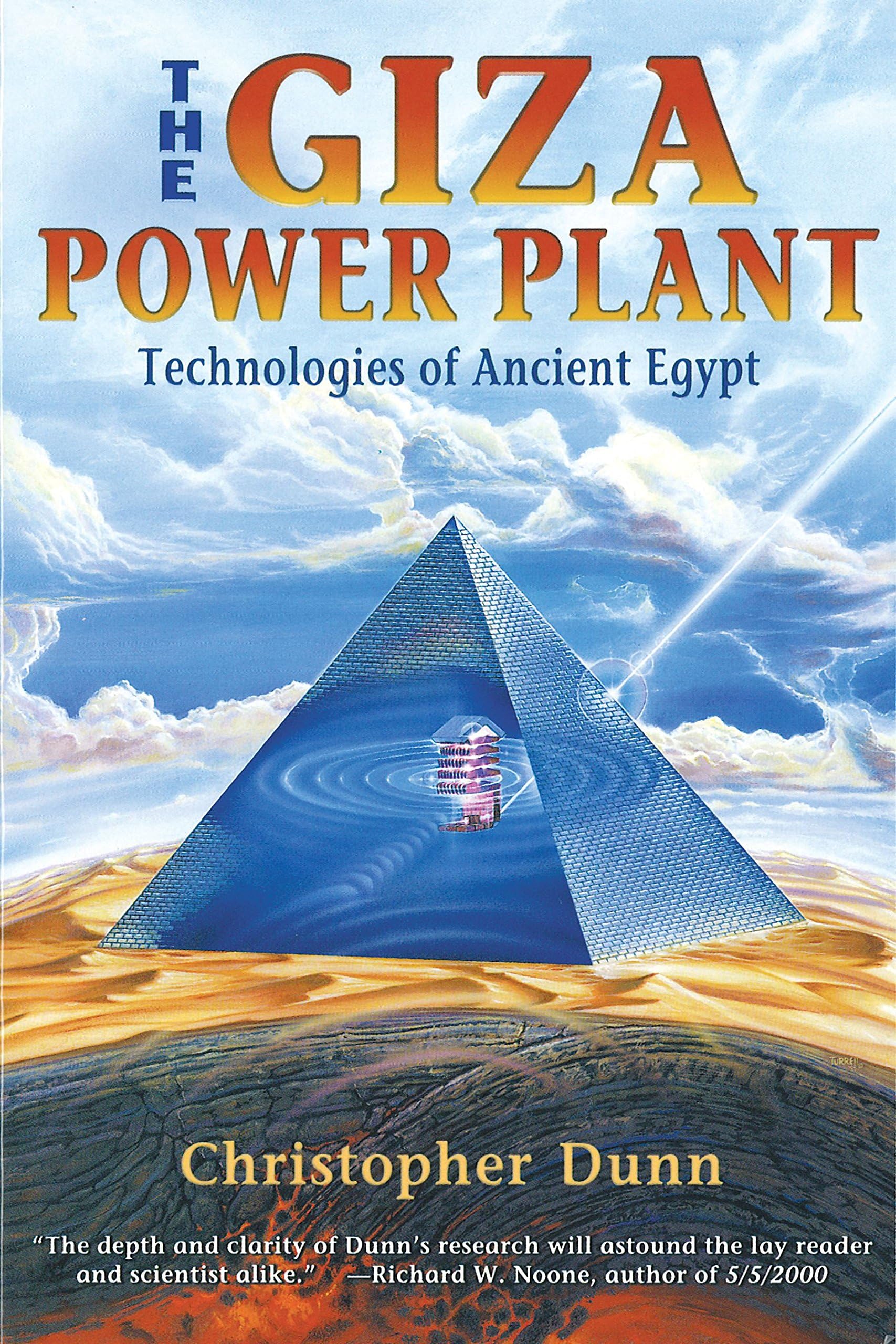
Did a highly advanced civilization exist in prehistory? Is the Giza Pyramid a remnant of their technology? Then, what was the power source that fueled such a civilization? The technology of harmonic resonance, claims renowned master craftsman and engineer Christopher Dunn. In a brilliant piece of reverse engineering based on twenty years of research, Dunn reveals that the Great Pyramid of Giza was actually a large acoustical device! By its size and dimensions, this crystal edifice created a harmonic resonance with the Earth and converted Earth's vibrational energies to microwave radiation. The author shows how the pyramid's numerous chambers and passageways were positioned with the deliberate precision to maximize its acoustical qualities. This may be the same technology discovered by Nikola Tesla and the solution to our own clean energy needs. Review: Fascinating and well developed - This book is utterly fascinating. It comes at the historical artifacts from a physical, mechanical viewpoint. The theory is well thought out and thoroughly explained. This theory makes so much more sense than the tomb theory. A must read for anyone interested in ancient Egypt and the pyramids. Review: THE GREAT PYRAMID AS A MACHINE! Chris Dunn delivers a convincing argument. - First; a brief comment about another reviewer. I was looking over some of the old reviews before publishing mine, and out of curiosity I read a 'One-Star' review that was particularly harsh (not to mention lengthy) on Mr. Dunn's work. What I find most disturbing is the fact that it was written by the co-author (Marge Morris) of 'The Pyramids an Enigma Solved." This is a book that I have read and found to be intellectually stimulating, well written and relevant. What I find most distasteful is the fact that this fellow researcher and author, would use this forum to dismiss Mr. Dunn's hard work and research, and then go to great length to promote hers. I would like to believe (since we are all striving to better understand the mysteries of the ancient world), that there is room for more than one theory. Particularly when we are dealing with something as enigmatic and controversial as this subject appears to be. I am sure that Mr. Dunn has had to develop a thick skin over the ensuing years, due to the provocative and novel, leading edge ideas he has posited. Even though her particular review was written many years ago. it is still no less than small-minded, self-promoting, and above all unnecessary. Okay (now that I have that off my chest); this book was published in 1998 and I didn't get around to reading it until 2012, which means I'm a bit behind the 'Power' curve (pun not withstanding), yet as they say "better late than never." I'm so glad this book finally came to my attention and that I took the time to read it. That may have been due to seeing Mr. Dunn on the History channel being interviewed for the show "Ancient Aliens" (a popular show with an unfortunate name that implies everything has something to do with aliens, which I question but do not dismiss completely; I just think there are perhaps other alternatives?). I have also heard Mr. Dunn's interviews on the Coast to Coast late night talk show as well as 'youtube' videos of his presentations and have always found him to be intelligent, forthright and sensible. I would be remiss if I did not add that other theories aside, his appears to bring us much closer to some ultimate understanding of what this mighty edifice of precision engineered stone is all about. I have had the good fortune to have actually taken the tour inside the Great Pyramid of Giza, as a serving member of the USAF back in the mid-nineties. It left indelible impressions on me, and my regret is that as a young man I did not have the understanding or appreciation of Egyptian culture and her monuments, that I now have some twenty years later, after much reading and research on the subject. Back then my understanding of Egypt and her history was based on what I had seen in movies or on TV. Having made that clear, I very well remember walking (more like a stooped crouch as I recall) awkwardly up the ascending corridor and wondering why was it necessary to have a makeshift wooden ramp with cross-members to help tourists and the general public safely ascend to the Grand Gallery; could not the architects have incorporated stairs? Although I did not dwell on such a trivial (to some) issue at the time (due to the overwhelming sensory input akin to a child exploring a mysterious place for the first time), however I was subliminally aware that something was amiss; something did not add up? I was further baffled by the strange configuration of the Grand Gallery, with its odd architecture of corbelled sides rising up and towards each other for some inherent, and yet occluded purpose? Still believing what I had always been told; that this great mountain of stone was built with the sole purpose as a pharaoh's tomb. Upon gaining access to the so-called "Kings Chamber" with its much abused "sarcophagus" (?), I was startled to find that the walls (of which are perfectly flat and squared at the corners) were oddly devoid of any markings? Save for the questionable markings of red ochre paint attributed to the builders (this was unknown to me at the time) who in the manner of 'graffiti' painted the name of their pharaoh who supposedly commissioned this monument for his burial place. These suspect markings were"allegedly" found by one Col. Vyse in 1837, in the (so called) "relieving chambers" directly above the Kings Chamber; which had to be blasted open with gunpowder, no less! There was (is) absolutely no sign of hieroglyphics to be found anywhere else within this immense structure! This from a culture known to cover its monuments and funerary walls with numerous hieroglyphs in honor of deeds accomplished, feats to be remembered, as well as praise for their 'god-like' pharaohs, and with great detail. And yet nothing of the sort is found here; nothing save perfection in stone; stone which feels and looks much older than the attributed 4th dynasty origins (circa 2500 B.C.). Perhaps the author himself said it best when he wrote; "I was astonished and could find no logical resemblance to any feature one would find in a building constructed for human activity." It does make one wonder, if the Great Pyramid was not built for human activity (alive or deceased), than just what the heck was this monumental undertaking designed to do? This is exactly What Chris Dunn, a master craftsman and engineer dares to answer in his ground-breaking and paradigm shifting treatise, which posits no less than the unthinkable; that this mountain of precision engineered stone just might have been designed to "machine tolerances" beyond anything reasonable in the architecture of "HUMAN" habitats or structures, to function as a MACHINE! Or more specifically a "Power Plant," (the functioning details are found in his book). Let's review what has come to light in the last several decades: 1. The thee main pyramids of Giza, are aligned to the three bright stars of Orion' belt; thanks to Robert Bauval and his "Orion Correlation Theory." 2. The Great Pyramid has been called "The Bible in Stone" by some, due to its antiquity (pre or post deluge?) and the esoteric knowledge built into it by its creators. 3. The three main pyramids as well as the Great Sphinx were intended as a set of monuments coeval with an unknown yet interconnected purpose. 4. The Sphinx at Giza is far older than previously thought, as evidenced by the "water erosion" apparent on its (un-refurbished) sides as shown by Dr. Robert Schoch; (which would suggest coeval antiquity of the Giza complex as a whole). 5. The exterior dimensions of the Great Pyramid show that the builders had knowledge of the circumference of the Earth, our distance from the Sun, as well as the precession of the equinox(s), with its 26,000 year duration , which the ancients called the "Great Year." 6. The interior design of the Great Pyramid is unusual, enigmatic and serves no (known) human function imaginable, based on our understanding of architectural science for the human species. 7. The (so-called) architectual "Relieving Chambers" layered above the (so-called) "Kings Chamber" (named from the Arabic perspective); are in fact "Relieving" what exactly? The massive weight from above? And yet considering that this chamber is several courses above the (so-called) "Queens Chamber - situated well below it, for which the architects saw no need for "relieving chambers," even though there must be millions of additional tons of stone above it? Clearly these spaced and layered chambers above the 'KC' had another function; (of which Mr. Dunn has an interesting idea that has to do with resonance as I recall). 8. No mummified remains of anyone were ever found in the Great Pyramid. And as for the others it is my understanding that any found were from much later periods and in the best tradition of "re-purposing" an already existing monument! 9. Contrary to what mainstream Egyptologists would have us believe, Khufu (Gr. Cheops) did not have this pyramid built, but rather inherited it intact, as a legacy structure form a former age, just as the stele found between the paws of the Sphinx has implied. 10. The so-named "Gang of Khufu" did not write his name with red ochre paint in the crawlspace of one of the relieving chambers; this was a fraud perpetrated by a glory-hound and fund seeking explorer "wannabe" of Egyptian antiquities; who has been characterized as the "Black sheep" of his family. We find Colonel Vyse, along with his cohort(s) in crime, who accomplished this heinous act of fraud after blasting his way into a sealed cavity, in 1837. This outrageous act of fraud has 'mucked-up' our understanding of these monuments to this very day, IMHO. (See the late authors Z. Sitchin's "Stairway to Heaven," Chapter entitled "Forging the Pharaoh's Name." Also The late Phillip Coppens, "Murder and forgery inside the Great Pyramid?" As found online; both provide in-depth perspective on this travesty). The ten items offered above, are but the tip of a vast iceberg of information concerning this subject; the list of incongruous anomalies and found revelations, could go on for several pages. And now we must add the very real possibility that a primary function of this last existing 'wonder of the ancient world', may have been a cleverly designed source of (free) power or energy as well? It is exciting and boggles the mind, but don't expect mainstream, conventional Egyptology to climb on board any of this any time soon. They are content to believe the lie about Khufu. They are loath to admit that Victorian era antiquarians may have mislead those extant institutions of higher learning for fame and profit. A legacy that muddles the picture and hampers a fresh perspective. For me personally, after all the books I've read on this particular subject; I have come to the conclusion that we are dealing with something far older than we dare imagine. A multi-faceted and purpose built structure, designed by a culture seemingly far brighter than we think we are. A structure (including others on the Giza plateau) that are so 'hoary with age' that they were inherited and, Here's the key, "repurposed" over time by younger civilizations who had forgotten the true genesis of these structures, or who the original builders might have been? These later cultures tried their best to copy these pyramids, and mostly failed to execute such lasting edifices. Hopefully one day we will learn who really built these Giza pyramids, we may never fully comprehend how. For as advanced as we "think" we are, those answers still elude us. In my mind the notion of a "Power Plant" built with machine precision, is not too much of a stretch of ones imagination. Even if this isn't the case, and its intended or inherent purpose was something else altogether; I think many would agree that the Great Pyramid is of a much older provenance, regardless of what mainstream Egyptology (including a shady character named Zawi Hawass) would have us believe. As for Khufu (aka Cheops) being the commissioning pharaoh of this massive and enigmatic undertaking; there is very little, if not suspect or contradictory evidence that he was indeed the guy that said "let it be built." However the evidence (if one is open to it) would suggest that Khufu did, in fact "inherit" the Great Pyramid, which to my thinking is much more plausible. Mind you this was a culture who venerated their esteemed pharaohs with cyclopean statues and yet we find but just one statue of Khufu (now in the Cairo museum) which stands a mighty 3 inches tall! Yeah that makes sense; are we to believe he used up all his "pharaoh monument points" on the Great Pyramid? Sure, that must be what happened. I can just see Biff thumping on Marty's dad's head now, as he shouts; "Wake Up Mcfly!" Perhaps we are the ones that need to "Wake UP" to the true heritage and legacy of our ancient ancestors. Taken collectively, all the cyclopean, monolithic and enigmatic stone structures found all over this planet, it is increasingly clear that we are missing something profound and wondrous about our very ancient, and un-doubtfully 'pre-cataclysmic' past. Read Mr. Dunn's book and decide for yourself. I think you will find that his thesis is very credible, extremely astute and helps to explain some very unusual design features within this enigmatic structure. His book is well written, captivating and hard to put down.















| Best Sellers Rank | #27,747 in Books ( See Top 100 in Books ) #3 in Prehistory #10 in Ancient Egyptians History #19 in Ancient & Controversial Knowledge |
| Customer Reviews | 4.7 out of 5 stars 1,121 Reviews |
E**R
Fascinating and well developed
This book is utterly fascinating. It comes at the historical artifacts from a physical, mechanical viewpoint. The theory is well thought out and thoroughly explained. This theory makes so much more sense than the tomb theory. A must read for anyone interested in ancient Egypt and the pyramids.
G**Y
THE GREAT PYRAMID AS A MACHINE! Chris Dunn delivers a convincing argument.
First; a brief comment about another reviewer. I was looking over some of the old reviews before publishing mine, and out of curiosity I read a 'One-Star' review that was particularly harsh (not to mention lengthy) on Mr. Dunn's work. What I find most disturbing is the fact that it was written by the co-author (Marge Morris) of 'The Pyramids an Enigma Solved." This is a book that I have read and found to be intellectually stimulating, well written and relevant. What I find most distasteful is the fact that this fellow researcher and author, would use this forum to dismiss Mr. Dunn's hard work and research, and then go to great length to promote hers. I would like to believe (since we are all striving to better understand the mysteries of the ancient world), that there is room for more than one theory. Particularly when we are dealing with something as enigmatic and controversial as this subject appears to be. I am sure that Mr. Dunn has had to develop a thick skin over the ensuing years, due to the provocative and novel, leading edge ideas he has posited. Even though her particular review was written many years ago. it is still no less than small-minded, self-promoting, and above all unnecessary. Okay (now that I have that off my chest); this book was published in 1998 and I didn't get around to reading it until 2012, which means I'm a bit behind the 'Power' curve (pun not withstanding), yet as they say "better late than never." I'm so glad this book finally came to my attention and that I took the time to read it. That may have been due to seeing Mr. Dunn on the History channel being interviewed for the show "Ancient Aliens" (a popular show with an unfortunate name that implies everything has something to do with aliens, which I question but do not dismiss completely; I just think there are perhaps other alternatives?). I have also heard Mr. Dunn's interviews on the Coast to Coast late night talk show as well as 'youtube' videos of his presentations and have always found him to be intelligent, forthright and sensible. I would be remiss if I did not add that other theories aside, his appears to bring us much closer to some ultimate understanding of what this mighty edifice of precision engineered stone is all about. I have had the good fortune to have actually taken the tour inside the Great Pyramid of Giza, as a serving member of the USAF back in the mid-nineties. It left indelible impressions on me, and my regret is that as a young man I did not have the understanding or appreciation of Egyptian culture and her monuments, that I now have some twenty years later, after much reading and research on the subject. Back then my understanding of Egypt and her history was based on what I had seen in movies or on TV. Having made that clear, I very well remember walking (more like a stooped crouch as I recall) awkwardly up the ascending corridor and wondering why was it necessary to have a makeshift wooden ramp with cross-members to help tourists and the general public safely ascend to the Grand Gallery; could not the architects have incorporated stairs? Although I did not dwell on such a trivial (to some) issue at the time (due to the overwhelming sensory input akin to a child exploring a mysterious place for the first time), however I was subliminally aware that something was amiss; something did not add up? I was further baffled by the strange configuration of the Grand Gallery, with its odd architecture of corbelled sides rising up and towards each other for some inherent, and yet occluded purpose? Still believing what I had always been told; that this great mountain of stone was built with the sole purpose as a pharaoh's tomb. Upon gaining access to the so-called "Kings Chamber" with its much abused "sarcophagus" (?), I was startled to find that the walls (of which are perfectly flat and squared at the corners) were oddly devoid of any markings? Save for the questionable markings of red ochre paint attributed to the builders (this was unknown to me at the time) who in the manner of 'graffiti' painted the name of their pharaoh who supposedly commissioned this monument for his burial place. These suspect markings were"allegedly" found by one Col. Vyse in 1837, in the (so called) "relieving chambers" directly above the Kings Chamber; which had to be blasted open with gunpowder, no less! There was (is) absolutely no sign of hieroglyphics to be found anywhere else within this immense structure! This from a culture known to cover its monuments and funerary walls with numerous hieroglyphs in honor of deeds accomplished, feats to be remembered, as well as praise for their 'god-like' pharaohs, and with great detail. And yet nothing of the sort is found here; nothing save perfection in stone; stone which feels and looks much older than the attributed 4th dynasty origins (circa 2500 B.C.). Perhaps the author himself said it best when he wrote; "I was astonished and could find no logical resemblance to any feature one would find in a building constructed for human activity." It does make one wonder, if the Great Pyramid was not built for human activity (alive or deceased), than just what the heck was this monumental undertaking designed to do? This is exactly What Chris Dunn, a master craftsman and engineer dares to answer in his ground-breaking and paradigm shifting treatise, which posits no less than the unthinkable; that this mountain of precision engineered stone just might have been designed to "machine tolerances" beyond anything reasonable in the architecture of "HUMAN" habitats or structures, to function as a MACHINE! Or more specifically a "Power Plant," (the functioning details are found in his book). Let's review what has come to light in the last several decades: 1. The thee main pyramids of Giza, are aligned to the three bright stars of Orion' belt; thanks to Robert Bauval and his "Orion Correlation Theory." 2. The Great Pyramid has been called "The Bible in Stone" by some, due to its antiquity (pre or post deluge?) and the esoteric knowledge built into it by its creators. 3. The three main pyramids as well as the Great Sphinx were intended as a set of monuments coeval with an unknown yet interconnected purpose. 4. The Sphinx at Giza is far older than previously thought, as evidenced by the "water erosion" apparent on its (un-refurbished) sides as shown by Dr. Robert Schoch; (which would suggest coeval antiquity of the Giza complex as a whole). 5. The exterior dimensions of the Great Pyramid show that the builders had knowledge of the circumference of the Earth, our distance from the Sun, as well as the precession of the equinox(s), with its 26,000 year duration , which the ancients called the "Great Year." 6. The interior design of the Great Pyramid is unusual, enigmatic and serves no (known) human function imaginable, based on our understanding of architectural science for the human species. 7. The (so-called) architectual "Relieving Chambers" layered above the (so-called) "Kings Chamber" (named from the Arabic perspective); are in fact "Relieving" what exactly? The massive weight from above? And yet considering that this chamber is several courses above the (so-called) "Queens Chamber - situated well below it, for which the architects saw no need for "relieving chambers," even though there must be millions of additional tons of stone above it? Clearly these spaced and layered chambers above the 'KC' had another function; (of which Mr. Dunn has an interesting idea that has to do with resonance as I recall). 8. No mummified remains of anyone were ever found in the Great Pyramid. And as for the others it is my understanding that any found were from much later periods and in the best tradition of "re-purposing" an already existing monument! 9. Contrary to what mainstream Egyptologists would have us believe, Khufu (Gr. Cheops) did not have this pyramid built, but rather inherited it intact, as a legacy structure form a former age, just as the stele found between the paws of the Sphinx has implied. 10. The so-named "Gang of Khufu" did not write his name with red ochre paint in the crawlspace of one of the relieving chambers; this was a fraud perpetrated by a glory-hound and fund seeking explorer "wannabe" of Egyptian antiquities; who has been characterized as the "Black sheep" of his family. We find Colonel Vyse, along with his cohort(s) in crime, who accomplished this heinous act of fraud after blasting his way into a sealed cavity, in 1837. This outrageous act of fraud has 'mucked-up' our understanding of these monuments to this very day, IMHO. (See the late authors Z. Sitchin's "Stairway to Heaven," Chapter entitled "Forging the Pharaoh's Name." Also The late Phillip Coppens, "Murder and forgery inside the Great Pyramid?" As found online; both provide in-depth perspective on this travesty). The ten items offered above, are but the tip of a vast iceberg of information concerning this subject; the list of incongruous anomalies and found revelations, could go on for several pages. And now we must add the very real possibility that a primary function of this last existing 'wonder of the ancient world', may have been a cleverly designed source of (free) power or energy as well? It is exciting and boggles the mind, but don't expect mainstream, conventional Egyptology to climb on board any of this any time soon. They are content to believe the lie about Khufu. They are loath to admit that Victorian era antiquarians may have mislead those extant institutions of higher learning for fame and profit. A legacy that muddles the picture and hampers a fresh perspective. For me personally, after all the books I've read on this particular subject; I have come to the conclusion that we are dealing with something far older than we dare imagine. A multi-faceted and purpose built structure, designed by a culture seemingly far brighter than we think we are. A structure (including others on the Giza plateau) that are so 'hoary with age' that they were inherited and, Here's the key, "repurposed" over time by younger civilizations who had forgotten the true genesis of these structures, or who the original builders might have been? These later cultures tried their best to copy these pyramids, and mostly failed to execute such lasting edifices. Hopefully one day we will learn who really built these Giza pyramids, we may never fully comprehend how. For as advanced as we "think" we are, those answers still elude us. In my mind the notion of a "Power Plant" built with machine precision, is not too much of a stretch of ones imagination. Even if this isn't the case, and its intended or inherent purpose was something else altogether; I think many would agree that the Great Pyramid is of a much older provenance, regardless of what mainstream Egyptology (including a shady character named Zawi Hawass) would have us believe. As for Khufu (aka Cheops) being the commissioning pharaoh of this massive and enigmatic undertaking; there is very little, if not suspect or contradictory evidence that he was indeed the guy that said "let it be built." However the evidence (if one is open to it) would suggest that Khufu did, in fact "inherit" the Great Pyramid, which to my thinking is much more plausible. Mind you this was a culture who venerated their esteemed pharaohs with cyclopean statues and yet we find but just one statue of Khufu (now in the Cairo museum) which stands a mighty 3 inches tall! Yeah that makes sense; are we to believe he used up all his "pharaoh monument points" on the Great Pyramid? Sure, that must be what happened. I can just see Biff thumping on Marty's dad's head now, as he shouts; "Wake Up Mcfly!" Perhaps we are the ones that need to "Wake UP" to the true heritage and legacy of our ancient ancestors. Taken collectively, all the cyclopean, monolithic and enigmatic stone structures found all over this planet, it is increasingly clear that we are missing something profound and wondrous about our very ancient, and un-doubtfully 'pre-cataclysmic' past. Read Mr. Dunn's book and decide for yourself. I think you will find that his thesis is very credible, extremely astute and helps to explain some very unusual design features within this enigmatic structure. His book is well written, captivating and hard to put down.
J**N
A Strong Theory Towards Solving the Giza Mystery...
When I first sat down to this book I was very curious to see how Christopher Dunn would try to sell his -Theory- on a Giza Power Plant. The concept is pretty far fetched at first along side the theory of aliens building the pyramids. However, while many theories often ramble about observations and scriptures Dunn took a completely different approach I can relate to. Having received a degree in Electrical Engineering (telecommunications) I enjoyed seeing how Dunn approached his theory from an engineering / scientific standpoint rather than piecing together various writings. The first 1/3 of the book (~90 pages) will introduce you to Dunn's method for his theory. Over these pages he will outline trips to the pyramid and explain how he began to arrive at this theory through taking measurements and using logic. It becomes clear after his introductory parts that there is plenty of evidence to question the current logic held about pyramids. A great example used in Dunn's book is how mainstream Egyptologists all agree that at the time the best tools Egyptians had were made of Copper. Copper can not cut granite so how did they carve the granite? Let alone carve it so precisely with corridors barely 0.20 inches from being straight, precision that today could only be obtained by using machinery. Clearly Egyptians had a technique we have yet to discover. Researching this subject further I found that in 1999 a NOVA special showed how Egyptians couldn't cut granite with copper tools so instead they used SAND and would grind the copper against the sand. This method worked but was no where near being capable of producing the precise measurements we see in the pyramids. The second part of the book (~120 pages) begins to go into detail, using the information Dunn gathered to piece together how "The Giza Power Plant" could be assembled and its purposes. It is a fantastic read which slowly begins to put the puzzle together to form an actual power plant that, at least in theory, has the potential to work. Once the plant has been built, Dunn details how it would operate and would go back to his earlier evidence to show how his theory might explain the abnormalities many archeologists have logged over the years. This leads to the final part of the book which essentially summarizes his theory and the content provided (~25 pages) **OVERALL** Dunn's book is a fantastic read. It is put together from an engineering perspective on the pyramids and makes for some great reading. With this said though, the material he discusses can be a bit complex at times. The use of Radians, Degrees, Minutes etc for measurements... diagrams drawn a bit like engineering specs with tolerances etc. While Dunn does a great job explaining what the measurements and material mean, the images felt right out of one of my engineering books. If we look past this, the material in this book is fascinating. The overall theory is great! Dunn put a lot of effort into his research over the years and did a fine job connecting the dots to backup his theory. This is a 5 star book that I think would greatly entertain someone who loves the pyramids or ancient history. Out of the many theories for the pyramid I believe Dunn's has a leg to stand on. While it may or may not be true, in the end his theory takes into account the notion that man was intelligent even in the ancient times. **NOTE: The material in this book is the basis for a theory. Expect to see content like "Perhaps they..." "May have..." "Could have..." basically like any theory there is some assumption that goes along with the content to make it work. **NOTE: If you enjoyed the material, or question some of the theory, each chapter has its Bibliography outlined independently. This makes it very easy to research the material yourself rather than sift through hundreds of footnotes to find the right one.
R**T
This is a very well researched and very thought provoking book
This is a very well researched and very thought provoking book. The author makes assumptions that go directly against mainstream Egyptology which frankly they should, because when one discusses the Giza pyramids and makes feeble attempts to explain the incredible accuracy and skill required to build them and offer inadequate reasons such as mere egotistical funerary demands for these attributes, this is where ridicle should be levelled as such explanations are grossly insufficient. There will be naysayers of course and these 'theories' should be questioned but the author does make a very convincing augument, one worthy of further experiment. Remember 'There is nothing either good or bad, but thinking makes it so (Shakespeare) in other words our perception, or how we think about something, determines whether we see it as good or bad, true or false, worthy or ignoble. For me I am exited by all those exploring alternative theories about ancient civilizations and history.
I**E
This book may hold the key to endless renewable energy -- and the future of mankind.
This book is well worth reading for anyone who has ever asked, "How did they build the Pyramids" or "If the Egyptians built the Great Pyramids, how did they forget how to do it?". Using layman terms, Mr. Dunn takes the reader on a journey that he, himself, traveled over a 20-year period for answers. During his research, Mr. Dunn discovers information and artifacts that cannot be replicated without the use of advanced technology, and cannot be explained by Egyptologist. Many of these artifacts had been hidden from public view for many years. Questions Mr. Dunn attempts to answer in his book are those such as "in a time before iron or steel, how were granite blocks cut with such precision?" and "what were the suspended granite monoliths above the kings chamber for, and what broke them?". In the past, all questions about the pyramids were taken to the Egyptian curators. The problem being that these experts are students of passed down historical information -- of which many of the answers passed down were from fairly recent explorers that were guessing as to the nature and purpose of the artifacts, not scientists or engineers using empirical data. Mr. Dunn has exposed, recorded and categorized unexplainable information and artifacts relating to the pyramids that has been ignored, dismissed, or hidden by Egyptologist. Then using a novel approach for getting answers to these questions about the pyramids, Mr. Dunn took the anomalous information and/or artifacts to technological experts (scientists, engineers, academia, and tradesmen) to find an answer to the simplest way of reproducing the artifact, or explaining the anomaly. In many cases, Mr. Dunn found that it would take advanced technology, even by today's standards, to replicate the artifacts. He also found that conventional explanations given by Egyptologists regarding anomalous information to be frequently inaccurate and not plausible, and that there were simpler scientific explanations. In other cases, many of the technological marvels of the pyramids cannot be explained by the technological experts or reproduced with the finest and most advanced technology today. Based on the answers given by experts in their field from around the world, Mr. Dunn is able to establish a body of evidence that substantiates his claim that the Great Pyramid could not have been built by masses wielding only copper chisels and stone hammers to produce such a magnificent engineering colossus. Precise measurements and empirical data, along with expert testimony, drove Mr. Dunn to an obvious conclusion that not even he expected. I have read this book, many times, and being from Missouri, have tried to pick it apart -- I have been unsuccessful. The evidence presented in this work is concise and accurate. Against popular opinion and conventional wisdom, Mr. Dunn is open-minded and has the curiosity, persistence, and tenacity to search for the truth without regard to negative peer-pressure, harassment, and even putting his own reputation at stake in presenting his evidence. I have read the very negative and lengthy review that suggest the use of geopolymers as opposed to Mr. Dunn`s hypothesis. This review attacks the integrity of Mr. Dunn and the validity of his work. This author of the negative review ignores the fact that the purpose of a book review is to provide an accurate appraisal of the books merit, content, readability, and plausibility. Normally when discrediting a scientific or engineering theory or hypothesis, once shows that the methods used to draw conclusion were flawed -- testing done improperly, results cannot be replicated, or the evidence manipulated. In this case, the negative review fails to take into consideration that Mr. Dunn did use the proper scientific methods to build a body of evidence that allowed him to draw plausible conclusions. The tone of the negative review is unscientific in nature while the attempt to discredit Mr. Dunn's work is based on an unsubstantiated alternative hypothesis. It appears to me that the author of that negative review does not understand the scientific method and has a second addenda unrelated to Mr. Dunn's effort. I took the time to look at all of the reviews written by the author of this negative review. I found that in every case, all of the reviews ever written by this person were negative, and that she has always given any book she is reviewing only one star. I feel this fact alone negates the credibility of a negative review against the work of Mr. Dunn. I therefore submit, as a scientist and engineer, that if you are an open minded individual in the pursuit of plausible theories that describe possibilities for the construction and purpose of the Great Pyramid that is gaining acceptance in the scientific community, that you should read this book and judge the validity of Mr. Dunn's methods and theories for yourself -- without bias... Warmest regards, Mike
T**H
Finally, Some Answers to the Puzzle of Giza
Chris Dunn has given us a powerful new vision of the Great Pyramid at Giza, by using his technical expertise to "reverse engineer" the pyramid. What he finds is a magnificent machine that produced power using the earth itself as the source and incorporating the science of vibration and sound. Dunn works backwards from the artifacts produced by the ancient Egyptians, showing that only sophisticated machine tools could have produced the hollowed out diorite bowls and other works created by this civilization. He fashions his theory on the evidence found inside the Great Pyramid, explaining the purpose of all the passages and "rooms" inside. He draws on some of the observations of researchers who went before him, who have noted the unusual acoustic characteristics inside the pyramid. He uses the detailed notes left to us by W. Flinders Petrie more than a century ago. Petrie made extensive measurements and examinations of the pyramid long before the "tomb" theory became gospel. Dunn points out that not a single original burial has been found in any Egyptian pyramid! There is actually no credible evidence that pyramids were built to be tombs. Another compelling argument against the tomb idea is the tremendous amount of resources that went into building the Great Pyramid. Would a civilization devote such resources to something that returned nothing? Dunn argues that a power plant would provide a large return, potentially of benefit to the whole society, and with the incredible precision and durability of the pyramid, it would provide power for a long, long time. At least, until a disaster struck... Dunn sees evidence that a destructive force did strike the King's Chamber, pushing the walls back. Was it an accident inside the power plant? I found especially compelling Dunn's discussion of the supposed fact that the Egyptians did not use the wheel. Perhaps they did not need it for the uses we employed it for, because they had hovercraft (much better suited to going over sand), for instance. We must also remember that the Nile River was the primary "road" in their country. Dunn says that Germany under the Nazis developed technology along different lines from the US after only 12 years of isolation. It would hardly be strange if the Egyptian civilization, separated from us by thousands of years, might have developed along different technological lines from us. I was also excited to see Dunn discuss the Coral Castle in Florida, produced by Ed Leedskalnin back in the 1920s. Somehow, one small frail man was able to move huge blocks of rock by himself. Leedskalnin claimed to have discovered how the Egyptians moved the huge blocks that made up the pyramids but he died without revealing the secret. Dunn theorizes that it involves magnetism and would mean discarding some of the current scientific beliefs about gravity. Dunn treads gingerly around the Edgar Cayce material, almost apologizing for including it, but I am glad he did. Many of us who seek the truth about our own past find Cayce's words compelling, with their great internal consistency. What Cayce said about the Atlanteans destroying themselves through the misuse of a powerful energy source fits with Dunn's findings about the ancients knowing how to produce electrical power. Maybe they had a more efficient and potentially destructive power than even our own civilization has discovered. One criticism of Dunn's ideas is that there is little representation in Egyptian art of the uses of this power. There is the famous "light bulb" picture in the Temple of Dendera which seems to show Crookes tubes in use, complete with power cables. There are also in other places depictions of what could be flying machines, so the evidence of advanced technology is not completely absent in Egyptian art, but there are also pictures of people plowing fields using animals and other seemingly primitive ways of working. But as Dunn rightly points out, different societies would use a power source for different purposes. Because they didn't have toaster ovens and cars doesn't prove they had no source of electrical power. Uses of electricity would depend on the economic system of Egyptian society. Was there a profit motive to produce consumer products that use electrical power, as in our society? Who owned the power created in the pyramid and how was electrical power distributed? Dunn has no answer to these questions, although he offers speculations. Another weakness in Dunn's presentation is that he doesn't deal with specific timeframes for the development of Egyptian technology. The Egyptian civilization lasted for thousands of years which Egyptologists divide into three periods. Dunn vaguely refers to the pyramid builders as "ancient Egyptians" but does not discuss any specific years or relate the accomplishment to any other known historical event. He does not attempt to show how the technology fits into a culture. But of course, Dunn is not claiming to be a historian or archeologist. It would be good if the people who care about this could each bring their expertise to bear on solving the enigmas inherent in the Great Pyramid. Chris Dunn certainly has some of the expertise needed... but not all. Dunn discusses the inventions of Nikola Tesla who believed electrical power could be delivered without wires, which may be how the Egyptians delivered it. Dunn says wireless power was never pursued because there was not an easy way to meter it -- how would those who controlled it make money? Was the profit motive part of Egyptian society, or would power have been made freely available, or would it only be for use of the ruling class? The need for a return on investment is a primary driver of technology in our present society (and may keep many potentially useful and even life-saving technologies from ever being developed), but what drove technological development in ancient civilizations? We just don't know. Dunn does not discuss the purpose of the other two pyramids or the other buildings on the Giza plateau. His theory is not complete without discovering the history and purpose of everything built around the Great Pyramid. Could its use as a power plant involve even more ancient Atlantean technology that was later incorporated with other more ceremonial uses? When was knowledge of its true purpose lost? I hope Chris Dunn will continue his inquiries and that other researchers will carefully consider what he has presented in this wonderful book. Thanks, Chris! You've given us a lot to think about!
S**S
At last, a believable explanation of the true nature of the Great Pyramid of Giza
(Edited 29/09/2012) Whilst it is of course open to anyone to come up with a theory about the Great Pyramid and write a book about it, and indeed many have done so, as someone who has had a deep interest in ancient Egypt since early childhood I have always found the theories to be lacking. Generally it seems most theories don't explain everything that has so far been found inside the pyramid or they resort to orthodoxy one way or another. Christopher Dunn's theory on the other hand is the most complete and the most convincing that I have yet read, and the engineer in me tells me that he's right, or very nearly right. The beauty of his theory is that not only does it explain everything found and recorded, from the noxious smell reported by early explorers to the salt encrustation on the walls of the so-called Queen's Chamber, without any single component it would fall apart. In other words, it demands the existence of everything which is currently known, and even allows the author to predict the nature of previously undiscovered features such as the apparent downward hole in the cavity behind Gantenbrink's Door. Christopher Dunn is a machinist, someone who has spent half a lifetime with machines and tools, and has spent the last 20 years or so working to "reverse-engineer" the known features of the Great Pyramid of Giza with a technologist's knowledge and experience and has arrived at the unshakeable conclusion that this was without a doubt an energy-generation device; a coupled oscillator which was precisely tuned to the resonant frequency of the earth itself; which operated on acoustical energy generated in the so-called "Grand Gallery" (in reality an acoustical resonance chamber), amplified in the King's Chamber then emitted from one of the shafts which are conventionally thought to be air-shafts. The other shaft carried into the King's Chamber the microwave input signal, the ever-present background resonance of universal hydrogen for which the perfect waveguide would be the exact dimensions of this shaft. The granite box in the King's Chamber, reputed to be a sarcophagus, was in reality (due to the high quartz content in the granite) essentially a crystal oscillator. Whilst the author, with disarming honesty, admits he does not know exactly how the microwave energy emitted was harnessed, it is of course well-known that Nicola Tesla demonstrated over a century ago how to transmit electricity without the use of wires; if the ancients were knowledgeable enough to create such devices then it goes without saying they would have found a way to harness the energy created. Dunn shows how the "Kings Chamber" is essentially a resonant cavity such as found in a guitar, perfectly tuned to the F Sharp chord despite being made of granite; how the massive granite beams in the so-called Relieving Chambers above the King's Chamber contain holes which show where material was removed in order to perfectly tune them to very specific frequencies (or notes); and how there was a massive explosion in antiquity which damaged the walls and ceiling of the King's Chamber, cracked the granite beams above it and effectively ended the Giza Power Plant's operational life. Conventional thinking is that the damage is the result of an earthquake. This however does not make sense; the 350-feet long Descending Passage deviates by approximately 1/4 inch over its entire length despite being bored 200 feet into the bedrock beneath the pyramid, yet shows no sign of any earthquake disturbance in the very place where it would be most expected. The nature and date of the event which put an end to this civilisation is, in my opinion, a hugely interesting question with a number of possible answers. Whilst as always conventional theories, paying lip-service to the principles of uniformity, fail to explain anything convincingly, for anyone who has read the works of "catastrophists" such as Immanuel Velikovsky, David Talbott, Dwardu Cardona, and a host of others, there are many possibilities worthy of consideration. Velikovsky, perhaps the "father" of modern catastrophism and also possibly the most perceptive, suggested there were global cataclysms around 3500 years ago, around 6000 years ago, and the greatest, the Universal Flood, possibly some time within the last 10,000 years. He also suggested there were others, on a greater or lesser scale, that have occurred whilst homo sapiens has lived on the planet. There are, of course, many variations. Cardona and Talbott for instance, both originally influenced by an unpublished suggestion of Velikovsky's, came from completely different directions yet both arrived at the exact same conclusion: that the Earth was once a satellite of the planet we now know as Saturn, once the father of all mythological gods. It seems likely to me that the cataclysm which undoubtedly ended the working life of the Great Pyramid occurred rather earlier than later, perhaps 10,000 years ago, and that the scattered remnants of a once-great people took many millenia to recover and rebuild a civilisation which was a shadow of its former self, no longer possessing the knowledge or wherewithal to regain its former glory. Its rather pathetic attempts to emulate earlier works culminated in the Step Pyramid of Djoser, an artefact which we have always been told is the oldest pyramid due to its crude construction but is actually most likely the youngest for the very same reason. I think the reason we have so far not stumbled across the machinery that undoubtedly once absolutely MUST have existed in order to creation this amazing machine is because numerous planetary catastrophes have occurred within the past 10 millennia or so and that if it still exists it lies buried far beyond our present capacity for recovery - if we knew where to even start looking. Many will scoff at such theories as far-fetched, conditioned as they are to believe that the majority view is the correct one. Yet so far no-one has proposed a satisfactory explanation for the existence of the Antikythera Mechanism, a mechanical astronomical computer recovered from a Greek ship which sank in approximately 100 B.C. This, it seems, offers irrefutable proof that the majority view is desperately in need of major revision at least, and possibly even complete rejection, for it clearly demonstrates that, even if it were the only such artefact ever to have existed (which is highly unlikely for many reasons), still there was at one time in grey antiquity a civilisation which possessed a technology which would not have been out of place in the early 20th Century. The fact that this object may have been today's equivelant of a Grandfather clock in its own time is neither here nor there; no conventional explanation has yet been able to account for it, and its very existence is a stark reminder that the more we insist we have now discovered everything there is to be discovered, the less we, or rather those who insist on clinging to such narrow-minded views, actually know about the recent history of the planet Earth and the human race. The now undeniable fact that there was previously an advanced civilisation capable of creating the industry necessary to manufacture the precision tools with which to then engineer a precision instrument such as the Antikythera Mechanism is lent additional weight by the superlative work of Dunn who documents what seems to be irrefutable evidence that the ancient Egyptians possessed advanced machining techniques which allowed them to cut and drill through igneous rocks such as granite, diorite and basalt apparently far quicker and more efficiently than we can today. They also apparently possessed the ability to guide high-powered precision stone cutting, shaping and inscribing tools through three or more axes with incredible accuracy and reliability in order to cut and shape granite and other hard igneous rocks, among the hardest known naturally occurring substances, into huge and yet intricate shapes as though they were plastic, and suggests that for him the question of the nature of the technology used to guide these tools, rather than the fact that the tools themselves indisputably once must have existed, is perhaps the more fascinating aspect. There is much much more to this book. Whilst only 280 pages there is a huge amount of information and analysis contained within it, and for anyone who finds themselves dissatisfied with the current paradigm of Egyptology which insists that these staggeringly huge and yet amazingly precise structures were built by the ancients for purposes as prosaic as burial or stargazing, this is to my knowledge the most holistic theory yet presented. Read it yourself - I am sure you will similarly feel that the apparent mystery of the true purpose of the Great Pyramid of Giza is no longer a mystery.
J**Z
This book is amazing. A must read with an open mind.
This book is incredible!! Astonishing research. This is a must read book with an open mind. It makes sense. There really is no better explanation to describe the purpose of the pyramids.
A**R
Well researched !! Well Done !!
I have worked in a closely related field to Christopher Dunn and I am very impressed with his research and the detail he has collected. He has managed to account for many details that traditional Egyptologists are confused by.. It was a fascinating read. Most of the theories he has purposed are very well constructed, presented and convincing. He says himself that the ultimate use of the power that would flow from the structure is a mater of conjecture. His conjecture is good but there are also other possibilities. Overall a very interesting and thought stimulating read, I would highly recommend this book to anyone with a background or interest in the physical sciences.
G**E
Lavoro molto interessante.
Quando si parla di Antico Egitto le teorie "alternative" sono veramente infinite e quindi occorre fare una severa scrematura alla fonte, perché l'alieno e i dischi volanti sono sempre facili da inserire... Tra le tante teorie, scartando quindi quelle basate su postulati risibili e infondati e che affondano le loro basi solo sulla fantasia più sfrenata, quella che ha catturato la mia attenzione e che merita comunque di essere valutata, è quella di Christopher Dunn. Dunn ha fatto un lavoro molto meticoloso, onesto e preciso, che gli è costato anni ed anni di ricerche specialistiche, fornendoci così una indagine molto accurata che sicuramente apre il raggio delle ipotesi verso nuove ed interessanti possibilità. Sicuramente l'approccio metodologico di Dunn merita rispetto e attenzione. Purtroppo tutte le pubblicazioni e le conferenze di Christopher Dunn non sono tradotte in italiano, ma se masticate un po' di inglese troverete molti spunti interessanti anche per una ricerca personale...
C**N
Fascinant
Une hypothèse séduisante voir convaincante à des années lumières du narratif égyptologique officiel. Une seule certitude pour moi, la destinée des pyramides n'était pas de servir de tombeau aux pharaons. L'hypothèse de DUNN reste une hypothèse. La lecture de ce livre m'a pourtant ouvert les yeux au point que, depuis, je jette un regard entièrement neuf sur les autres pyramides. Mystérieuse Egypte...
A**R
Very interesting!
Very interesting explanation about the construction and past use of this amazing buildings.
F**T
Theory based on true engineering technical research about the Giza Pyramid as a Power Plant
The writer explain all the engineering analysis until arriving to the theory of the Giza Pyramid as a Power Plant. I'm not engineering and I've never been in Egypt, but I have analytical sense and, taking into account the researches of archeologists and the engineers consulted by the writer, it is a well ploted history/theory. I finished the book and I'm very satisfied about the theory of the writer. Well written and exposed! But overall, if the reader believe all that the writer has written...that fact will trasport the reader to ask himself a lot of questions about the history of humanity as it has been explained nowadays. It is a book for awake minds!
Trustpilot
2 months ago
1 week ago