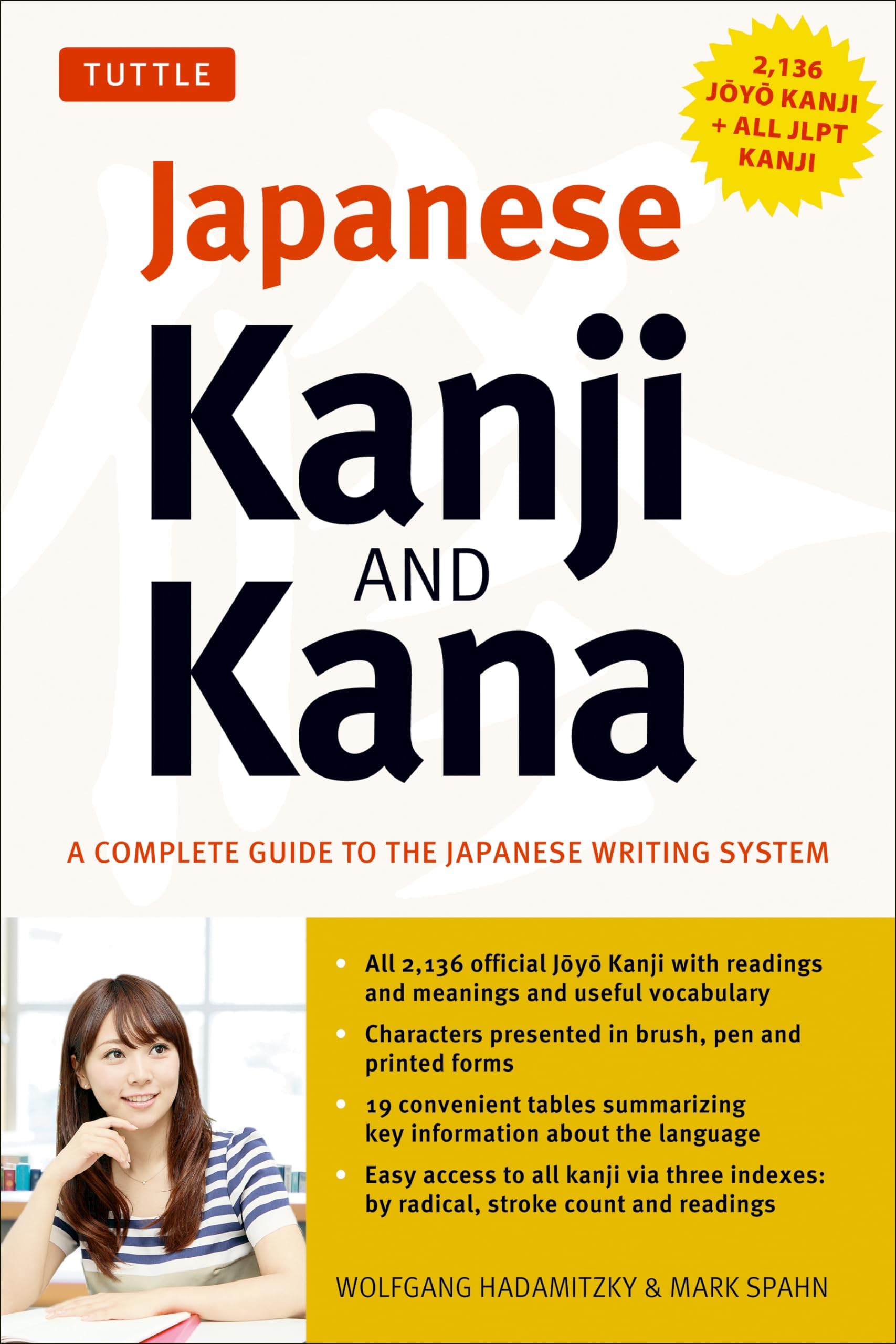
Japanese Kanji & Kana: A Complete Guide to the Japanese Writing System: (JLPT All Levels) A Complete Guide to the Japanese Writing System (2,136 Kanji and All Kana)
Product ID: 51899826
Buy anything from 5,000+ international stores. One checkout price. No surprise fees. Join 2M+ shoppers on Desertcart.
Desertcart purchases this item on your behalf and handles shipping, customs, and support to Vietnam.
Buy Japanese Kanji & Kana: A Complete Guide to the Japanese Writing System: (JLPT All Levels) A Complete Guide to the Japanese Writing System (2,136 Kanji and All Kana) Revised by Wolfgang Hadamitzky, Mark Spahn (ISBN: 9784805311165) from desertcart's Book Store. Everyday low prices and free delivery on eligible orders. Review: Excellent beginners' guide to writing (and reading) Japanese - Having struggled to learn Kanji for many years, I recently decided to give it another go, this time with an up to date guide. This one is so much better than previous (ISBN 0804802262 Tuttle 1990) admittedly old reference. Firstly, the characters are large and thus clear and easy to distinguish minor variations between characters including stroke order. Second, the order in which characters are presented is logical with compounds only presented when both components have been introduced. Third, it contains all the essential characters, although frustratingly the list seems to get longer as fast as I learn them. Fourth, each character is introduced along with relevant words which seem better suited to a modern vocabulary, although "halberd" still sneaks in somehow. It also contains both hiragana and katakana as well as useful introductions, explanations of how to use and learn the characters. The "dictionary" sections are, as ever in Japanese, a real challenge, but even here the characters are presented and cross referenced clearly. I have only been using this guide for a couple of months, but not only do I seem to be making progress, it is actually a pleasure to explore the characters and their meanings. Review: Excellent - I have a degree in Japanese language. It’s important to me to keep my Kanji skills sharp. This makes it so much easier. There’s also a lot more relevant vocabulary available to learn than the books I usually use, and because I have it on kindle I don’t have an extra thing to carry around with me 🙂


| Best Sellers Rank | 118,121 in Books ( See Top 100 in Books ) 97 in Handwriting Reference 106 in Language Readers Reference 226 in Grammar, Structure & Syntax |
| Customer reviews | 4.7 4.7 out of 5 stars (290) |
| Dimensions | 15.24 x 2.79 x 22.86 cm |
| Edition | Revised |
| ISBN-10 | 4805311169 |
| ISBN-13 | 978-4805311165 |
| Item weight | 753 g |
| Language | English |
| Print length | 448 pages |
| Publication date | 10 Mar. 2012 |
| Publisher | Tuttle Shokai Inc |
N**T
Excellent beginners' guide to writing (and reading) Japanese
Having struggled to learn Kanji for many years, I recently decided to give it another go, this time with an up to date guide. This one is so much better than previous (ISBN 0804802262 Tuttle 1990) admittedly old reference. Firstly, the characters are large and thus clear and easy to distinguish minor variations between characters including stroke order. Second, the order in which characters are presented is logical with compounds only presented when both components have been introduced. Third, it contains all the essential characters, although frustratingly the list seems to get longer as fast as I learn them. Fourth, each character is introduced along with relevant words which seem better suited to a modern vocabulary, although "halberd" still sneaks in somehow. It also contains both hiragana and katakana as well as useful introductions, explanations of how to use and learn the characters. The "dictionary" sections are, as ever in Japanese, a real challenge, but even here the characters are presented and cross referenced clearly. I have only been using this guide for a couple of months, but not only do I seem to be making progress, it is actually a pleasure to explore the characters and their meanings.
K**Y
Excellent
I have a degree in Japanese language. It’s important to me to keep my Kanji skills sharp. This makes it so much easier. There’s also a lot more relevant vocabulary available to learn than the books I usually use, and because I have it on kindle I don’t have an extra thing to carry around with me 🙂
D**R
Kanji
This book is proving to be very helpful to me .It has 3 indexes for finding an individual kanji and a great section on the radicals and hiragana and katakana .I can happily recommend this to any one new to learning Japanese.
J**E
Hehe nice
It’s perfectly fine, personally it would have been better if the Kanji meanings were in Japanese
T**I
Best Japanese learning book
I love this book, has everything about Japanese kanji and easy to find what you're looking for. Definitely recommend this amazing book!
G**L
very informative and great seller
Fantastic book with everything you require to learn Japanese. Seller was excellent. Great communication and speedy delivery. Would definitely recommend
T**T
Excellent
Bought for my brother who is teaching himself Japanese - finds it simple and easy to use.
D**M
Very helpful
Has everything you need to know.
ば**ん
漢字の意味合いが分からない2世の息子に送りました。 将来、子孫の名付けに役立つでしょう。
H**E
alles ok
R**S
Muito bom. Boa organização dos kanjis. Boa explicação dos kanas. Vale apena comprar, bem compreto e facil entendimento, mesmo para quem nao sabe inglês
S**Y
I really love the updated version of Hadamitzky's "Kanji & Kana." It is in a slimmer, more compact volume that does away with the spaces for practicing (for the most part) but keeps all the essential information, like stroke count and order, furigana, readings, and examples of the kanji. Along with Halpern's "Kodansha Kanji Learner's Dictinary," this book serves as my complete kanji study material. It is not dressed up with bells and whistles, but is organized very logically and efficiently to serve the look-up learner, though you could also go through it numerically. I personally like learning kanji. To me, it's more artistic than boring recitation or repetition. Still, even I have trouble just trudging through the book, swallowing up one kanji after another. I find it best to look up and learn kanji as you encounter them. That way you get the proper context and have a better memory association. I personally use song lyrics and focus on one song at a time, then practice writing and reading the lyrics while listening to the song. Since I like singing, this works out well for me in that I am learning the song and the kanji at the same time. Whatever method you use, be sure to do something that personally appeals to you in order to keep yourself motivated, and to have FUN while LEARNING. (It is feasible, and not just for the uber nerdy!)
J**N
An excellent teaching book
Trustpilot
2 months ago
1 month ago