

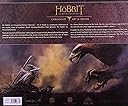
Chronicles: Art & Design (The Hobbit: An Unexpected Journey)
Product ID: 51464621
Buy anything from 5,000+ international stores. One checkout price. No surprise fees. Join 2M+ shoppers on Desertcart.
Desertcart purchases this item on your behalf and handles shipping, customs, and support to Vietnam.
Buy Chronicles: Art & Design (The Hobbit: An Unexpected Journey) by Falconer, Daniel, Weta (ISBN: 9780007487332) from desertcart's Book Store. Everyday low prices and free delivery on eligible orders. Review: A "precious" book - There are two very important things you must know about me. First of all, I'm a huge, and I mean HUGE Lord Of The Rings fan. I have read all the books, I've seen all the movies countless times, I own the special extended DVD edition etc. To me (and, as I can understand, a lot others) these movies truly represent what great storytelling can accomplish. The story is pitch-perfect, the characters are deep, all the actors knock it out of the park, the angles are amazing, the music is epic, the directing is perfect, it's as faithful to the original material as it can get, the visual effects are perfect, the atmosphere is perfect and, mainly, the designs are excellent. They try to be so true to Professor Tolkien's writings that it actually influenced the way everybody now sees Middle-Earth. It's just so... I don't even have a word to describe these movies' awesomeness. But then we arrive at the Hobbit movies. While by no means better than Lord Of The Rings (but, let's be honest here, who is better than Lord Of The Rings?) I really did like the Hobbit films. They were fun, creative, kept all the good elements from the original trilogy and I even think that the directing here is actually BETTER than Lord Of The Rings (But that doesn't mean of course that the directing on LOTR is bad. That's like saying Citizen Cane is worse than Vertigo). The SECOND thing you have to know is that I am rather fond of the visual development through conceptualization as the artistic result of one's interpretations of the given script that later goes into the process of physical manufacture for everything that can be seen on a certain motion picture, a stage play, even as far as an electronic piece of entertainment, or, in layman's terms, the not-so-humble concept art (whoa, that was way too formal for me) . Naturally, as soon as I saw this masterpiece of an “Art Of” book, I had to buy it. So here's my review for the blending of two of my favourite things on the planet (just writing that sentence makes me want to grab it and read it all over again. But anyways, enough mumbling, let's get on with it before I bore you from the second paragraph) . The first impression you immediately get from this book is its cover. It's very lush and has an almost 3D vibe to it, that makes it very nice to touch. I also love the fact that the title is surrounded by a circle of elven motifs, so I'm already really hyped . If someone puts that much effort in just the cover, you know you're in for a treat. You are then being introduced into this realm of excellence that really, throughout this book, makes you feel like you're leaving reality and enter Middle-Earth, which was exactly what the designers were striving for. It is present in both LOTR and The Hobbit that they try to give everything its own cultural significance and thus make Middle-Earth a real, living place because Peter Jackson as well as Prof.Tolkien wanted to treat it this way. But, of course, that means redesigning a whole new world with as much detail as the real ancient civilizations we have, which equals to insurmountable amounts of work, from which, ultimately, only 10% is shown in camera and the average viewer notices about 5% of that 10%. So, when you see a movie with really impressive sets, costumes, props etc. you're really only scratching the surface. That is why I love “Art Of” books. You get a chance to explore every single minor thing to its full detail and appreciate all the effort that's been put into it and really understand what extremes the designers went to richen the world they created with the tiniest of tiniest of details (I'm talking arrow heads details) which details are usually associated with written commentary by the artists detailing the design choices. But, for me, The Hobbit and ESPECIALLY LOTR go so far, that I always have to ask myself two questions: 1) Why couldn't Prof. Tolkien live long enough to see how true they tried to stay about everything he wrote and 2) Is it worth for someone to work so hard just for a 3-hour movie? Well, to answer that I'm going to quote lead Weta Workshop artist for the films Richard Taylor-People keep saying to me “Why bother? Why did you go to so much trouble”. We didn't put the detail in for detail's sake. We put it in there because it rationalizes out a theoretical culture- That sentence right there describes everything I said in this paragraph and is why I love Tolkien's Middle-Earth so much. The first place you travel to is the fan-beloved Hobbiton. It has been completely duplicated for the Hobbit, but with a few adjustments. The color palette is brighter (how is possible for HOBBITON to be any more brighter than in LOTR is beyond me) and there is a lot more life in this place. We also get to explore a lot more of Bag End. The detail is so magical and prepares you for what is to come later in this book. Bag End is such a peaceful and calm surrounding that you're kind of jealous of Bilbo Baggins (Be honest. How many of you wished to live in there at least once in your life? I know I have). But that peace and serendipity is very quickly crashed by the arrival of the Dwarves, which is the next chapter. Let me say something. This chapter, THIS FREAKING CHAPTER is GOLD. NO, SORRY, PLATINUM!!! This chapter is the best 37 pages I have ever seen in an “Art Of” book. Like, period!! “Come on, really? I think you're exaggerating a bit” I can hear you thinking to yourself. Well, yes, you are correct for thinking that. I'm just trying to show you how awesome this chapter is. Because it takes everything I said on the last paragraph and doubles it. Basically, you are taken through the design phases of hair, make up, costume, props and weapons for each of the 13 dwarves. What is so awe-inspiring here is the fact that Prof. Tolkien goes into very little detail about the dwarves (nothing beyond the color of their hoods) and has them do even less (basically, they're in the book because their names rhyme). That means the designers were totally free to give whatever interpretation they want and give the dwarves unique personalities. And every single one of the designs embraces that option (my favourite has got to be Bifur. I don't know why, but every time I see him on the screen, he cracks me up). So, after 43 minutes in the film (and 1145 words in this review) the adventure begins. The next chapter is kind of similar to the last one, but it shows the dwarves in their glory days, back on Erebor before the coming of Smaug as well as the battle of Azanulbizar near the Mines Of Moria. Really, I don't have to say anything else here other than the designs are excellent. We then travel to another area only briefly mentioned by Tolkien. Radagast the Brown's house, Rhosgobel, and Radagast himself. First of all, I have to clarify that I fell in love with Radagast's design the minute I saw him (it's a tie between him and the dwarves as to who is the best design in the movie). And Rhosgobel looks whimsical and magical. I love how random it is. It looks like something that would fit perfectly on a Disney movie, so it feels totally out of place to the trying-to-achieve-realism style of design that follows through on LOTR and the Hobbit, but is a welcome edition nonetheless. But Rhosgobel is a bit too small, and Middle-Earth is such a huge place, you can't just have the fellowship of the Arkenstone (yeah, that's how I'll call the dwarves from now on) go from one event in the book to the other. That's where the next chapter comes to handy. It's 6 glorious pages of amazing landscapes for our heroes to journey through, all done by Gus Hunter, one of the main Weta Workshop artists. They look spectacular to say the least, ranging from jagged mountains, to deep chasms, to beautiful forests and so forth. They don't look like anything we have seen before, and it helps the audience understand the difference between Middle-Earth and our real world. They are so lavish, I am kind of sad there's so little of it. Honestly, while it may appeal to some as a cheap excuse to fill the number of pages needed, I wanted to see more. But, I guess that's a good complaint. Finally returning to the book, we have the encounter with three of the most beloved characters in the Hobbit. I am, of course, referring to the Trolls, the adorable goofballs we all know and love, Tom, Bert and William. I have read The Hobbit, and, I can say that this incident is one of the most memorable moments in the Hobbit. We see their designs, and, that's about it. Nothing else to really mention. The chapter is rather short, but the satisfying designs of the Trolls (as well as Thorin's sword, Orcrist) would make even Prof.Tolkien proud. Now, in the average movie time, the audience begins to get a little bored with all the action sequences at that point (unless you're in a Peter Jackson movie, in which case, you have to sit through another one and a half hour before the credits roll). In this case, the only thing you need is something to break up the pace, but also advance the story. So, conveniently enough, Rivendell will do the trick. Rivendell is treated here pretty much the same way as Hobbiton. They redesign a lot of the areas previously seen in LOTR, but add more details. The color palette is also brightened here and, yes, it's a lot more obvious here than in Hobbiton. In LOTR, Rivendell was this very quiet and melancholic place, almost like a church. And that made sense, because the Elves were leaving Middle-Earth. But here, they're at their finest, as the Hobbit is set 60 years earlier than LOTR. That meant fleshing it out even more, which is a common theme in the Hobbit, now that I think about it. Mainly two new locations have been explored. Elrond's observatory, where they read the moon-runes of Thror's map and the Council Chamber, where IAN McKELLEN, CATE BLANCHETT, HUGO WEAVING AND CHRISTOPHER LEE have a conversation about Sauron (Any arguments about the Hobbit being bad are so invalid, it's not even a joke). Adding to the already incomprehensible amounts of content (if you couldn't tell from the number of paragraphs it has taken me just to explain what's included in the book. Although I do believe I'm rather brief. Wait till you see part 2), we have the Stone Giant scene. It is a great sequence and I'm glad the director put it in there. The Stone Giants do appear in the book but are not encountered. Bilbo and the others just attend them having this epic fight. When I read the Hobbit, that seemed like a missed opportunity for a great sequence. Fortunately, Peter Jackson shared this opinion and decided that the Dwarves should interfere in the fight. Or, more correctly, the Stone Giants interfere in the Dwarves' way. I have to be honest, there's nothing really interesting here. I'm not going to act like a stubborn nitpicker and say the designs suck because they're just rock men. I know the designers did the best they could and nobody could've done it better, and I can't applaud them enough for this but I felt a bit empty. But, the next chapter is just so awesome and imaginative that it more than makes up for it (note that the last chapter isn't bad at all. It just feels a bit stale when compared to everything else this book has to offer) .It's one of the best sequences in the film and is a great pay-off. Goblin-Town. Good God!!! I love Goblin-Town so much. The very first drawing of it is one of the most mind-boggling and amazing pictures I have seen in my entire live. It's very detailed and, while it's not colored, gives you an incredible vibe of the atmosphere dazzling this place. It's so unbelievably sublime, I would go out and buy even more copies of the book to watch multiple Goblin-Town's all at once. To say that it's the best drawing in the book is an understatement. To say it's the highlight of ANY “Art Of” book I have ever seen is putting it nicely (do you understand why you should stop reading this review and order it right now? Or do I need to praise the hell out of this ONE, PARTICULAR, DRAWING more?) That drawing is so freaking awesome, I had to change paragraphs to honor it. It's too good to get squeezed in with the rest of Goblin-Town. However, after this magnificence, the rest of the chapter couldn't live up to it. Right? WRONG!! WRONG, WRONG, WRONG!!! The chapter is still unbelievable. You explore some great locations, get an understanding of the Goblins' culture, the effort the designers put to make it a terrifying and dark set, the Goblin-King's throne and even some Goblin designs. However, you can get lost to its charm very easily and overlook its flaws (and I have this weird feeling I have seen something similar, though I can't quite put my finger on it). The main complaint I have with Goblin-Town is that it is riddled with CGI. One of the things that made LOTR great is the fact they tried new things before jumping straight into digital. There were macquettes, animatronics, camera coordinating tricks, miniatures, scale doubles and lots of other things to make it, as Legolas put it, a “diversion”. When it comes to The Hobbit, Peter Jackson just said “I don’t care. I made King Kong, I made District 9, I made Tin-Tin so the Hobbit's going to be all-digital” (please note that I don't hate Peter Jackson in any conceivable way. I respect him and admire him as much as the next guy, but overloading a world with CGI devalues the realism LOTR was so desperate to achieve. In LOTR's days, he would make a physical model of Lothlorien, The Mines of Moria AND Minas Tirith, all really hard sets to build. In the Hobbit, even Bag End is green-screened!!). Speaking of CGI, who could forget the scene with Gollum? It was one of the best scenes in the movie and arguably the most character driven sequence of the entire series (my favorite scene is by a long far the final confrontation between Azog the Defiler who, by the way, doesn't appear in this book, and Thorin. But Gollum's scene is a close second). This is the shortest chapter in the book, even more so than the landscapes, since there isn't much to cover. Hallelujah, we have finally arrived at the last chapter in the book. It's all about the Wargs, the Orcs, the cliff and the carrock where the eagles land our heroes at the end of the movie. The Wargs look as intimidating and badass as always (and they might be a bit scarier than the original trilogy), the cliff at the end of the forest isn't nothing special since, what else is there to do other than add the trees described by Tolkien and the carrock shows what good design can accomplish. I say that because it's simply a steep rock with a hint of a ladder carved on it side. The designers made it look unique by adding a very vague pattern on the rocks to make them look like a bear. That's great because a) it kind of spoils the later part of the story with Beorn and what not (if you don't know who Beorn is, I can either assume that you haven't seen the Hobbit 2 or you don't really care for Tolkien's Middle Earth in general and are reading this review just to see how far I'll go before my fingers blow up) and b) IT'S JUST A ROCK! Why would anyone get into any trouble just for a (yeah, yeah, you know the drill. But if you are getting bored with my repetitiveness, then you should have left 4 paragraphs ago. This is a review for a die-hard Tolkien fan that probably has an attention spam the size of Canada). However, rocky carrocks and scary Wargs aside, what really sells this chapter for me is the design of the Orcs. They look way more threatening and creepy than LOTR ever wished to achieve. There are some really excellent designs here, ranging from skeleton armour, slimy faces to dangerous weapons. Every single component that makes a good armour is present here and manages to separate them greatly from what was previously seen in LOTR. And, if these features weren't enough to satisfy even the most hardcore troller in the world, the book offers two authentic replicas of significant props in the movie: Thror's map of Erebor WITH GLOW-IN THE DARK RUNES and Bilbo's burglar contract. Now I'll talk about the art in this book. It is awesome to say the least. I don't think there is a single drawing that didn't a)captivate me, b)portray perfectly the atmosphere it was trying to push and c)show the true majesty of design. Richard Taylor, Ra Vincent, Nick Keller, Gus Hunter and more really surprised me. Whether it was Nick Keller's epic first take on the Dwarves, Ra Vincent's colorful sets or Gus Hunter's majestic landscapes, there is not one drawing that gives me boredom. Ann Maskrey really breathes life to the world with her amazing costumes, although they aren't really shown. Whether it is creatures, sets, props or even dwarf designs, all of these people and more really put their full skill to use to create something unique. The final designs that did make it into the film show that Peter Jackson has maintained his creative outlook from LOTR days but the runner-ups show the power of the creative mind and help you understand why Weta Workshop is the top design and digital studio in the world. And all of that spawned from a hole in the ground. But, while everybody does their hardest to match (and sometimes top) Tolkien's vivid imagination, nobody does it better than the two lead concept-artists, John Howe and Alan Lee. Really, they're the main stars of this book and could have held it just on their own. And that is true. Every single piece of design these two Tolkien geniuses make usually ends up on the finished film, because, let's be honest, they spent so many years thinking about Prof.Tolkien's stories until somebody puts them in front of a desk to design a movie, that all the ideas they have for props and sets come off as natural instincts. You can clearly see that Alan Lee's scruffier style matches landscapes and sets a lot better (that epic Goblin-Town drawing is actually made by him), while John Howe's more detailed and precise penciling suits props or little details. However, when one tries the other the end result is nothing short of unbelievable. In conclusion, I believe this book is TOTALLY worth your time and money. The beautiful illustrated images accompanied by the great text explaining the functionality and the idea behind almost everything in it makes for a great overall experience. There are some great understandings of human-as well as Dwarvish- culture and what we, as a species, can only look at and gasp from the sheer size and majesty of everything. That's how I feel about LOTR and The Hobbit. The Hobbit has both the advantage and the curse of being split into three movies. That's great because it allows the trip to take a slower route and explore a lot more design aspects which you couldn't really spot. I say that because three movies based on a 345-page book demands for it to be stretched, so what in the book was one chapter is now translated into forty minutes of screen-time. That's also a curse because it slows the pace down, making it harder to watch. But you know what. I believe this film is deserved to be watched more and more people ought to lighten up on it. That applies in the book. It's a journey we all need to take and go on our own adventure. Thanks for reading. Review: The Pregnancy of The Hobbit-movie - From a owner of every "Art of..." from Lord of the Rings; this book is so full of wonderful images I couldn't even look through all of it in one go...it's so picture dense I couldn't digest everything at once. It delighted me at first read and continues to amaze me, after a month it's still the book which sits on my coffee table, the book which I, my kids and many of my guests most often pick up and delve into with great awe! I'm so glad that we're gonna spend all this time in Middle Earth again, I don't mind the wait. Not for the movies and not for the books. I have ever been a great fan of both Alan Lee and John Howe, and it shows that they have been happy to return to NZ! Not to mention the designers at Weta...NZ is just sprouting creative talent! Every piece of personal equipment and furniture...adds to the build. The environments are stunning. But what really has me giggling like a fan girl is the Dwarven culture...its so well developed and detailed, I love all the chapters! There is layer upon layer building each character. Being a costumer myself I am over the moon with all the sketches and stories told by the Weta crew, of how they arrived at the end designs. I love the dwarf women, even if one hardly see them in the movie...I made a dwarf woman costume for myself prior to the premiere and it was a hoot to discover that one of my own designs were close to what is presented in the book! If you get this you won't be sorry...you'll be begging for more!
| Best Sellers Rank | 459,891 in Books ( See Top 100 in Books ) 184 in Cinematography Production & Technology 488 in Film Direction & Production (Books) 1,305 in Film Genres |
| Book 1 of 6 | The Hobbit |
| Customer reviews | 4.8 4.8 out of 5 stars (516) |
| Dimensions | 31.1 x 2.1 x 24.6 cm |
| ISBN-10 | 0007487339 |
| ISBN-13 | 978-0007487332 |
| Item weight | 1.37 kg |
| Language | English |
| Print length | 208 pages |
| Publication date | 14 Dec. 2012 |
| Publisher | HarperCollins |
E**A
A "precious" book
There are two very important things you must know about me. First of all, I'm a huge, and I mean HUGE Lord Of The Rings fan. I have read all the books, I've seen all the movies countless times, I own the special extended DVD edition etc. To me (and, as I can understand, a lot others) these movies truly represent what great storytelling can accomplish. The story is pitch-perfect, the characters are deep, all the actors knock it out of the park, the angles are amazing, the music is epic, the directing is perfect, it's as faithful to the original material as it can get, the visual effects are perfect, the atmosphere is perfect and, mainly, the designs are excellent. They try to be so true to Professor Tolkien's writings that it actually influenced the way everybody now sees Middle-Earth. It's just so... I don't even have a word to describe these movies' awesomeness. But then we arrive at the Hobbit movies. While by no means better than Lord Of The Rings (but, let's be honest here, who is better than Lord Of The Rings?) I really did like the Hobbit films. They were fun, creative, kept all the good elements from the original trilogy and I even think that the directing here is actually BETTER than Lord Of The Rings (But that doesn't mean of course that the directing on LOTR is bad. That's like saying Citizen Cane is worse than Vertigo). The SECOND thing you have to know is that I am rather fond of the visual development through conceptualization as the artistic result of one's interpretations of the given script that later goes into the process of physical manufacture for everything that can be seen on a certain motion picture, a stage play, even as far as an electronic piece of entertainment, or, in layman's terms, the not-so-humble concept art (whoa, that was way too formal for me) . Naturally, as soon as I saw this masterpiece of an “Art Of” book, I had to buy it. So here's my review for the blending of two of my favourite things on the planet (just writing that sentence makes me want to grab it and read it all over again. But anyways, enough mumbling, let's get on with it before I bore you from the second paragraph) . The first impression you immediately get from this book is its cover. It's very lush and has an almost 3D vibe to it, that makes it very nice to touch. I also love the fact that the title is surrounded by a circle of elven motifs, so I'm already really hyped . If someone puts that much effort in just the cover, you know you're in for a treat. You are then being introduced into this realm of excellence that really, throughout this book, makes you feel like you're leaving reality and enter Middle-Earth, which was exactly what the designers were striving for. It is present in both LOTR and The Hobbit that they try to give everything its own cultural significance and thus make Middle-Earth a real, living place because Peter Jackson as well as Prof.Tolkien wanted to treat it this way. But, of course, that means redesigning a whole new world with as much detail as the real ancient civilizations we have, which equals to insurmountable amounts of work, from which, ultimately, only 10% is shown in camera and the average viewer notices about 5% of that 10%. So, when you see a movie with really impressive sets, costumes, props etc. you're really only scratching the surface. That is why I love “Art Of” books. You get a chance to explore every single minor thing to its full detail and appreciate all the effort that's been put into it and really understand what extremes the designers went to richen the world they created with the tiniest of tiniest of details (I'm talking arrow heads details) which details are usually associated with written commentary by the artists detailing the design choices. But, for me, The Hobbit and ESPECIALLY LOTR go so far, that I always have to ask myself two questions: 1) Why couldn't Prof. Tolkien live long enough to see how true they tried to stay about everything he wrote and 2) Is it worth for someone to work so hard just for a 3-hour movie? Well, to answer that I'm going to quote lead Weta Workshop artist for the films Richard Taylor-People keep saying to me “Why bother? Why did you go to so much trouble”. We didn't put the detail in for detail's sake. We put it in there because it rationalizes out a theoretical culture- That sentence right there describes everything I said in this paragraph and is why I love Tolkien's Middle-Earth so much. The first place you travel to is the fan-beloved Hobbiton. It has been completely duplicated for the Hobbit, but with a few adjustments. The color palette is brighter (how is possible for HOBBITON to be any more brighter than in LOTR is beyond me) and there is a lot more life in this place. We also get to explore a lot more of Bag End. The detail is so magical and prepares you for what is to come later in this book. Bag End is such a peaceful and calm surrounding that you're kind of jealous of Bilbo Baggins (Be honest. How many of you wished to live in there at least once in your life? I know I have). But that peace and serendipity is very quickly crashed by the arrival of the Dwarves, which is the next chapter. Let me say something. This chapter, THIS FREAKING CHAPTER is GOLD. NO, SORRY, PLATINUM!!! This chapter is the best 37 pages I have ever seen in an “Art Of” book. Like, period!! “Come on, really? I think you're exaggerating a bit” I can hear you thinking to yourself. Well, yes, you are correct for thinking that. I'm just trying to show you how awesome this chapter is. Because it takes everything I said on the last paragraph and doubles it. Basically, you are taken through the design phases of hair, make up, costume, props and weapons for each of the 13 dwarves. What is so awe-inspiring here is the fact that Prof. Tolkien goes into very little detail about the dwarves (nothing beyond the color of their hoods) and has them do even less (basically, they're in the book because their names rhyme). That means the designers were totally free to give whatever interpretation they want and give the dwarves unique personalities. And every single one of the designs embraces that option (my favourite has got to be Bifur. I don't know why, but every time I see him on the screen, he cracks me up). So, after 43 minutes in the film (and 1145 words in this review) the adventure begins. The next chapter is kind of similar to the last one, but it shows the dwarves in their glory days, back on Erebor before the coming of Smaug as well as the battle of Azanulbizar near the Mines Of Moria. Really, I don't have to say anything else here other than the designs are excellent. We then travel to another area only briefly mentioned by Tolkien. Radagast the Brown's house, Rhosgobel, and Radagast himself. First of all, I have to clarify that I fell in love with Radagast's design the minute I saw him (it's a tie between him and the dwarves as to who is the best design in the movie). And Rhosgobel looks whimsical and magical. I love how random it is. It looks like something that would fit perfectly on a Disney movie, so it feels totally out of place to the trying-to-achieve-realism style of design that follows through on LOTR and the Hobbit, but is a welcome edition nonetheless. But Rhosgobel is a bit too small, and Middle-Earth is such a huge place, you can't just have the fellowship of the Arkenstone (yeah, that's how I'll call the dwarves from now on) go from one event in the book to the other. That's where the next chapter comes to handy. It's 6 glorious pages of amazing landscapes for our heroes to journey through, all done by Gus Hunter, one of the main Weta Workshop artists. They look spectacular to say the least, ranging from jagged mountains, to deep chasms, to beautiful forests and so forth. They don't look like anything we have seen before, and it helps the audience understand the difference between Middle-Earth and our real world. They are so lavish, I am kind of sad there's so little of it. Honestly, while it may appeal to some as a cheap excuse to fill the number of pages needed, I wanted to see more. But, I guess that's a good complaint. Finally returning to the book, we have the encounter with three of the most beloved characters in the Hobbit. I am, of course, referring to the Trolls, the adorable goofballs we all know and love, Tom, Bert and William. I have read The Hobbit, and, I can say that this incident is one of the most memorable moments in the Hobbit. We see their designs, and, that's about it. Nothing else to really mention. The chapter is rather short, but the satisfying designs of the Trolls (as well as Thorin's sword, Orcrist) would make even Prof.Tolkien proud. Now, in the average movie time, the audience begins to get a little bored with all the action sequences at that point (unless you're in a Peter Jackson movie, in which case, you have to sit through another one and a half hour before the credits roll). In this case, the only thing you need is something to break up the pace, but also advance the story. So, conveniently enough, Rivendell will do the trick. Rivendell is treated here pretty much the same way as Hobbiton. They redesign a lot of the areas previously seen in LOTR, but add more details. The color palette is also brightened here and, yes, it's a lot more obvious here than in Hobbiton. In LOTR, Rivendell was this very quiet and melancholic place, almost like a church. And that made sense, because the Elves were leaving Middle-Earth. But here, they're at their finest, as the Hobbit is set 60 years earlier than LOTR. That meant fleshing it out even more, which is a common theme in the Hobbit, now that I think about it. Mainly two new locations have been explored. Elrond's observatory, where they read the moon-runes of Thror's map and the Council Chamber, where IAN McKELLEN, CATE BLANCHETT, HUGO WEAVING AND CHRISTOPHER LEE have a conversation about Sauron (Any arguments about the Hobbit being bad are so invalid, it's not even a joke). Adding to the already incomprehensible amounts of content (if you couldn't tell from the number of paragraphs it has taken me just to explain what's included in the book. Although I do believe I'm rather brief. Wait till you see part 2), we have the Stone Giant scene. It is a great sequence and I'm glad the director put it in there. The Stone Giants do appear in the book but are not encountered. Bilbo and the others just attend them having this epic fight. When I read the Hobbit, that seemed like a missed opportunity for a great sequence. Fortunately, Peter Jackson shared this opinion and decided that the Dwarves should interfere in the fight. Or, more correctly, the Stone Giants interfere in the Dwarves' way. I have to be honest, there's nothing really interesting here. I'm not going to act like a stubborn nitpicker and say the designs suck because they're just rock men. I know the designers did the best they could and nobody could've done it better, and I can't applaud them enough for this but I felt a bit empty. But, the next chapter is just so awesome and imaginative that it more than makes up for it (note that the last chapter isn't bad at all. It just feels a bit stale when compared to everything else this book has to offer) .It's one of the best sequences in the film and is a great pay-off. Goblin-Town. Good God!!! I love Goblin-Town so much. The very first drawing of it is one of the most mind-boggling and amazing pictures I have seen in my entire live. It's very detailed and, while it's not colored, gives you an incredible vibe of the atmosphere dazzling this place. It's so unbelievably sublime, I would go out and buy even more copies of the book to watch multiple Goblin-Town's all at once. To say that it's the best drawing in the book is an understatement. To say it's the highlight of ANY “Art Of” book I have ever seen is putting it nicely (do you understand why you should stop reading this review and order it right now? Or do I need to praise the hell out of this ONE, PARTICULAR, DRAWING more?) That drawing is so freaking awesome, I had to change paragraphs to honor it. It's too good to get squeezed in with the rest of Goblin-Town. However, after this magnificence, the rest of the chapter couldn't live up to it. Right? WRONG!! WRONG, WRONG, WRONG!!! The chapter is still unbelievable. You explore some great locations, get an understanding of the Goblins' culture, the effort the designers put to make it a terrifying and dark set, the Goblin-King's throne and even some Goblin designs. However, you can get lost to its charm very easily and overlook its flaws (and I have this weird feeling I have seen something similar, though I can't quite put my finger on it). The main complaint I have with Goblin-Town is that it is riddled with CGI. One of the things that made LOTR great is the fact they tried new things before jumping straight into digital. There were macquettes, animatronics, camera coordinating tricks, miniatures, scale doubles and lots of other things to make it, as Legolas put it, a “diversion”. When it comes to The Hobbit, Peter Jackson just said “I don’t care. I made King Kong, I made District 9, I made Tin-Tin so the Hobbit's going to be all-digital” (please note that I don't hate Peter Jackson in any conceivable way. I respect him and admire him as much as the next guy, but overloading a world with CGI devalues the realism LOTR was so desperate to achieve. In LOTR's days, he would make a physical model of Lothlorien, The Mines of Moria AND Minas Tirith, all really hard sets to build. In the Hobbit, even Bag End is green-screened!!). Speaking of CGI, who could forget the scene with Gollum? It was one of the best scenes in the movie and arguably the most character driven sequence of the entire series (my favorite scene is by a long far the final confrontation between Azog the Defiler who, by the way, doesn't appear in this book, and Thorin. But Gollum's scene is a close second). This is the shortest chapter in the book, even more so than the landscapes, since there isn't much to cover. Hallelujah, we have finally arrived at the last chapter in the book. It's all about the Wargs, the Orcs, the cliff and the carrock where the eagles land our heroes at the end of the movie. The Wargs look as intimidating and badass as always (and they might be a bit scarier than the original trilogy), the cliff at the end of the forest isn't nothing special since, what else is there to do other than add the trees described by Tolkien and the carrock shows what good design can accomplish. I say that because it's simply a steep rock with a hint of a ladder carved on it side. The designers made it look unique by adding a very vague pattern on the rocks to make them look like a bear. That's great because a) it kind of spoils the later part of the story with Beorn and what not (if you don't know who Beorn is, I can either assume that you haven't seen the Hobbit 2 or you don't really care for Tolkien's Middle Earth in general and are reading this review just to see how far I'll go before my fingers blow up) and b) IT'S JUST A ROCK! Why would anyone get into any trouble just for a (yeah, yeah, you know the drill. But if you are getting bored with my repetitiveness, then you should have left 4 paragraphs ago. This is a review for a die-hard Tolkien fan that probably has an attention spam the size of Canada). However, rocky carrocks and scary Wargs aside, what really sells this chapter for me is the design of the Orcs. They look way more threatening and creepy than LOTR ever wished to achieve. There are some really excellent designs here, ranging from skeleton armour, slimy faces to dangerous weapons. Every single component that makes a good armour is present here and manages to separate them greatly from what was previously seen in LOTR. And, if these features weren't enough to satisfy even the most hardcore troller in the world, the book offers two authentic replicas of significant props in the movie: Thror's map of Erebor WITH GLOW-IN THE DARK RUNES and Bilbo's burglar contract. Now I'll talk about the art in this book. It is awesome to say the least. I don't think there is a single drawing that didn't a)captivate me, b)portray perfectly the atmosphere it was trying to push and c)show the true majesty of design. Richard Taylor, Ra Vincent, Nick Keller, Gus Hunter and more really surprised me. Whether it was Nick Keller's epic first take on the Dwarves, Ra Vincent's colorful sets or Gus Hunter's majestic landscapes, there is not one drawing that gives me boredom. Ann Maskrey really breathes life to the world with her amazing costumes, although they aren't really shown. Whether it is creatures, sets, props or even dwarf designs, all of these people and more really put their full skill to use to create something unique. The final designs that did make it into the film show that Peter Jackson has maintained his creative outlook from LOTR days but the runner-ups show the power of the creative mind and help you understand why Weta Workshop is the top design and digital studio in the world. And all of that spawned from a hole in the ground. But, while everybody does their hardest to match (and sometimes top) Tolkien's vivid imagination, nobody does it better than the two lead concept-artists, John Howe and Alan Lee. Really, they're the main stars of this book and could have held it just on their own. And that is true. Every single piece of design these two Tolkien geniuses make usually ends up on the finished film, because, let's be honest, they spent so many years thinking about Prof.Tolkien's stories until somebody puts them in front of a desk to design a movie, that all the ideas they have for props and sets come off as natural instincts. You can clearly see that Alan Lee's scruffier style matches landscapes and sets a lot better (that epic Goblin-Town drawing is actually made by him), while John Howe's more detailed and precise penciling suits props or little details. However, when one tries the other the end result is nothing short of unbelievable. In conclusion, I believe this book is TOTALLY worth your time and money. The beautiful illustrated images accompanied by the great text explaining the functionality and the idea behind almost everything in it makes for a great overall experience. There are some great understandings of human-as well as Dwarvish- culture and what we, as a species, can only look at and gasp from the sheer size and majesty of everything. That's how I feel about LOTR and The Hobbit. The Hobbit has both the advantage and the curse of being split into three movies. That's great because it allows the trip to take a slower route and explore a lot more design aspects which you couldn't really spot. I say that because three movies based on a 345-page book demands for it to be stretched, so what in the book was one chapter is now translated into forty minutes of screen-time. That's also a curse because it slows the pace down, making it harder to watch. But you know what. I believe this film is deserved to be watched more and more people ought to lighten up on it. That applies in the book. It's a journey we all need to take and go on our own adventure. Thanks for reading.
L**G
The Pregnancy of The Hobbit-movie
From a owner of every "Art of..." from Lord of the Rings; this book is so full of wonderful images I couldn't even look through all of it in one go...it's so picture dense I couldn't digest everything at once. It delighted me at first read and continues to amaze me, after a month it's still the book which sits on my coffee table, the book which I, my kids and many of my guests most often pick up and delve into with great awe! I'm so glad that we're gonna spend all this time in Middle Earth again, I don't mind the wait. Not for the movies and not for the books. I have ever been a great fan of both Alan Lee and John Howe, and it shows that they have been happy to return to NZ! Not to mention the designers at Weta...NZ is just sprouting creative talent! Every piece of personal equipment and furniture...adds to the build. The environments are stunning. But what really has me giggling like a fan girl is the Dwarven culture...its so well developed and detailed, I love all the chapters! There is layer upon layer building each character. Being a costumer myself I am over the moon with all the sketches and stories told by the Weta crew, of how they arrived at the end designs. I love the dwarf women, even if one hardly see them in the movie...I made a dwarf woman costume for myself prior to the premiere and it was a hoot to discover that one of my own designs were close to what is presented in the book! If you get this you won't be sorry...you'll be begging for more!
A**Y
'The Hobbit: An Unexpected Journey Chronicles - Art & Design'
'The Hobbit: An Unexpected Journey Chronicles - Art & Design' is a gorgeous hardcover book that is packed cover to cover with over a thousand images of concept art, photographs, sketches and paintings from the artists working behind the scenes to help bring Peter Jackson's vision of 'The Hobbit' onto the screen. The book is compiled by Weta senior concept designer Daniel Falconer with a foreward by Production Designer Dan Hannah and an introduction from Richard Taylor, Weta's Design & Special Effects Supervisor. Each chapter of the book details a particular section of the film; starting with Bilbo Baggins, Bag End, Hobbiton and the rest of the Hobbits, through to a very detailed look at each of the Dwarves (even a quick look at Moria and the Battle Of Azanulbizar), the wizards, the trolls, the elves, Gollum, the landscapes and the other creatures from Middle-Earth that feature in the film. Each chapter is looked at in depth with prelim sketches, beautiful concept art and photographs. There are two special fold-out features to this book; a large replica of Thorin's map, printed in glow-in-the-dark ink and a three page fold-out replica of Bilbo's burglar contract. You can see as to how much detail has been put into this book, with the Weta team working very closely with the production team to make sure that the book is packed to the gills. Apparently this is only the first of a series of lavish hardcover books from Weta. If that's the case, and after reading this volume, I can't wait to see what the other books in the series will be like.
J**A
Awesome artwork by the team. You could actually go through the whole movie by browsing through the book. There is so much detail cramped into the book but still you would desire more. Must for the fans of this fantasy world. And for aspiring artist there is so much to learn.
S**S
Primero de los 6 libros sobre cómo se hizo la trilogía de el Hobbit. Los libros 1,3 y 5 son de concept art y dibujo, los libros 2,4 y 6 hablan sobre el making of de la película, y hay más fotografías, decorados reales, ropa y vestuario. En este podemos encontrar los dibujos y el material gráfico de inicio, para la creación de la primera película. Todo el libro, como los otros, es una joya para los amantes de la Tierra Media y fans de las películas.
A**E
Das Buch ist toll aufgemacht und allein durch seine stilvolle und bis ins Detail designte Optik eine wahre Freude. Im Buch selbst wird die Entwicklung der Figuren-, Set- und Requisitendesigns anhand von Skizzen, Grafiken und Zeichnungen erläutert. Dies lässt einen wesentlich tieferen Einblick zu, als es bei den sonst üblichen Setfotos möglich ist. Im englischen Text werden interessante Einblicke in die Entscheidungs- und Entstehungsprozesse gegeben. Es werden auch ein paar Brücken zur Buchvorlage geschlagen, die zumindest mir im Film gar nicht aufgefallen sind, im Nachhinein aber auch wieder die Liebe und den Respekt der Filmschaffenden vor der literarischen Vorlage demonstrieren. So hat Tolkien im Buch die Kapuzenmäntel der Zwerge beschrieben und dabei jedem Zwerg eine eigene Farbe zugewiesen. Im Film hat man sich dann aber für eine realistischere und erwachsenere Optik in Erdtönen entschieden. Die Tolkienschen Farbschemas wurden aber dennoch übernommen! Und zwar im Innenfutter der Mäntel! Wenn man es weiß und darauf achtet, kann man es in der Szene bei den Steinriesen kurz erkennen. Alles in allem also ein Buch, das interessierten Lesern gute Einblicke fernab der üblichen Werbefotos und -texte der anderen "Filmbücher" bietet. Kaufempfehlung!
K**A
以前アラン・リーによる「The Lord of the Rings Sketchbook」 The Lord of the Rings Sketchbook という書籍が刊行されており、それが実に良い本だったので、今回もその種のものが出るのではないかと検索したら案の定あったので即購入しました。 PJ中つ国映画のデザインが好きであるならばマストです。持っていなければなりません。 各シーンの風景がどうイメージされて、コンセプトがまとめられていったのかという過程が収録されているのもさることながら、各登場人物の外見に関しても、最終的にあの形になるまでどういう経緯をたどったかがつぶさに追えるようになっています。持ち道具の詳細な設定画などどれだけ見ていても飽きません。 解説もちょっと英語が読めれば理解できるでしょう。恐れる必要はありませんよ。 折込みのかたちで「トーリンの地図」と、ビルボに渡された「契約書」の詳細も掲載されており、読み応え満点です。素晴らしく手の込んだ装丁も込みで、手に入れれば必ず満足感に浸れることでしょう。 これはまだ第一部「思いがけない冒険」の範囲です。このあと二部、三部の分も刊行されていくことと思いますが、恐らく日本ではこの手の本は売り上げが見込めないからと出版されないでしょう。 邦訳されるのを待っていてはいけません。どうせもう、心は決まっているのでしょう?
N**I
L'article reçu était conforme à la description et en excellent état ; c'est très bel artbook, très intéressant à lire et avec de belles photos et recherches graphiques.
Trustpilot
1 month ago
1 day ago