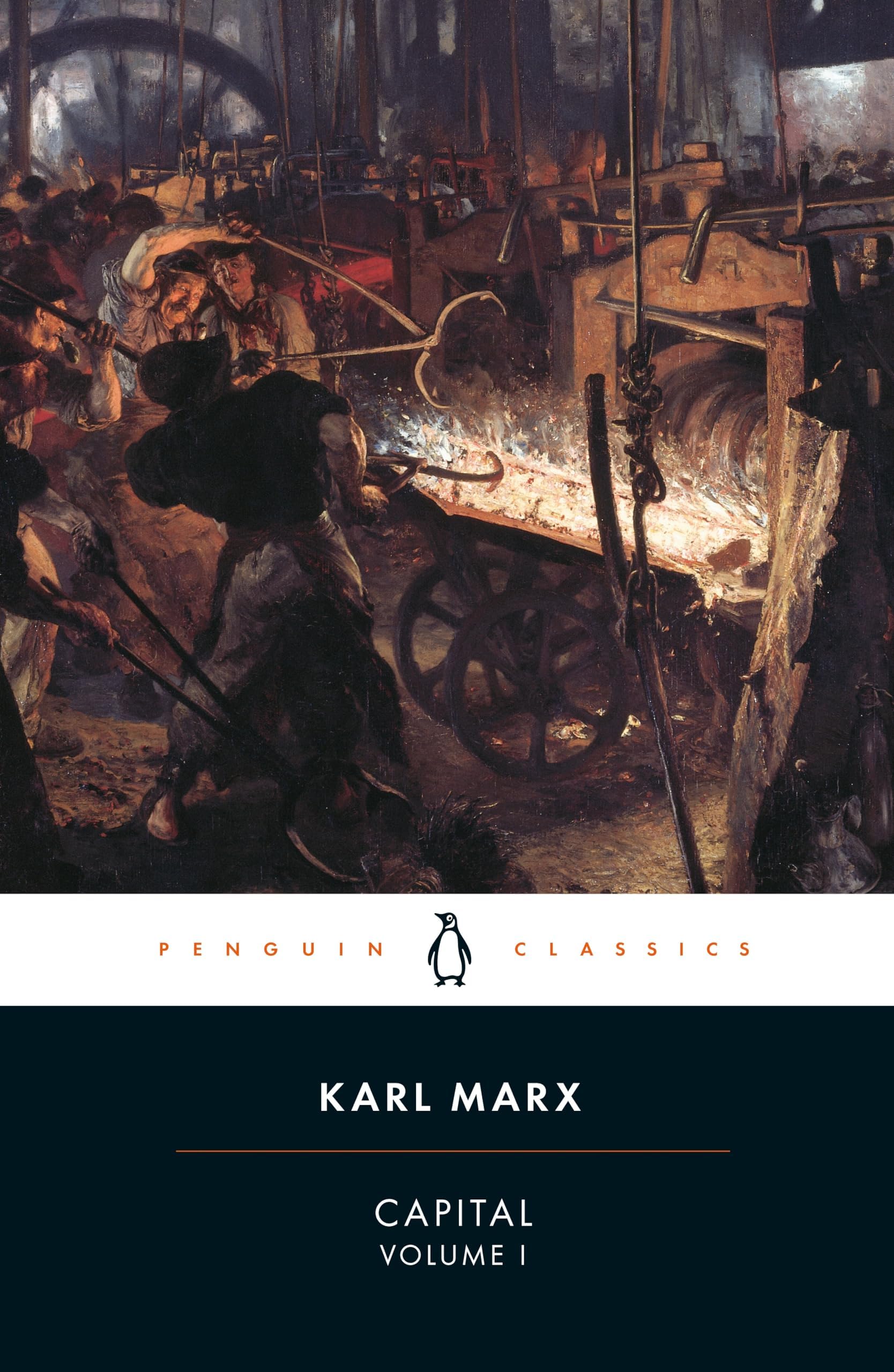
Capital: Critique of Political Economy v. 1 (Classics S.)
Product ID: 51240575
Buy anything from 5,000+ international stores. One checkout price. No surprise fees. Join 2M+ shoppers on Desertcart.
Desertcart purchases this item on your behalf and handles shipping, customs, and support to Vietnam.
'A groundbreaking work of economic analysis. It is also a literary masterpice' Francis Wheen, Guardian One of the most notorious and influential works of modern times, Capital is an incisive critique of private property and the social relations it generates. Living in exile in England, where this work was largely written, Marx drew on a wide-ranging knowledge of its society to support his analysis. Arguing that capitalism would cause an ever-increasing division in wealth and welfare, he predicted its abolition and replacement by a system with common ownership of the means of production. Capital rapidly acquired readership throughout the world, to become a work described by Marx's collaborator Friedrich Engels as 'the Bible of the working class'. Translated by BEN FOWKES with an Introduction by ERNEST MANDEL Review: Good book - No problems whatsoever Review: A very readable translation of a true classic - What can you say about such a book? I spent at least six months reading it, it's not an easy one, but that said, it isn't as cryptic as many people seem to think. If you have, like myself, been working for wages your whole life, then you'll find countless things here you already know to be true in life (in the capitalist society), although you probably haven't been able to put your finger on them by yourself. Marx was writing to workers, he wanted Capital to be used as a manual in the struggle to free the proletariat. It's something completely different than what I expected the book be, and in a very positive sense so. As a companion to reading this, I heartily recommend David Harvey's "Reading Marx's Capital", it's provides insight to the more difficult passages, as well as providing historical and political background. And the translation is really, really good and readable. I'm a native Finn, and I tried reading the Capital in Finnish at first, but the Finnish translation was so bad and felt so cryptic, that I changed to this Penguin Classics edition, and it's true: it read a lot better than the one in my native language! I also have researched into the translation's critical quality, and have learned from many very respected sources that it's supposed to be very good, too.


















| Best Sellers Rank | 15,887 in Books ( See Top 100 in Books ) 119 in Business & Economic History 4,584 in Society, Politics & Philosophy |
| Customer Reviews | 4.7 out of 5 stars 1,235 Reviews |
E**.
Good book
No problems whatsoever
O**T
A very readable translation of a true classic
What can you say about such a book? I spent at least six months reading it, it's not an easy one, but that said, it isn't as cryptic as many people seem to think. If you have, like myself, been working for wages your whole life, then you'll find countless things here you already know to be true in life (in the capitalist society), although you probably haven't been able to put your finger on them by yourself. Marx was writing to workers, he wanted Capital to be used as a manual in the struggle to free the proletariat. It's something completely different than what I expected the book be, and in a very positive sense so. As a companion to reading this, I heartily recommend David Harvey's "Reading Marx's Capital", it's provides insight to the more difficult passages, as well as providing historical and political background. And the translation is really, really good and readable. I'm a native Finn, and I tried reading the Capital in Finnish at first, but the Finnish translation was so bad and felt so cryptic, that I changed to this Penguin Classics edition, and it's true: it read a lot better than the one in my native language! I also have researched into the translation's critical quality, and have learned from many very respected sources that it's supposed to be very good, too.
M**G
Brilliant translation!
I read this previously in the Moscow version, which was the translation by Moore and Aveling. This translation is much clearer, and makes the book more understandable. It brings out the Hegelian language better, enabling the reader to make up his or her own mind about whether we are dealing with "coquetting" with Hegelian terms or with something more substantial. The chapter on the working day, with examples of incredibly long days worked by both adults and children, is really striking. While in Britain, at least, we do not have children working extremely long hours, we are increasingly getting people constrained to work long hours by the gig economy, or while working as care workers in the community. Obviously there are very numerous and complex debates about how to interpret Marx's analyses and the extent to which they are valid, but this translation gives the reader an accurate starting point.
G**L
More relevant than ever.
I've not got much more to add to the other reviews that praise 'Capital', other than to say that, although it is difficult to read and it does involve hard work, it is not beyond the averagely intelligent person to get to grips with. Given that we are now well into another massive global crisis of capitalism, the book that explains the system the best deserves to be read again and again. The Penguin edition is the best one to get because it's the edition which ties in with the best guide/companion to 'Capital' which is David Harvey's 'Companion to Marx's 'Capital''. The introductory essay by Ernest Mandel is also useful for discussion on some of the subsequent objections and criticisms of 'Capital' and whether such critiques are valid. Only criticism? Cheap paper which yellows rather too soon.
T**S
The better edition
If you want to read the Capital this is the edition you should buy. The translation is more modern than the one in previous editions, which made the book almost illegible (and it's already a hard book!)
M**H
Five months well spent
This is a surprisingly enjoyable book to read. Not only does it give a disturbingly vivid (albeit skewed) account of capitalist history and working conditions, but much of the discussion revolves around industry in the UK (which then included Ireland), making it very close to home for British readers. Next time you whine about your long hours in the office, think of your poor ancestors toiling sixteen hours a day for poverty wages! As others have mentioned, Harvey's book A Companion to Marx's Capital is very good for shedding light on the intricate layers of argument in Capital. I would also highly recommend reading Capital alongside Emile Zola's Germinal (Penguin Classics) , which is almost the fictional counterpart to Capital. Like me, you may not sign up to Marx's vision of the future - Communism, government control, planned economy, abolition of property etc. - but you may be surprised (like me) at how much sense his 150-year-old critique of our current system makes.
S**M
Read it for its footnotes
This (in)famous book needs no introduction, it is a masterpiece of historic research and economic thinking. As an economist, I appreciate Marx' attention for the basics, which are too often taken for granted. He's a smart and witty writer, but he also has done an enormous effort to gather so many detailed discussions of labour conditions and a thorough reading of economic theory at the time. When you go through the text, make sure not to skip the savvy footnotes: this is referencing as it should be.
T**K
A masterful critique
Marx was a giant of political economy, grappling with the massive spectre of maturing capitalism. This work is the culmination of intense research and is a revelation for anyone struggling to make sense of the capitalist system. Marx was also a revolutionary activist, and this work serves as a learned critique of a system sowing the seeds of its own destruction and that of humanity itself.
A**C
Essential reading for revolutionaries
The most important book ever written. Be sure to read it in a reading group with other comrades. This is a tough text to tackle completely on your own.
V**R
The book that I want
The book came in perfect conditions
新**水
わかりやすい
ある程度の語学力は必要だが、新日本出版の新版資本論に比べ、はるかにわかりやすい。もっとも、新日本の方も、訳の参考に必携ではあるが。
T**L
Gelecek kırmızı, gelecek sosyalist
Sermayenin yıkıcı ve diyalektik bir eleştirisi. İkinci ve üçüncü ciltleri de mutlaka ardı ardına (ve sonra tekrar tekrar) okunmalı.
N**L
Not a polemic but a keeper nonetheless
There is an enormous collection of valuable information in volume 1 of Marx's Capital. Volume 1, moreover, serves very effectively as the first of three volumes in which Marx gives truly compelling evidence of his genius -- how else could one author come to terms with this massive account of the reality of capitalist production as Marx uniquely understands it? While it soon becomes abundantly clear that Marx was a master prose stylist, there is no mistaking the fact that he did not write for the ease and convenience of his readers. I can't imagine taking the full measure of this volume, much less the two volumes which follow, without the sustained help of explanatory material such as that provided by David Harvey, a veteran American academician who takes Marx very seriously indeed. Without question, even for exceptionally well informed and intellectually capable readers, this book is a bear. If you invest the substantial amount of time and prodigious effort needed to master it, you will definitely come to understand why Marxists become Marxists, and you may very well become one yourself. At the very least, you'll see the world differently, and you'll have a firmer grasp on the character of our contemporary world, not just its economic make-up, but in a socially expansive way. It's hard to imagine anyone reading the book carefully and with a modicum of understanding and coming away with the judgment that this is merely an ideologically motivated, long-winded exercise in willful self-deception and the deception of others. If you encounter someone who characterized Marx as a willfully wrong-headed ideologue, you may safely assume that you're dealing with someone who has not read Capital. Capital Volume 1 is, in fact, a richly informative and very difficult piece of world-class research. I imagine that most readers who take its full measure will come back to it again and again. I can't imagine doing justice to Capital Volume 1 without putting forth the kind of effort that makes for the creation of a life-long connection. Marx himself claims to have sacrificed his health, happiness, and family to writing the book. This has the pathetic sound of self-pitying exaggeration. But given what I know of Marx and the necessarily prodigious demands of the kind of work he produced, I'm sure he's being dispassionately truthful. You may be disappointed to find that Capital is much less polemical than it is rigorously analytical. That was my first response. For the long term, however, I realized the book is a keeper, and I acknowledged that I'd have to look elsewhere for a call-to-arms that is not also embedded in massive learning. It's true, of course that Marx was an active professional revolutionary, but he was also a world-class scholar with a prodigiously cultivated mind. Reading Marx makes me want to spend a year or two in the library of the British Museum, where Marx did his best scholarship. Marx and Charles Darwin exchanged fairly frequent correspondence. Everyone knows that Darwin transformed our understanding of the world and our place in it. Much the same is true of Marx's contribution to human knowledge. It's interesting to acknowledge that social and religious conservatism were barriers to the rightful dissemination of both. That Marx maintained an ongoing relationship with others of undeniable genius, such as Darwin, bespeaks Marx's own intellectual prowess and reflects his status as a wonderfully original thinker. In his own authentic way, Marx was at least as much a brilliant scientist as Darwin. Darwin changed the way we thought about ourselves, but Marx changed the way we live.
Trustpilot
3 days ago
3 weeks ago