🎶 Elevate your sound game—wireless freedom meets pro mixing finesse!
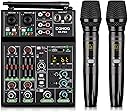
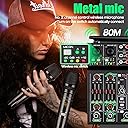
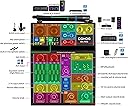
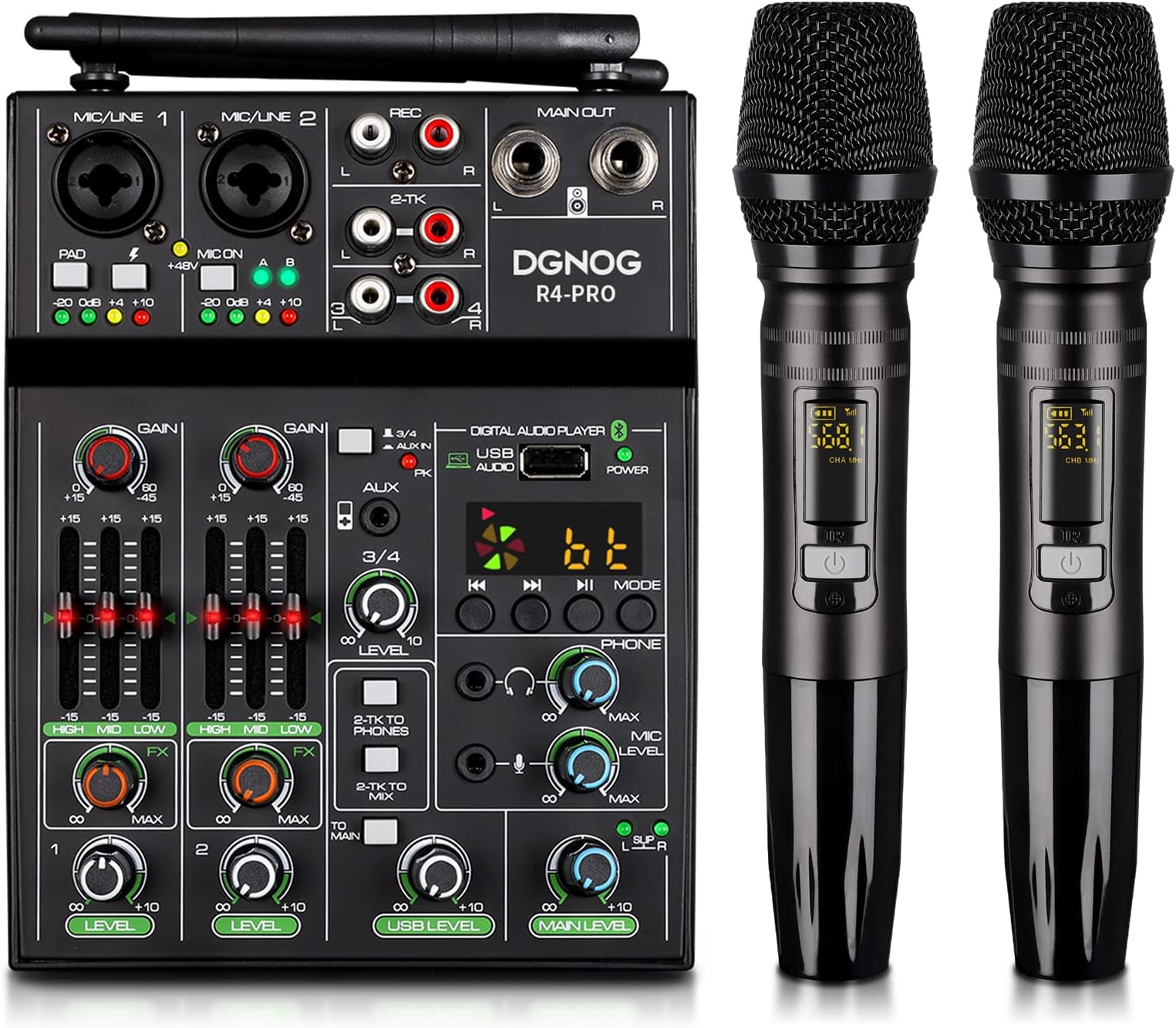
The DGNOG R4 Pro is a compact 4-channel audio mixer featuring dual UHF wireless microphones with a 180 ft range, 48V phantom power, and versatile inputs including XLR, 1/4" jack, USB, and Bluetooth 3.0. Designed for home karaoke, DJing, recording, and live streaming, it offers precise sound control with 3-band EQ, echo effects, and a USB audio interface for seamless PC or phone integration. Powered via USB-C and boasting up to 6 hours of mic battery life, this mixer delivers professional-grade features in a portable, user-friendly package.


| ASIN | B0B3TFQ1RQ |
| Audio Input | XLR |
| Best Sellers Rank | #20,590 in Musical Instruments ( See Top 100 in Musical Instruments ) #93 in DJ Mixers |
| Brand | DGNOG |
| Brand Name | DGNOG |
| Connectivity Technology | Interfac,Xlr,Usb,Bluetooth |
| Customer Reviews | 4.2 out of 5 stars 215 Reviews |
| Frequency | 576 MHz |
| Item Dimensions D x W x H | 1.77"D x 7.08"W x 9.25"H |
| Item Type Name | DJ Mixer |
| Item Weight | 1300 Milligrams |
| Manufacturer | DGNOG |
| Manufacturer Part Number | R4 PRO |
| Model Number | R4 PRO |
| Number of Channels | 4 |
| Output Connector Type | RCA |
| Power Source | Corded Electric |
| Product Dimensions | 1.77"D x 7.08"W x 9.25"H |
| UPC | 721703544089 |
| Voltage | 48 Volts |
| Warranty Description | Manufacturer warranty for 60 days from date of purchase. |
K**H
Great Budget Karaoke Mixer with Solid Wireless Mics and Useful Features
I was recently sent the DGNOG R4-Pro Karaoke Mixer for demo and review purposes, and I’ve been really impressed with what it offers—especially at this price point and form factor. Here’s a breakdown of my experience: Unboxing & Build Quality: The package includes the mixer unit itself, two wireless microphones, two mic anti-roll rings, USB-A to USB-A and USB-A to USB-C cables, a power brick, an RCA to 3.5mm audio cable, and a user manual. The microphones have a sturdy metal body with plastic battery caps and require two AA batteries each (not included). The mic rings are a nice touch to prevent them from rolling around, although they fit a bit loosely. Power & Connectivity: The mixer is powered via a USB-C port (5V2A), which is super convenient. There are plenty of inputs and outputs for various setups, and the instruction manual is surprisingly well-written and informative, helping you get things connected quickly. Mic Performance: The wireless mics connect easily and sound clear. I appreciate the physical Mic On/Off button on the mixer that gives you quick control. There's a dedicated gain knob for the wireless mic input—setting it around 10 o’clock gave me the best balance without distortion. Cranking it too high can cause clipping, so some adjustment is needed for the best performance. I have a background in Pro Audio, and although I typically work with higher-end Shure (SLXD, QLXD, ULXD) and Sennheiser (EW G4, EW-D, etc.) systems exclusively, I can definitely vouch that I was pleasantly surprised by the quality of these mics considering the price and form factor of this package. The fact that these are using the UHF band is also surprising! Sound Customization: The mixer includes a 3-band EQ (lows, mids, highs). The layout is a bit unconventional—the high frequencies are controlled by the left-most knob and the lows by the right-most, which feels unintuitive. That said, the EQ works well: I prefer cutting the lows and mids slightly while boosting the highs for a cleaner vocal tone. There’s also a combined FX knob that controls reverb and delay. Turning it up adds a spacious echo effect to your vocals. It’s not overly complex but gets the job done for home karaoke or small event setups. Use Case Tip: One cool setup I tried was hooking this mixer up to a car stereo system for a mobile karaoke session. Just use the RCA to 3.5mm cable and plug into the AUX input of your car—worked great for an impromptu karaoke night. Final Thoughts: Overall, this is a solid karaoke mixer with a great set of features: wireless mics, EQ control, USB audio interfacing, and decent build quality. The quirks (like reversed EQ layout and needing your own batteries) are minor trade-offs for what you get. There is a bit of background hissing sound, but it’s not noticeable once music or vocals are playing. Whether you're setting up for a party, event, or just home karaoke fun, the DGNOG R4-Pro delivers good performance and value.
A**W
HUGE value! Some issues.
I have only had this for a few weeks and I have not tested every aspect, but it works great for my use case, especially for the price. I planned to buy JBL wireless mics and a separate mixer at a cost of a $250+ but then saw this at the last minute and figured I'd try it. We use it for karaoke, plugging the TV audio into 3/4 RCA jacks at the top, which provides a volume control knob on the DGNOG. The DGNOG is also connected to a USB in on the TV, which provides it with power and a way to turn it on and off since it doesn't have a switch (please fire that guy). Audio out is routed to 2 Mackie Thump 15s. Karaoke is streamed from a tablet to the TV via YouTube so everyone in our basement bar can add songs to the queue using the tablet. It's pretty seamless and sounds fantastic. We threw a baller party with it. I have a few concerns/issues. 1) It feels pretty flimsy, so I hope it holds up in my low-touch environment. 2) The lack of a power switch is reason enough to remove the word "Professional" from the name. I own tons of professional audio gear and every item has a power switch. 3) It's dumb to have both mics on the same channel. Maybe that was a way to keep it cheap by only running one receiver but it's a bummer that gain, EQ, FX, and volume are shared by both mics. If you have one quiet singer and one loud singer, there is no way to compensate with the built in mics. 4) Mics are very sensitive, blowing out every T and P and picking up every breath. Foam wind covers are a must. It's an inexpensive fix (so they should have included them), and it gives you a chance to add some color coding. Ultimately, this little package is good enough for me to have recommended it to friends. To get all the functionality promised - wireless mics, Bluetooth, 2 combo XLR/TS inputs, RCA record out, 2 RCA in, a mini jacks for audio in, phones, and another mic, and then volume knobs for most of that - you would need multiple devices and spend hundreds of dollars. This thing checks a lot of boxes for $80.
D**N
The system has problems
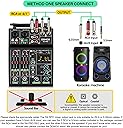
OK, so the price is good if it is a unit that does the things it says it does. When you get it to work, it is very cool. My primary usage is to play a music track via bluetooth (BT) while I have the wireless microphone on to sing along. Getting BT to work is not likely unless you figure out that you'll need a 2A power source. Before being informed of this requirement, I found that when you turn the unit on, the BT display shows "HI" and then blacks out. Pressing the 'Mode' button won't do anything if the 'Mic On' button is depressed. If you turn off the 'Mic On' button the BT screen is still black and doesn't change when you hit the 'Mode' button. Instead, you'd have to power off the unit (via disconnecting the power cord because there is NO power switch!!!) and then, if the 'Mic On' switch is off, you can turn on BT. Regarding output, this unit is really for a home usage situation because a professional will have a much more impressive mixer. Not many home users have an amp or receiver with 1/4" mono input jacks? You may be thinking that you can use the 'Rec' RCA output jacks on this unit to connect to your receiver. After all, one of the pictures on this Amazon page shows "RCA or 4/1" connected to a "Home Threat Setup" (yup, made in China). No, connecting the "Rec" output to my receiver sounded like $#!^. I had to purchase 1/4" - to - 1/8" adaptors and then 1/8" - to - RCA cords. Pretty messy, but it works. And finally, the microphones. They work well, look nice and sound nice. Just don't leave the switch on for a few hours or you will kill the batteries. Probably not a bad idea to have some auto-off functionality in the event that the mic doesn't pick up any noise for some period of time. Update: I've been using the unit regularly for 6months and ended up being totally happy with the unit, Unfortunately, one of the mics just died. I'll post the outcome of this problem.
L**N
Honestly, I really like this device!
Bass Performance: The frequency response starts to dip around the 45-50 Hz range, which is pretty much the lowest point for most karaoke tracks. For 99% of karaoke songs, this range is more than enough. The bass sounds great! I tested it with both Bluetooth and wired connections for music playback, and I’d say the sound quality is slightly better with a wired connection. Experience: The battery compartment is a bit tight, so removing the batteries can take a little effort. I’d recommend using scissors or another small tool to help get them out more easily. The microphone has a faint background noise, but it’s barely noticeable and much quieter than the music itself. Honestly, almost every audio device has some degree of background noise; it’s all about managing it properly! Initially, I had some issues connecting the device, but after reaching out to the DGNOG team, they not only helped me resolve the issue but also shared some helpful insights on audio equipment, giving me a whole new perspective. Their support was fantastic! Suggestions: Although the user manual provides a detailed connection guide, I’d suggest reaching out to the supplier if you encounter any issues during setup. Misconfigurations could potentially damage the speaker or other connected devices. Pros: Affordable price, low latency for karaoke, and it has a knob with a slight center detent for stability. It’s compact—just a little longer than your hand. High frequencies reach around 17.5 kHz, which is completely sufficient for Bluetooth music playback, especially from streaming platforms like YouTube. Conclusion: Simple design, focused functions, and no unnecessary features. Personally, I think an RCA port for the main output would be preferable over the 6.5mm jack. Overall, this device is perfect for family gatherings, karaoke, or even small venues. Highly recommended!
F**O
Que auque ami no me iso el trabajo que yo esperaba atra persona puede gustarlecomo trabaja.
A mi no me funsiono no fue lo que yo esperaba
M**Z
Great Multi-purpose Mixer for Small Spaces!
Summary: This mixer / mic combo is a real winner if you want to have a karaoke party, but also want more practical inputs for your audio setup! It takes a little playing around, but once you find the right settings there's a lot you get for the money. Pros: - Very compact design: in order to save space, additional 1/4 inch jacks for inputs you might find on other mixers have been swapped out for a 3.5mm (1/8 inch) 'Aux' input and 'Mic' input, each of which have their own volume control. For most people who aren't using studio equipment, this makes a lot of sense. - To this end, there's also an RCA input which shares channel 3 and 4. To activate the Aux input, you need to toggle the button above that input. - Generally really low noise output (from 1/4 inch jacks, and the headphone port.) , provided you play with the gain and level knobs. I'd say the dynamic range averages somewhere between 50-60 dB. - That said, you still have a 1/4 inch output which is nice for running a balanced dual mono to XLR to my audio interface - There's a separate Bluetooth input which is activated with the Mode button, and the sound is surprisingly clean. You'll need to toggle the "To Main" switch to hear it, but it also has its own volume control - The XLR ports double as a dual mono Line In (left and right). Can you use them at the same time as the wireless mics? Yep! See my third image. - Channels 1 and 2 have their own level monitors. - USB-C power! I've tried this with a power bank and ports on my computer. Cons: - The RCA input on Channel 3/4 is pretty noisy if you use the included RCA to 3.5mm cable. This may be because it shares circuitry with the Aux channel but I'm not sure. It could also be because RCA is an 'unbalanced' signal. - Channel 3/4 does not have its own EQ sliders or an FX channel. This was likely to save space. You could patch channels 3/4 through to channel 2 though! - Nor does the USB / Bluetooth audio have its own EQ or FX channel. Not a deal breaker but something to be aware of - Channel 2 is used for both mics. I would have liked to see separate level monitors for each mic but it's not a big deal for karaoke.
S**.
BAD. Most of the inputs DO NOT work!!
The wireless mic functionality works well. I had tried others and there was a bad lag. This one actually sounded good. The only problem (and it's a BIG one) is that none of the inputs work except for the computer-style plug, and similarly none of the outputs seem to work except for the small analog (computer-type) output. At first I thought it was my audio system and got it to work using those little plugs. However later as I tried to add more devices I discovered none of the other inputs or outputs seemed to be working. So it's basically a glorified wireless mic base. I will have to get a whole other mixing board and somehow connect this to it just to be able to expand - pretty ridiculous. Oh, and other than a schematic diagram the instructions are not helpful in the least for troubleshooting or anything else.
R**O
If you are getting it for Karaoke…
I didn’t expect much from this small unit. Expected a total fail. Yet it proved to do the job and well. The wireless Mics and the bt work exceptionally well. I would go as far as to say better when connected to a dac it did not sound good. Personally thought bt sounded a bit brighter, not entirely sure if due to the source device or a little loss of quality during the digital to analog conversion. Either, way as most who gave good reviews i too had to find and dial in to the right tuning, as most who stated as much advised. Im not sure if my ears are become conditioned, but i feel the units sound improves with use, as if the circuits are breaking in, but thats speculation. Things i did notice that might be helpful to others. 1. The manual only makes sense to someone that has experience with mixers. I suggest doing a small tutorial on how mixers work on YT. If not you will be turning knobs and pushing buttons and since some of us do connect it to our expensive theater systems, we don’t want the risk of damaging any components or speakers. 2. Some people mentioned a hum. I’ve experienced it once. As if the unit was stuck in a sound loop. I unplugged and it rebooted fine. From that i learned the unit likes a certain order in which it is power cycled. Recommendations: I do not like that to power cycle you have to plug or unplug the c connecter. I found a dongle that connects between the unit and the power cord that has a switch. It is basically an external on off switch and gives me peace of mind not to damage the unit with constant un/plugging. I recommend using 1/4 plugs for the main out. It’s a better connection. Also recommend foam mic (wind) covers. I feel these mics sound warmer with. Lastly, always make sure the mics, and main volume are set at min before and after each use. Protects your other equipment. I hope this review is helpful. As a disclaimer, I cant speak on the recording or connection to pc functions, others have had different experiences, but for karaoke it performs very well. Although the manual is more a road map to what things do, it does make sense, unfortunately after you learn basic mixer operations. As a karaoke solution, 5 stars! Do not hesitate. Regards, -rb.
G**A
Buen producto.
Buen producto.
J**N
Muy buen producto
Excelente calidad
J**N
Excelente opción para Karaoke Amateur
Quedé muy satisfecho con el producto. 5 canales de entrada, dos de ellos entrada mixta para audífono o guitarra, entrada RCA, entrada Bluethoot, y los micrófonos vienen integrados en la entrada 2. Los micrófonos excelente audio, claro, y largo alcance, sin importar paredes. Tiene excualizacion independiente por cada canal 1 y 2, volúmenes independientes. Y salida RCA para grabación y monitor por miniplug, para audífonos es ideal. Recomiendo un cargador independiente de 2A para evitar ruido. También usar cable de salida en plug como viene de fabrica la salida. Aquí en Amazon, hay muchas opciones con plug a mini plug. Muy recomendable.
Trustpilot
4 days ago
2 months ago