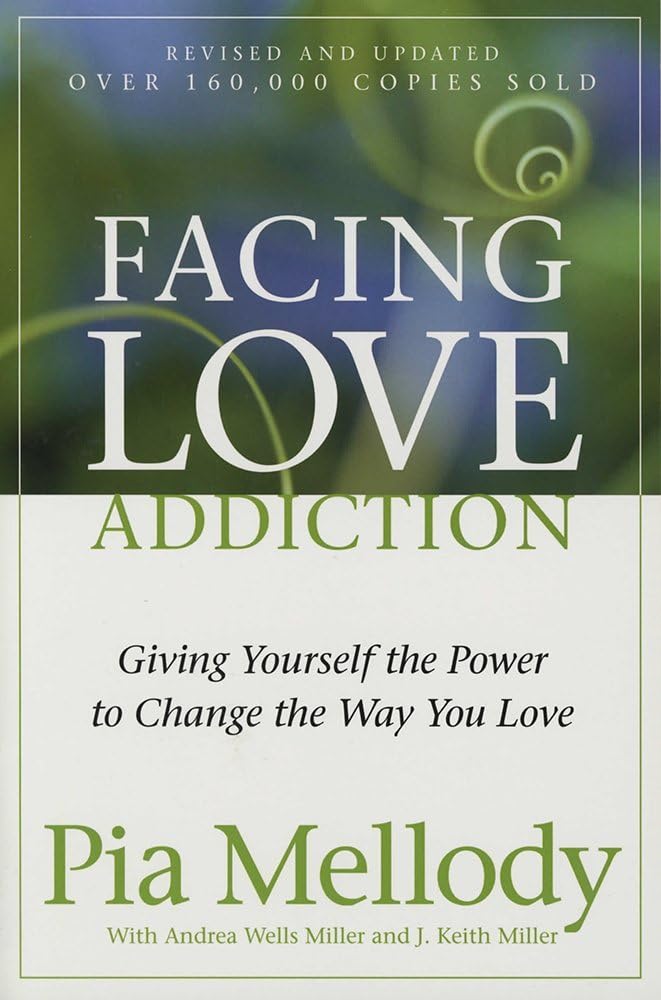
Facing Love Addiction: Giving Yourself the Power to Change the Way You Love
Product ID: 4559413
Buy anything from 5,000+ international stores. One checkout price. No surprise fees. Join 2M+ shoppers on Desertcart.
Desertcart purchases this item on your behalf and handles shipping, customs, and support to Vietnam.
Facing Love Addiction: Giving Yourself the Power to Change the Way You Love [Mellody, Pia, Miller, Andrea Wells, Miller, J. Keith] on desertcart.com. *FREE* shipping on qualifying offers. Facing Love Addiction: Giving Yourself the Power to Change the Way You Love Review: You can do it. Confidence is key. Work at it every day, but one day at a time. - This book is saving my relationship. I can feel it working. The hardest thing to do is hold a partner in postive regard when you feel they are distancing from you. But I realized that was the key to detaching from him with love. I see things in Black and White. I thought it was Borderline personality disorder but I see I'm just a love addict and possibly bipolar. This book is teaching me how to love myself and care for myself. It deals with codependence which I wasn't aware that I had. It all ties in together and is helping me love this man who triggers my fear of abandonment. When he distances, I chase him and it feels like neglect. But really the avoidant just feels like I'm needy. I understand now why he feels superior and sees me as weak. Thanks to Pia Melody, I feel empowered and I can detach with love. I can hold that gray area and it's taking daily journaling. I'm also going to a Shaman. I am in therapy weeks and use DBT skills to cope with the silence when we're not being intense. It's a process for sure. But this book hit me at the core where my addiction truly lays. He's just not that important and when I realized that I was able to take him off the pedastal and put him where he belongs, and in doing so I can love him better for who he truly is. This is my story and I put it out there in hopes that it helps someone relate and pick up this book, read it and do the work. I feel free from two decades of love addiction. It's good to go to SLAA meetings too. There are phone meetings. I wouldn't have invested my heart with this man if I didn't love him. And beyond addiction, the love is there between us. I just hope it can survive without the intensity of our interaction. I believe it will. I'm scared, but I have confidence now. If you get healthy with this book, and surely you will if you do the work, and your partner leaves you it's because they are addicted to intensity. That's on them. You may get healthy and find a healthier relationship. Either way you win if you do the work and keep the focus on you. This book is truly empowering, finally someone understands the love addict. Pia gives the compassion, understanding and resources for us to change the way we love. I am humbled for the first time, and confident in myself- beyond addiction and the low self-esteem and all the shame I felt inside all these years that were unecessary, all due to trauma. Take your time with this book. Do the work, the journaling, go to meetings, therapy and believe in yourself. I think confidence is the most important part. If I can do this at 39 years old after messing up a handful of long term, dysfunctional relationships, you can do it. There's another book that can help with the withdrawel process without having to use anti-depressants, the Art of Living by Thich Nhat Hahn. Review: Finally, I understand my relationship issues. - Most books about codependency focus on the classic relationship dichotomy of co-dependent and alcoholic/addict/narcissist. This is the only book I have found that deeply explores the relationship that is created when two co-dependents come together. For years I have been involved in a relationship that I knew was co-dependent, but none of the books I found on codependency really captured my situation. When I started reading this book my heart started pounding-- It was as if the author knew me, my partner and my relationship inside and out. I am only through part one of this book, but it has already transformed my understanding of my current romantic issues. To summarize, there are co-dependents who are love-addicted and co-dependents who are love-avoidant: Love addicts are driven by a primary fear of abandonment spawned from childhood neglect/abandonment. They are characterized by low-self esteem and neediness, and are looking for someone to rescue them and fill the hole in their hearts. Love avoidants are driven primarily by guilt and a fear of intimacy. During childhood they took an inappropriate "care-taking" role for a parent, which taught them that loving is to care for another, but also that to love is to be drained and controlled by another persons need. They are often characterized by being very capable and very busy, but also controlling (to avoid being controlled) and fickle. When the two come together they are initially very happy. But, with time, the neediness of the love-addict activates the love-avoidant's fear of intimacy and being controlled. The avoidant then begins to pull away, activating the abandonment fears of the love addict, and driving them to be even more desperate and needy. And thus the downward spiral begins... The love avoidant feels suffocated and wants to pull away, but often cannot leave because of the crippling guilt they feel at the thought of abandoning the already damaged love-addict. Meanwhile, the love addict will supplicate themselves and engage in dangerously manipulative behavior in order to save the relationship and avoid the feeling of abandonment. The result is an incredibly unhealthy relationship in which neither party has their emotional needs met (in part because neither party can acknowledge their own emotional needs). This book spoke to me in a way that no other book on the topic of codependency has. It is not only incredibly enlightening, but also well-written and an engaging read. What's more, I really appreciate the tone of the book. Where as most books written about codependency tend to be overly sympathetic and almost coddling to the co-dependent reader (for example, the Melody Beattie series), the author's approach to this kind of codependency is very detached, analytical and clinical. I personally found this a much more approachable and helpful style for my personality type. All in all, I am incredibly glad I bought this book (on a whim!) and I am really looking forward to finishing this book and working on my issues as a love-avoidant.


| Best Sellers Rank | #13,453 in Books ( See Top 100 in Books ) #23 in Codependency (Books) #100 in Interpersonal Relations (Books) #112 in Love & Romance (Books) |
| Customer Reviews | 4.7 4.7 out of 5 stars (1,579) |
| Dimensions | 6 x 0.68 x 9 inches |
| Edition | 1st |
| ISBN-10 | 0062506048 |
| ISBN-13 | 978-0062506047 |
| Item Weight | 2.31 pounds |
| Language | English |
| Print length | 240 pages |
| Publication date | June 5, 1992 |
| Publisher | HarperOne |
J**Y
You can do it. Confidence is key. Work at it every day, but one day at a time.
This book is saving my relationship. I can feel it working. The hardest thing to do is hold a partner in postive regard when you feel they are distancing from you. But I realized that was the key to detaching from him with love. I see things in Black and White. I thought it was Borderline personality disorder but I see I'm just a love addict and possibly bipolar. This book is teaching me how to love myself and care for myself. It deals with codependence which I wasn't aware that I had. It all ties in together and is helping me love this man who triggers my fear of abandonment. When he distances, I chase him and it feels like neglect. But really the avoidant just feels like I'm needy. I understand now why he feels superior and sees me as weak. Thanks to Pia Melody, I feel empowered and I can detach with love. I can hold that gray area and it's taking daily journaling. I'm also going to a Shaman. I am in therapy weeks and use DBT skills to cope with the silence when we're not being intense. It's a process for sure. But this book hit me at the core where my addiction truly lays. He's just not that important and when I realized that I was able to take him off the pedastal and put him where he belongs, and in doing so I can love him better for who he truly is. This is my story and I put it out there in hopes that it helps someone relate and pick up this book, read it and do the work. I feel free from two decades of love addiction. It's good to go to SLAA meetings too. There are phone meetings. I wouldn't have invested my heart with this man if I didn't love him. And beyond addiction, the love is there between us. I just hope it can survive without the intensity of our interaction. I believe it will. I'm scared, but I have confidence now. If you get healthy with this book, and surely you will if you do the work, and your partner leaves you it's because they are addicted to intensity. That's on them. You may get healthy and find a healthier relationship. Either way you win if you do the work and keep the focus on you. This book is truly empowering, finally someone understands the love addict. Pia gives the compassion, understanding and resources for us to change the way we love. I am humbled for the first time, and confident in myself- beyond addiction and the low self-esteem and all the shame I felt inside all these years that were unecessary, all due to trauma. Take your time with this book. Do the work, the journaling, go to meetings, therapy and believe in yourself. I think confidence is the most important part. If I can do this at 39 years old after messing up a handful of long term, dysfunctional relationships, you can do it. There's another book that can help with the withdrawel process without having to use anti-depressants, the Art of Living by Thich Nhat Hahn.
W**!
Finally, I understand my relationship issues.
Most books about codependency focus on the classic relationship dichotomy of co-dependent and alcoholic/addict/narcissist. This is the only book I have found that deeply explores the relationship that is created when two co-dependents come together. For years I have been involved in a relationship that I knew was co-dependent, but none of the books I found on codependency really captured my situation. When I started reading this book my heart started pounding-- It was as if the author knew me, my partner and my relationship inside and out. I am only through part one of this book, but it has already transformed my understanding of my current romantic issues. To summarize, there are co-dependents who are love-addicted and co-dependents who are love-avoidant: Love addicts are driven by a primary fear of abandonment spawned from childhood neglect/abandonment. They are characterized by low-self esteem and neediness, and are looking for someone to rescue them and fill the hole in their hearts. Love avoidants are driven primarily by guilt and a fear of intimacy. During childhood they took an inappropriate "care-taking" role for a parent, which taught them that loving is to care for another, but also that to love is to be drained and controlled by another persons need. They are often characterized by being very capable and very busy, but also controlling (to avoid being controlled) and fickle. When the two come together they are initially very happy. But, with time, the neediness of the love-addict activates the love-avoidant's fear of intimacy and being controlled. The avoidant then begins to pull away, activating the abandonment fears of the love addict, and driving them to be even more desperate and needy. And thus the downward spiral begins... The love avoidant feels suffocated and wants to pull away, but often cannot leave because of the crippling guilt they feel at the thought of abandoning the already damaged love-addict. Meanwhile, the love addict will supplicate themselves and engage in dangerously manipulative behavior in order to save the relationship and avoid the feeling of abandonment. The result is an incredibly unhealthy relationship in which neither party has their emotional needs met (in part because neither party can acknowledge their own emotional needs). This book spoke to me in a way that no other book on the topic of codependency has. It is not only incredibly enlightening, but also well-written and an engaging read. What's more, I really appreciate the tone of the book. Where as most books written about codependency tend to be overly sympathetic and almost coddling to the co-dependent reader (for example, the Melody Beattie series), the author's approach to this kind of codependency is very detached, analytical and clinical. I personally found this a much more approachable and helpful style for my personality type. All in all, I am incredibly glad I bought this book (on a whim!) and I am really looking forward to finishing this book and working on my issues as a love-avoidant.
N**K
Great Resource
SOLID READ. Does an AMAZING job of describing the dynamics between the avoidant and the Anxious
D**A
Inspiring and really eye opening
Really valuable real like examples and insights from people in recovery that have overcome this disease
N**A
ドラッグ依存症、アルコール依存症に加え、Love Addiction も現在のアメリカ社会が抱える問題のひとつである、と一番最初に提起した著者の一冊。著者自身がlove Addictionを克服した一人なだけにとても実践的で説得力のある本です。 「こんなに尽くしているのに」別れてしまう、などの経験がある人には必読書だと思います。「尽くす女性」には「尽くす」という問題があり、尽くす女が恋愛対象とする男性には「尽くされると心の距離を置きたくなる」というパターンがある、と明確にしています。 まずは、自分のそのような恋愛パターンの問題に気づき、すこしづつ自分の行動を変えていくことによって、問題のある男性には惹かれなくなり(また、問題のある男性からはまったく好意ももたれなくなり)、健全でゆたかな恋愛関係や結婚を手に入れることができる、と著者はいいます。 そのために、自分の分析の仕方、改善の仕方、相手の見極め方、人間関係の作り方、過去の自分の見つめ方などもとても丁寧に書いています。 将来の人間関係に明るい展望と気づきを与えてくれるすばらしい一冊です。
H**S
Good quality and good packaging
N**E
"Facing Love Addiction" expresses what is essentially a fairly straightforward idea and does so in similarly uncomplicated language that is easy to grasp. You will not get lost in the psychology and there are plenty of recapitulations and helpful re-phrasings to avoid confusion. Saying this, the implications of the basic psychological model being proposed are huge. Reading this book can offer explanation for the intensity of fear and pain you experience in relationships, make the fear and pain conscious rather than unconscious so that recovery can begin, and also present a new, healthier way of relating to people that you can begin to implement. It's a journey of extreme self-discovery that takes a lot of work and you WILL need a lot of extra therapeutic support. But working through the recovery process and breaking the destructive patterns with those with whom you are in relationship (especially yourself!) provides a feeling of self-sufficiency and worth that helps allay fears in *all* areas of your life. So, the basic premise: Pia Mellody's model of love addiction illustrates two people: the love addict and the love avoidant. The love addict has a conscious fear of being abandoned and an unconscious fear of intimacy. Conversely, the love avoidant's conscious fear is of intimacy and their unconscious fear of being abandoned. The love addict wants to feel "close and connected" to their partner and initially are drawn inexorably towards the love avoidant. (Note that although the love avoidant's label might make them sound weedy, submissive wimps their fear of intimacy is masked by a "wall of seduction"- in other words they usually seem inticingly strong, sexy and charismatic individuals who positively invite a relationship in the beginning). The love avoidant sees what they believe to be the perfect person to meet their needs for intimacy, self-esteem and connection and jump right in. After a while, however the love avoidant's fear of intimacy (being overwhelmed/controlled/engulfed) kicks in, and to protect themselves they create a distance between themselves and the love addict. This can be achieved through an emotional not-there-ness or through busying themselves with addictions or activities outside the realtionship. As soon as they create distance, the love addict panics: they're not feeling close any more- they're being abandoned! To get close again they'll pretty much do anything; using sex or even changing their entire identity to appeal more to the love avoidant. These desperate attempts just send the love avoidant further away and eventually the love addict shows signs of being unable to cope with it and leaving. At this point, the love avoidant's unconscious fear of being abandoned arises and all of a sudden they start showing the love addict attention again to get them back. The love addict breathes a sigh of relief and then the whole cycle starts again... The structure of the book is as follows: Part I explains the connection between codependence and love addiction, the cycles of the love addict and avoidant and their interactions together (what a co-addicted relationship looks like). Part II outlines the recovery process and addresses questions of bringing relationships to an end or putting them on hold, withdrawal symptoms and re-entering a relationship. Part III provides illustration of what healthy relationships look like (neither addicts nor avoidants have never truly learned or experienced real intimacy) Part IV has practical exercises to support the recovery process (a working knowledge of 12 Step Programmes and having a sponsor is *especially* helpful here). In conclusion, a few notes: *Knowledge and particularly experience of 12 step Programmes (particularly CoDA, Co Dependents Anonymous) is helpful when reading this book. Fairly early on the author makes reference to such programs of recovery and uses the term 'Higher Power' when describing the way in which the love addict puts the avoidant on a pedestal. Her whole approach to finding recovery is based on the 12 Steps too, and working through her suggestions for journalling or writing a Step 1 would be infinitely more thorough when shared with the experiences of others in the fellowship rather than just a therapist. * Building upon that point, recovery is going to be more robustly 'completed' when as many resources as possible are accessed. Working through extreme fears of abandonment and going through the withdrawal is all but impossible on your own. * Finally, two books that I found great (as a love addict) to read alongside this one was "Women Who Love Too Much: when you keep wishing and hoping he'll change" by Robin Norwood and "Getting Past Your Breakup" by Susan J Elliot.
Y**.
A little bit repetitive however the ideas are very clear and well explained. It basically touchea the different types of attachment but doesn't explaim how to heal.
L**E
Anyone facing a love addiction will gain great insight into themselves and their partners. It was like I was reading my own story and I finally understood why I...and my partners act the way I do. Thank you so very much Pia Mellody for helping shine some light on this addiction!!!
Trustpilot
2 weeks ago
3 weeks ago