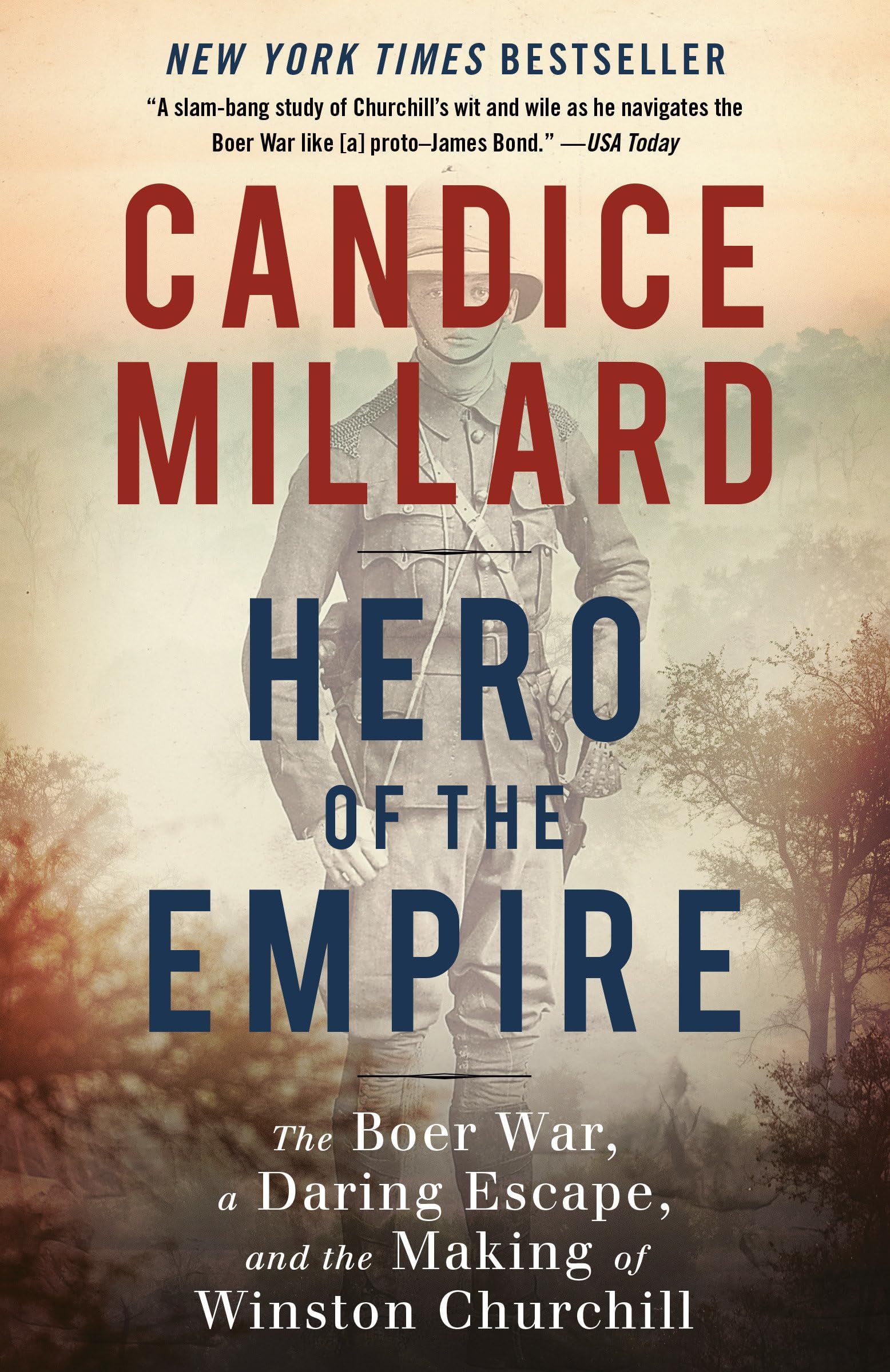
Hero of the Empire: The Boer War, a Daring Escape, and the Making of Winston Churchill
Product ID: 43514652
Buy anything from 5,000+ international stores. One checkout price. No surprise fees. Join 2M+ shoppers on Desertcart.
Desertcart purchases this item on your behalf and handles shipping, customs, and support to Vietnam.
From the bestselling author of Destiny of the Republic , this thrilling biographical account of the life and legacy of Wintson Churchill is a "nail-biter and top-notch character study rolled into one" ( The New York Times ). At the age of twenty-four, Winston Churchill was utterly convinced it was his destiny to become prime minister of England. He arrived in South Africa in 1899, valet and crates of vintage wine in tow, to cover the brutal colonial war the British were fighting with Boer rebels and jumpstart his political career. But just two weeks later, Churchill was taken prisoner. Remarkably, he pulled off a daring escape—traversing hundreds of miles of enemy territory, alone, with nothing but a crumpled wad of cash, four slabs of chocolate, and his wits to guide him. Bestselling author Candice Millard spins an epic story of bravery, savagery, and chance encounters with a cast of historical characters—including Rudyard Kipling, Lord Kitchener, and Mohandas Gandhi—with whom Churchill would later share the world stage. But Hero of the Empire is more than an extraordinary adventure story, for the lessons Churchill took from the Boer War would profoundly affect twentieth century history. Look for Candice Millard’s latest book, River of the Gods. Review: Another Millard Classic - Nobody does it quite like Candice Millard. She finds relatively obscure historical events – the assassination of President Garfield, the desertcart adventure of former President Teddy Roosevelt, and here the young exploits of Winston Churchill in South Africa – and turns them into absolutely top-notch popular history. Her narratives are compulsively readable. My only complaint is that she hasn’t written more. Young Winston Churchill was, to put it mildly, a man on the make. “There is no ambition I cherish so keenly,” he told his younger brother, Jack, “as to gain a reputation for personal courage.” He was as good as his word. Before he was 24-years-old he had experienced close order combat in Cuba as a journalist observer, seen comrades hacked to pieces by Pashtun warriors in Malakand on the Afghan border, and became separated from his regiment in the desert sands of Sudan in the war against the Mahdi. But it wasn’t enough. “[Churchill] wanted not simply to fight,” writes Millard, “but to be noticed while fighting.” He was, in short, a “medal hunter.” And none of his previous adventures had resulted in the public acclaim that he so hungered for. Churchill was, Millard stresses, quite literally willing to risk his life for fame and glory. After defeat in his first stand for election to the House of Commons in 1899, Churchill seized on the conflict in South Africa as the stage upon which he might finally achieve his seemingly unlimited ambitions. Churchill would join the war not as a soldier but as a war correspondent for a respected British daily newspaper, the Morning Post. And he was not just any war correspondent, however, but the most highly paid one in England. Despite his youth and relative inexperience he had established a strong reputation as a fearless man with an unusual skill as a writer. In the glowing words of Sir Arthur Conan Doyle, the young Churchill was “the greatest living master of English prose.” Churchill left for the front on the same boat that carried the recently appointed British general in chief, General Redvers Buller. The dashing young war correspondent was intent on beating the 30,000 British reinforcements to the front. Many in the British Army at first held a low opinion of their Boer adversary, but not Churchill, who wrote that they were “the finest mass of rifle-armed horsemen ever seen and the most capable mounted warriors since the Mongols.” Through a mix of pluck and ingenuity, Churchill had placed himself about as far forward as was humanly possible for a young British war correspondent in South Africa in late 1899: the small outpost town of Estcourt some 50 miles south of the British forces besieged at Ladysmith in Natal Province. In hopes of getting an even closer look at the fighting – and hopefully finally setting his eyes on a real Boer fighter – he volunteered to accompany a dangerous (and relatively pointless) armored train expedition out of Estcourt in the direction of Ladysmith. The venture was an unmitigated disaster for the British as the Boers effectively ambushed the train on its way back to Estcourt, killing five and taking 60 prisoners, the intrepid journalist Winston Churchill among them. The Boer ambush of the armored train and Churchill’s conspicuous gallantry in the ensuing melee were front-page news all across England. “He had become not only the talk of the city but the subject of widespread praise and admiration,” Millard writes, “something he had long felt deserving of, but had certainly never been before.” Unfortunately, Churchill was in no position to enjoy his newfound fame. He vehemently protested his imprisonment, arguing that he was a journalist and civilian non-combatant. The Boers, however, were not about to release so famous a captive as the son of a British Lord, especially one who had famously maligned the Boers in the past. Millard writes that Churchill absolutely detested captivity and the slovenly guards assigned to prevent his escape from their makeshift POW camp in Pretoria. “[From] the moment he had raised his hands he had hated his captivity with an intensity that surprised even him … So much did Churchill loathe his imprisonment that the experience would stay with him for the rest of his life.” All he could think about was escape, no matter the dangers involved. On December 12, 1899, after a month in captivity, Churchill dashed over the back wall of the prison. His two fellow accomplices were unable to join him. He would have to fight his way through 300 miles of hostile Transvaal territory on his own. “Failure being almost certain,” Churchill later wrote, “no odds against success affected me. All risks were less than the certainty.” The situation for the British in South Africa was bleak in late 1899. Anticipation of a quick and easy victory were dashed by a series of shocking defeats during a short period known as Black Week, none bigger than General Buller’s decisive defeat against Luis Botha at the Battle of Colenso on December 15, 1899. General Buller, nicknamed “the Steamroller,” was unceremoniously sacked after just three months in South Africa. The British, Millard writes, were desperate for heroes. News of Churchill’s dramatic escape from captivity and his treacherous overland flight to safety were just what the British public needed. Churchill’s saga was again front-page news. He was, Millard says, exactly what the British wanted in their heroes – “resilient, resourceful and, even in the face of extreme danger, utterly unruffled.” After stowing away on a train for some 70 miles east of Pretoria, he debarked to find himself, quite miraculously, in the midst of British men operating a coalmine in the Transvaal. At much personal risk, his countrymen kept Churchill hidden away in a rat-invested mineshaft for nearly a week before arranging for him to be spirited away on a train headed to Portuguese East Africa (modern day Mozambique) hidden in a giant spool of wool. It really is an almost unbelievable adventure tale. Churchill arrived in Durban, Natal’s largest city, on 23 December to a raucous hero’s welcome. After two full weeks on the run, he was finally safe and, indeed, the “Hero of the Empire.” Churchill leveraged his newfound fame to the fullest, somehow finagling an Army commission as a lieutenant in the South African Light Horse while retaining his role as foreign war correspondent for the Morning Post. He was present at the Battle of Spion Kop outside of the Ladysmith on 23 January 1900, one of the bloodiest fights of the war that left 600 dead and 1,500 wounded. He was also present for the British capture of Pretoria and the liberation of his POW camp in June 1900. Churchill returned to England and was easily elected to Parliament in the same district where he was defeated in 1899. His remarkable career was on its way; his election no doubt owing to his South African exploits. Review: A Tribute to Millard's Writerly Skill That She Makes a Book from a Short, Passive Period of Churchill's Life - The author photo on the dust jacket of Hero of the Empire shows Candice Millard sitting cross-armed and cross-legged, looking almost smug. Well it should, as Millard has managed to take a small chunk, of a period of only a few months, in the life of one of the most written-about men in history, and turned it into an interesting book. With Winston Churchill, that's about all that's left for writers to do, as there have been so many full-scale biographies and so many more histories of little pieces of his long and important life. Millard takes for her subject Churchill's "South African period," when he went to Africa as a foreign correspondent hoping to become a war hero. Churchill, from one of England's most aristocratic families, was convinced he was to play a great role in history. At only 24, after an undistinguished experience at public schools and Harrow, he had already seen battle in India and the Sudan and had covered an uprising in Cuba as a war correspondent, but he had not yet made a name for himself. His first run at a seat in Parliament had ended in defeat. Churchill saw the second colonial war against the Boers in 1899 as his main chance for fame and glory. As it turned out, he was quickly taken prisoner by the Boers and spent the next few months in a POW camp in Pretoria. Then, in a bungled escape attempt, luck was with him and he spent the next weeks trying to get to Portuguese territory. What becomes clear, even to a reader such as I who does not know much about either Churchill or the Boer Wars, is that poor Winston had mostly a passive role during this time. He sat around moping in the prison camp and then, wildly lucky, managed to escape through not his own efforts but mostly to the efforts of others. It is difficult to make a book out of such a time in the subject's life, but Millard has succeeded in doing so. Of course, the really important events, the great sweep of history and the beginning of Churchill's true career, take place in the book's 19-page Epilogue. But it is a tribute to Millard's skill as a writer that she makes quite an interesting book out of what to most authors would be a boring short chapter in a long and rich life.


| Best Sellers Rank | #29,746 in Books ( See Top 100 in Books ) #2 in South African History #4 in Historical African Biographies (Books) #74 in Political Leader Biographies |
| Customer Reviews | 4.6 out of 5 stars 4,930 Reviews |
T**I
Another Millard Classic
Nobody does it quite like Candice Millard. She finds relatively obscure historical events – the assassination of President Garfield, the Amazon adventure of former President Teddy Roosevelt, and here the young exploits of Winston Churchill in South Africa – and turns them into absolutely top-notch popular history. Her narratives are compulsively readable. My only complaint is that she hasn’t written more. Young Winston Churchill was, to put it mildly, a man on the make. “There is no ambition I cherish so keenly,” he told his younger brother, Jack, “as to gain a reputation for personal courage.” He was as good as his word. Before he was 24-years-old he had experienced close order combat in Cuba as a journalist observer, seen comrades hacked to pieces by Pashtun warriors in Malakand on the Afghan border, and became separated from his regiment in the desert sands of Sudan in the war against the Mahdi. But it wasn’t enough. “[Churchill] wanted not simply to fight,” writes Millard, “but to be noticed while fighting.” He was, in short, a “medal hunter.” And none of his previous adventures had resulted in the public acclaim that he so hungered for. Churchill was, Millard stresses, quite literally willing to risk his life for fame and glory. After defeat in his first stand for election to the House of Commons in 1899, Churchill seized on the conflict in South Africa as the stage upon which he might finally achieve his seemingly unlimited ambitions. Churchill would join the war not as a soldier but as a war correspondent for a respected British daily newspaper, the Morning Post. And he was not just any war correspondent, however, but the most highly paid one in England. Despite his youth and relative inexperience he had established a strong reputation as a fearless man with an unusual skill as a writer. In the glowing words of Sir Arthur Conan Doyle, the young Churchill was “the greatest living master of English prose.” Churchill left for the front on the same boat that carried the recently appointed British general in chief, General Redvers Buller. The dashing young war correspondent was intent on beating the 30,000 British reinforcements to the front. Many in the British Army at first held a low opinion of their Boer adversary, but not Churchill, who wrote that they were “the finest mass of rifle-armed horsemen ever seen and the most capable mounted warriors since the Mongols.” Through a mix of pluck and ingenuity, Churchill had placed himself about as far forward as was humanly possible for a young British war correspondent in South Africa in late 1899: the small outpost town of Estcourt some 50 miles south of the British forces besieged at Ladysmith in Natal Province. In hopes of getting an even closer look at the fighting – and hopefully finally setting his eyes on a real Boer fighter – he volunteered to accompany a dangerous (and relatively pointless) armored train expedition out of Estcourt in the direction of Ladysmith. The venture was an unmitigated disaster for the British as the Boers effectively ambushed the train on its way back to Estcourt, killing five and taking 60 prisoners, the intrepid journalist Winston Churchill among them. The Boer ambush of the armored train and Churchill’s conspicuous gallantry in the ensuing melee were front-page news all across England. “He had become not only the talk of the city but the subject of widespread praise and admiration,” Millard writes, “something he had long felt deserving of, but had certainly never been before.” Unfortunately, Churchill was in no position to enjoy his newfound fame. He vehemently protested his imprisonment, arguing that he was a journalist and civilian non-combatant. The Boers, however, were not about to release so famous a captive as the son of a British Lord, especially one who had famously maligned the Boers in the past. Millard writes that Churchill absolutely detested captivity and the slovenly guards assigned to prevent his escape from their makeshift POW camp in Pretoria. “[From] the moment he had raised his hands he had hated his captivity with an intensity that surprised even him … So much did Churchill loathe his imprisonment that the experience would stay with him for the rest of his life.” All he could think about was escape, no matter the dangers involved. On December 12, 1899, after a month in captivity, Churchill dashed over the back wall of the prison. His two fellow accomplices were unable to join him. He would have to fight his way through 300 miles of hostile Transvaal territory on his own. “Failure being almost certain,” Churchill later wrote, “no odds against success affected me. All risks were less than the certainty.” The situation for the British in South Africa was bleak in late 1899. Anticipation of a quick and easy victory were dashed by a series of shocking defeats during a short period known as Black Week, none bigger than General Buller’s decisive defeat against Luis Botha at the Battle of Colenso on December 15, 1899. General Buller, nicknamed “the Steamroller,” was unceremoniously sacked after just three months in South Africa. The British, Millard writes, were desperate for heroes. News of Churchill’s dramatic escape from captivity and his treacherous overland flight to safety were just what the British public needed. Churchill’s saga was again front-page news. He was, Millard says, exactly what the British wanted in their heroes – “resilient, resourceful and, even in the face of extreme danger, utterly unruffled.” After stowing away on a train for some 70 miles east of Pretoria, he debarked to find himself, quite miraculously, in the midst of British men operating a coalmine in the Transvaal. At much personal risk, his countrymen kept Churchill hidden away in a rat-invested mineshaft for nearly a week before arranging for him to be spirited away on a train headed to Portuguese East Africa (modern day Mozambique) hidden in a giant spool of wool. It really is an almost unbelievable adventure tale. Churchill arrived in Durban, Natal’s largest city, on 23 December to a raucous hero’s welcome. After two full weeks on the run, he was finally safe and, indeed, the “Hero of the Empire.” Churchill leveraged his newfound fame to the fullest, somehow finagling an Army commission as a lieutenant in the South African Light Horse while retaining his role as foreign war correspondent for the Morning Post. He was present at the Battle of Spion Kop outside of the Ladysmith on 23 January 1900, one of the bloodiest fights of the war that left 600 dead and 1,500 wounded. He was also present for the British capture of Pretoria and the liberation of his POW camp in June 1900. Churchill returned to England and was easily elected to Parliament in the same district where he was defeated in 1899. His remarkable career was on its way; his election no doubt owing to his South African exploits.
L**N
A Tribute to Millard's Writerly Skill That She Makes a Book from a Short, Passive Period of Churchill's Life
The author photo on the dust jacket of Hero of the Empire shows Candice Millard sitting cross-armed and cross-legged, looking almost smug. Well it should, as Millard has managed to take a small chunk, of a period of only a few months, in the life of one of the most written-about men in history, and turned it into an interesting book. With Winston Churchill, that's about all that's left for writers to do, as there have been so many full-scale biographies and so many more histories of little pieces of his long and important life. Millard takes for her subject Churchill's "South African period," when he went to Africa as a foreign correspondent hoping to become a war hero. Churchill, from one of England's most aristocratic families, was convinced he was to play a great role in history. At only 24, after an undistinguished experience at public schools and Harrow, he had already seen battle in India and the Sudan and had covered an uprising in Cuba as a war correspondent, but he had not yet made a name for himself. His first run at a seat in Parliament had ended in defeat. Churchill saw the second colonial war against the Boers in 1899 as his main chance for fame and glory. As it turned out, he was quickly taken prisoner by the Boers and spent the next few months in a POW camp in Pretoria. Then, in a bungled escape attempt, luck was with him and he spent the next weeks trying to get to Portuguese territory. What becomes clear, even to a reader such as I who does not know much about either Churchill or the Boer Wars, is that poor Winston had mostly a passive role during this time. He sat around moping in the prison camp and then, wildly lucky, managed to escape through not his own efforts but mostly to the efforts of others. It is difficult to make a book out of such a time in the subject's life, but Millard has succeeded in doing so. Of course, the really important events, the great sweep of history and the beginning of Churchill's true career, take place in the book's 19-page Epilogue. But it is a tribute to Millard's skill as a writer that she makes quite an interesting book out of what to most authors would be a boring short chapter in a long and rich life.
S**N
An excellent biography of the Winston Churchill few Americans know - the young man before WWII
If Winston Churchill hadn't lived, novelists and playwrights would have had to invent him. Like Theodore Roosevelt, hero of Candice Millard's "River of Doubt," Winston was a larger-than-life braggart oozing talent who was as aware of his talent as he was relentless in his drive to achieve. In "Hero of the Empire," Millard writes as thrilling a history as one can ask for and tells the fascinating story of how Britain came just-that-close to losing one of its paramount 20th century figures. Even Americans who are only distantly connected to history know who Churchill is, but the Churchill they know is the cigar-chomping Prime Minister of World War II. Very few would recognize the trim young man on the cover of Millard's wonderful biography, but Churchill lived a lifetime before he turned 30. Desperate to achieve greatness, Churchill and Roosevelt shared a desire to fight in a war. Teddy's mania for fighting was in part served when he forced his way into Cuba. Churchill was able to use South Africa and the Boer War to place himself in the ultimate crucible of manhood, as he saw it. Millard tells this story with her trademark gifts - economy of language, an eye for the key detail, and an ear for the perfect quote. You can imagine much of the dialogue in her books as spoken with a single arched eyebrow, and "Hero of the Empire" is no exception. Millard expertly details how the Boer War came about and how Churchill got in the front lines of a debacle, a British train blundering headlong into a Boer ambush. The British Army may have been the mightiest in the world, but it's well-ordered discipline and dedication to honorably fighting on the open battlefield was poorly suited in the Boer War, where the locals preferred ambush, clever tactics, and lethal-yet-mobile firearms rather than stupidly banging away toe-to-toe against the plodding Brits. After narrowly surviving a battle, Churchill was taken prisoner - indeed, the only thing that saved Churchill's life was that he misplaced his sidearm, because if he hadn't, he would have gone down in a suicidal blaze of glory, futilely defending his honor. Instead, the unarmed Churchill was dumped into a South African POW prison, and the latter half of the book describes Churchill's daring escape and trek to neutral Portuguese territory. I just love this book and I'm sure I will re-read it again and again. If you know anyone who says "history is boring," give them a copy of this and call their bluff. Highest recommendation.
G**K
Great content, not good condition from Great Book Dealz
I have just started this book, but already love it as I knew I would. Simply the fact that Candice Millard wrote it is enough to know that it's outstanding. I read another one of her books entitled Destiny of the Republic and was immediately hooked on her. She is an amazing author who researches her work impeccably and then writes a compelling book. I also wanted to read this book because of my keen interest in Winston Churchill's life. Having said that, unfortunately, I now have to say that I won't order another book from Great Book Dealz. I have ordered a number of used books from Amazon in the past and have been pleased with all my orders until this one. I always order either very good or good as far as condition. This one was labeled "good" on the site, but the cover was torn and a corner was bent. I don't plan to order from this seller again. In my previous review, I mistakenly named the wrong bookseller. Apologies!
Q**N
An important and fascinating history story
While mostly a story of Winston Churchill's capture and escape in what has been termed "The Boer War".(1899-1902) It is a also the fascinating story of young Churchill's rise to political prominence in Great Britain. The author tells the capture and escape story in great detail and suspense. In the process the author introduces the reader to the Boer War, which is largely unknown today. Termed Britain's Vietnam It tested world power Britain fighting these farmer guerrillas. Britain's powerful army was defeated in battle after battle with the Boers. It was only with massive effort including Britain's first introduction of concentration camps causing death of Boer women and children that the Boers were defeated. Boer War impacts---Prior to the Boer War. Britain's soldiers wore the famous redcoats in its European wars. It was quickly learned those redcoats were great targets for the Boers so Britain reluctantly adopted kaki uniforms it would later use in World War I and beyond. Also Lord Baden Powell was the commander of British troops there. On his return to Great Britain after that war he started the International Boy Scouts and in doing so he put the scouts in look a like uniforms adopted from British army field uniform from the Boer war which the Scouts continue to use today around the world. Finally there is one of the best movies ever made which came from the Boer War. It is "Breaker Morant". Available on Netflex etc. A true story of an Australian unit looked down on as colonists, the British army decides to court martial and execute Breaker and two others for shooting Boer prisoners despite being authorized by field orders. The secret British motive was to placate Germany and keep it out the war. It was a scandal that outraged Australia. Breaker tells the unusual story of a country sending men to kill the enemy in a war only to try them later for murder when they do so. Not evident in World War II or Korea that really started in Vietnam where I had privilege of defending one or more such cases. There have been more cases in the recent Gulf Wars with many soldiers accused of violating the politically correct rules of engagement. The common reason given is to win the hearts and minds of the locals or other parties. It didn't work too well in Vietnam. Unfortunately not given much publicity.
S**N
Adventure from the young Winston Churchill's life
An interesting book. . . . The central focus here is Winston Churchill's escape from a prison during the Boer War. The back story. . . . He was already ambitious for political success and had fastened on the ultimate goal of becoming prime minister (keep in mind that he was only 24 at the time of this adventure). He had already run to be elected to the House of Commons--and had been defeated. He determined to take part in war and carry out good deeds as a steppingstone to political success. However, he had been thwarted despite his efforts for a record. The picture of Churchill is nicely nuanced. There is no doubt of his courage. But his desperation for success is a bit raw. He could sometimes lack discretion. He was self-centered. He then tried South Africa, as a journalist covering the Boer War. Shortly after he arrived there, he was on a military train on a scouting expedition. The train was ambushed and--despite genuinely heroic efforts by Churchill--those not killer were captured. Off to prison. A handful of his friends were also there. Churchill was keen on escape and developed a plan with a couple friends. The escape was bungled, but Churchill did break free. After a difficult time of it, beginning with scarcely any food or resources, he completed a spectacular escape and covered English successes after his rearrival with the army. One issue that I have with the book. Up to Churchill's capture, the English forces faced failure after failure militarily. Upon his return, the English forces were doing much better. There was no real bridge explaining why the tide had changed. Still a fascinating story from the early life of Winston Churchill.
J**F
Good history and a great story
As the 19th Century drew to a close, Great Britain was as powerful as ever and a young Winston Churchill was dying (or at least willing to risk death) for fame. His goals were set high. After serving in the military in India and the Sudan and as a military observer with the Spanish in Cuba during the revolution there just before the Spanish American War, the young Churchill ran for parliament. He lost, but this was first displayed his unusual talents of public speaking. Although he was only in his mid-20s, Churchill felt that his life was rushing away. He was also more than a little disturbed by his beautiful American mother (his father was deceased by this time) flirting with men not much older than him. So when war broke out in South Africa with the Boers, Churchill took the first ship he could find to head south as a war correspondent. At first the war wasn’t going very well for the British. The Boers were fiercely independent and loyal to their homeland and were armed with better weapons than the British. Although the British had finally given up their red coats for khaki, they still fought as they had in the American Revolution, in lines that marched toward the enemy. The Boers were masters at concealment (which the British felt was cowardly). But concealment was effective against the British discipline. Churchill traveled across the country by train and then ship to arrive where the fighting was underway. Once there, he volunteered to go along with risky missions including riding an armored train that would be used to spy upon the Boer’s movements. Of course, the train being limited to tracks, provided little useful information and made itself a sitting duck. As the train was heading down a hill, the Boers caused it to jump track and then attacked, killing and capturing many of the British soldiers. Among those captured was a war correspondent, Churchill, who had essentially taken over command of the train and helped get it back on track allowing for part of the detachment to escape. The rest were taken to Pretoria where they were held as POWs. As a POW, Churchill was in danger. First, the Boers knew that he had been involved in the fighting even though he was a civilian, which was against the rules of war. Those who made it back to the safety of the British lines spoke of his bravery, which reached back to Britain. He was also the son of Lord Churchill, who had spent time in South Africa before his death and seemed to have upset everyone, especially the Boer population. But after a few uncertain days, the Boers allowed Churchill to stay with the officers, who were given a lot of privileges including buying luxuries, such as liquor and cigars, as well as receiving packages. While imprisoned, Churchill developed a wild plan for an escape. The officers would overpower the guards, then free the enlisted men. Together they would capture the Boer capital and end the war. That idea was shot down, but eventually another plan developed where three of them would escape together. Of the three, only Churchill was able to make it over the wall and then had to find a way to travel 100s of miles to reach Portuguese East Africa. Stealing away in a train, he headed across the country, which got him out of Pretoria. He eventually finds his way to an English mine superintendent who, with the help of a merchant who exported wool, managed to slip Churchill out of the country. Churchill, once he made his way back to the British forces, is commissioned an officer and continues to fight (but we are only provided a brief summary of his war experiences). After the war is over, Churchill returns to Britain as a hero and begins his rise in the political ranks. This was a book I read for a men’s book club of which I’m a member. I enjoyed it and found it a fast read. However, there are some gaps. As this is a story about Churchill, Millard never really tells us how Britain’s as able to gain the upper hand in South Africa. She tells some of Churchill’s military involvement in India and mentions the Sudan, but I found myself wanting to know more. She tells enough to make the point that Churchill (who wasn’t that religious) did feel he had survived because something great was expected from him. I found Churchill a bit annoying, partly because he felt his greatness was foreordained. Had I been those guys trying to escape the POW prison, I would have probably encouraged Churchill to go off along for it appears he couldn’t keep his mouth shut. In the movie, “Darkest Hour” which I watched with my daughter after Christmas, Churchill is recalling for his wife how he was so struck by her beauty that he was speechless. His wife laughs and said in that case she must have been very beautiful because it would have been the only time in his life in which he was speechless. I also was shocked with how hard Churchill worked at giving speeches. A close friend remarked that he spent the best years of his life composing impromptu speeches. He also had a mild speech and struggled to pronounce the letter “s”, but this he overcame. I recommend this book to anyone interested in Churchill. I now need to learn more of the Boer War! This is the second book I've ready by Candice Millard. In 2006, I reviewed her book on Teddy Roosevelt's South America's Expedition, River of Doubt. I like her writing style and will read more!
J**S
She is an excellent writer using great research to provide interesting facts and ...
Hero of the Empire By; Candice Millard This is the third book written by this author. The others are; Destiny of the Republic and River of Doubt. Now I have read them all. She is an excellent writer using great research to provide interesting facts and intimate details that add to the authenticity. Rather than attempt to write my own review I will only write the following found on the jacket. “At age 24, Winston Churchill was utterly convinced it was his destiny to become Prime Minister of England one day, despite the fact he had just lost his first election campaign for Parliament. He believed that to achieve that goal he must do something spectacular on the battlefield. Despite putting himself in extreme danger as a British officer in the colonial wars in India and Sudan, and as a young journalist covering a Cuban uprising against the Spanish, glory and fame had eluded him.” “Churchill arrived in South Africa in 1899, valet and crates of vintage wine in tow, there to cover the brutal colonial war the British were fighting with Boer rebels. But just two weeks after his arrival, the soldiers he was accompanying on an armored train were ambushed and Churchill was taken prisoner. Remarkably he pulled off a daring escape--but then had to traverse hundreds of miles of enemy territory, alone, with nothing but a crumpled wad of cash, four slabs of chocolate, and his wits to guide him.” “The story of his escape is incredible enough, but then Churchill enlisted, returned to South Africa, fought in several battles, and ultimately liberated the men with whom he had been imprisoned.” For those of you interested in history as I am I strongly recommend this book to you. Mine is available on loan. Jack B. Walters April 5, 2017
F**Y
Wonderful Winston
What is not to love about this book. Any age can read it as it is a part of history not just Winston but England and South Africa and bravery. Here is a man that knew he would survive whatever he engaged in. A very very brave man and there is no one to follow in his footsteps. He love England to the very end.
D**O
Interessante biografia che si legge quasi come un romanzo d'avventura!
Molto interessante sia la vita di Churchill da giovane che la guerra contro i Boeri della quale sapevo ben poco, salvo qualche reminiscenza di storia del liceo e la "mistics" Scout!
A**4
サスペンスある戦争ものに伝記
サスペンスある戦争もの脱出もの、これだけで十分面白い。そして、伝記の要素に描かれた社会、政治、経済、なによりチャーチルの魅力、読後は彼のファンになる
C**N
Excelente Libro
Gran autora y gran libro. Totalmente recomendable para todo aquellos que les guste leer de historia y de grandes personajes de la Politica mundial.
J**N
Another great book from Millard
Candice Millard is my new favourite non-fiction author. This book, like her others are well written, easy to understand with straightforward prose and exciting details. The tangents in the story are always germane and add to the story, not detract from it. Excellent
Trustpilot
4 days ago
3 weeks ago