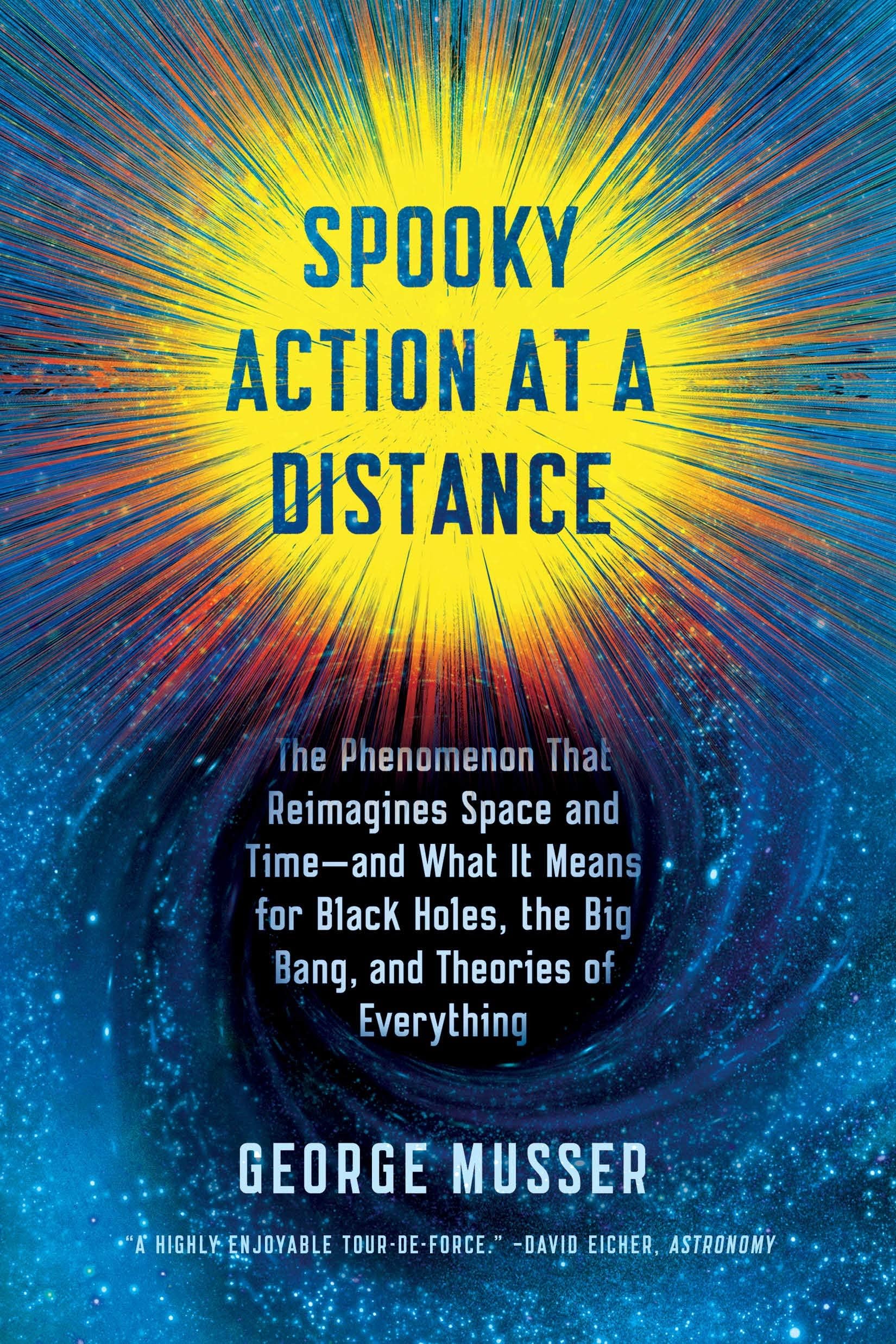
Spooky Action at a Distance: The Phenomenon That Reimagines Space and Time--and What It Means for Black Holes, the Big Bang, and Theories of Everything
Product ID: 43407601
Buy anything from 5,000+ international stores. One checkout price. No surprise fees. Join 2M+ shoppers on Desertcart.
Desertcart purchases this item on your behalf and handles shipping, customs, and support to Vietnam.
Buy Spooky Action at a Distance: The Phenomenon That Reimagines Space and Time-and What It Means for Black Holes, the Big Bang, and Theories of Everything on desertcart.com ✓ FREE SHIPPING on qualified orders Review: But it's brilliant gibberish. Musser is either a charlatan or a ... - This book is gibberish. But it's brilliant gibberish. Which kind of makes sense because he's explaining quantum physics, which is useful gibberish. Musser is either a charlatan or a great explainer. Or both. I read this book foolishly expecting him to explain quantum entanglement. He can't. Nobody can. Feynman said don't feel bad if you don't understand quantum physics - nobody does. I tossed the quantum entanglement problem to my really smart 10 year old grandson who has not yet been biased by a conventional physics education and even he couldn't figure it out. But his explanations were every bit as entertaining as Musser's explanations of whether time and space really exist. So why the 5 stars? He does a superb job of explaining all the nonsense theories. Very entertaining. My advice - Never try to read explanations of quantum physics sober. Review: Non-Locality as General Principle(?) - The term “spooky action at a distance” comes from Einstein’s view of quantum non-locality and was later renamed “entanglement” by Schrodinger. That entanglements really were non-local was emphasized by John Bell and hundreds of subsequent “Bell tests.” Since entanglement non-locality seems to operate outside of time and space, it raises the question, “If space isn’t what we thought it was, then what is it?” That is the key question addressed by Musser’s book. Much of the reading is about people and history of modern speculative physics at its fringes (holography, duality, strings, loops, D0-branes, black hole horizons, twistors, amplituhedron, wormholes, matrix models, and non-commutative geometry). The many ideas discussed are all beyond present test abilities; and the book trades any detail for wide breadth of coverage. Because it is on the fringes of physics, there is no closure or conclusions and a feeling of handwavings. The overall lack of tangibility can be pretty frustrating. One of the key players mentioned in the book was Fotini Markopoulou who had worked in the areas of causal sets, causal dynamical triangulation theory (CDT, 2006 with Lee Smolin) theory and quantum graphity (2008) but then left physics for work in Innovation Design in 2012 (not “industrial design” as stated in the book). It is of great interest to know what modern theoretical physicists are working on, and Musser provides that. His book is well-written with many short but clear analogies and colorful terms (like the “prebangian epoch”). Apart from quantum mechanics, one example of non-locality is black hole horizons: “the location of the horizon depends not only on how strong the hole’s gravity is now, but how strong it will be.” But the horizon is a deduced view of an observer lying very far away from a region where time seems to stand still – not a conventional use of the term “location.” I believe that book would have had more needed solidity if it had initially discussed the strongly well-verified experimental state of Bell Tests for quantum entanglement and showed more space-time diagrams of non-local strangeness. Here, Anton Zeilinger is a very key player (perhaps worthy of a future Nobel Prize). One of his experiments showed "delayed-choice entanglement swapping" and another “teleportation” of a quantum state. Swapping means the transfer of a quantum state of one photon to another. Possibly his most famous demonstration was quantum teleportation over 144 kilometers between two Canary Islands. Other authors did a separate 2013 test called, "Entanglement Swapping between Photons that have Never Coexisted"-- entanglement can be over spacelike or timelike separations. The easiest understanding of non-local entanglement is perhaps the “transactional interpretation” from John Cramer. This allows sub-quantum communication between an emitter and an absorber both forwards and backwards in time (“zig-zag”, you know where you’re going because you’ve already been there). The classical world only allows time to progress forwards, but the quantum wavefunction lives in a different world more resembling “the square root of reality” and may communicate both ways in time (retarded and advanced). Then all the tested space-time diagrams of non-locality make simple intuitive sense. This is mentioned briefly in the book under “reverse causation” but then quickly dismissed (perhaps due to a confusion over the term signaling as classical versus sub-quantum). The book has many good reviews, communications with many great modern physicists, extensive bibliography and notes, and a good index. But good understanding would require a lot of individual effort investigating elsewhere.
| Best Sellers Rank | #442,720 in Books ( See Top 100 in Books ) #120 in Relativity Physics (Books) #194 in Quantum Theory (Books) #242 in Astrophysics & Space Science (Books) |
| Customer Reviews | 4.2 4.2 out of 5 stars (585) |
| Dimensions | 5.47 x 0.72 x 8.16 inches |
| Edition | Reprint |
| ISBN-10 | 0374536619 |
| ISBN-13 | 978-0374536619 |
| Item Weight | 9.6 ounces |
| Language | English |
| Print length | 304 pages |
| Publication date | November 15, 2016 |
| Publisher | Scientific American / Farrar, Straus and Giroux |
S**D
But it's brilliant gibberish. Musser is either a charlatan or a ...
This book is gibberish. But it's brilliant gibberish. Which kind of makes sense because he's explaining quantum physics, which is useful gibberish. Musser is either a charlatan or a great explainer. Or both. I read this book foolishly expecting him to explain quantum entanglement. He can't. Nobody can. Feynman said don't feel bad if you don't understand quantum physics - nobody does. I tossed the quantum entanglement problem to my really smart 10 year old grandson who has not yet been biased by a conventional physics education and even he couldn't figure it out. But his explanations were every bit as entertaining as Musser's explanations of whether time and space really exist. So why the 5 stars? He does a superb job of explaining all the nonsense theories. Very entertaining. My advice - Never try to read explanations of quantum physics sober.
D**N
Non-Locality as General Principle(?)
The term “spooky action at a distance” comes from Einstein’s view of quantum non-locality and was later renamed “entanglement” by Schrodinger. That entanglements really were non-local was emphasized by John Bell and hundreds of subsequent “Bell tests.” Since entanglement non-locality seems to operate outside of time and space, it raises the question, “If space isn’t what we thought it was, then what is it?” That is the key question addressed by Musser’s book. Much of the reading is about people and history of modern speculative physics at its fringes (holography, duality, strings, loops, D0-branes, black hole horizons, twistors, amplituhedron, wormholes, matrix models, and non-commutative geometry). The many ideas discussed are all beyond present test abilities; and the book trades any detail for wide breadth of coverage. Because it is on the fringes of physics, there is no closure or conclusions and a feeling of handwavings. The overall lack of tangibility can be pretty frustrating. One of the key players mentioned in the book was Fotini Markopoulou who had worked in the areas of causal sets, causal dynamical triangulation theory (CDT, 2006 with Lee Smolin) theory and quantum graphity (2008) but then left physics for work in Innovation Design in 2012 (not “industrial design” as stated in the book). It is of great interest to know what modern theoretical physicists are working on, and Musser provides that. His book is well-written with many short but clear analogies and colorful terms (like the “prebangian epoch”). Apart from quantum mechanics, one example of non-locality is black hole horizons: “the location of the horizon depends not only on how strong the hole’s gravity is now, but how strong it will be.” But the horizon is a deduced view of an observer lying very far away from a region where time seems to stand still – not a conventional use of the term “location.” I believe that book would have had more needed solidity if it had initially discussed the strongly well-verified experimental state of Bell Tests for quantum entanglement and showed more space-time diagrams of non-local strangeness. Here, Anton Zeilinger is a very key player (perhaps worthy of a future Nobel Prize). One of his experiments showed "delayed-choice entanglement swapping" and another “teleportation” of a quantum state. Swapping means the transfer of a quantum state of one photon to another. Possibly his most famous demonstration was quantum teleportation over 144 kilometers between two Canary Islands. Other authors did a separate 2013 test called, "Entanglement Swapping between Photons that have Never Coexisted"-- entanglement can be over spacelike or timelike separations. The easiest understanding of non-local entanglement is perhaps the “transactional interpretation” from John Cramer. This allows sub-quantum communication between an emitter and an absorber both forwards and backwards in time (“zig-zag”, you know where you’re going because you’ve already been there). The classical world only allows time to progress forwards, but the quantum wavefunction lives in a different world more resembling “the square root of reality” and may communicate both ways in time (retarded and advanced). Then all the tested space-time diagrams of non-locality make simple intuitive sense. This is mentioned briefly in the book under “reverse causation” but then quickly dismissed (perhaps due to a confusion over the term signaling as classical versus sub-quantum). The book has many good reviews, communications with many great modern physicists, extensive bibliography and notes, and a good index. But good understanding would require a lot of individual effort investigating elsewhere.
A**H
Great beginner book for quantum mechanics
Well done. Interesting information. Helped me understand the basics.
T**P
Nice comprehensive treatment, but...
This was my first exposure to nonlocality as a dedicated topic and the book gave what seemed to be a comprehensive coverage both historically and in relation to the science itself. I certainly walked away with an appreciation of its various manifestations in nature, related theoretical work, and likely indication of an underlying reality that is well outside our daily experience. The author has a broad command of current work in the field and concepts being studied to help the reader better understand this dauntingly obscure (but apparently very real) character of nature. My thanks for his taking the time to create this work. I did find the book pedagogically challenged however in several aspects. To begin with, the entanglement experiment that motivates the subject early on, seems to describe a system that could easily be interpreted through classical means and this is obviously not the intention. That is, for all the reader knows the generated photon pairs could be coherent (or anti-coherent - may not have this right ) - the description of moving the second polarizer 90 deg notwithstanding (this might indeed unambiguously demonstrate entangled behavior, but it's not explained sufficiently to enable the reader to see that vs the more obvious classical explanation). Also, data measurements are stated in units of events and coincidences per second where they should be events per hundred detections (since he implies resulting values are percentages. Stated units are OK if apparatus is set to deliver precisely 100 photon pairs/s but not obvious why one would do this and not so described). In some places the reading just seems out of synch with common terminology such as describing collisions in the Large Hadron Collider as being those of gluons and with gluon collision products. This seems like an unusual way to describe such events since gluons do not appear by themselves in nature (have never been isolated empirically). If there's a beneficial reason for describing these collisions in this non-standard manner (singling out only the strong boson component), why not help out the learning reader by saying what that is. At another point early on, an analogy is made for the expansion of space, which can cause distant objects to separate faster than light speed - the analogy being a line dance where dozens of dancers are added per second resulting in the ends reaching high speeds ("55 mph") without any one person needing to move quickly. Sorry but this just seems wrong. The end dancers would each need to move at least at half the separation speed - nearly 30 mph (on average). Does he instead mean "dancers need not move quickly relative to their neighbor"? There are plenty of other examples where the analogies and metaphors either seemed confusing or to only hold in a limited sense. The latter is always the case to some degree with such devices however enough of them seemed to have had me scratching my head early on that it was hard to shake my skepticism and embrace them to help digest the many subtle concepts that followed. Finally, after the first half, the book seems to lose some focus. There are stories of meetings with and opinions of leaders in the field, various anecdotes, ties with historical developments and between various theoretical explorations, etc. All potentially helpful and quite possibly a good survey for someone already familiar with the field, but seeemed protracted and diffuse for someone unfamiliar trying to sort out the main takeaways. Having said all this and in fairness to the author, this is seems to be an elusive subject indeed and one that has defied having its veil pierced (with any clarity) by brilliant minds past and present. The book is a useful introduction and survey on the topic for an armchair fan of physics and philosophy such as myself who's willing to put his/her head down and get through it.
M**S
Great outlook on Quantum Nonlocality
I do not have professional experience in the field of physics, however I have been studying it for a couple years and this book was EXCELLENT. The approach the writer takes is very neutral to the many outlooks of the consequences of quantum nonlocality, and he ensures to touch on the validity of each claim. The book may be a little advanced for someone who hasnt ever studied Quantum Mechanics however I do not think you need a degree to understand some of the material. Highly recommend this book.
B**H
The book gave me pleasure to read, but ... I have the impression that it is going to mystify the general audience about the current state of Physics. The book brings to the forefront an inconsistency in our comprehension of Physics. Many people are trying to bridge this gap by exploring wild ideas, and the author does a good job at reviewing these ideas. However, theories are not idea. A theory in physics should be (i) falsifiable and (ii) predictive. None of these ideas (Holistic universe, holographic universe, parallel universe, quantum graphity, ...) is even close to these gold standards of physics. The book however presents all these idea as kind of theories, letting the non-physicist wonder what do we smoke in our labs (disclaimer: I am a physicist). It is only in the concluding chapter that the author tries to make the distinction between ideas and theories, and I'm not sure that many readers will get to this point.
A**N
George Musser is profoundly disserved by his book’s cover. Featuring garish colours, a clichéd title and fatuous sub-title, it is easy to assume that this is a sensationalist popularisation for dummies. You could not be further from the truth. George Musser is a contributing editor for Scientific American and the author of ‘ Complete Idiot's Guide to String Theory (Complete Idiot's Guides (Lifestyle Paperback)) ’ – he has interviewed the world’s leading physicists and produced a wonderfully clear account of how our familiar spacetime might be emergent. He starts with the classic experiment: produce two photons in correlated polarisation states. Set them going in opposite directions. If the polarisation of one photon is measured, its value instantly determines the polarisation state of the other, no matter how far away it has flown. This is quantum non-locality and it tells us that something is wrong with our understanding of spacetime as a smooth continuum with light cones determining cause and effect. Physicists tend to hate this kind of observation. Given that quantum theory itself defies any straightforward interpretation as a theory of ‘reality’ it seems that non-locality is just one more piece of ontological weirdness. Better to shut up and calculate: we know the theory work incredibly well and we know how to interpret the answers (as probabilities). The sense that ‘reality’ is real and should make sense in its own terms is a powerful intuition. It has frequently been use to highlight conceptual weaknesses in otherwise successful theories. Musser recounts just how much trouble Newton’s contemporaries (and Newton himself) had with the apparently infinite speed of gravity in his theory – this is also a kind of non-locality. It was nineteenth century field theories (Faraday, Maxwell), followed by General Relativity, which (briefly) restored locality to physics. Quantum non-locality is something else. Musser writes (p. 125), “Instead of thinking of quantum non-locality as an effect which operates within space, I think we need to take it as a sign that space itself is a doomed concept.” What would a theory of emergent spacetime look like? There are a number of ideas; naturally none are fully worked out. Fay Dowker talks about causal sets - space is built out of discrete units, ordered in a complex network whose structure creates space. Fotini Markopoulou has a similar networked theory of ‘atomic grains of space’ in an approach punningly-termed quantum graphity; the link density is determined by the available energy, from which emerges space as we know it. String theory has a model of emergent-space based on matrix models: the matrices catalogue the web of interactions between D0-branes, dimension zero building blocks of space. Leonard Susskind is associated with this line of research. Musser explains these various theories in some detail, as best he can, describing their applications to black hole modelling and the early universe. AdS/CFT makes its obligatory appearance with yet another brave attempt to explain the holographic principle. But these diverse approaches deal mainly in space, treating time asymmetrically. The book finishes with the Amplituhedron. Built on the foundations of S-matrix theory and twisters with a dash of string theory, the amplituhedron is a geometric structure used for calculating transition probabilities for particle interactions. Each particle contributes a polyhedron vertex with its momentum setting the size of the corresponding polyhedral face. The interior volume gives the resulting amplitude. ‘“There are no fields, no particles, no interactions,” Trnka says. The locality we observe in daily life is a consequence of the way the faces fit together – specifically that they form a closed shape, as opposed to disconnected planes.’ I don’t think the reader is expected to fully grasp this. The idea that the 13.8 billion light year observable universe is an emergent artefact of an underlying non-spatial non-temporal quantum reality is surely the most mind-blowing concept of modern physics. Yet there are excellent reasons for taking it seriously. George Musser has written a clear, accessible and intelligent review of how this might be possible – it’s as near as most of us are ever going to get to understanding it – and he is to be congratulated.
M**O
Esclarecedor. O autor apresenta a parte histórica acompanhada da física acerca dos vários tipos de não-localidade. Recomendável para não especialistas e para especialistas que desejam conhecer a área. É um dos MELHORES livros que já li sobre não-localidade e sobre a possibilidade do espaço ser discretizado.
A**R
great book. I had to buy it after listening to the author on CBC "quirks and quarks" I have read it twice and loved it. I let my boss at the observatory read and he too found it unsettling .
K**I
Nice ! The book quality is good pages are soft loved to read !! But it takes 3 weeks in shipping thats annoying .. I hope they will make delivery more faster for this product !
Trustpilot
1 month ago
1 month ago