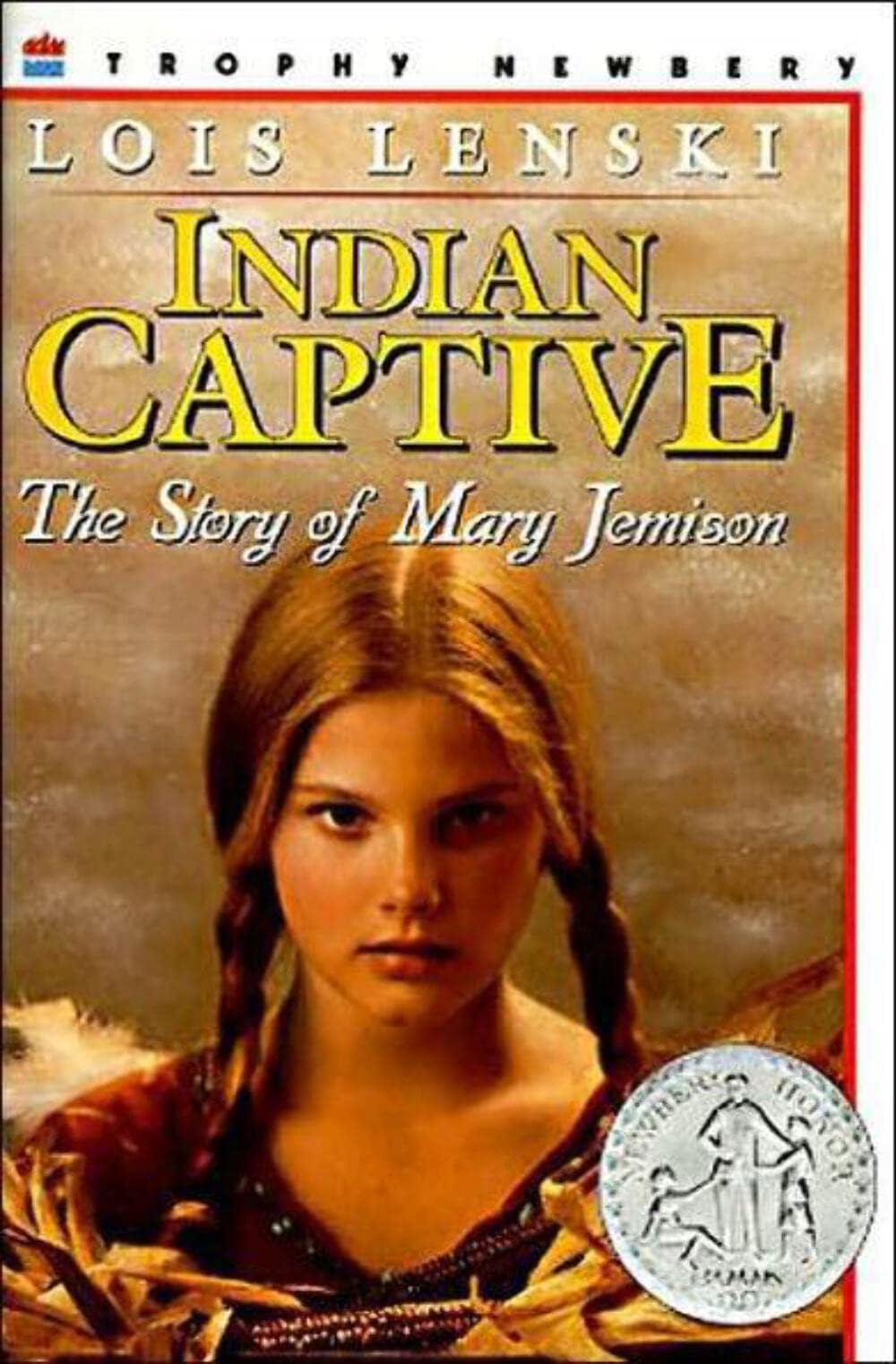
Indian Captive: The Story of Mary Jemison
Product ID: 4320363
Buy anything from 5,000+ international stores. One checkout price. No surprise fees. Join 2M+ shoppers on Desertcart.
Desertcart purchases this item on your behalf and handles shipping, customs, and support to Vietnam.
In this classic frontier adventure, Lois Lenski reconstructs the real-life story of Mary Jemison, who was captured in a raid as young girl and raised among the Seneca Indians. Meticulously researched and illustrated with many detailed drawings, this Newbery Honor novel is an unforgettable tale. Twelve-year-old Mary Jemison took for granted her peaceful days on her family's farm in eastern Pennsylvania. But on a spring day in 1758, something happened that changed her life forever. When a band of warriors invades the Jemisons' house and takes the family captive, Mary is separated from her parents and siblings. She travels with the Indians to southern Ohio and later to a Seneca village on the Genesee River in what is now western New York. Mary's new life is not easy. She misses her family terribly and is unaccustomed to Seneca ways. But even after her several unsuccessful attempts to run away, the Indians are kind to Mary and teach her many things about the earth, its plants, and its creatures. She develops deep bonds with the animals and even her captors. When Mary is finally given the chance to return to the world she had inhabited, she struggles with her newfound feelings. Review: Great true story to make history come alive for 4th to 6th graders! - 3 Generations of girls in my family have read this book! It is well researched and is a true story about Mary Jemison. If you are looking for history to share with your children, this is a great book! Lois Lenski was a teacher and took different journeys each summer to research and write about different cultural backgrounds in the US at that time. Great stories about our US history. Review: excellent middle school must read! - Excellent Middle School Read – Engaging and Educational Indian Captive is a required middle school read, and I can see why. The story is captivating, well-written, and gives young readers both historical insight and an engaging narrative they can connect with. It’s one of those books that not only meets curriculum requirements but also keeps students genuinely interested. Delivery was fast and easy, and the book arrived in perfect condition. Highly recommend for classrooms, homeschooling, or any middle schooler’s reading list.


| Best Sellers Rank | #129,477 in Books ( See Top 100 in Books ) #17 in Children's Colonial American Historical Fiction #73 in Children's Native American Books #1,580 in Children's Action & Adventure Books (Books) |
| Customer Reviews | 4.5 out of 5 stars 711 Reviews |
T**M
Great true story to make history come alive for 4th to 6th graders!
3 Generations of girls in my family have read this book! It is well researched and is a true story about Mary Jemison. If you are looking for history to share with your children, this is a great book! Lois Lenski was a teacher and took different journeys each summer to research and write about different cultural backgrounds in the US at that time. Great stories about our US history.
D**A
excellent middle school must read!
Excellent Middle School Read – Engaging and Educational Indian Captive is a required middle school read, and I can see why. The story is captivating, well-written, and gives young readers both historical insight and an engaging narrative they can connect with. It’s one of those books that not only meets curriculum requirements but also keeps students genuinely interested. Delivery was fast and easy, and the book arrived in perfect condition. Highly recommend for classrooms, homeschooling, or any middle schooler’s reading list.
A**R
A 6th Grade Book Review
Indian Captive Book Review By: Lilia, 6th grade In the book Indian Captive by Lois Lenski a young girl named Molly is captured by the Seneca Nation Native Americans and is taken to live with them. There she learns how to be tough and grow up in a different culture. After Molly is taken she struggles not to forget her family by repeating their names and talking to herself in English. While living with the Senecas Molly starts to notice how much she is starting to look and act like them. Molly starts going back and forth between wanting to like the Senecas and at the same time turning away their way of life. Molly’s biggest struggle is between adapting to the Seneca culture or holding on and never forgetting her own. The book Indian Captive takes place during the French and Indian War around 1754, When Molly was captured. In this war the Senecas were on the French side and they were fighting against the British. Molly was captured to replace a young boy who was killed by the British. She was just one of the many children captured by the Senecas as retribution for the killing of a member of their tribe. Molly never really had a side because she was with the Senecas who now cared and loved her but she still wanted to go back to her white American family. In the end, Molly learned her family died and is faced with possibly one of the hardest decisions in her life. Should she stay with the Senecas that have raised her? Or go back to the culture she was raised in? Throughout the book, she wants to adapt to the culture of the Senecas but also doesn't want to forget her own culture. This is the struggle molly continues to have. The choice Molly makes really reflects on her internal struggle. Think this book was great because it is always moving. I found it hard to get bored while reading this because I was always wondering what would happen next. Another reason I liked this book is that even though this book is partially fictional it takes an actual history of the French and Indian war into play. If you are looking for a book that is fun, intriguing, and historical I would definitely recommend this book to you.
S**R
Great gift
Great book!!! I read as a child; so I bought grandson a copy. Highly recommend. Fast shipping!!!
G**A
Superbly Done - And Still A Treasure!
It was only just a few days ago that I happened to mention Indian Captive: The Story of Mary Jemison (Trophy Newbery) in another book review. My own treasured copy is with my granddaughter, so I can't tell you how delighted I was to find the Kindle version of this dear old friend on a Daily Deal bright and early this morning! I first met Lois Lenski's beautifully told story of Mary Jemison, White Captive of the Genesee, as a girl myself. The story was originally published in 1941 and was a 1942 Newbery Honor Book. First, Mary Jemison was real. She was captured by the Shawnee in 1755 while the French & Indian War was at its peak at about the age of 12. Mary remained all of her long life with the Seneca, mostly in what is now New York state, and is buried in Letchworth State Park in Castile, New York. Lenski took huge pains to make her fictionalized account of Mary Jemison's story as accurate a portrayal of life among the Seneca as possible, spending countless hours in various museums examining the various objects in their extensive collections, speaking with artists and even interviewing Mary Jemison's descendants. The drawings in the book are Lenski's own and this beautifully done Kindle version includes all of them, exactly as the original did. If you happen to visit the New York State Museum at Albany, you can see many of the objects that Lenski used as models for her illustrations, nearly all of them collected by the same Arthur C. Parker who wrote the introduction to Indian Captive: The Story of Mary Jemison , himself a member of the Seneca tribe and even today recognized as a - perhaps even "the" - noted authority on American Indian culture. To this date, no better or more accurate account of life among the American Indians has been written for young people. While the story is a fictionalized adaptation of Mary Jemison's own telling of her history, Lenski's presentation of native culture is accurate right down to the food preparation, clothing and toys. Suitable for Grades 4 and up. Very Highly Recommended
A**.
Well written historical fiction
An amazing read. This little girl had so much courage. Well written and keeps your attention. This was a favorite read a loud of all my children.
K**E
A Decent Read
I read this book after reading The Ransom of Mercy Carter by Caroline B. Cooney about a thousand times (if you haven't read that book, please do so! It's amazing!) and this book was recommended for readers who enjoyed that book, but I was disappointed. I understand Mary Jemison's story is about a real life occurrence (with certain liberties taken due to the reading level set for this book), but I still didn't get involved with the story or love the character. I usually end up rooting for the character, no matter what choices they make. However, the author didn't get me as involved as I'd have liked. I'd have liked more detail and more background than just the same thing over and over. Some may like it, but this didn't do it for me. Perhaps that's because I compared it to the Ransom of Mercy Carter the whole time, but still, if it was good enough, it would have found it's own spot in my heart, just like all the other books I've read and loved.
J**H
Captive
Homeschooler here. Great added on reading for history.
A**E
Five Stars
excellent
E**E
nicht zu empfehlen
Ich habe das Buch auf Grund der sehr guten Bewertungen bestellt und erwartete eine Art Tatsachenbericht der damals entführten Frau. Diese Erwartung wurde schwer enttäuscht, das Buch ist absolut oberflächlich im Stil eines Kinderbuches geschrieben und wer die Geschichte von Blauvogel kennt, weiß in etwa was ihn erwartet. Auch die hochgelobten Illustrationen und die angeblich so aufwendigen Recherchen zu Werkzeugen u.s.w. erwiesen sich als absolut unbefriedigend. Wer etwas über das Indianerleben lernen möchte ist hier völlig falsch.
H**H
Stockholm Syndrome?
Today the Seneca captive would be considered a victim of Stockholm Syndrome! However, the book was written in 1941 (and re-released). As was the fashion, the opening chapter is written in a dialect that attempts to convey the limited education and means of Molly's frontier family. This makes for slow going at the start. The characterization of Molly's family members is pretty thin. Fortunately, the dialect falls away with Molly's capture. More successful is the attempt to convey the Seneca speech patterns and nature references. The description of Seneca daily life in the eighteenth century is very detailed and carefully stated, to the point where it becomes the main subject of the book rather than a backdrop for the interactions between characters. Overall, the central tension around whether escape is possible for Molly is convincing and engrossing. A good read. Loosely based on a true story. Not certain whether this would appeal to today's tween and teen readers.
C**E
Three Stars
more of a kid's book !
Trustpilot
1 month ago
1 month ago