We remain fully operational. Our teams are working around the clock to ensure your deliveries continue safely.

DOWNLOAD THE APP


Copyright © 2025 Desertcart Holdings Limited
DOWNLOAD THE APP
Buy anything from 5,000+ international stores. One checkout price. No surprise fees. Join 2M+ shoppers on Desertcart.
Desertcart purchases this item on your behalf and handles shipping, customs, and support to Vietnam.
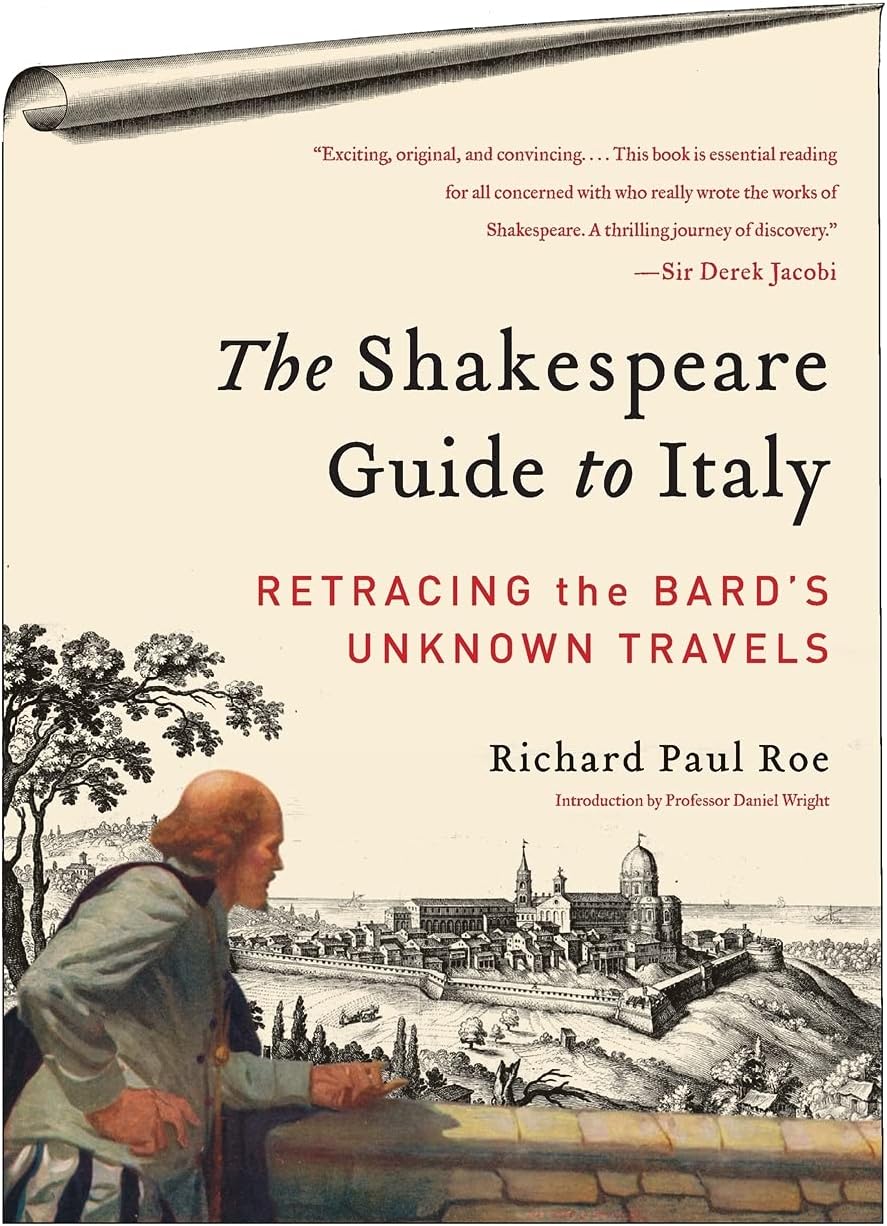
desertcart.com: The Shakespeare Guide to Italy: Retracing the Bard's Unknown Travels: 9780062074263: Roe, Richard Paul: Books Review: Whoever Wrote 'Shakespeare' Loved Traveling Italy and So Will I - 'The Shakespeare Guide to Italy' is the most enjoyable book about the plays I have read and the most beautiful. It is a big book that opens up in the reader's hands and finds again, by word and photograph, the sixteenth century La Italia that is fixed in the amber of the Bard's descriptions. Richard P. Roe retraced 'Shakespeare's journey, which modern scholarship says, even hopes, never really happened. The prevailing view is that all was imagination. Roe proved it was true. He first came upon eternal Italy as a very young man on Army-Air-Force assignment to attack the Axis's oil refineries in Romania during World War II. The mortality rate was 80-90%. He survived. I wondered if the journey back to Italy was a metaphor in him of transcending time, to stand once more among lasting things. He saw the same places, buildings, rivers, voyage routes, and neighborhoods meticulously described by the author of the Shakespeare canon. They were still there. He made a study of the scattered geographical notes, off-hand descriptions, ships' names, abandoned wells, little churches, impresa, embedded in the Italian plays, which to most of us are an unlikely testament. Using old maps and paintings he re-constructed the topography of a dozen cities. This book is as much an aesthetic as a literary study, charmingly combined. The journey embodied an unverbalized faith that 'Shakespeare' did not fake fanciful lands and places-- he honored his travels on the earth as he did his songs and suffering, to express their truth. Roe's lasting contribution to scholarship will be that he proved 'Shakespeare' did not commit geographical or cultural error in the Mediterranean plays. Instead, he was uncannily accurate. The prodigious implication of this, which Roe never stated, not being a big talker, is that our entire conception of who 'Shakespeare' was must now change. The man from Stratford never left England. We agree on that. The author went to Italy and knew it well. Sycamore trees stand west of the city walls in Verona, mentioned in Romeo and Juliet. The grove of trees barely in sight beyond the Porta Palio has been reduced to copses, it is true, but they are there. You can see them through the arch. Midsummer Night's Dream had a neighborhood called 'Little Athens'. It still exists in Sabbioneta, not Greece. Shall we sail from Verona to Milan, as in Two Gentlemen of Verona? Laughable?--today maybe it is--but by traveling overland to Ostiglia, they did it routinely, via the river Adda and canals. What about visiting the Bohemian coastline, near Trieste? Impossible now, but then Bohemia had thirty miles of access to the Gulf of Venice. Ben Jonson said 'Shakespeare' got it wrong. Jonson was wrong. He never left Western Europe. The author did. One finds the book full of long-buried gems, not only referenced in the works of Shakespeare and the medieval past, but also sustained in native knowledge, freely shared by the people Roe met as he searched back and forth in time. Contextual knowledge literally returns to life. Roe's search was buoyed by a certain relentless laconic pride. This man was a warrior. He didn't give up. The breadth of his spirit is expressed perhaps by a brief passage about how he searched for and found 'Shakespeare': "This is the playwright who is said to be ignorant of Italy. But truth is revealed in trifles, not in the great words that sweep. Truth hides in the words that are overlooked--the dull words, odd words, the words that are dismissed as cluttering, inconsequential, irrelevant. These are the words, not the soaring ones, that tell what a person knows. But one must listen." There are many ghosts in Italy,'Shakespeare's and Roe's among them. Most highly recommended. Review: Groundbreaking and Meticulous - "One of the great satisfactions of life is to embark upon a long leisurely journey--especially an absorbing intellectual adventure filled with mystery and promise." So begins "The Shakespeare Guide to Italy"...a new and decidedly adventurous book by the late Richard Paul Roe. Thirty years ago, the consensus among what may be termed 'Professional Shakespeare Academics' (let's call them PSAs) regarding the bard's knowledge of Italy was: "...he knew little of Italian geography and customs...making glaring errors..." and "...the Italy he wrote about was mostly invented inside his head...with little regard for historical fact." 'Learned English Professors' (LEPs), the local foot soldiers for the infinitely more glamorous PSAs, followed suit, clucking softly to themselves and parroting the notion that Shakespeare's "glaring errors" on Italy were a by-product of his London based research and writing. The passing years have not always been kind, however, to these views. Several members of the traditionally-minded academic community have already broken ranks over the past two decades as, one by one, the "glaring errors" purportedly made by Shakespeare have been shown to have NOT been errors at all, but rather, to be evidence of detailed knowledge of Italian geography and travel practices as they existed in the late 16th century. The most obvious example of this detailed knowledge is evidenced by archeological discoveries in Northern Italy which have revealed the extensive system inland waterways that existed in the region during Shakespeare's era and beyond. These include the canals which made possible a journey by boat between Verona and the inland city of Milan...just as Shakespeare himself described in The Two Gentleman of Verona...the journey ridiculed by the PSAs and the LEPs. Now comes this book by Mr. Roe which seeks to validate not only the MAJOR points of Italian geography and the travel customs of the era as described by Shakespeare, but in addition, to analyze all of Shakespeare's "Italian Plays" in great detail...with an eye toward proving that Shakespeare made virtually no errors in points large OR small regarding Italy. This project was especially ambitious, as the late Mr. Roe was not a PSA, or even a lowly LEP. Mr. Roe was a practicing attorney with undergraduate degrees in the fields of History and English Literature. In other words, in the eyes of the PSAs and the LEPs, he was a `rank amateur'...lower in the academic food chain than even the most junior grad student. So what did Mr. Roe, this 'rank amateur', actually unearth ? In my opinion, he has revealed that the great author knew his Italy quite well. One might even go so far as to say: "As Schliemann `discovered' Troy, so has Richard Paul Roe 'discovered' Shakespeare's Italy...not with pick and shovel mind you, but rather with his probing intellect". Mr. Roe, like Schliemann, has shown that the 'self-proclaimed experts' have been wrong...wrong as to their 'facts'...wrong as to their basic assumptions...wrong about the need to even CONSIDER the possibility that Shakespeare had gained his knowledge of Italy first-hand...wrong about nearly EVERYTHING as concerns Shakespeare and Italy. Mr. Roe has, to put it bluntly, made 'the professionals' look quite bad. For this sin alone, I suspect he will likely endure a period of ridicule by the 'self-proclaimed experts'. I further suspect that later will come 'reluctant acceptance' and then, finally, some of those same 'experts' will probably start taking credit for Mr. Roe's discoveries. Such is often the case with regards to groundbreaking research of this ilk. I will refrain from revealing here the extraordinary finds presented in Mr. Roe's book, as I prefer that the skeptics of 'rank amateurs' such as Mr. Roe, to be required to actually READ his book before they write reviews on it. I will simply state that what Mr. Roe has planted, are the seeds from which decades of debate and further research will spring. Whether these sprouts will be tended by slightly humbled professionals, or by increasingly confident 'rank amateurs', only time will tell. Buy and read this book if you love Shakespeare's Italian Plays and want to learn more about how they came to be written. Buy and read this book if you prefer to seek knowledge with an open mind. Buy and read this book, if you want to see into the future of Shakespeare scholarship. Buy and read this book if you, like me, believe that one day, from seeds such as this, true erudition may grow. Note: This book was written by an author who questions the traditional authorship attribution for the Shakespeare canon, but the main text is not written as an argument of those views at all, rather, it merely examines the locales of the 'Italian Plays of William Shakespeare' one by one without further comment upon the authorship attribution of those plays. It is a very objective piece of scholarship.


| Best Sellers Rank | #916,147 in Books ( See Top 100 in Books ) #323 in Shakespeare Literary Criticism #328 in Renaissance Literary Criticism (Books) #3,384 in Author Biographies |
| Customer Reviews | 4.8 4.8 out of 5 stars (112) |
| Dimensions | 7 x 1 x 9.5 inches |
| Edition | Illustrated |
| ISBN-10 | 0062074261 |
| ISBN-13 | 978-0062074263 |
| Item Weight | 2.08 pounds |
| Language | English |
| Print length | 336 pages |
| Publication date | December 5, 2011 |
| Publisher | Harper Perennial |
W**Y
Whoever Wrote 'Shakespeare' Loved Traveling Italy and So Will I
'The Shakespeare Guide to Italy' is the most enjoyable book about the plays I have read and the most beautiful. It is a big book that opens up in the reader's hands and finds again, by word and photograph, the sixteenth century La Italia that is fixed in the amber of the Bard's descriptions. Richard P. Roe retraced 'Shakespeare's journey, which modern scholarship says, even hopes, never really happened. The prevailing view is that all was imagination. Roe proved it was true. He first came upon eternal Italy as a very young man on Army-Air-Force assignment to attack the Axis's oil refineries in Romania during World War II. The mortality rate was 80-90%. He survived. I wondered if the journey back to Italy was a metaphor in him of transcending time, to stand once more among lasting things. He saw the same places, buildings, rivers, voyage routes, and neighborhoods meticulously described by the author of the Shakespeare canon. They were still there. He made a study of the scattered geographical notes, off-hand descriptions, ships' names, abandoned wells, little churches, impresa, embedded in the Italian plays, which to most of us are an unlikely testament. Using old maps and paintings he re-constructed the topography of a dozen cities. This book is as much an aesthetic as a literary study, charmingly combined. The journey embodied an unverbalized faith that 'Shakespeare' did not fake fanciful lands and places-- he honored his travels on the earth as he did his songs and suffering, to express their truth. Roe's lasting contribution to scholarship will be that he proved 'Shakespeare' did not commit geographical or cultural error in the Mediterranean plays. Instead, he was uncannily accurate. The prodigious implication of this, which Roe never stated, not being a big talker, is that our entire conception of who 'Shakespeare' was must now change. The man from Stratford never left England. We agree on that. The author went to Italy and knew it well. Sycamore trees stand west of the city walls in Verona, mentioned in Romeo and Juliet. The grove of trees barely in sight beyond the Porta Palio has been reduced to copses, it is true, but they are there. You can see them through the arch. Midsummer Night's Dream had a neighborhood called 'Little Athens'. It still exists in Sabbioneta, not Greece. Shall we sail from Verona to Milan, as in Two Gentlemen of Verona? Laughable?--today maybe it is--but by traveling overland to Ostiglia, they did it routinely, via the river Adda and canals. What about visiting the Bohemian coastline, near Trieste? Impossible now, but then Bohemia had thirty miles of access to the Gulf of Venice. Ben Jonson said 'Shakespeare' got it wrong. Jonson was wrong. He never left Western Europe. The author did. One finds the book full of long-buried gems, not only referenced in the works of Shakespeare and the medieval past, but also sustained in native knowledge, freely shared by the people Roe met as he searched back and forth in time. Contextual knowledge literally returns to life. Roe's search was buoyed by a certain relentless laconic pride. This man was a warrior. He didn't give up. The breadth of his spirit is expressed perhaps by a brief passage about how he searched for and found 'Shakespeare': "This is the playwright who is said to be ignorant of Italy. But truth is revealed in trifles, not in the great words that sweep. Truth hides in the words that are overlooked--the dull words, odd words, the words that are dismissed as cluttering, inconsequential, irrelevant. These are the words, not the soaring ones, that tell what a person knows. But one must listen." There are many ghosts in Italy,'Shakespeare's and Roe's among them. Most highly recommended.
J**I
Groundbreaking and Meticulous
"One of the great satisfactions of life is to embark upon a long leisurely journey--especially an absorbing intellectual adventure filled with mystery and promise." So begins "The Shakespeare Guide to Italy"...a new and decidedly adventurous book by the late Richard Paul Roe. Thirty years ago, the consensus among what may be termed 'Professional Shakespeare Academics' (let's call them PSAs) regarding the bard's knowledge of Italy was: "...he knew little of Italian geography and customs...making glaring errors..." and "...the Italy he wrote about was mostly invented inside his head...with little regard for historical fact." 'Learned English Professors' (LEPs), the local foot soldiers for the infinitely more glamorous PSAs, followed suit, clucking softly to themselves and parroting the notion that Shakespeare's "glaring errors" on Italy were a by-product of his London based research and writing. The passing years have not always been kind, however, to these views. Several members of the traditionally-minded academic community have already broken ranks over the past two decades as, one by one, the "glaring errors" purportedly made by Shakespeare have been shown to have NOT been errors at all, but rather, to be evidence of detailed knowledge of Italian geography and travel practices as they existed in the late 16th century. The most obvious example of this detailed knowledge is evidenced by archeological discoveries in Northern Italy which have revealed the extensive system inland waterways that existed in the region during Shakespeare's era and beyond. These include the canals which made possible a journey by boat between Verona and the inland city of Milan...just as Shakespeare himself described in The Two Gentleman of Verona...the journey ridiculed by the PSAs and the LEPs. Now comes this book by Mr. Roe which seeks to validate not only the MAJOR points of Italian geography and the travel customs of the era as described by Shakespeare, but in addition, to analyze all of Shakespeare's "Italian Plays" in great detail...with an eye toward proving that Shakespeare made virtually no errors in points large OR small regarding Italy. This project was especially ambitious, as the late Mr. Roe was not a PSA, or even a lowly LEP. Mr. Roe was a practicing attorney with undergraduate degrees in the fields of History and English Literature. In other words, in the eyes of the PSAs and the LEPs, he was a `rank amateur'...lower in the academic food chain than even the most junior grad student. So what did Mr. Roe, this 'rank amateur', actually unearth ? In my opinion, he has revealed that the great author knew his Italy quite well. One might even go so far as to say: "As Schliemann `discovered' Troy, so has Richard Paul Roe 'discovered' Shakespeare's Italy...not with pick and shovel mind you, but rather with his probing intellect". Mr. Roe, like Schliemann, has shown that the 'self-proclaimed experts' have been wrong...wrong as to their 'facts'...wrong as to their basic assumptions...wrong about the need to even CONSIDER the possibility that Shakespeare had gained his knowledge of Italy first-hand...wrong about nearly EVERYTHING as concerns Shakespeare and Italy. Mr. Roe has, to put it bluntly, made 'the professionals' look quite bad. For this sin alone, I suspect he will likely endure a period of ridicule by the 'self-proclaimed experts'. I further suspect that later will come 'reluctant acceptance' and then, finally, some of those same 'experts' will probably start taking credit for Mr. Roe's discoveries. Such is often the case with regards to groundbreaking research of this ilk. I will refrain from revealing here the extraordinary finds presented in Mr. Roe's book, as I prefer that the skeptics of 'rank amateurs' such as Mr. Roe, to be required to actually READ his book before they write reviews on it. I will simply state that what Mr. Roe has planted, are the seeds from which decades of debate and further research will spring. Whether these sprouts will be tended by slightly humbled professionals, or by increasingly confident 'rank amateurs', only time will tell. Buy and read this book if you love Shakespeare's Italian Plays and want to learn more about how they came to be written. Buy and read this book if you prefer to seek knowledge with an open mind. Buy and read this book, if you want to see into the future of Shakespeare scholarship. Buy and read this book if you, like me, believe that one day, from seeds such as this, true erudition may grow. Note: This book was written by an author who questions the traditional authorship attribution for the Shakespeare canon, but the main text is not written as an argument of those views at all, rather, it merely examines the locales of the 'Italian Plays of William Shakespeare' one by one without further comment upon the authorship attribution of those plays. It is a very objective piece of scholarship.
K**N
Stratfordian who Loves this Book
I am a Statfordian, not and Oxfordian, but this book is a must-read for any Shakespeare fan. It is beautifully written, wonderfully researched, and it provides us with some very interesting theories as to how Shakespeare procured his Italian inspirations. When trying to reconcile the assertion that the William Shakespeare of Stratford on Avon is also the man of Roe’s book who travelled to Italy, I just console myself with Shakespeare’s lost years, in which his movements are unaccounted for. Suppose he spent these years in Italy? Shakespeare is widely considered to have been a practicing Catholic. He could have taken a pilgrimage. If perhaps he was fleeing the country to escape prosecution by one Thomas Lucy for poaching on the nobleman’s land. It is certainly a fun idea to entertain. Whatever the case, Roe’s work is fascinating, compelling, and vibrantly alive. Part Shakespeare biography, part Rick Steves inspired travelogue. Thoroughly enjoyable!
C**L
Tolles Buch! Hervorragende Urlaubsvorbereitung! Nach der Lektüre möchte man direkt Koffer packen! Kann ich nur empfehlen - wir freuen uns, weitere Leser auf der Reise zu treffen!
M**I
Thank you Mr Roe for this invaluable piece of research made the old fashion way, not by cutting and pasting Wikipedia articles, but by travelling to the actual places in Italy that inspired William Shakespeare (or whoever hid behind that name) and his Italian plays. The book reads like a novel and it uncovers the depth of Shakespeare's knowledge of the places, the language, the culture of Italy that so deeply permeate his works. So much so in fact, that at the end of the book you cannot help but wondering: how could a semi-illiterate lad from Warwickshire, who never travelled outside Italy, who did not have any book to leave to his heirs, who did not correspond with anyone, know all that? Could it really be that behind the Shakespeare pen-name someone else was hidden? The name John Florio comes to mind, like that of his father Michelangelo. But that maybe is another book that waits to be written.
K**R
Arguably the most important book on Shakespeare in years! Most Shakespeare scholars have said for decades that the man from Stratford never left England, and got Italy all wrong. They have said this since it is highly unlikely that an Elizabethan commoner like the man from Stratford could have traveled widely, and there is certainly no record of him travelling. Some scholars have written that Shakespeare put Italian names on British places, and knew nothing of Italy. Or even the ludicrous idea that all of Shakespeare’s vast knowledge of the country came from “a few choice conversations” with Italians living in London. As though this might somehow explain 106 scenes set in Italy with over 800 references to the country. Of course Shakespeare scholars never went to Italy to check if the references were accurate, because that would be research which is “walled off” and “taboo.” And anyway, these scholars had already decided what findings they wanted. So why do research? But Richard Roe, wasn’t an academic, he was a real estate lawyer, and he spent 20 years in all the Italian cities described in the Shakespeare plays. Roe showed Shakespeare got Italy dead right! Leaving us with the question who actually wrote the Works? To Roe's credit, he does not force any alternate, but simply calls this person, "the writer." This book should be required reading at all schools, colleges and universities.
R**N
This book is a masterpiece of diligent scholarship and following one's nose. Tracing the Bard's steps in Italy with direct reference to the text of Shakespeare, Roe follows the clues around Northern Italy and provides deep insight into the sources for the plays. It is very clear that whoever Shakespeare was, he had to have travelled to Italy: only a person with first hand visual experience could have made such accurate references to Italy as are in Shakespeare's plays. Roe dismantles accusations levelled at Shakespeare that he was unknowledgeable about Italy, pointing out, for example, the clear indications of an intricate canal network linking cities in Northern Italy. I would suspect strongly that the negative reviews of this stunning book relate not so much to the content, but to deep seated anger and discomfort vis-a-vis evidence suggesting that the author of the works of 'Shakespeare' was actually someone well travelled. Read the book for yourself and make up your own mind.
J**S
Comprar el libro de segunda mano no ha significado una merma en la calidad de éste. De contenido interesante, el libro explora la vertiente italiana de Shakespeare con gran precisión y con unas ilustraciones impresionantes
Trustpilot
3 days ago
1 week ago