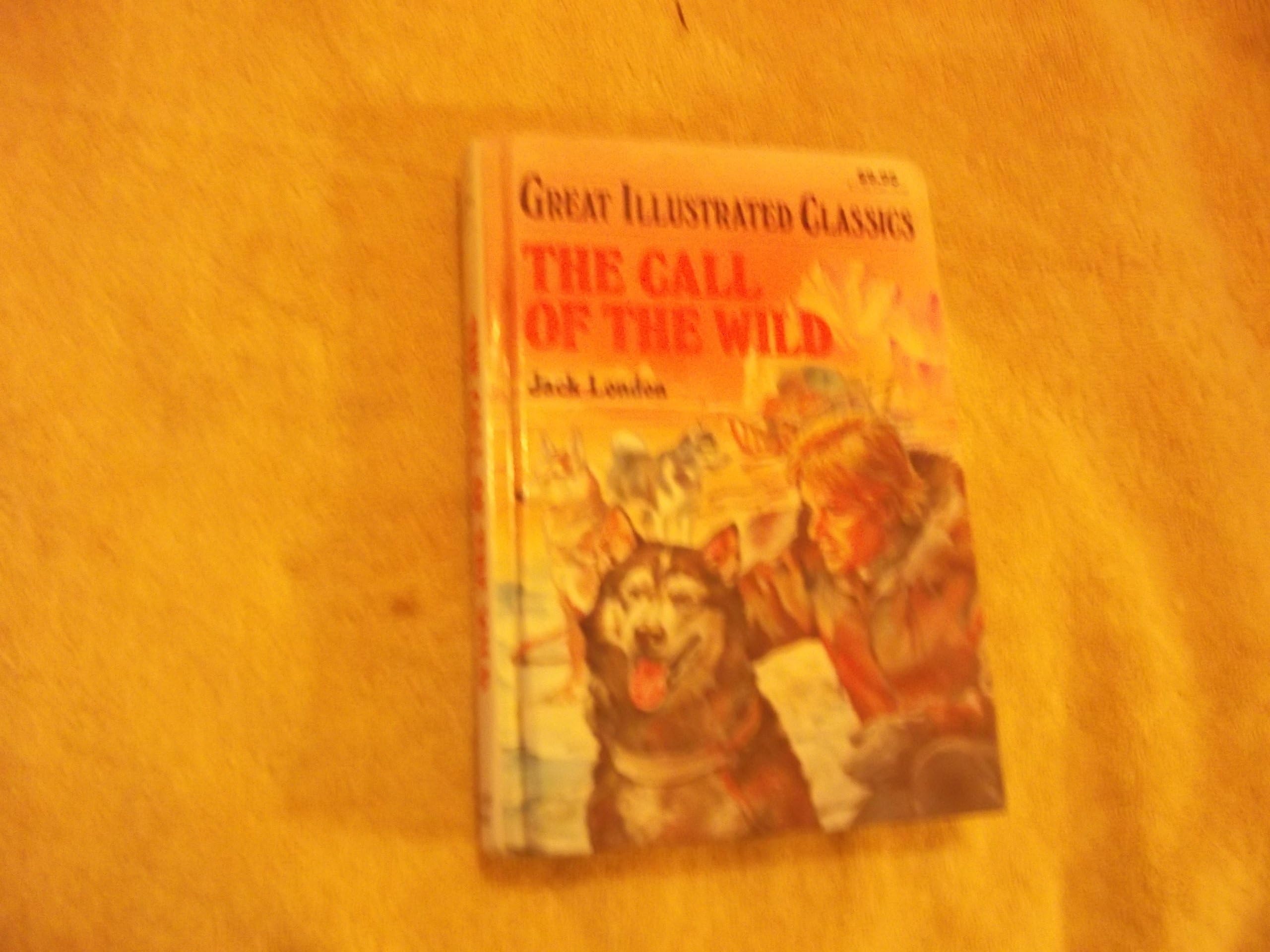
The Call of the Wild (Great Illustrated Classics)
Product ID: 41621788
Buy anything from 5,000+ international stores. One checkout price. No surprise fees. Join 2M+ shoppers on Desertcart.
Desertcart purchases this item on your behalf and handles shipping, customs, and support to Vietnam.
The adventures of an unusual dog, part St. Bernard, part Scotch shepherd, that is forcibly taken to the Klondike gold fields where he eventually becomes the leader of a wolf pack. Review: Call of the Wild an American Classic - I really enjoyed this audiobook. The narrator's delivery was easy to listen to, and he seemed to get into the story quite nicely. Now for the review: Jack London takes his Alaskan gold mining experience to create an awesome tale. Buck belonged to a judge in California, in the days of the Klondike gold rush in Alaska. Buck was a large dog, half St. Bernard and half German Shepherd. he was not one of the judge's "kennel dogs," nor was he one of the "house dogs." He walked with his master when he was outside, and hunted with the judge's sons. Buck was the king of his outside domain, but even though the judge treated him well, he did not know love. One day the judge's Chinese cook ran up a gambling debt, and when no one was looking, he took Buck to town on a rope leash and sold him to a Klondike sled dog broker. It was then Buck learned the law of the club and fang. To get Buck into submission, the broker beat him mercilessly with a club. Buck was later sold and took to Alaska to start the menial and hard life of a sled dog. London's writings are powerful and insightful. Buck goes from pet to work dog, from a life of relative ease to one of the harsh reaities of survival in one of the harshest environments of the world. Buck toughens up and survives, and rises to the top of the sled dog pack. Through a series of jobs where the dogs are nearly used up and destroyed, Buck is nearly killed by a family of idiots who buy them. He is saved by a man who shows him true love. Once his new master is lilled by Indians, Buck is free to join a wolf pack and becomes its leader. From beginning to end, this shows of survival of the fittest and the call of the wild on all dogs. For and animal lover like myself, there were many times where I was cringing at the treatment of the animals. Buck triumphs over harsh treatment, harsh weather, lack of food, and other dogs that would kill him. The call of the wild is a phrase that is part of American language even today. Great book. Review: It's a very inspiring story about how a family pet is kidnapped and he becomes a sled dog in Alaska. - It is a quality hardcover book.
| Best Sellers Rank | #5,752,776 in Books ( See Top 100 in Books ) |
| Customer Reviews | 4.6 out of 5 stars 12,400 Reviews |
M**M
Call of the Wild an American Classic
I really enjoyed this audiobook. The narrator's delivery was easy to listen to, and he seemed to get into the story quite nicely. Now for the review: Jack London takes his Alaskan gold mining experience to create an awesome tale. Buck belonged to a judge in California, in the days of the Klondike gold rush in Alaska. Buck was a large dog, half St. Bernard and half German Shepherd. he was not one of the judge's "kennel dogs," nor was he one of the "house dogs." He walked with his master when he was outside, and hunted with the judge's sons. Buck was the king of his outside domain, but even though the judge treated him well, he did not know love. One day the judge's Chinese cook ran up a gambling debt, and when no one was looking, he took Buck to town on a rope leash and sold him to a Klondike sled dog broker. It was then Buck learned the law of the club and fang. To get Buck into submission, the broker beat him mercilessly with a club. Buck was later sold and took to Alaska to start the menial and hard life of a sled dog. London's writings are powerful and insightful. Buck goes from pet to work dog, from a life of relative ease to one of the harsh reaities of survival in one of the harshest environments of the world. Buck toughens up and survives, and rises to the top of the sled dog pack. Through a series of jobs where the dogs are nearly used up and destroyed, Buck is nearly killed by a family of idiots who buy them. He is saved by a man who shows him true love. Once his new master is lilled by Indians, Buck is free to join a wolf pack and becomes its leader. From beginning to end, this shows of survival of the fittest and the call of the wild on all dogs. For and animal lover like myself, there were many times where I was cringing at the treatment of the animals. Buck triumphs over harsh treatment, harsh weather, lack of food, and other dogs that would kill him. The call of the wild is a phrase that is part of American language even today. Great book.
M**E
It's a very inspiring story about how a family pet is kidnapped and he becomes a sled dog in Alaska.
It is a quality hardcover book.
B**S
After watching PBS’s Great American Read
I had always heard about The Call of the Wild and intended to read it much sooner. After watching PBS’s Great American Read, I was reminded of all the classics I have yet to read (and those I need to revisit). This was a hard one for me to rate and to review. There are so many different themes represented in the book: man and the natural world, competition, pride, suffering, respect, loyalty, friendship, perseverance, knowledge, and more! The story is told from the point of view of a good and kind dog named Buck. Buck’s life takes some drastic and (devastating) turns. He experiences pain (both physical and emotional) from both humans and other animals. But he doesn’t give up. He fights. Becomes stronger. And in doing so, becomes more in tune with the “wild animal” inside of him. And this is where Buck’s story culminates, with his full devotion and acceptance of the wild parts of his being, and subsequent return to nature. What exactly did London what the reader to glean from his writing? No one will ever really know except London himself, but in a lot of ways, I wondered if this wasn’t a clever way of telling the story of how all beings (even humans) can, if they are not careful, lose their grip on who they really are. How important it is to remain true to who we are deep inside. Our natural self. Not that we should venture off into the woods and live off the land, but rather we shouldn’t let the world around us shape us into a person we don’t feel comfortable (or happy) being. The prose is fairly effortless to read compared to some classics, so this would be well suited even for fairly young readers. BEWARE: If you are at all triggered by animal cruelty and violence, you may want to skip this over. Often the best and most lasting art leaves those who enjoy it with more questions than answers. This is surely one of those. A great pick for a book club discussion.
P**L
Jack London - Part Prolific Novelist, Part Wolf
After reading "The Call of the Wild" or more precisely, after being transferred to another place and time, or even more to the point after being totally submerged into the being of this animal, I'm left completely awe-struck by London's work. To see what Buck saw, to feel the forces and the instincts that he felt... that is the power of this book. Here's a passage from the third chaper to illustrate what I mean: "At the mouth of the Tahkeena, one night after super, Dub (a member of the sled-dog team) turned up a snowshoe rabbit, blundered it, and missed. A hundred yards away was a camp of the Northwest Police, with fifty dogs, huskies all, who joined the chase. The rabbit sped down the river, turned off into a small creek, up the frozen bed of which it held steadily. It ran lightly on the surface of the snow, while the dogs plowed through by main strength. Buck led the pack, sixty strong, around bend after bend, but he could not gain. He lay down low to the race, whining eagerly, his splendid body flashing forward, leap by leap, in the wan white moonlight. And leap by leap, like some pale frost wraith, the snowshoe rabbit flashed on ahead. All the stirring of old instincts which at stated periods drives men out from the sounding cities to forest and plain to kill things by chemically propelled leaden pellets, the blood lust, the joy to kill--all this was Buck's, only it was infinitely more intimate. He was ranging at the head of the pack, running the wild thing down, the living meat, to kill with his own teeth and wash his muzzle to the eyes in warm blood. There is an ecstasy that marks the summit of life, and beyond which life cannot rise. And such is the paradox of living, this ecstasy comes when one is most alive, and it comes as a complete forgetfulness that one is alive. This ecstasy, this forgetfulness of living, comes to the artist, caught up and out of himself in a sheet of flame; it comes to the soldier, war-mad on a stricken field and refusing quarter; it came to Buck, leading the pack, sounding the old wolf-cry, straining after the food that was alive and that fled swiftly before him through the moonlight. He was sounding the deeps of his nature, and of the parts of his nature that were deeper than he, going back into the womb of Time. He as mastered by the sheer surging of life, the tidal wave of being, the perfect joy of each separate muscle, joint, and sinew in that it was everything that was not death, that it was aglow and rampant, expressing itself in movement, flying exultantly under the stars and over the face of dead matter that did not move."
A**E
Better today
The Call of the Wild by Jack London is better today than it was when I was younger. I’ve read it several times over the years but this is the first time listening to an audio of it. I listened to the version narrated by Roger Dressler and quite enjoyed it, as I listened in one sitting. One of the things I love about this story is that our narrator in the story is Buck, a Saint Bernard/shepard mix, I believe it gives us a unique perspective and insight into his world that we otherwise wouldn’t see if the story was told from a human perspective. I would recommend this as it is a classic however, just know there is animal cruelty.
R**D
The Call of the Wild
The Call of the Wild, by Jack London Buck was born into a pampered life of civilization. He was raised in the south with a big family; 3 generations worth. But unfortunately, one of the men who worked on the farm was a gambler, and like most gamblers, he often lost; had mouths to feed and debts to pay. So one night, that man decided to kidnap Buck and sell him to another man for a few bills--I say "kidnap", but that word is not quite appropriate: Buck is not a child, but a dog, and because gold has been found in Alaska, large dogs like him are bringing a premium price in Alaska. Immediately upon arrival at his destination, Buck is beaten into submission by a club-wielding man in a red sweater. This is his first introduction to the law of the wild; with might comes law. Not long after he has been purchased to join a dog-sled team, a fight breaks out between the team leader and a different new dog named Curly. The fight ends with Curly's death. This is his second introduction to the law of the wild; mercy is a weakness. Because of his natural tendencies towards pride, he himself gets into a lot of fights with the team leader. However, he is much to cunning to bring it to an immediate stand-up battle; instead, he reinforces the other dogs' tendencies towards anarchy, bringing down the efficiency of the pack overall. This irritates the team leader to no end. Finally, they have it out, and Buck emerges triumphant; the old team leader is never heard from again. Buck takes his earned place (by virtue of his might) as the new team leader, and immediately brings the other dogs back into line. Their efficiency becomes so great that they set a new record on a run. The rest of the story continues on, and Buck slowly slips further and further away from civilization; following the call of the wild, he eventually joins with a pack of wolves. As a favorite quote of mine proclaims, "beneath the veneer of civility, we're all children of Cain." Nowhere (to my knowledge) is this thought further explored than in this book. It is both a great story, and an interesting look at just how easily it would be for civilization to fall away. Really, excluding all of our neat gadgets, not much has changed: all of our vaunted rules and mores exist merely because we're much too afraid to venture out alone at night. Memorable Quote: Faithfulness and devotion, things born of fire and roof, were his; yet he retained his wildness and wiliness. He was a thing of the wild, come in from the wild to sit by John Thornton's fire. For more reviews like this, please check out my profile!
F**R
Weird Format
This is one of my favorite novels of all time, and I wanted to put a copy in our town's Little Free Library. I ordered this edition, and to my dismay it had a really weird layout. It was formatted more like a magazine than a book, but hopefully, someone will read and enjoy it.
J**Y
Nice Large Print of a Classic Book
90 year old mother in law wanted to re read this book so we found this large print version. Very nice. Very nice indeed. for those who have not read The Call of the Wild before, be prepared ... it's not a modern book, and it has some violence, but it is a classic. I'll never forget it. I may just reread this large print copy myself.
K**É
Fascinating
4 stars. The first time I read this book, I quite enjoyed it. It’s not for everyone. It's blunt and wild and violent and intense and alive. There were parts where even I cringed—particularly at the beginning. But somehow one grows hardened quickly, along with the dogs and the men… yet you never grow callous, only stronger. The merit of this book is fascinating—real life in the Canadian Northwest in the 1890s, so often romanticized although anything but. It’s a story of sled dogs and mail couriers, with all their unvarnished coolness and strength. It is the tale of a dog stolen from a good home and becoming more and more brutalized until he joins his untamed brethren in the wilderness and forgoes civilization entirely. The writing style of this book is really quite striking. Jack London brings to stark life the cold, cruel North. Although I live relatively to the South—relatively to Buck and his friends, that is—I have enough of a daily experience with the Canadian winter to recognize how accurately London writes. Besides good description, he has an excellent trick of saying much in few words, and giving much action without great detail. He makes a splendid study in brevity and clarity. The characters of the book pass in and out like their shadows did through Buck’s life. François and Perrault won respect, if not affection, by their humanity and justness. They were a product of their surroundings—coarse, hard, simple men—but they were fair, and they treated their dogs with the humaneness they could afford. Charles, Mercedes, and Henry form a brief and tragic chapter; and then John brings a flow of real love that melts book’s iciness slightly. The book is rather short—about a hundred pages, a novella’s size—but the story feels much longer, so much is compacted within those few 32,000 words. There is the warm beginning, a startling inciting event, then all of Buck’s education under Perrault as he runs the mail course up North; the return down South, worn to threadpaper; the terrible, crazy journey to the goldmines; the call of the wild… and the bittersweet ending. All along, London balances humour and grit, beauty and pain. The theme of the book seems to be the puniness of mankind pitted against the grandeur of God’s creation, and it is strongly borne out to the reader. Man’s inability to control his own or his possessions’ life is deeply underlined. It is not, contrary to what London insists, blind chance or an impersonal train of events. But he shows the fragility of civilization against wilderness, of humanity against nature, in a way that drives home the folly of our own pride and self-sufficiency. The laws of creation are there, and man will never, can never, override them—they are set unchangingly by the Creator. This is one of the books that, depending on your worldview, changes dramatically. London’s own is evolutionary; and with that mindset, life is indeed drear and terrifying. With a God-centered perceptive, though, one finds comfort and security. A smaller message is the difference between caving to surroundings and becoming as harsh as they, as opposed to retaining one’s moral and civil code. Content: violence; mild language. A Favourite Quote: There is an ecstasy that marks the summit of life, and beyond which life cannot rise. And such is the paradox of living, this ecstasy comes when one is most alive, and it comes as a complete forgetfulness that one is alive. This ecstasy, this forgetfulness of living, comes to the artist, caught up and out of himself in a sheet of flame; it comes to the soldier, war-mad on a stricken field and refusing quarter; and it came to Buck, leading the pack, sounding the old wolf-cry, straining after the food that was alive and that fled swiftly before him through the moonlight.... He was mastered by the sheer surging of life, the tidal wave of being, the perfect joy of each separate muscle, joint, and sinew in that it was everything that was not death, that it was aglow and rampant, expressing itself in movement, flying exultantly under the stars and over the face of dead matter that did not move.
S**E
storia di Buck
Un bellissimo libro d'avventura che esprime tutto il talento dello scrittore statunitense e il suo amore per la natura, anche nei suoi aspetti più duri e selvaggi. La storia del cane Buck inizia in California alla fine dell'Ottocento, figlio di un sanbernardo e di una femmina di pastore scozzese, vive nella villa del giudice Miller. Con l'inizio della "corsa dell'oro" nel Klondike, aumenta la richiesta di cani da slitta, unico mezzo possibile per percorrere quella freddissima parte settentrionale del continente americano e il povero Buck viene venduto dal losco giardiniere del suo padrone a un trafficante dai modi brutali... le dure condizioni dei cani da slitta sono descritte in modo molto realistico e commovente.
L**P
Retorno à natureza primordial
Jack London cria uma impressionante história sobre a vida literalmente selvagem de homens e cães no cenário inóspito do Alasca, nos tempos da corrida pelo ouro. Sendo um aventureiro, provavelmente muitas de suas experiências pessoais dão suporte à narrativa. Seu estilo, simples e direto, facilita a entrada do leitor nesta incrível aventura e o prende até o final do livro. A história é contada pela perspectiva de um cão doméstico, Buck, acostumado a uma vida tranquila em um sítio na Califórnia, até ser sequestrado e levado às terras do Norte. Lá, ele se torna parte de uma matilha de cães puxadores de trenó. A duras penas, Buck vai percebendo a natureza boa ou má dos companheiros caninos, a lei do chicote e a crueldade dos homens, despidos de qualquer compaixão. No rigor do ambiente gelado o que resta a Buck é a luta corajosa por manter-se vivo. Assim, vai deixando aflorar seu instinto primitivo e primordial, anteriormente mascarado por um verniz de civilidade. O livro também pode ser lido como uma metáfora. Quando submetida a condições extremas, a fina divisória entre a civilização e a barbárie é rompida. Mas Buck ainda guarda uma ética rudimentar. Ele nunca perde a dignidade. Sua violência é pela sobrevivência, não é gratuita. No meio da traição, esperteza, ciúme, raiva e inveja, ainda há espaço para a amizade, gratidão, lealdade e amor.
A**E
Ll
Très bien
N**K
Buch
Sehr schön.
Trustpilot
1 month ago
1 week ago