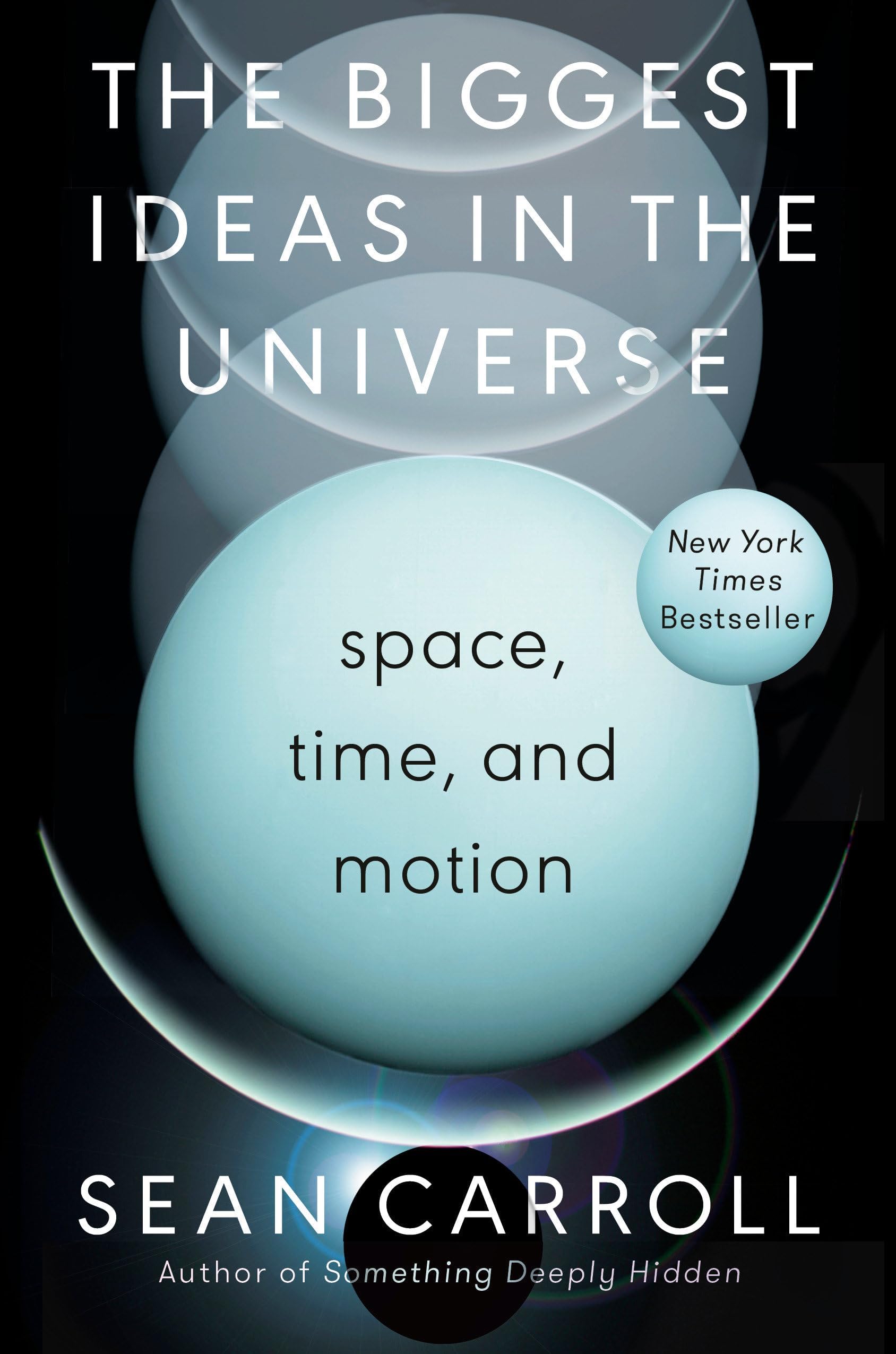
The Biggest Ideas in the Universe: Space, Time, and Motion
Product ID: 399082833
Buy anything from 5,000+ international stores. One checkout price. No surprise fees. Join 2M+ shoppers on Desertcart.
Desertcart purchases this item on your behalf and handles shipping, customs, and support to Vietnam.
Buy The Biggest Ideas in the Universe: Space, Time, and Motion on desertcart.com ✓ FREE SHIPPING on qualified orders Review: Advanced Explanations of Space, Time, and Motion - I love to watch Sean Carroll's videos and his method of teaching is unique and mesmerizing. However, his speaking skills don't translate well into the written media. In this way, I was a bit disappointed -- but maybe I was expecting too much. This is not to say that the book didn't fulfill its promises. It does. I thought the first third of the book was a good review of my long-ago 12th grade Physics class. But it soon began to blossom into more advanced concepts that were supported by a little more math than I had been hoping for. I thought he did an excellent job of leading up to and explaining the meaning of "curved spacetime", as well as how and why gravity modifies spacetime (the topic I was most interested in, for which I had to wait until Chaper 8). Admittedly, the math overwhelmed me in the later chapters, but it wasn't difficult to wreak out its meanings and results. I also appreciated the historical references to the pioneer physicists and their contributions to everything we know today. There are so many advances and discoveries that have been made in understanding our physical world in a relatively short period of time, as discussed in this book, but so many questions are still unanswered. Carroll leaves us with a kind of excitement in attempting to imagine what might be yet to come. Review: A Huge Accomplishment in Scientific Explanation - I wish this book had been available during my educational experiences. I finished lots of courses feeling I’d looked at the material from a distance (through a straw, if you will). This book suddenly puts all those subjects in view together, helping to see the interactions among subjects (seeing “the big picture”, if you will). This is a master communicator at work. Amazing! I particularly liked the intermingling of history with the scientific concepts. There’s just the right amount of information about humanity’s “big thinkers” to clearly see how each of them through the years “stood on the shoulders of giants” and at the same time were very human in some of their egos and hubris. There’s a saying among scientific authors that every equation included in a book reduces the author’s sales potential by 10%. Yet the finest authors, including this one, sprinkle equations liberally a productively.


| Best Sellers Rank | #28,344 in Books ( See Top 100 in Books ) #4 in Physics of Gravity (Books) #8 in Relativity Physics (Books) #21 in Cosmology (Books) |
| Customer Reviews | 4.5 4.5 out of 5 stars (1,272) |
| Dimensions | 5.7 x 1 x 8.5 inches |
| ISBN-10 | 0593186583 |
| ISBN-13 | 978-0593186589 |
| Item Weight | 13.6 ounces |
| Language | English |
| Print length | 304 pages |
| Publication date | September 20, 2022 |
| Publisher | Dutton |
A**N
Advanced Explanations of Space, Time, and Motion
I love to watch Sean Carroll's videos and his method of teaching is unique and mesmerizing. However, his speaking skills don't translate well into the written media. In this way, I was a bit disappointed -- but maybe I was expecting too much. This is not to say that the book didn't fulfill its promises. It does. I thought the first third of the book was a good review of my long-ago 12th grade Physics class. But it soon began to blossom into more advanced concepts that were supported by a little more math than I had been hoping for. I thought he did an excellent job of leading up to and explaining the meaning of "curved spacetime", as well as how and why gravity modifies spacetime (the topic I was most interested in, for which I had to wait until Chaper 8). Admittedly, the math overwhelmed me in the later chapters, but it wasn't difficult to wreak out its meanings and results. I also appreciated the historical references to the pioneer physicists and their contributions to everything we know today. There are so many advances and discoveries that have been made in understanding our physical world in a relatively short period of time, as discussed in this book, but so many questions are still unanswered. Carroll leaves us with a kind of excitement in attempting to imagine what might be yet to come.
N**R
A Huge Accomplishment in Scientific Explanation
I wish this book had been available during my educational experiences. I finished lots of courses feeling I’d looked at the material from a distance (through a straw, if you will). This book suddenly puts all those subjects in view together, helping to see the interactions among subjects (seeing “the big picture”, if you will). This is a master communicator at work. Amazing! I particularly liked the intermingling of history with the scientific concepts. There’s just the right amount of information about humanity’s “big thinkers” to clearly see how each of them through the years “stood on the shoulders of giants” and at the same time were very human in some of their egos and hubris. There’s a saying among scientific authors that every equation included in a book reduces the author’s sales potential by 10%. Yet the finest authors, including this one, sprinkle equations liberally a productively.
A**N
Readable overview of some major ideas in classical mechanics and beyond
Space Time and Motion is Sean Carroll's first book in his new series on the biggest ideas in physics. This one discusses mainly ideas the are the foundation of classical mechanics from Newton to Einstein. The book is minimal in equations and intended for the general audience and I believe it follows his podcasts which I have not listened to. Nonetheless the author does communicate the ideas quite effectively and clears up some concepts that are often glossed over in physics textbooks in the pursuit of trying to give an understanding of the foundations of physics rather than just present calculation tools. Overall the book is pretty good but I prefer Leonard Susskind's approach to this which uses more equations but gives the reader a deeper picture into the same material. The book covers 9 major topics some of which follow naturally from one another while others could deserve their own book. The author starts with discussing the ingredients of physics and begins with conservation. he highlights how physicists use terms and what their meaning is and the remarkable properties that enable us to make predictions . Starting with conservation the author describes conservation of momentum and energy. He also lays the foundation of abstraction by describing how physicists drop most assumptions and focus on bare essentials to find patterns using a spherical cow joke to make the point. From there the author moves on to dynamics and in particular change. Forces are introduced with gravitation and the author starts to weave in some basic math like how physicists describe dynamical change with functions of time and differential and integral calculus to capture continuous changes. Simple mathematical concepts like taylor series are introduced and the author also tackles ideas like Hamiltonian mechanics and phase space. The treatment of momentum as independent of position is well done and the author does a good job giving the abstraction intended for Hamiltonian mechanics rather than just the benefits it delivers in calculation. The author then moves on to space and eventually spacetime. Given the author's first published book was a general relativity textbook, this is an area of deep expertise for him. The chapters on geometry, differential and Riemannian are well written and interpretable, albeit condensed for anyone to really get that much out of. The move into general relativity proper with the metric tensor along with write ups on covariant derivatives are also well done. The author gives the fundamental ideas that provided Einstein with the tools to construct a theory of gravity and that is a definite accomplishment. He then ventures into Schwarzschild's solution, then Kerr and tackles black holes as the final chapter. Overall the book is readable but not that deep. It does give a reasonable picture of the big ideas in physics but given the length of the book and the breadth of topics it is inevitably superficial. As mentioned I believe Susskind's books to be more realistic in their attempt to give the bare minimum to understand the bare minimum of these topics and it requires three books of slightly longer length to cover this one book. Nonetheless it is better than many popular physics books and is not without any merit. I find the author's subsequent work much more disappointing and unable to deliver on its goals, but this slightly hits the target.
G**N
My kind of physics book
This book is a welcome relief from the many popular books on physics and other science topics which assume that books won’t sell unless they create analogies with phenomena which a third grader can relate to. In this book Carroll writes for intelligent, educated adults who had a good comprehension of calculus and geometry 30 or 40 years ago but eventually choose a career path that led elsewhere. Medicine in my case. So Carroll undertakes to begin at the beginning, giving a review of important math topics in a few pages. For anyone who has never taken a course in calculus or linear algebra in their lives, his book will be rough going. But for readers who only need a refresher, the book is a wonder. One thing I really enjoyed early on are the subtle connections Carroll makes in physics and math, where he points to a deeper, hidden understanding of certain topics. My college professors were too obsessed with proofs and exercises to point these out. The book moves at a brisk pace but Carroll isn’t writing a text book, he follows a rather quirky path which makes each page interesting, if not fascinating, pages worth pondering and enjoying. There is one improvement I would suggest, expressing more concepts in terms of units. For me anyway, thinking about the units involved in a concept often leads to quicker understanding. For example, early on when he’s discussing oscillators, he uses the common symbol ω, the angular velocity. But he never seems to mention that ω is radians/second. Anyone who hasn’t studied much physics would have difficulty here.
A**T
Easy to read and understand
Great for reading in your trip
G**E
Il miglior testo 'divulgativo' che abbia mai letto, anche se definirlo divulgativo è riduttivo. Rispetto ai soliti, che lasciano sempre un po' insoddisfatti, una geniale analisi delle formule, che non richiede mai più dell'algebra di terza media, fa comprendere a fondo i concetti. Sarebbe ideale come testo per le scuole superiori o, meglio ancora, come supporto agli insegnanti.
A**S
Sean Carroll is a genial master at making real physics accessible to non-specialists. This first volume in his Biggest Ideas series is aimed at any bright and motivated reader who can handle high-school mathematics. From classical Euclidean geometry through Galilean relativity and Newtonian mechanics to the neoclassical cosmology that peaks in Einstein’s cosmological equation, Carroll presents the real math behind the curved spacetime we now know we inhabit in such an honest and perceptive way that its meaning is clear. A confession: As a lazy reader who tends to skim over any math he can’t do in his head, I had never befriended tensor calculus, differential geometry, and the like to the level where I could quite get the hang of the various four-dimensional tensors that feature in Einstein’s equation. Most of the dazzling detail in Misner, Thorne, and Wheeler’s beautifully crafted blockbuster Gravitation was a closed book to me. But now, with Carroll’s brilliant new book as a primer, its thickets of Greek superscripts and subscripts make more sense. Carroll explains all the formulas in his story lucidly and transparently, so much so that the big ideas behind them shine through. His book is not about the math, but it does show how mathematics is the natural language to use when the ideas in play are as big as space, conservation, symmetry, mechanics, and gravity, and how those all fit together. If you want to understand our modern theory of the expanding universe from its hot Big Bang origin to its fate in a cold night of black holes at more than the mythic level, read Carroll. The book offers a dramatic narrative, with such heroic characters as Copernicus, Kepler, Newton, Leibniz, Laplace, Gauss, Hamilton, Riemann, Maxwell, Einstein, Minkowski, Hilbert, Schwarzschild, Penrose, Hawking, and many more to animate it. If any of these names mean something to you, and you like simple math, and you want to understand how Einstein’s glorious update of Newton’s law of gravitation really works, this is the book for you. Then follow it with Cox and Forshaw’s recent book on black holes.
L**A
Sean Carroll es uno de los mejores divulgadores sobre cosmología y, en esta ocasión ha escrito un libro para todos aquellos que busquen un mayor entendimiento y comprensión de las bases físicas de los fenómenos descritos. Sin ser un libro académico per se, si que es necesario una base en cálculo para manejarse con el texto. Explica conceptos complicados de una manera simple y rigurosa para profundizar si el lector lo desea más adelante. Es un excelente libro de física.
G**O
Très bon
S**U
Muhteşem
Trustpilot
1 month ago
5 days ago