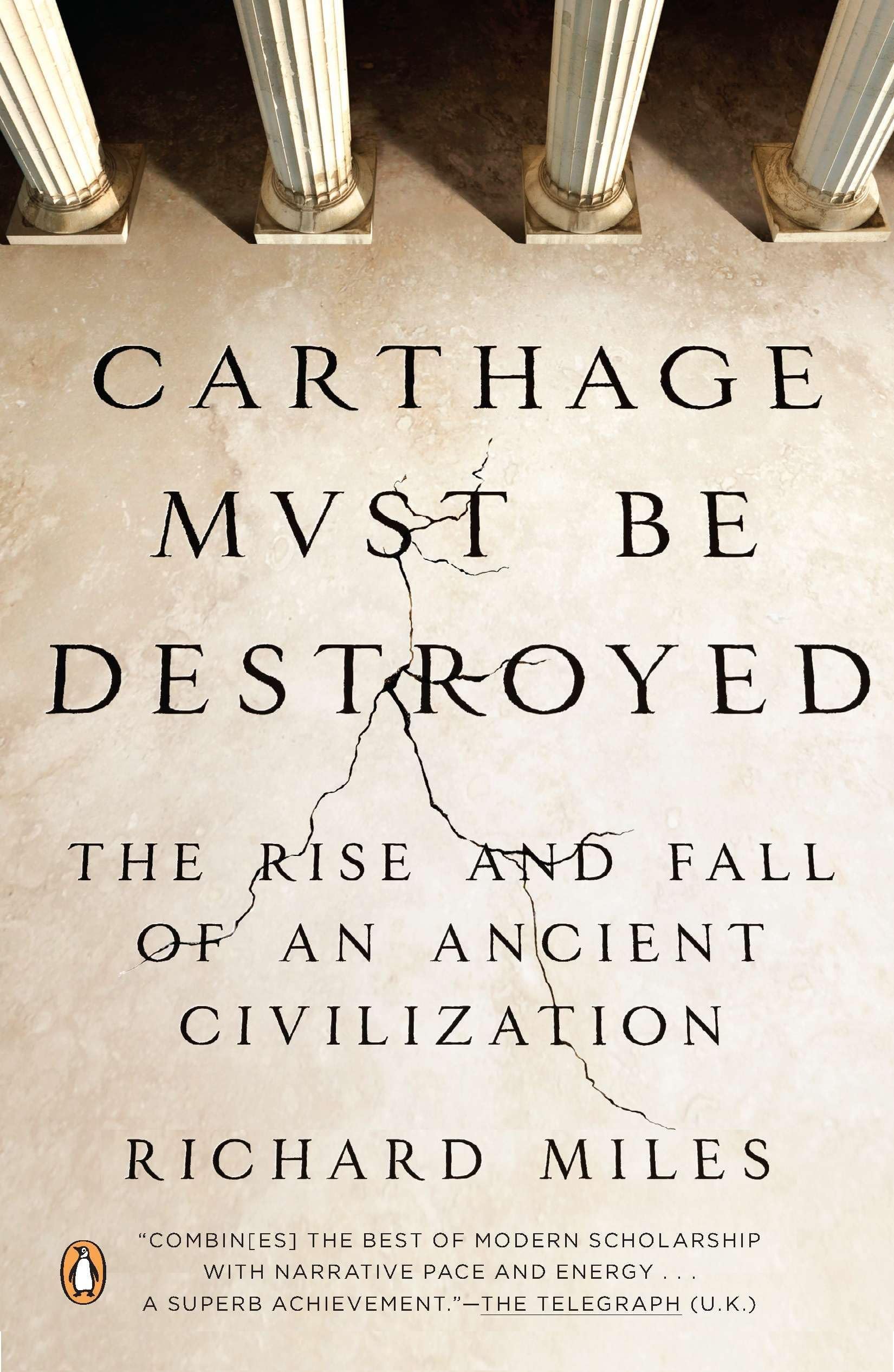
Carthage Must Be Destroyed: The Rise and Fall of an Ancient Civilization
Product ID: 3876714
The first full-scale history of Hannibal's Carthage in decades and "a convincing and enthralling narrative." ( The Economist ) Drawing on a wealth of new research, archaeologist, historian, and master storyteller Richard Miles resurrects the civilization that ancient Rome struggled so mightily to expunge. This monumental work charts the entirety of Carthage's history, from its origins among the Phoenician settlements of Lebanon to its apotheosis as a Mediterranean empire whose epic land-and-sea clash with Rome made a legend of Hannibal and shaped the course of Western history. Carthage Must Be Destroyed reintroduces readers to the ancient glory of a lost people and their generations-long struggle against an implacable enemy. Review: Repeating history? - “Repeating History?” This is truly an amazing book of ancient Mediteranean history. Reading Livy, Polybius, Gibbon, and J.D. Bury, among many others, seemed exciting but confusing. These earlier historians employed long lost city and cultural references making it difficult to get a solid focus on sequence of events. Not so Richard Miles. He makes all the social, political, cultural and mercenary issues in the two Punic Wars absolutely clear. Where clarity may have been less in the body of the narrative it is satisfactorily explained in almost a hundred pages of notes at end of the book. It was simply a pure pleasure reading “Carthage” as though a piece of entertaining fiction. It is, of course, an amply lucid recounting of history between ancient cities of Rome and Carthage. Any of my doubts or misunderstandings from reading earlier historians of this period are generally here put to rest. It is the smoothest retelling of history I have ever read, and as thorough. The full story covers history from about 1000 BC to a couple decades before the present historical era. Prelude to the main events between Rome and Carthage is told of commercial and cultural activity in the Mediterranean from 969 BC up to a first treaty between Rome and Carthage in 509 BC. This portion of the book would be well worth time spent reading if going no further. The meat of the tale begins with this background of commercial and cultural change from Greece on the east, to a lesser extent, and the pillars of Hercules on the west. The arena is Mediterranean North Africa and what became Southern European states. This geographical portion of Mediterranean history clearly establishes relationships of early European countries on the north coast to those on the North African continent. Substance of the Carthage-Rome relationships begins at about Chapter 5. From this point on the full history of Roman and Carthaginian commerce, war, cultural changes, religions, ‘families’ and component ‘peoples’ (such as the Numidians) is retold in modern terms based on the history of languages and personalities of the times. As well this history is also based on results from more recent archaeological ‘digs’. In my experience this portion of the book makes an excellent clarification for portions of Gibbon’s “Decline and Fall of Rome” while repeating bits of the prehistory. In this part of the book I came fully to understand Hannibal, along with his Barcid family. In particular his exploits leading Carthaginians from Spain (crossing the Pyrennes Mountains) across what became France and thence over early winter Alps! A landmark movement of resources and service to daily human needs let alone elements affected by multi-cultural confrontations. That anyone in this era could cross all this geography, generally on foot, and arrive in condition suitable to wage war must be regarded as even more amazing than worldwide movement of troops and weapons at present for similar purposes. After reading the book I went through complete notes at the end. Before doing so I had come to a conclusion this explication of history offered a terrible moral parallel to our present, since the world wars, but more significantly for our ‘limited’ wars in Viet Nam and Iraq particularly. In so many ways all of this ancient history between ‘powers’ of that era has been repeated, with little significant variation, by the United States and more than one other major ‘enemy’. Our present enemies are no more ‘real’ threats than those of the Mediterranean past. In both cases motives were less those of threats to our nation than to personal interests. Families of Carthage and Rome have simply been replaced by international corporations and financial interests as well as the ‘families’ behind them. Surely this book should be considered as curricula for courses at the USA national war college, Westpoint and Colorado Springs, among other such military ‘educational’ institutions. That ‘families’ of this Rome-Carthage era profited from war and made that a conclusive consideration in their decision making is exactly the same in USA experience with such as Haliburton. Consequences of atrocities in war then are no more horrendous than at present. The destruction of nature, infrastructure and social cohesion in Iraq and Viet Nam are exactly the same (thought time compressed) as in the decades long conflict between Carthage and Rome. The only difference seems to be power of weapons used and distance between areas of combat. Perhaps the cruelty then was more personal since thousands of combatants confronted each other face to face, across a battle ground fighting hand to hand. Thus different but no less disastrous for humans. Footnotes to the book hint at examination of this parallel between past and present even though the author did not. A Toronto Star reporter concluded ‘An iron fisted foreign policy: Bush’s hard line on Iraq serves notice that no Carthage will be allowed to challenge today’s Rome.” The more things change, it seems, the more they stay the same! Review: The History of Carthage - When looking at world history, Carthage is perhaps best known as the enemy of Rome during the 200s and 100s BCE. In Carthage Must Be Destroyed, the entire history of the Carthage, not just how it relates to Rome, is looked at. Carthage started out as a trading colony of the Phoenicians. As time moved on, Carthage became more independent and expanded its territory. This would come into conflict with the also expanding Rome. Through three large scale wars, the Punic Wars as they are called, Rome beat Carthage each time. In the First Punic War, Rome took possession of Sicily. In the aftermath, Carthage found itself with serious internal problems. A war was fought against mercenaries Carthage had hired to fight in war against Rome. During this period, Rome annexed Sardinia and Corsica, formerly Carthaginian possessions. The Second Punic War would be the most famous for the actions of Hannibal such as his trek through the Alps. The war would be another loss for Carthage seeing all of its Spanish territories lost to Rome. In the end, Carthage was left with only North African territory. Despite a growing economy, Rome would wipe Carthage off the map in the Third Punic War. Aside from the relations with Rome, the religious history and mythology of Carthage is also extensively looked at such as how parallels existed between them and the Greeks. My only problem with the book is that this is one of the drier histories I have read. Despite the massive conflict and war, the prose of the book is not all that exciting, just very factual. Sometimes, the author tends to meander from one subject to another when he would have been better off just separating these into different sections. All in all, this was a generally enjoyable and informative look at the history of Carthage. I would recommend this to those interested in world history, ancient history, or Roman history.

| Best Sellers Rank | #102,707 in Books ( See Top 100 in Books ) #7 in North Africa History #31 in Archaeology (Books) #102 in Ancient Roman History (Books) |
| Customer Reviews | 4.4 out of 5 stars 647 Reviews |
P**A
Repeating history?
“Repeating History?” This is truly an amazing book of ancient Mediteranean history. Reading Livy, Polybius, Gibbon, and J.D. Bury, among many others, seemed exciting but confusing. These earlier historians employed long lost city and cultural references making it difficult to get a solid focus on sequence of events. Not so Richard Miles. He makes all the social, political, cultural and mercenary issues in the two Punic Wars absolutely clear. Where clarity may have been less in the body of the narrative it is satisfactorily explained in almost a hundred pages of notes at end of the book. It was simply a pure pleasure reading “Carthage” as though a piece of entertaining fiction. It is, of course, an amply lucid recounting of history between ancient cities of Rome and Carthage. Any of my doubts or misunderstandings from reading earlier historians of this period are generally here put to rest. It is the smoothest retelling of history I have ever read, and as thorough. The full story covers history from about 1000 BC to a couple decades before the present historical era. Prelude to the main events between Rome and Carthage is told of commercial and cultural activity in the Mediterranean from 969 BC up to a first treaty between Rome and Carthage in 509 BC. This portion of the book would be well worth time spent reading if going no further. The meat of the tale begins with this background of commercial and cultural change from Greece on the east, to a lesser extent, and the pillars of Hercules on the west. The arena is Mediterranean North Africa and what became Southern European states. This geographical portion of Mediterranean history clearly establishes relationships of early European countries on the north coast to those on the North African continent. Substance of the Carthage-Rome relationships begins at about Chapter 5. From this point on the full history of Roman and Carthaginian commerce, war, cultural changes, religions, ‘families’ and component ‘peoples’ (such as the Numidians) is retold in modern terms based on the history of languages and personalities of the times. As well this history is also based on results from more recent archaeological ‘digs’. In my experience this portion of the book makes an excellent clarification for portions of Gibbon’s “Decline and Fall of Rome” while repeating bits of the prehistory. In this part of the book I came fully to understand Hannibal, along with his Barcid family. In particular his exploits leading Carthaginians from Spain (crossing the Pyrennes Mountains) across what became France and thence over early winter Alps! A landmark movement of resources and service to daily human needs let alone elements affected by multi-cultural confrontations. That anyone in this era could cross all this geography, generally on foot, and arrive in condition suitable to wage war must be regarded as even more amazing than worldwide movement of troops and weapons at present for similar purposes. After reading the book I went through complete notes at the end. Before doing so I had come to a conclusion this explication of history offered a terrible moral parallel to our present, since the world wars, but more significantly for our ‘limited’ wars in Viet Nam and Iraq particularly. In so many ways all of this ancient history between ‘powers’ of that era has been repeated, with little significant variation, by the United States and more than one other major ‘enemy’. Our present enemies are no more ‘real’ threats than those of the Mediterranean past. In both cases motives were less those of threats to our nation than to personal interests. Families of Carthage and Rome have simply been replaced by international corporations and financial interests as well as the ‘families’ behind them. Surely this book should be considered as curricula for courses at the USA national war college, Westpoint and Colorado Springs, among other such military ‘educational’ institutions. That ‘families’ of this Rome-Carthage era profited from war and made that a conclusive consideration in their decision making is exactly the same in USA experience with such as Haliburton. Consequences of atrocities in war then are no more horrendous than at present. The destruction of nature, infrastructure and social cohesion in Iraq and Viet Nam are exactly the same (thought time compressed) as in the decades long conflict between Carthage and Rome. The only difference seems to be power of weapons used and distance between areas of combat. Perhaps the cruelty then was more personal since thousands of combatants confronted each other face to face, across a battle ground fighting hand to hand. Thus different but no less disastrous for humans. Footnotes to the book hint at examination of this parallel between past and present even though the author did not. A Toronto Star reporter concluded ‘An iron fisted foreign policy: Bush’s hard line on Iraq serves notice that no Carthage will be allowed to challenge today’s Rome.” The more things change, it seems, the more they stay the same!
F**K
The History of Carthage
When looking at world history, Carthage is perhaps best known as the enemy of Rome during the 200s and 100s BCE. In Carthage Must Be Destroyed, the entire history of the Carthage, not just how it relates to Rome, is looked at. Carthage started out as a trading colony of the Phoenicians. As time moved on, Carthage became more independent and expanded its territory. This would come into conflict with the also expanding Rome. Through three large scale wars, the Punic Wars as they are called, Rome beat Carthage each time. In the First Punic War, Rome took possession of Sicily. In the aftermath, Carthage found itself with serious internal problems. A war was fought against mercenaries Carthage had hired to fight in war against Rome. During this period, Rome annexed Sardinia and Corsica, formerly Carthaginian possessions. The Second Punic War would be the most famous for the actions of Hannibal such as his trek through the Alps. The war would be another loss for Carthage seeing all of its Spanish territories lost to Rome. In the end, Carthage was left with only North African territory. Despite a growing economy, Rome would wipe Carthage off the map in the Third Punic War. Aside from the relations with Rome, the religious history and mythology of Carthage is also extensively looked at such as how parallels existed between them and the Greeks. My only problem with the book is that this is one of the drier histories I have read. Despite the massive conflict and war, the prose of the book is not all that exciting, just very factual. Sometimes, the author tends to meander from one subject to another when he would have been better off just separating these into different sections. All in all, this was a generally enjoyable and informative look at the history of Carthage. I would recommend this to those interested in world history, ancient history, or Roman history.
H**D
A Most Helpful, A Most Needful Book
The author has done us a valuable service in uniting the disciplines of Archaeology and Classical Studies to either validate ancient assertions, such as the Carthaginian practice of "tophet," or human/child sacrifice; or, invalidate long held biases perpetuated by Greek and Latin authors which argue for a polarized mediterranean world in which the Carthaginians represent the dark forces of barbarity and all that is alien to Western Civilization, while the Greeks and Romans represent the vanguard of all that is civil and good, with little cultural cross pollination occurring between them. Miles does a good job, mostly with the assistance of archeology to show that contrary to the above, the ancient mediterranean was a potpourri of the syncretism of Carthaginian, Etruscan, Roman, Greek, and Egyptian influences...in art, architecture and religion. The clash between Carthage and Rome was the outcome of the inevitable clash of regional hegemonies whose interests clashed as each sought to extend its influence further, and consequently into the orbit of the "other's" influence. Overall, Miles provides us with a highly readable volume of scholarly value, and which belongs to the growing genre of the interdisciplinary partnership of history, literary criticism and archeology. One of the standout themes is the syncretism and competition with regard to the legacy of Heracles, not only between rival peoples, such as the Romans and Carthaginians, but even between rival generals of the same party, such as was the case with the dictators Fabius Maximus and Minucius Felix. How the highlights of this god's journey from Spain, through Italy onward to Greece with Geryon's herd are exploited by Greeks, Romans and Carthaginians to stake their territorial claims in Spain, Sicily, Sardinia and North Africa is a recurring theme, and does much to forward and validate the author's worldview/thesis of syncretism. So interesting is this Hereclean theme alone, that it merits an entire work on its own right (perhaps Richard Miles will take on this "Hereclean" task?). Lastly, after the extensive background that Miles provides to the conflict itself, once the book reaches the Second Punic War, the reader is treated to what reads like a great story/narrative, while never loosing its scholarly tenor. The chapter, "Desolation of Carthage," in which the fateful meeting between the Roman consul and Carthaginian emissaries takes place several miles away from Carthage, during which the emissaries are told that they must agree to the destruction/oblivion of their city and their way of life as seafaring merchants, and to their relocation inland as simple agrarians left me empathizing with those Carthaginians, and at the same time, loathing Rome, whose calculus behind the destruction of the city was the manifestation of nothing more than greed and lust for empire (as the Carthaginians comprised no real threat then). It also reinforced my own skeptical approach to any postmodern view towards the subject of today's arena of international affairs, which would have us think that we have entered an age of unlimited cooperation and potential goodwill among the nations and defining elements of the power structure of the world. The same brutal end that the Carthaginians met awaits any of us who dismiss what lust for power and empire is still capable of doing.
B**E
Quality of a used book.
Excellent quality for a used book. Great price and delivery. Thank you
T**G
Less Than Meets the Eye
Carthage Must Be Destroyed is a pretty fair example of a new style in the writing of ancient history, one that combines a great deal of secondary bibliography with an ideological or polemical fixation usually aimed at debunking traditional interpretations but tends to lack a firm grasp of ancient literature. If Carthage has been portrayed as an enemy of Western civilization, then it must now be reinvented as the equal or superior. If Carthaginian foreign policy has been generally regarded as imperialistic, the tables must now be turned to make Carthage the victim of Greek aggression. It's not a bad gig, really, and it opens the door to hundreds of dissertations and books. On the whole, Richard Miles is less tendentious than many younger ancient historians and more willing to consider the fine points. His emphasis on the syncretism of Greek and Phoenician culture in Sicily and Sardinia is useful and usually keeps him from demonizing the Greeks. Nonetheless, his treatment of Greek sources is sloppy, and it is not at all clear that he knows Greek--the necessary language, since the best sources on Carthage are written in Greek--or sufficiently understands Greek literature and history. For example, he pops out Herodotus' tale that Gelon of Syracuse was waiting to see which side won (during the invasion of 480) before declaring his allegiance without considering Herodotus' willingness to repeat any story he has heard or Herodotus' generally favorable view of Gelon, whom he does not accuse of Medizing. Besides, even if the story is literally true, it means no more than that Gelon, in the midst of defending Sicily from invasion, could not really spare his forces to fight against the Persians, and, if the Persians won, it would be foolish to declare his enmity. In the same chapter, Miles has a howler--making Theron the brother of Gelon--which, if it is not a typo--would indicate serious deficiencies in his knowledge of Sicilian history. Miles complains, naturally, of the bias of Greek historians against Carthage and sees it (following the speculative and tendentious work of Edith Hall) as an invention of the fifth century, a piece of propaganda orchestrated by Sicilian Greeks who wanted to claim some of the panhellenic glory won by Athens and Sparta against the barbarians. But the stories and artistic representations of the Hellenic struggle with mythical barbarians antedates the Persian Wars. The Greeks were simultaneously aware of how much they owed to eastern cultures and yet determined to assert their own unique identity. This is no late invention. Miles might also consider the plain fact that the Carthaginians did not produce much of a literature. It is not only that they were eventually defeated by the Romans, since Greeks and Romans did translate and read Carthaginian books, when they were of interest. The truth is that the Carthaginians were a lot like Americans, more interested in getting and spending than in creating anything particularly beautiful or original. This left them, naturally, vulnerable to Greek culture. Although it is loosely written and ineffectively arranged--his distracting excursus, e.g. on Melqart, should have been turned into appendices--Carthage Must be Destroyed is a valuable contribution and should be read by anyone interested in Carthage and its conflicts with Greece and Rome. If it displays the typical postmodern hatred of the West and enthusiasm for the "other," those faults can be corrected either by rereading Herodotus, Diodorus, and Livy or by looking at the earlier works on ancient history by, for example, Edward Freeman, Bury, Hammond, and even Grote.
E**E
First-rate scholarship slightly marred by a theological fixation
First and foremost -- this is an excellent study of Carthage, its antecedents and main characters. The writing is crisp, informative and well-worth reading particularly the passages on Hannibal. I believe teh architectural/art aspects were well-displayed, and in some conflict with other reviewers, thought the Heracles-Melquart narratives helpful. I was also interested in the tophet information and how it was related to other contemporary cultures. The author does put an interesting light on not only who the Carthaginians were, but also how they were perceived by their foes. This aspect is not revisionist, just a different perspective I found fascinating. So why say 'marred'? This is mostly a quibble, but as others have observed, the obsession with the Heracles myth and also with a few select historians went from informative to the academic equivalent of a rat hole. Being interested in how the myth fed the reality is one thing; to relentlessly beat it to death in service to the thesis was ultimately a detractor. I found myself skimming these sections after a while; I 'get it' that the myths played much more of a role than later historians depict but to use the fact as a blunt instrument ends up being something of a disservice to the reader. That said, this book is a good one which I recommend.
D**)
Excellent introduction to the full sweep of the history of Carthage
Carthage has long been considered an also-ran of the ancient world simply because it was eradicated by Rome and Roman historians were the predominant tellers of the tale. For modern people knowledge of Carthage is often limited to having heard of Hannibal Barca, or maybe the Battle of Cannae, or possibly having seen Turner's painting of Hannibal crossing the Alps. If you have read Dryden's translation of Plutarch, you may have been riveted, as I was, by the biography of Fabius Maximus and his experiences with the Carthaginians. Richard Miles has provided an excellent overview of Carthage that serves as an essential introduction to the subject. Beginning with the sacking of Carthage by Scipio Aemilianus, Miles then goes back to Carthage's roots in Phoenicia and then through the centuries in spare, but by no means dry, language, including its involvement in Sicily and Sardinia and the Punic Wars with Rome. Incidentally, he provides an excellent précis of Phoenician history as well. Interwoven through this is the story of the importance of Heracles to Carthage and to Rome and his usage by both in waging war by propaganda. If Miles betrays a certain bias towards Carthage, it seems to me that it is only a corrective to Roman and Greek historians who exemplify the dictum that history is written by the victors (after all, Richard III received a lot of bad press from hostile Tudor apologists before and after the Battle of Bosworth). So it was for Carthage after its razing after the third Punic War. Some things to consider: Hannibal Barca, (he of the Battle of Cannae) only makes his appearance more than two thirds into the book, and descriptions of battles are terse. There is not a lot of humor in this book as the last few chapters are necessarily grim and depressing (one notable exception is the earlier tale of Publius Claudius Pulcher and his set to with some sacred chickens). Readers should not be confused by the myriad Hannibals, Hamilcars, Hannos, and Hasdrubals among the Carthaginians. Miles places each one firmly in his own time. Readers may be surprised by the profound effect Carthage had on the collective Roman psyche years after the Punic Wars ended. In sum, this book is well-written and generally fascinating (I DID get a little tired of the whole Heracles aspect of the story). This book is highly recommended.
E**M
History that can be read and understood is a good thing!
Carthage Must Be Destroyed is a nearly perfect book for the history buff. I am no scholar and although I have a fairly recent master’s degree in history I haven’t taken a course in ancient history since my undergraduate days 45 years ago. I rarely read about ancient history but I was curious to learn about Carthage after reading a review of this book. Although I normally read ten to fifteen history books a year, since becoming bogged down in The Sleepwalkers: How Europe Went to War in 1914 last year I’ve been concentrating on historical novels. Carthage has renewed my confidence that serious historical scholarship can be fun to read. Richard Miles has done a masterful job in writing an eminently readable account in which his sources are summarized, analyzed and sometimes criticized in a most helpful way. This is a scholarly work – the voluminous notes testify to that. His account of Carthage, which naturally is highly dependent on Roman sources, also refreshed my recollection of the rise of Rome. My only criticism is that I did not understand the economic underpinnings of Carthage prior to the end of the second Punic War. Miles describes the economy of Carthage in its final years rather well at the close of the book, but it only underlined the need to explain it more fully at earlier stages. Miles is careful to not use analogies, but I gather, for lack of clear alternatives, that Carthage’s economy was similar to medieval Venice’s. But Venice had things to export as well as being master traders, so perhaps Carthage did as well? Nevertheless, the other elements of Carthage’s growth and destruction are well explained, including the religious and military aspects of its history. It’s a great book.
A**.
Perfect Balance between Academic and Readability
This was a brilliant book on a topic that did not spring immediately to my mind when I was looking for a good history read. I have an MA in modern history, so I have a reasonably strong grounding in the classical period, but certainly not comprehensive knowledge. This work was incredibly informative, yet did not require plunging in to Wikipedia to gain background. Despite rather obnoxiously dropping my own academic background, I do so only to assure any prospective reader that the research is incredibly rigourous. However, this is combined with an infinitely readable and compelling narrative. All too often obscure historical topics results in a thematic-based book that is torture to read, even for someone very used to academically-dense works. Whether you are an advanced reader of history, or are looking for a fascinating true-story, I think this book is a real triumph.
I**H
Excellent Read - but dismal publishing
Fascinating book, both well researched and well written. Sadly the author has been let down by his publisher in that the selection of monochrome illustrations in the centre of the book are so very cheap and nasty that it is impossible to "read" some of them at all. Even a photocopier would have given clearer reproductions. Even the layout is sub-standard - with the top of each page only just within the edge of the book. This book certainly deserves better!
J**Z
Interessant und informativ, leicht zu lesen
Habe das Buch in 10 Tagen im Strandurlaub gelesen. Hochinteressant, da die Schulbildung ja immer nur von Rom lebt. Der zweite Punische Krieg und Hannibals 15 Jahre in Italien wird sehr kurz abgehandelt, darüber ist ja alles hinreichend bekannt. Dafür wird auf die Zeit der Anfänge Karthagos von der Gründung bis 200vC ausführlich eingegangen. Miles schreibt so, daß selbst trockene Materie lesbar bleibt. Nur schade, dass es noch keine deutsche Ausgabe gibt, wobei die englische für mich kein Problem darstellte.
H**K
Un excellent aperçu de l'histoire de Carthage
Lecture très intéressante. On en apprends beaucoup sur la légendaire cité-état phénicienne, de ses débuts à sa rivalité avec Syracuse jusqu'à sa chute finale aux mains de Rome. Vous verrez défiler sur les pages des noms tels Scipion l'africain, Caton l'ancien ou encore Hannibal Barca.
J**S
Explaining why it had to go, and much more besides...
This book is certaily a masterpiece of scholarship but it also shows how history can be told in a fascinating way without being academic. As such, it is a rare gem that can satisfy both the "history buff" and the more general reader. The book has numerous other qualities. A number of other reviewers have touched upon some of them already, so I'll try to keep it short. By telling so well the story of the "rise and fall of an ancient civilization", Richard Miles demonstrates and shows all through the book why Cato the Elder was so insistent and persistent in wanting it destroyed. This was far more than just an old ultra-conservative Romam senator that had become somewhat obsessive. Simply put, Carthage was Rome's most dangerous opponent around the Mediterranean. It was the only one to hold out so long against against Rome and to threaten it so much. This in itself explains why Rome was so unrelenting, elt obliged to raze Carthage to the ground and tried to blacken its name. It also explains, for instance, why Hannibal had to be hunted down across the eastern Mediterranean. Rome had almost lost and was facing a rival that was almost as resilient as itself. Rome, although no Roman would ever admit it, was afraid, too afraid to let live a city that it had deprived of its commercial empire in Sicily, Corsica and Sardinia, of its colonial empire in Spain and of its predominance and home territory in Africa. However, this book is not only about the contest between the two great powers of the Western Mediterranean. It is far more than that because it tries - and essentially succeeds, despite the odds,in telling the history of one of the most elusive civilizations of Antiquity. This is the second "tour de force" of Richard Miles because it is achieved largely in spite of the rather problematic written sources which are essentially Roman or Greek and which are, in their vast majority, hostile to the Carthaginians. The original texts of pro-Carthagenian Greek writters have generally not survived, with the exception of a few fragments and quotations. We know however that a number of historians wrote on Carthage. We also know that Hannibal had and used his own Greek historians as part of his all-out war against Rome (a war which, just like Alexander the Great, included the use of propaganda). This is where Miles use of what are sometimes called the auxiliaries of history (geography, archeology, numismatics etc...) become so precious. As Ben Kane mentioned in his review of this book, Georges Lancel's 1995 book on Carthage used to be the reference. Having also read this book (although it is much less accessible), I definitely agree with him: Carthage must be destroyed has become the NEW reference on Carthage. The third great merit that I found with this book is that it goes beyond the power plays between the Greeks, the Carthaginians and Rome. It is not just a history of Carthage either. Two elements stand out in particular. One is the thorough discussion on Carthaginian (I don't like using the term "punic" because this is who their ennemies seem to have called them) religion, its influences and its evolutions. Another is the last chapter entitled "punic faith", which is largely about how the Roman conquerors wrote the "official" history and distorted the facts to such an extent that the term "punic faith" in Latin became synomyous of treasonous behavior. This rewritting of history might have started just after the destruction of Carthage. It certainly culminated under Augustus with Titus-Livius in one of the main roles. A careful study of the events tends to show that: - in the first and third Punic wars, the Romans were clearly the ones spoiling for a fight whereas both the Barcids (and, less obviously, at least part of Carthage's leading citizens) and the Romans wanted the Second War - when comparing behaviors in each camp, the Romans were at least (and even perhaps more) ready to break their word and take advantage of circumstances. This happened for instance with their occupation of Sardinia after the end of the First War while Carthage, with which they had signed a peace treaty, was busy fighting for its survival and unable to do anything about it. I could go one, and on, and on, but I hope by now to have made the point: this is a fabulous book and if there is one book to read about Carthage and one book to offer to someone who likes history, it is this one.
Trustpilot
3 days ago
1 month ago