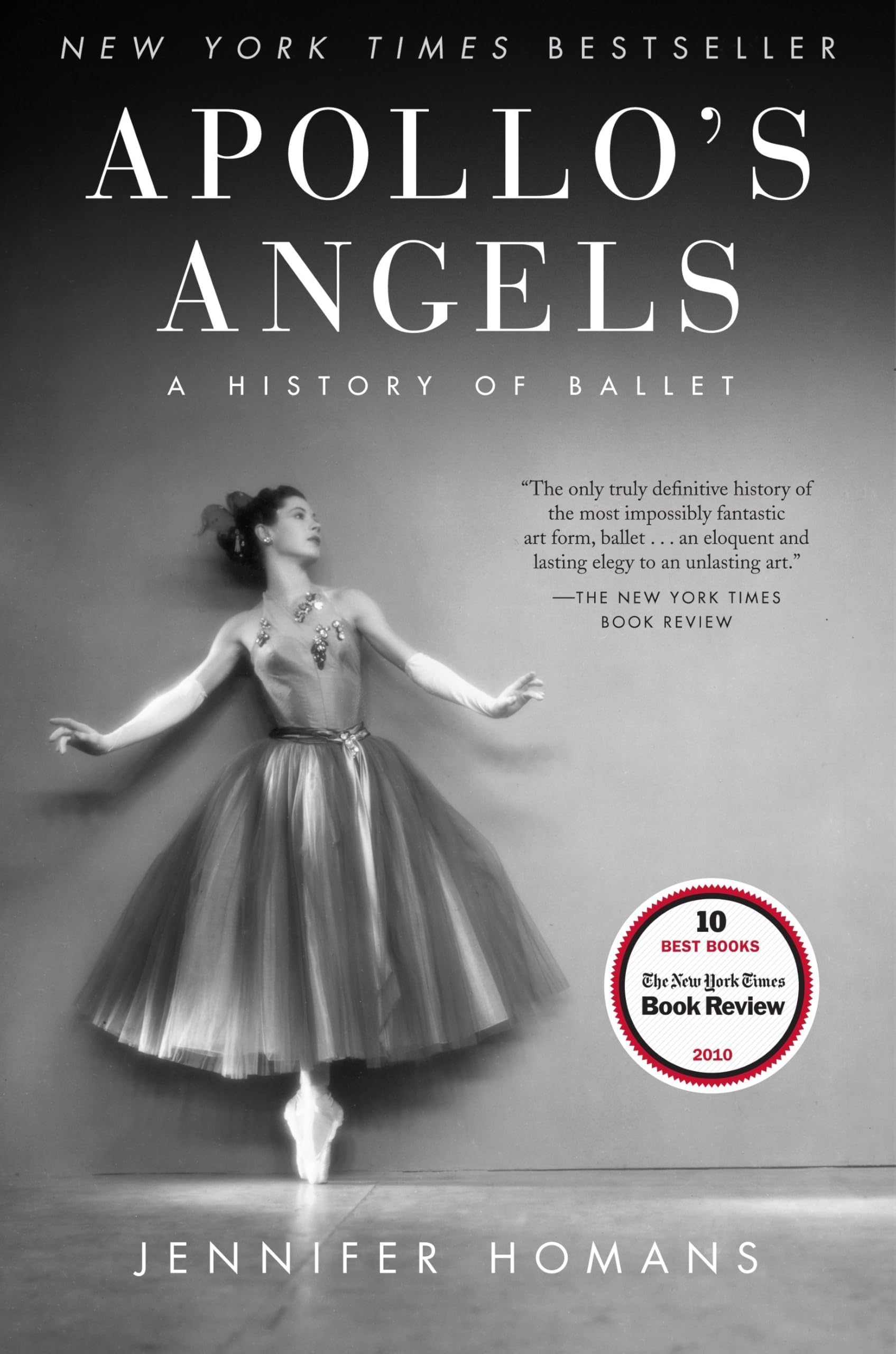
Apollo's Angels: A History of Ballet
Product ID: 362466
🎭Cultural Impact
📚Comprehensive History
🩰Ballet Evolution
Buy anything from 5,000+ international stores. One checkout price. No surprise fees. Join 2M+ shoppers on Desertcart.
Desertcart purchases this item on your behalf and handles shipping, customs, and support to Vietnam.
🩰 Dance Through Time with Apollo's Angels!
Apollo's Angels: A History of Ballet by Random House Trade offers an in-depth exploration of ballet's evolution, highlighting its cultural significance and the stories of the artists who have shaped this timeless art form.


| Best Sellers Rank | #84,689 in Books ( See Top 100 in Books ) #6 in Classical Dancing #389 in Historical Study (Books) |
| Customer Reviews | 4.6 4.6 out of 5 stars (345) |
| Dimensions | 6.15 x 1.53 x 9.18 inches |
| ISBN-10 | 0812968743 |
| ISBN-13 | 978-0812968743 |
| Item Weight | 1.7 pounds |
| Language | English |
| Print length | 720 pages |
| Publication date | November 29, 2011 |
| Publisher | Random House Trade Paperbacks |
L**N
Fantastic cultural history of classical ballet!!!
Apollo’s Angels by Jennifer Homans is a major one-volume cultural history of classical ballet. Homans takes the reader from ballet’s origin in the French Renaissance through to our own time, covering in detail the development of the art form and its evolution as it passed through 16th century France and Italy, to Denmark, Britain, Russia, and eventually to contemporary America. The book focuses specifically on how ballet came to embody ideas, or a people, or a time. Homans shows how and why ‘the steps’ were never just the steps but rather were a set of beliefs and a way of life. She explains the ideas, idealism, and politics behind the development of ballet, and she explains very well how the art form was shaped by the Renaissance and French Classicism, by revolutions and Romanticism, by Expressionism and Bolshevism, and by Modernism and the Cold War. The chapter on France and the classical origins of ballet are the most interesting. Homans explains that ballet’s roots can be traced to Charles IX’s time, when he established the Academie de Poesie et de Musique all the way back in 1570. The purpose of the Academie was to bring spirituality to theatre and art. Homans writes, “…these poets believed that hidden beneath the shattered and chaotic surface of political life lay a divine harmony and order – a web of rational and mathematical relations that demonstrated the natural laws of the universe and the mystical power of God.” This is where we see the theoretical foundations of ballet, which just needed to be codified into a technique, which would then ‘elevate man…and bring him closer to the angels and God’ (Homans 2010). Very entertaining in particular is the author’s description of court etiquette and the vanity of kings. Also interesting is her explanation of state strategy, the difference between courtiers and trained dancers, and the eventual move from court to theater in the late 17th century. The connection between dance and politics is emphasized throughout the book, and the reader will understand how ballet – although wordless – is an art form that carries both meanings and subtexts. The reader learns, for example, that the ballerina Marie Antoinette established a trend dressed as a shepherdess, whereafter women in white tunics “became powerful symbols of a nation cleansed of corruption and greed.” (Homans 2010). The women in white became what we know today as the corps de ballet, which took its cue from the Revolution. “They represented the claims of the community over those of the individual” (Homans 2010). The chapters on ballet in the New World focus mostly on the influential Russian choreographer George Balanchine, who founded New York City Ballet in the 20th century to rival the European ballet companies. But, despite Balanchine’s innovative creations of neoclassical ballets that paved the way for a tradition of classical ballet in America, Homans sees no future for ballet. She ends her book with an Epilogue called “The Masters Are Dead and Gone” in which she laments what she perceives as a decline of the classical ballet during the past 20 plus years. Her feeling is that we no longer admire ballet, and that without new genius creators the art form will not survive. That is a perplexing view, given the fact that dance always has been a fluctuating art form. Despite the book’s massive volume of 650 pages, it is rarely boring. Homans’ descriptions of important artists and the works they created or danced are vivid and expressive, - possibly due to the fact that Homans herself was a professional ballerina who danced many of the works she writes about. While her writing is packed with meaning it is never dense or convoluted. A fluid writing style makes it easy for any reader to follow and understand the scenarios surrounding the evolution of ballet for hundreds of years. Apollo’s Angels is scholarly and entertaining at the same time, and beautifully told. I recommend it to anyone who is interested in history, dance, and body politics.
M**�
Remarkably Well-Researched & Beautifully Written
A fantastic and very comprehensive and well-researched history of ballet as well as the political, social, and cultural mores of the countries that influenced its development. This has been a most enjoyable and thought-provoking read. I was impressed by the depth and breadth of the author's research!
M**3
A treat for the dancer and choreographer
I have always been unable to connect with dance, let alone ballet. I picked this book after reading James Lipton's MIRRORS. MIRRORS gave me insight into dance, and I wanted to learn more about the history of dance. APOLLO'S ANGELS is an excellent history of ballet, but probably not the first choice for a complete novice about ballet. Ms. Homans is thorough and detailed in her research and the personalities of dance. The writing is well-organized and logical in tracing the ever-moving centers of the ballet world. At times it is a bit dense for someone unfamiliar with terminology and the major companies to read easily. The greatest challenge is keeping all of the players straight. I spent quite a bit of time on the internet looking up the dancers and choreographers trying to keep them straight in my head, especially when dealing with the Russian era. I would certainly recommend this book to anyone familiar with ballet who is interested in delving deeper into its history. I think it would be a good follow-up book for someone like me, after reading a more superficial overview of ballet.
D**E
Essential reading!
This book is absolutely essential for anyone who loves the balletic art form. Comprehensive, educational and entertaining.
A**N
An Exhaustive Overview of the History of Ballet
I haven't finished reading this yet, but my inner ballet nerd absolutely loves it. Homans provides a look at the history of ballet that is at once extremely broad and deep enough to allow the reader to make useful connections between important players in the development of the art as we know and love (or hate) it today. Readers may or may not agree with Homans' assessment of the direction of ballet today, but any reader should be able to appreciate the care and thoroughness with which she crafts a framework upon which we may hang our understanding of the evolution of ballet. Dancers and fans alike will appreciate Homans' explication of the origins of the tensions, traditions, and culture that surround the art itself. Homans has produced a meticulously researched, densely-written, and authoritative work that is well worth the price of admission. Anyone with a serious interest in dance will find Apollo's Angels a compelling read.
C**L
Apollo's Angels is a treat for anyone who loves the ballet. Jennifer Homans, herself a former ballerina, recounts its beginning as a form of court ritual in France where Kings and Queens played the leading role, follows the transformations of this ever-changing and elusive art form as it shifts to include popular elements from the folk-dance and acrobatics, and then veers back to grasp at elements of classical Greek theater. History and anecdote combine to make this book a treasure!
C**N
Uno de los mejores libros para conocer la historia del ballet, es bastante extenso pero es una joya si te interesa el ballet.
V**Y
Wonderful book. Well researched. A must for balletomanes.
C**O
Recomendo a leitura!
C**N
Ich bin langjähriger Liebhaber klassischer Musik und kenne natürlich die klassischen Ballette als Musikstücke; besonders hat mich das Genre als solches aber bislang noch nicht interessiert. Das vorliegende Werke jedoch hat eine "ansteckende" Wirkung. Ich kann es jedem empfehlen, der nur einigermaßen bereit ist, sich auf das Thema einzulassen. Es beginnt bereits mit der Einleitung, in der die Autorin dem Leser verdeutlicht, was ein Ballett als Kunstwerk eigentlich darstellt, nämlich eine über Generationen tradierte Aufführungspraxis eines bestimmten Stücks, die von Einzelpersönlichkeiten und Traditionen geprägt, von Schülern memoriert und zwischen Generationen weitergegeben wird. Wenn die Autorin verdeutlich, wie sorgfältig Bewegungsabläufe, Ausdrucksgesten und Pantomimisches von den Tänzern untereinander beobachtet und verinnerlicht werden, wird auch das Interesse des Lesers hell wach. Historische Aufführungen, von denen keine Videoaufzeichnung existiert, leben so in der Erinnerung wieder. Dies beeindruckt zutiefst. Genauso packend ist auch der Hauptteil des Buches gestaltet: Es beginnt bei der Hochzeit der Maria von Medici, als erstmals - in Anlehnung an die italienischen "balli" - höffische Tanzszenen zum Einsatz kommen und setzt einen ersten Schwerpunkt bei Ludwig XIV. Hier zeigt sich die zweite Stärke des Buches: Es ist bis ins kleinste Detail recherchiert und an keiner Stelle oberflächlich. So werden etwa die Entwicklungsstadien des klassischen Balletts sehr sorgfältig in drei Stadien von der höflichen "belle dance" über die von Molière und Lully entworfene Mischform aus Komödie und Ballett bis hin zu den Opern Lullys mit Balletteinlage nachvollzogen. Es schließen sich Kapitel zum Einzug des Balletts (mit Hilfe französischer Tänzerinnen) in England an, während sich die Darstellung in den späteren Kapiteln zunächst auf die großen Ballette (ab Giselle) und danach auf die großen Tänzer selbst und ihre gestalterischen Fähigkeiten verlegt. Die Darstellung ist deshalb so packend, weil die Autorin in ihrer Darstellung mehrere Punkte vereinigt: Die Ereignisse werden in eine historische Kontinuität gestellt; die Zeitumstände sind so sorgfältig und detailliert recherchiert, dass der menschliche Funke bei einzelnen hier referierten Begebenheiten überspringt, und die Autorin kennt sich selbst als Tänzerin mit den technischen Aspekten so gut aus, dass sie dem Leser die Errungenschaften der diversen Künstler vermitteln kann. Fazit: Hier liegt eine gut geschriebene, spannend erzählte und selten anregende Ballettgeschichte vor, die ich rundum empfehlen kann.
Trustpilot
2 months ago
2 weeks ago