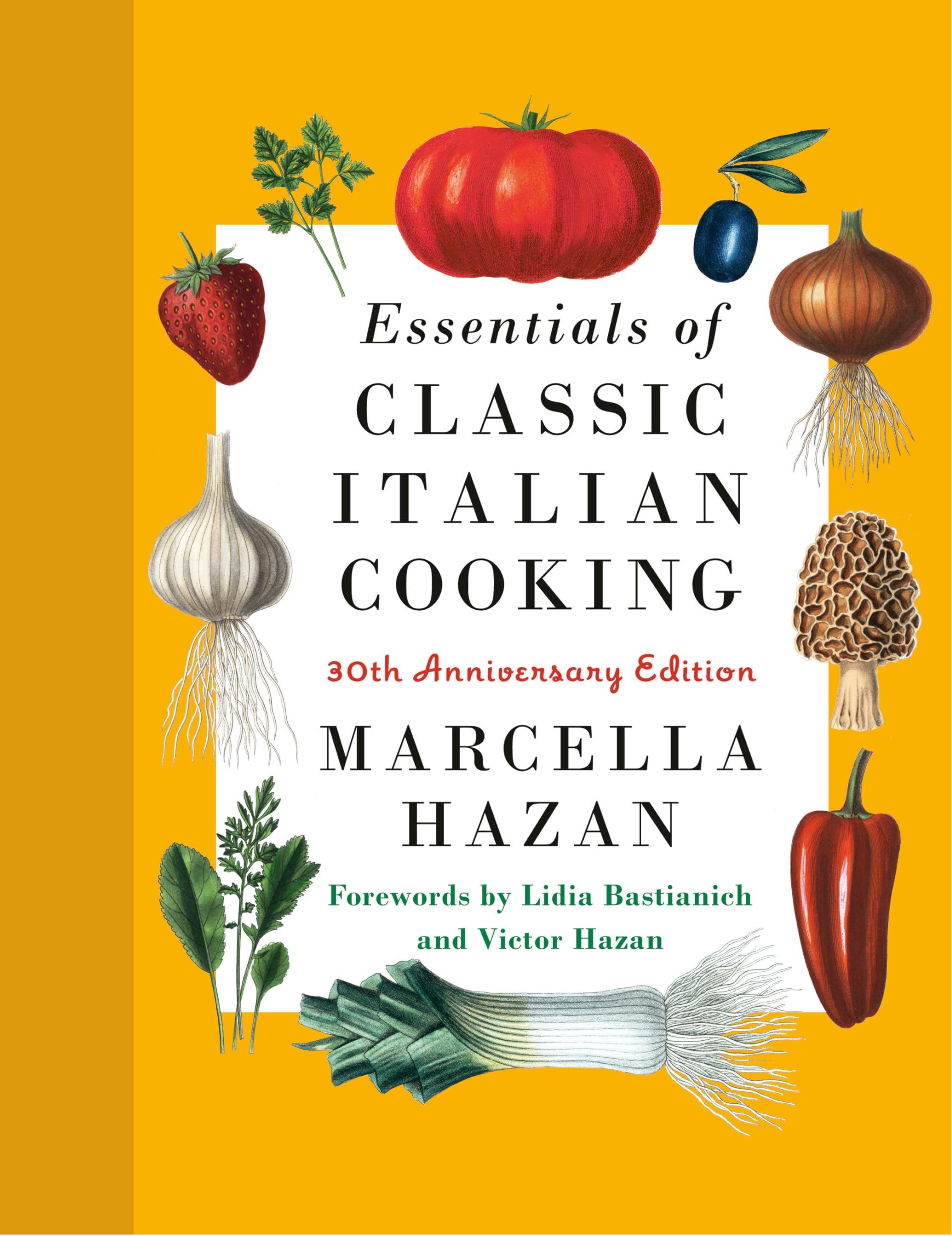
Essentials of Classic Italian Cooking: 30th Anniversary Edition: A Cookbook
Product ID: 354043838
Buy anything from 5,000+ international stores. One checkout price. No surprise fees. Join 2M+ shoppers on Desertcart.
Desertcart purchases this item on your behalf and handles shipping, customs, and support to Vietnam.
One of the most beloved cookbooks of all time, from “the Queen of Italian Cooking” ( Chicago Tribune ). A timeless collection of classic Italian recipes—from Basil Bruschetta to the only tomato sauce you’ll ever need (the secret ingredient: butter)—beautifully illustrated and featuring new forewords by Lidia Bastianich and Victor Hazan “If this were the only cookbook you owned, neither you nor those you cooked for would ever get bored.” —Nigella Lawson Marcella Hazan introduced Americans to a whole new world of Italian food. In this, her magnum opus, she gives us a manual for cooks of every level of expertise—from beginners to accomplished professionals. In these pages, home cooks will discover: • Minestrone alla Romagnola • Tortelli Stuffed with Parsley and Ricotta • Risotto with Clams • Squid and Potatoes, Genoa Style • Chicken Cacciatora • Ossobuco in Bianco • Meatballs and Tomatoes • Artichoke Torta • Crisp-Fried Zucchini blossoms • Sunchoke and Spinach Salad • Chestnuts Boiled in Red Wine, Romagna Style • Polenta Shortcake with Raisins, Dried Figs, and Pine Nuts • Zabaglione • And much more This is the go-to Italian cookbook for students, newlyweds, and master chefs, alike. Beautifully illustrated with line drawings throughout, Essentials of Classic Italian Cooking brings together nearly five hundred of the most delicious recipes from the Italian repertoire in one indispensable volume. As the generations of readers who have turned to it over the years know (and as their spattered and worn copies can attest), there is no more passionate and inspiring guide to the cuisine of Italy. Review: The Bible of Classic Italian Cooking - I have many years of experience in the kitchen cooking all different types of food--French, Greek, Mexican, American, Italian. But every time I make something from this book, I remain convinced that Italian is my absolute favorite food on earth. It is the cuisine I would choose if I had to forego all others, and this is the Italian cookbook in my collection I would choose to keep if I could keep only one. In this Bible of Italian Cooking, Marcella Hazan painstakingly pours out her love and knowledge of authentic Italian food. Hazan reveals the secrets and imparts the wisdom of centuries, not just generations. She is a brilliant woman who does an exceptional job showing you how to cook one of the world's finest cuisines. If you are new to Italian cooking, this is where you should begin. And possibly end. Ingredient lists for the recipes are often short and at first glance may seem unimpressive. You may say to yourself, "what can be so special about that?" But special it is! It is Hazan's expertise, the precise way that she tells you to put the ingredients together, that turns out a fabulous dish that you will want to make again and again. I was happy to learn that good Italian cooking doesn't necessarily require that you make a huge mess of your kitchen and spend hours slaving over a hot stove. Many of the recipes in this book take no longer than half an hour to prepare. And some, while needing several hours on the stove or in the oven to finish, allow you to leave the kitchen while they do. I have made about 50 of the recipes in this book. Sausage with Red Cabbage, Sausages and Cream Sauce, and Lamb Stew with Vinegar and Green Beans are among my favorites. The Chicken Cacciatore New Version is ridiculously good and Marcella is too modest about it. Not a bit of refined sugar is added, all sweetness occurs naturally from carmelized onions. I love to make Hazan's sauces and stews. I used to sauté onions only one way: Quickly over high heat. I now know to cook them very slowly in oil over low heat for a long time until they are sweet and golden and have released every ounce of flavor they have. Had it not been for Marcella, I think I never would have done anything with a clove of garlic but to push it through a press. I now chop, slice, and poach garlic as well as sauté the clove whole to release its subtle perfume. And if you were like me, your idea of a stew may be something made in a crock pot or something that comes out of a can. Forget those ideas. Hazan takes stew to places it's never been before. Get out your saucepan, not your slow cooker, and follow Hazan's instructions. You will soon have the most wonderful fragrances and aromas wafting from your kitchen that you have probably never even smelled before or thought possible. And that is to say nothing of the meal you sit down at the table later to savor. And if you have never rubbed a split clove of raw garlic on toast, drizzled it with a little olive oil and sprinkled it with salt and pepper, you are in for a real treat. But be forewarned: Bruschetta is addictive! I admit to never having made homemade pasta. Regrettably, I have never had either the time or the kitchen equipment necessary to do it. But I suspect Hazan's method is the Holy Grail of pasta-making, and if ever I have the opportunity in my life to take on this challenge, it will be Marcella who teaches me how. On the issue of pasta, however, this book will easily serve as your definitive guide to it. Everything you ever wanted or needed to know about pasta is here. The pasta chapter contains an extensive section devoted to matching all types of pasta, both dry and fresh, to sauces. And for each pasta sauce recipe, Marcella gives you at least two pasta choices, in order of her preference, to go with it. But this book won't just make you an expert on pasta. Soups, risotto, gnocchi, crespelle, polenta, and fritatte all have their own chapters and all receive Marcella's dedicated and thorough treatment. There are also separate chapters for appetizers, soups, vegetables, salads, desserts, and specialized breads and doughs. The final chapter of the book helps you to put menus together. Other reviewers who have said that the recipes are repetitive or uninteresting either don't have a real love of Italian food to begin with or they haven't spent much time looking through the book. I went searching for every favorite dish of mine thinking, oh, I bet I won't find it--I found it! While it is true there is no recipe for spaghetti and meatballs (because that dish isn't authentically Italian) there are recipes for meatballs, spaghetti carbonara, eggplant parmesan, chicken marsala, fettucini all'fredo, pasta e fagiole, minestrone, lasagna, clam sauce, steak florentine and all manner of filled pasta. And, yes, even pizza! I was pleasantly surprised to find that nearly every standard on the Olive Garden menu is here, the only difference being that in this book one can count on the dish to be correct. One of the greatest things about reading Hazan is not just the meal you end up preparing; it is the knowledge and the perspective that you take away with you, even when the meal you are making is not an Italian one and even if you didn't make it. Yes, Marcella can be fussy. But she can also be charitable. She has no problem offering acceptable substitutions for hard-to-find ingredients and she happily gives credit where it is due to that which is found outside of her native Italy. She seems to always anticipate every problem you could run into making a dish, as well as every opportunity to make the most of it. And she is always well worth listening to, even if you end up at times disagreeing with her. Because the chances are she will offer you much more advice that you wish to retain and use than you wish to reject. If all you want is a recipe, you don't need to buy this book. There are endless websites on the internet where you can find free recipes. But if you want to learn to cook well--and especially to cook Italian food the way it was meant to be cooked--then you can do no better than Marcella Hazan's Essentials of Classic Italian Cooking. Review: Essential First Book on Italian Cooking. Highly Recommended - `Essentials of Classic Italian Cooking' is Marcella Hazan's fourth book, composed of an edited and updated amalgam of her first two books, both of which were on `classic Italian cooking'. As with all of Ms. Hazan's books except for her latest, `Marcella Says', my main regret is that I have not read them sooner. All, especially this volume, are every bit as good as the blurbs may lead you to believe. Some reviewers have compared this book to `The Joy of Cooking'. It is much more accurate to compare it to Julia Child's seminal `Mastering the Art of French Cooking' on several counts. First, like Child's book, Hazan's book is devoted exclusively to the techniques, ingredients, and recipes of a single major national cuisine. Second, unlike `The Joy of Cooking', it does not cover absolutely every kitchen technique and issue such as hygiene, nutrition, preserving, and obscure game meats. Third, the book is published and edited by the same people, Knopf and senior editor Judith Jones. This common publishing team means the two books have a very similar look. Both are illustrated by line drawings and both benefit from Knopf's traditional skill in designing the typeface and layout of books in general for easy reading. Fourth, Ms. Hazan arrived at cooking in almost exactly the same manner as Julia Child, in that they found themselves married to men who likes to eat well, and they did not know how to cook at the time. The 64-dollar question of course is whether this book is equal in quality to Child's book. I think there is little shame in saying that while Hazan's book stands head and shoulders over virtually every other book I have read and reviewed on Italian cuisine, it does not quite match Child et al on the latters' innovations in recipe writing, the great good humor of the writing, and the comprehensive treatment of virtually every aspect of French kitchen equipment and the `cuisine bourgeois' techniques. This book by Dr. Hazan (she has a Ph.D. in natural sciences and biology) is the exception which proves Tony Bourdain's observation in his excellent new cookbook which claims that cooking professionals are mostly just ordinary blokes who happen to have learned a skill which you the reader do not yet have. This applies as much to most cookbook authors as it does to most chefs. The thing that separates most good cookbook authors (witness Jamie Oliver) from their readers is their passion for the importance of good ingredients, careful observation of technique, and love of achieving a desirable result. Ms. Hazan is one of the very, very few writers who approach their subject as much with the rigor of an academic as with the passion of a good cook. Ms. Hazan's academic voice is much more anthropological and phenomenological than it is scientific a la Shirley Corriher. Ms. Hazan succeeds in distilling for us the essence of Italian savory cuisine based on the notions of battuto (an Italian trinity of lard, parsley, and onion, chopped fine), soffritto (battuto sautéed until onion is translucent and garlic is pale gold), and insaporire (the technique of preparing ingredient such as the battuto and additions to extract flavor from the primary ingredients and impart that flavor to other ingredients, as when the flavors of the soffritto are imparted to the rice in making a risotto). After introducing these essential concepts, she gives us a very detailed tour of the most important ingredients in Italian cooking. To the casual American reader who may not have been schooled by `Molto Mario', there are some surprises, such as the fact that garlic is not as important an ingredient as you may believe. Another culture shock is the difference between the French stock and the Italian broth, and Ms. Hazan's insistence that using the former is simply not Italian cooking, thank you. That is not to say that there are not at least some things in common between French and Italian cooking. The most prominent is Bechamel sauce (Salsa Balsamella), made in exactly the same manner in Rome as it is in Paris. I am reluctant to steal any thunder from Ms. Hazan, but I must pass on to you her excellent suggestion for cutting your own scallopine from the top round, so that you can be sure of getting it cut against the grain. If there is any dissonance in Ms. Hazan's presentation, it is in her paean to the regionality of Italian cooking, where, for example, the cuisines of Bologna and Florence, just 60 miles apart, is almost as different from one another as the cuisines of Venice and Naples, which are over 400 miles apart. The geographical origin of most (but not all) recipes is given in the headnotes, yet the general discussion of Italian technique makes no notice of this great geographical variety. Like Child's book (taking volumes I and II together) and unlike virtually every other book on Italian cooking, this volume deals with so much more than the usual 6 chapters in that it has large, separate chapters on Soups, Pasta, Risotto, Gnocchi, Crespelle (Italian for crepes), Polenta, Frittate, Fish and Shellfish, Fowl and Rabbit, Veal, Beef, Lamb, Pork, Variety Meats, Vegetables (very large chapter), Salads, Desserts, Breads, and typical Italian menus. Also like Child's books and unlike her later books, this volume does deal almost exclusively with traditional dishes. I cannot guarantee that the book is complete, as it is missing any reference to Puttanesca or saltimbocca, two certifiable classics of regional Italian cuisine. But, completeness is not the objective here. The main objective is to teach you how to cook like an Italian. This book does not replace the dozens of good books on Italian regional cooking and it does not replace good books on Italian specialities, such as Carol Field's book on Italian baking. But, it should be the very first book you buy on Italian cooking to better understand what it is these other books are saying.
| Best Sellers Rank | #1,535 in Books ( See Top 100 in Books ) #2 in Italian Cooking, Food & Wine #4 in Christmas Cooking #6 in Celebrity & TV Show Cookbooks |
| Customer Reviews | 4.7 out of 5 stars 5,374 Reviews |
N**E
The Bible of Classic Italian Cooking
I have many years of experience in the kitchen cooking all different types of food--French, Greek, Mexican, American, Italian. But every time I make something from this book, I remain convinced that Italian is my absolute favorite food on earth. It is the cuisine I would choose if I had to forego all others, and this is the Italian cookbook in my collection I would choose to keep if I could keep only one. In this Bible of Italian Cooking, Marcella Hazan painstakingly pours out her love and knowledge of authentic Italian food. Hazan reveals the secrets and imparts the wisdom of centuries, not just generations. She is a brilliant woman who does an exceptional job showing you how to cook one of the world's finest cuisines. If you are new to Italian cooking, this is where you should begin. And possibly end. Ingredient lists for the recipes are often short and at first glance may seem unimpressive. You may say to yourself, "what can be so special about that?" But special it is! It is Hazan's expertise, the precise way that she tells you to put the ingredients together, that turns out a fabulous dish that you will want to make again and again. I was happy to learn that good Italian cooking doesn't necessarily require that you make a huge mess of your kitchen and spend hours slaving over a hot stove. Many of the recipes in this book take no longer than half an hour to prepare. And some, while needing several hours on the stove or in the oven to finish, allow you to leave the kitchen while they do. I have made about 50 of the recipes in this book. Sausage with Red Cabbage, Sausages and Cream Sauce, and Lamb Stew with Vinegar and Green Beans are among my favorites. The Chicken Cacciatore New Version is ridiculously good and Marcella is too modest about it. Not a bit of refined sugar is added, all sweetness occurs naturally from carmelized onions. I love to make Hazan's sauces and stews. I used to sauté onions only one way: Quickly over high heat. I now know to cook them very slowly in oil over low heat for a long time until they are sweet and golden and have released every ounce of flavor they have. Had it not been for Marcella, I think I never would have done anything with a clove of garlic but to push it through a press. I now chop, slice, and poach garlic as well as sauté the clove whole to release its subtle perfume. And if you were like me, your idea of a stew may be something made in a crock pot or something that comes out of a can. Forget those ideas. Hazan takes stew to places it's never been before. Get out your saucepan, not your slow cooker, and follow Hazan's instructions. You will soon have the most wonderful fragrances and aromas wafting from your kitchen that you have probably never even smelled before or thought possible. And that is to say nothing of the meal you sit down at the table later to savor. And if you have never rubbed a split clove of raw garlic on toast, drizzled it with a little olive oil and sprinkled it with salt and pepper, you are in for a real treat. But be forewarned: Bruschetta is addictive! I admit to never having made homemade pasta. Regrettably, I have never had either the time or the kitchen equipment necessary to do it. But I suspect Hazan's method is the Holy Grail of pasta-making, and if ever I have the opportunity in my life to take on this challenge, it will be Marcella who teaches me how. On the issue of pasta, however, this book will easily serve as your definitive guide to it. Everything you ever wanted or needed to know about pasta is here. The pasta chapter contains an extensive section devoted to matching all types of pasta, both dry and fresh, to sauces. And for each pasta sauce recipe, Marcella gives you at least two pasta choices, in order of her preference, to go with it. But this book won't just make you an expert on pasta. Soups, risotto, gnocchi, crespelle, polenta, and fritatte all have their own chapters and all receive Marcella's dedicated and thorough treatment. There are also separate chapters for appetizers, soups, vegetables, salads, desserts, and specialized breads and doughs. The final chapter of the book helps you to put menus together. Other reviewers who have said that the recipes are repetitive or uninteresting either don't have a real love of Italian food to begin with or they haven't spent much time looking through the book. I went searching for every favorite dish of mine thinking, oh, I bet I won't find it--I found it! While it is true there is no recipe for spaghetti and meatballs (because that dish isn't authentically Italian) there are recipes for meatballs, spaghetti carbonara, eggplant parmesan, chicken marsala, fettucini all'fredo, pasta e fagiole, minestrone, lasagna, clam sauce, steak florentine and all manner of filled pasta. And, yes, even pizza! I was pleasantly surprised to find that nearly every standard on the Olive Garden menu is here, the only difference being that in this book one can count on the dish to be correct. One of the greatest things about reading Hazan is not just the meal you end up preparing; it is the knowledge and the perspective that you take away with you, even when the meal you are making is not an Italian one and even if you didn't make it. Yes, Marcella can be fussy. But she can also be charitable. She has no problem offering acceptable substitutions for hard-to-find ingredients and she happily gives credit where it is due to that which is found outside of her native Italy. She seems to always anticipate every problem you could run into making a dish, as well as every opportunity to make the most of it. And she is always well worth listening to, even if you end up at times disagreeing with her. Because the chances are she will offer you much more advice that you wish to retain and use than you wish to reject. If all you want is a recipe, you don't need to buy this book. There are endless websites on the internet where you can find free recipes. But if you want to learn to cook well--and especially to cook Italian food the way it was meant to be cooked--then you can do no better than Marcella Hazan's Essentials of Classic Italian Cooking.
B**D
Essential First Book on Italian Cooking. Highly Recommended
`Essentials of Classic Italian Cooking' is Marcella Hazan's fourth book, composed of an edited and updated amalgam of her first two books, both of which were on `classic Italian cooking'. As with all of Ms. Hazan's books except for her latest, `Marcella Says', my main regret is that I have not read them sooner. All, especially this volume, are every bit as good as the blurbs may lead you to believe. Some reviewers have compared this book to `The Joy of Cooking'. It is much more accurate to compare it to Julia Child's seminal `Mastering the Art of French Cooking' on several counts. First, like Child's book, Hazan's book is devoted exclusively to the techniques, ingredients, and recipes of a single major national cuisine. Second, unlike `The Joy of Cooking', it does not cover absolutely every kitchen technique and issue such as hygiene, nutrition, preserving, and obscure game meats. Third, the book is published and edited by the same people, Knopf and senior editor Judith Jones. This common publishing team means the two books have a very similar look. Both are illustrated by line drawings and both benefit from Knopf's traditional skill in designing the typeface and layout of books in general for easy reading. Fourth, Ms. Hazan arrived at cooking in almost exactly the same manner as Julia Child, in that they found themselves married to men who likes to eat well, and they did not know how to cook at the time. The 64-dollar question of course is whether this book is equal in quality to Child's book. I think there is little shame in saying that while Hazan's book stands head and shoulders over virtually every other book I have read and reviewed on Italian cuisine, it does not quite match Child et al on the latters' innovations in recipe writing, the great good humor of the writing, and the comprehensive treatment of virtually every aspect of French kitchen equipment and the `cuisine bourgeois' techniques. This book by Dr. Hazan (she has a Ph.D. in natural sciences and biology) is the exception which proves Tony Bourdain's observation in his excellent new cookbook which claims that cooking professionals are mostly just ordinary blokes who happen to have learned a skill which you the reader do not yet have. This applies as much to most cookbook authors as it does to most chefs. The thing that separates most good cookbook authors (witness Jamie Oliver) from their readers is their passion for the importance of good ingredients, careful observation of technique, and love of achieving a desirable result. Ms. Hazan is one of the very, very few writers who approach their subject as much with the rigor of an academic as with the passion of a good cook. Ms. Hazan's academic voice is much more anthropological and phenomenological than it is scientific a la Shirley Corriher. Ms. Hazan succeeds in distilling for us the essence of Italian savory cuisine based on the notions of battuto (an Italian trinity of lard, parsley, and onion, chopped fine), soffritto (battuto sautéed until onion is translucent and garlic is pale gold), and insaporire (the technique of preparing ingredient such as the battuto and additions to extract flavor from the primary ingredients and impart that flavor to other ingredients, as when the flavors of the soffritto are imparted to the rice in making a risotto). After introducing these essential concepts, she gives us a very detailed tour of the most important ingredients in Italian cooking. To the casual American reader who may not have been schooled by `Molto Mario', there are some surprises, such as the fact that garlic is not as important an ingredient as you may believe. Another culture shock is the difference between the French stock and the Italian broth, and Ms. Hazan's insistence that using the former is simply not Italian cooking, thank you. That is not to say that there are not at least some things in common between French and Italian cooking. The most prominent is Bechamel sauce (Salsa Balsamella), made in exactly the same manner in Rome as it is in Paris. I am reluctant to steal any thunder from Ms. Hazan, but I must pass on to you her excellent suggestion for cutting your own scallopine from the top round, so that you can be sure of getting it cut against the grain. If there is any dissonance in Ms. Hazan's presentation, it is in her paean to the regionality of Italian cooking, where, for example, the cuisines of Bologna and Florence, just 60 miles apart, is almost as different from one another as the cuisines of Venice and Naples, which are over 400 miles apart. The geographical origin of most (but not all) recipes is given in the headnotes, yet the general discussion of Italian technique makes no notice of this great geographical variety. Like Child's book (taking volumes I and II together) and unlike virtually every other book on Italian cooking, this volume deals with so much more than the usual 6 chapters in that it has large, separate chapters on Soups, Pasta, Risotto, Gnocchi, Crespelle (Italian for crepes), Polenta, Frittate, Fish and Shellfish, Fowl and Rabbit, Veal, Beef, Lamb, Pork, Variety Meats, Vegetables (very large chapter), Salads, Desserts, Breads, and typical Italian menus. Also like Child's books and unlike her later books, this volume does deal almost exclusively with traditional dishes. I cannot guarantee that the book is complete, as it is missing any reference to Puttanesca or saltimbocca, two certifiable classics of regional Italian cuisine. But, completeness is not the objective here. The main objective is to teach you how to cook like an Italian. This book does not replace the dozens of good books on Italian regional cooking and it does not replace good books on Italian specialities, such as Carol Field's book on Italian baking. But, it should be the very first book you buy on Italian cooking to better understand what it is these other books are saying.
D**S
The Genius Is in the Simplicity
I will never buy pasta sauce in a jar again. Who would've thought that you could saute some onions and/or garlic in extra virgin olive oil, then add a can of chopped-up Italian plum tomatoes, simmer for 20 minutes, and have the best pasta sauce you've ever created? I certainly didn't, and I've spent years doctoring jarred sauce with sugar and various spices to make them palatable. The recipes in this book are simple, mostly inexpensive, and supremely delicious. Among my favorites are the Minestrone alla Romagnola, Red and Yellow Bell Pepper Sauce with Sausages, and Tuna Sauce with Tomatoes and Garlic. I love tuna, but when I saw a recipe for tuna in a red sauce, I wasn't sure what the outcome would be. But man oh man, it turned out to be my favorite way of preparing tuna. Another great thing about this dish is that it only costs about $7 to make 4 to 6 servings. For those of you who require photos in your cookbooks, I have good news and bad news. The bad news is that there are no photos, and there are very few illustrations. The good news is that you really don't need photos if you look at the recipes. They are all simple, as all great Italian cooking is. They use very few ingredients, and the steps are easy to follow. I would have to say that they are foolproof, idiotproof, and bulletproof. I don't really see how you could mess them up unless you weren't really paying attention to what you're doing. The "Fundamentals" section which begins the book is also a great read. Here the author explains how Italian flavors are created, the do's and don'ts, and how to select and use the ingredients. I think most people would pick up at least a couple of useful hints about cooking in general from this section. If you are at all serious about cooking Italian food, this book is a must-have. I have a lot of what are considered all-time great cookbooks, and this one might be the one I'd pick for the desert island scenario.
M**K
Insightful and Tasty
This was exactly the cookbook I was looking for. I made an amazing carbonara the day it arrived. It was tasty and flavorful. I love this book because it is easy to read and provides the history and traditions brought into the dishes.
A**S
Highly Recommend Recipes; Layout is Problematic.
I have mixed feelings about this cookbook. I had the original hardcover books but gave them to my eldest son when he got married; he loves to cook and he really liked the original books. Afterwards, I found that I missed them and often found myself wishing to use them. When I saw this book on Kindle, I was extremely pleased; both books combined and on sale, happy dance. However, as I read the introduction, I was upset that the author had rewritten the book, changing some recipes, dropping others, and adding new ones. The author’s explanation about changes made sounded reasonable, though, and I was satisfied that it was actually an improvement. I was happy that there were some new recipes, butI had serious reservations about some recipes being discarded. Maybe I’m a bit obsessive compulsive, but I was concerned that maybe a recipe that I liked had been discarded. Still, I would have given the book five stars, except for what I found to be a problem. The index/table of contents was poorly designed. I couldn’t just look in an alphabetical listing for recipes, which was very frustrating. The recipes were broken down into categories, which was helpful. However, it was frustrating to have to flip through all pasta recipes to find the one I wanted. If I want a lasagna recipe, I want to look in an index for the word ‘lasagna’, not just under the category ‘pasta’. I was able to bookmark recipes, but it shouldn’t be necessary. Therefore, I would have given this book three and a half stars if I could have, but since I couldn’t, I gave it four. As for the recipes themselves, they were excellent. The author gave careful instructions and even explained why one should or shouldn’t do something. Some recipes required a long list of ingredients and several steps but that shouldn’t put off a novice cook. Almost all of the ingredients are easily accessible in an ordinary grocery store. When an ingredient is not easily accessible, the author has listed substitutes that are easy to find. As well, when several steps were required, the author broke them down into easy to follow steps. She explained which steps to do first and why one step should be ready in advance of another step. She also was careful to note what would happen or what something would look like if the cook made a mistake. For example, onions should be sautéed first and then the garlic added to it, because onions take longer to cook and if garlic was added at the same time, it would get too brown and it would not taste the way it should. I recommend this cookbook to anyone who likes Italian cooking. Several recipes call for alcohol to be added, but there are usually non-alcoholic substitutes. So if someone is an total abstainer or is worried about cost, there are ways to work around a recipe. Overall, I don’t believe most recipes would be expensive to make. For example, I made the meatballs for a dinner party and I received a lot of compliments and requests for the recipe. It was amazing how good a simple meatball could be, just by changing how one prepared them, using the same basic ingredients that I always used, but using a different method.
M**N
Great book
Very fun, easy to understand recipes.
D**Y
Probaby THE most essential book on Italian cuisine in the English language
Among serious home cooks and many professional chefs, Hazan's book is widely considered to be one of THE essential books on Italian cuisine. All of her recipes are well written, well explained, well organized, and the flavors are well honed and she's obviously been making (and teaching) them over and over again for years ... and as a result, her book has a polished and reliable feel to it. Even if you momentarily lose your way and are faced with a leap of faith on some ingredient or technique, you quickly learn to trust Mrs Hazan's advice and experience, because she earns it the hard way. Her recipes range from the basic and reliable, to the sublime. Classic Risotto ? It's in there. Want to make various types of fresh pasta from scratch ? It's in there. Braised Pork Chops in Browned Sage Butter ? A fabulous recipe. I loved it so much that I went out and bought a $160+ top of the line heavy duty covered saute pan in order to do it proper justice, and to be able to serve 4 people at a time. If you're the sort of foodie who understands and appreciates the differences between "Classic Italian" and "Italian-American" cuisine, and if you cook either at home with any degree of regularity, then this is THE book for you. All glowing praise aside, I do have a few minor nits: 1) Although this book represents a welcome giant step beyond mere "Italian American" in the direction of Classic and Authentic Italian, the authoress could have gone still further, but didn't. For instance - there's not nearly as much focus on seafood in this book as there is in Italy. Also, sausage making dealt with fairly minimally, and Offal is barely mentioned at all. For those sort of things, you need to go to a hardcore gourmand chef like Mario Batali. Most mainstream home cooks won't bat an eye missing such things, so I can't really complain too vigorously ... but I adore offal, and I noticed its absence. 2) Marcella is most assuredly old school - and you either love or hate that. I happen to love it, but I thought it worth mentioning. Case in point - all pasta in this book is made the old fashioned way ... flour, egg yolks, and rolling pin, and occasionally a dowel or (if you're really a geek) a chitarra. You wont find any mention of taking shortcuts with semolina flour and water, or using food processors or electric rollers/extruders in this book, and if you were to ask her in person she'd probably shake her finger at you in a disapproving fit of apoplexy, while remarking that pasta that's extruded like [...] matter will taste like it too. Ok, I'm exaggerating a bit, but not much. Anyway, hardcore traditionalists love and admire her for her commitment to traditional techniques. Glowingly recommended.
D**T
Great Value, Tons of Recipes, If you only have one Italian Cookbook Make It This One
I wish I could give this more stars. This book has 630 pages of just recipes, that doesn't include the forward, the explanation of what you will use. It's just an amazing book, full of useful recipes and information. I can't wait to start.
A**A
A staple in italian cooling
Great book. Very different from the contemporary kookbooks with The illustrated steps and mouthwatering pictures. But if you have a little bit of imagination and a blind faith in Hazan then this should not stop you
C**N
Un vero tesoro!
Bellissimo libro con tantissime ricette di cucina italiana, inoltre c'è la conversione del peso in grammi il che non guasta!
Y**N
Doskonałe źródło wiedzy o tradycyjnej włoskiej kuchni
Nic dodać, nic ująć, bardzo fajnie opisana i napisana książka, z masą inspiracji i wiedzy o tradycyjnej włoskiej kuchni.
S**H
Fabulous
Fabulous book with wonderful food. Really informative and educational.
M**L
Delicious book
Just love her recipes, and this edition feels so special
Trustpilot
2 weeks ago
3 weeks ago