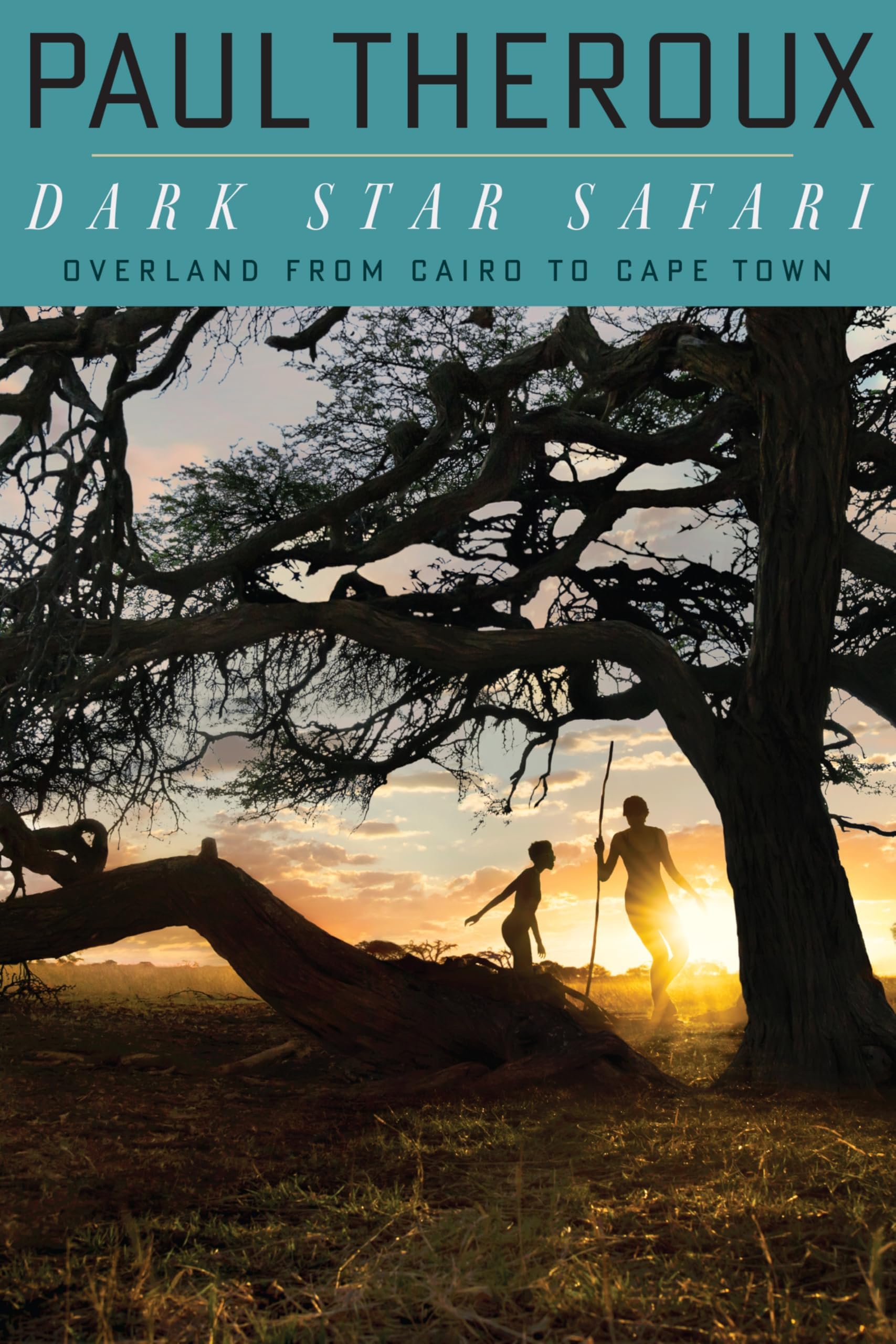
Dark Star Safari: Overland from Cairo to Capetown
Product ID: 3500004
Buy anything from 5,000+ international stores. One checkout price. No surprise fees. Join 2M+ shoppers on Desertcart.
Desertcart purchases this item on your behalf and handles shipping, customs, and support to Vietnam.
The legendary travel writer’s thrilling and dangerous account of his journey across Africa A rattletrap bus, dugout canoe, cattle truck, armed convoy, ferry, and train. In the course of his epic and enlightening journey―an overland trek from Cairo to Cape Town―wittily observant and endearingly irascible Paul Theroux endures danger, delay, and dismaying circumstances. Gauging the state of affairs, he talks to Africans, aid workers, missionaries, and tourists. What results is an insightful meditation on the history, politics, and beauty of Africa and its people. Theroux returns to the continent he knew as a young man, asking a hard question: After forty years of independence, foreign aid, and political turmoil, what has become of Africa? An Unflinching Travelogue: Join Theroux as he travels by rattletrap bus, dugout canoe, and cattle truck, finding an Africa that is hungrier, poorer, and more corrupt than the one he left decades before. Post-Colonial Realities: Through candid conversations with Africans, aid workers, missionaries, and tourists, Theroux gauges the true state of affairs on a continent shaped by foreign help and political upheaval. The Real Safari: Discover the original meaning of safari―a journey, not a game drive. This is a trek through the hinterland, far from the tourist trail, where the real challenges are human, not animal. A Master's Voice: Witty, irascible, and deeply insightful, Paul Theroux's account is a masterclass in travel writing, offering a powerful meditation on the history, politics, and enduring beauty of Africa and its people. Review: Hands Down, Theroux's Best "Travel" Book - By far, Theroux's best travel book. And they're all, at a minimum, extremely worth my time. What made this one exceptional was the timing of the read. I had held back on Dark Star Safari until 2018 after overdosing on other Theroux titles and feeling the need to sample other writers (many of them cited in Theroux's own works). His thesis - that Africa is doomed barring a miracle (sorry, Paul, that thought may be anathema) gains even more credence with me nearly two decades after Theroux journeyed from Cairo to Capetown, for this year has seen a spike in African strongmen rigging the game to stay in power and some economies struggling to diversify after the single-commodity free-falls of several years back. Local decision-making with roots in tribal governance, versus central government planning and concomitant shenanigans, seems to work best, the author suggests. And as an investor in a Sub-Saharan mutual fund, it's clear after reading this book that both Commerce Department analyses and investment come-ons remain woefully rose-colored. So Theroux, yet again, scores high marks for a very clear-eyed and sober approach to some very complex subject matter. Beyond the author's mastery of material (he has done plenty of homework and enjoys numerous contacts on the continent), Theroux's chops as an on-the-ground, sometimes in-your-face journalist, his disdain for "suffering fools gladly" and his ability to craft compelling mise-en-scene makes his work soar. The first 100 or so pages of Dark Star Safari are simply a delight to read, and as he moves down the spine of Africa his portraits of merchants, farmers, bureaucrats and fellow travelers prove deep and telling and sometimes just rollicking fun. Theroux has come light years from the work that made him famous, The Great Railway Bazaar, and what once amounted to caricatures in some cases are now real, live human beings that Theroux befriends and respects. (Having said that, "Bazaar" is still one of my favorite books.) Another great man of letters, Tom Wolfe, died this week. Reading his obituary, I realized for the first time that Theroux was one of the early proponents of The New Journalism that Wolfe helped found: painstaking attention to journalistic detail, no-holds-barred first-person narrative, and a unique, sometimes eye-popping way with the language that quickly drew lifelong fans. Here's hoping that Mr. Theroux, now pushing 80, isn't finished writing. Review: Well written and definately worth reading. - I liked the approach of the author and his bravery. Very interesting views on charitable work in Africa. Good questions asked regarding the way funding is utilesed for the NGO and its workers in stead of going into food, education and medicines for needy locals. Would be interesting if one could send someone on a similar route now (2025) and compare the situation now.
| Best Sellers Rank | #326,342 in Books ( See Top 100 in Books ) #25 in General Africa Travel Books #156 in Travelogues & Travel Essays #460 in Travel Writing Reference |
| Customer Reviews | 4.4 out of 5 stars 1,692 Reviews |
N**X
Hands Down, Theroux's Best "Travel" Book
By far, Theroux's best travel book. And they're all, at a minimum, extremely worth my time. What made this one exceptional was the timing of the read. I had held back on Dark Star Safari until 2018 after overdosing on other Theroux titles and feeling the need to sample other writers (many of them cited in Theroux's own works). His thesis - that Africa is doomed barring a miracle (sorry, Paul, that thought may be anathema) gains even more credence with me nearly two decades after Theroux journeyed from Cairo to Capetown, for this year has seen a spike in African strongmen rigging the game to stay in power and some economies struggling to diversify after the single-commodity free-falls of several years back. Local decision-making with roots in tribal governance, versus central government planning and concomitant shenanigans, seems to work best, the author suggests. And as an investor in a Sub-Saharan mutual fund, it's clear after reading this book that both Commerce Department analyses and investment come-ons remain woefully rose-colored. So Theroux, yet again, scores high marks for a very clear-eyed and sober approach to some very complex subject matter. Beyond the author's mastery of material (he has done plenty of homework and enjoys numerous contacts on the continent), Theroux's chops as an on-the-ground, sometimes in-your-face journalist, his disdain for "suffering fools gladly" and his ability to craft compelling mise-en-scene makes his work soar. The first 100 or so pages of Dark Star Safari are simply a delight to read, and as he moves down the spine of Africa his portraits of merchants, farmers, bureaucrats and fellow travelers prove deep and telling and sometimes just rollicking fun. Theroux has come light years from the work that made him famous, The Great Railway Bazaar, and what once amounted to caricatures in some cases are now real, live human beings that Theroux befriends and respects. (Having said that, "Bazaar" is still one of my favorite books.) Another great man of letters, Tom Wolfe, died this week. Reading his obituary, I realized for the first time that Theroux was one of the early proponents of The New Journalism that Wolfe helped found: painstaking attention to journalistic detail, no-holds-barred first-person narrative, and a unique, sometimes eye-popping way with the language that quickly drew lifelong fans. Here's hoping that Mr. Theroux, now pushing 80, isn't finished writing.
K**R
Well written and definately worth reading.
I liked the approach of the author and his bravery. Very interesting views on charitable work in Africa. Good questions asked regarding the way funding is utilesed for the NGO and its workers in stead of going into food, education and medicines for needy locals. Would be interesting if one could send someone on a similar route now (2025) and compare the situation now.
J**N
Great book considering how little insight the author has
This is a great book. But then I like all Theroux's travel books. His erudite but frank and often witty observations make his books fun to read. What makes this book special is that Theroux has done and writes about two things that relatively few people have done and almost no one has written about. He has traveled overland from Cairo to Cape Town and he has made visits to Uganda 40 years apart. My gripe about his lack of insight comes primarily from two passages. The first describes his contempt for the international aid workers who whiz past him in their air conditioned SUVs while he stands by the side of the road with his thumb out. As someone who has ridden in these air conditioned SUVs (Central and West Africa 1981-1985) and has also stood on the side of the road with his thumb out (Melilla to Dar 1972) I understand what Theroux doesn't. The aid workers don't spend their days whizzing around in air conditioned SUVs but work, often hard, for months on end under arduous conditions and the bug free a/c of the SUV may be the most comfortable environment they are in all day or even all week. He expects the aid workers to stop and pack their vehicle with the hordes of people they pass on the road who are desperate for a ride? That's too much to ask. Or does Theroux seriously think that as a muzungu out for a lark with a wad of money in his pocket relief workers should stop for him but not offer the same courtesy to the local people? The second passage that demonstrates Theroux's lack of insight is where he recounts his conversation with a U.S. embassy employee who listens to Theroux patiently but seems unimpressed and has NOT (can you imagine it) followed Theroux's instructions to arrange for him to give some lectures while he breezes through town. Does Theroux like to be perceived as arrogant? Besides all that, the book is fascinating for Theroux's observations about people, history, and places, especially because he visits some very out-of-the way places. Even more interesting to me were his comments about his sojourn in Malawi and Uganda in the 1960's and his recounting of the conversations he had during his recent trip with people he had known as a young man. I'd recommend this book to anyone familiar with and interested in Africa and to anyone interested in African development as well as to anyone who likes Paul Theroux's travel writing. I would not recommend this book to someone with little knowledge of Africa.
E**E
The next best thing to actually living in Africa
If you've lived in Africa, you'll love reading Paul Theroux's account of his overland trip from Cairo to Capetown, off the beaten track. So many of his accurate observations will remind you of your own experiences, whether it's his musings on African time ("But African time was not the same as American time... because Africa was going its own way at its own pace for its own reasons, it was a refuge and a resting place, the last territory to light out for") or train travel ("most trains in Africa look as if they are on their way to Auschwitz.") The fact that his writings are not always politically correct and don't aspire to be makes them all the more engaging. If you haven't lived in Africa or even traveled there, you'll also love Dark Star Safari. There will be no better way to let you experience what Africa is all about short of actually going there. Theroux's anecdotes are sometimes comical, sometimes sad, sometimes frightening, but always ring very true. He goes out of his way to meet the local people and hear their stories, some of which won't leave you for a very long time. I've done my share of travel writing and can unequivocally say that the crappier your experience, the better the story. On a similar vein, one of the acquaintance Theroux makes along the way observes it best: "You're going to Nairobi by road? Well, of course you are. Flying there would be too simple for you. It'll take a week or more. You'll have a terrible time. You'll have some great stuff for your book."
W**G
A gutsy venture brilliantly documented
Theroux is not everyone's cup of tea. He is opinionated--curmudgeonly is a word very frequently used to describe him--and will often shock readers who expect the usual "cultural relativist" pap with his unflinching willingness to hold the residents of other lands he is writing about accountable for their own inability or unwillingness to assume some sense of responsibility. I have read many of Theroux's books--I have been reading Theroux since he first wrote an article in Esquire in the 1960s about getting kicked out of the Peace Corps--and this is one of his best. He has written many books in the travel narrative genre, and this one is about Africa. I also feel well qualified to comment on the book, since I, like Theroux, was a Peace Corps Volunteer in Africa in the 1960s and, also like Theroux, have many vivid memories of those times. Theroux set out to take an overland journey from Cairo to Capetown, and to write about it. In doing so he manages, in slightly less than 500 pages, to encapsulate the sad story of the last 40+ years of African history. In many ways, this is a sad, even tragic book. Theroux remembers when Africa was full of hope. Newly freed from the ravages and exploitation of colonialism, Africa was full of optimism. Determined to free themselves from dependence on the west, most newly independent countries opted for socialism and were very cozy with the Soviet Union and Maoist China. This, according to Theroux, was what led to their downfall. Central planning led to one party dictatorships throughout the continent, and in turn to incompetence and corruption, and in some cases, tyranny and mass murder. Theroux's journey documents many of the aftereffects of these events. Most of the people Theroux meets on his journey are ordinary people who have no idea who he is. However, Theroux is not remiss to use his stature as a world famous writer to gain access to literary gatherings, to public officials, some of whom are old friends from his Peace Corps days, and on one occasion to the U.S. embassy. Good for him; the book is better as a result. It was difficult not to seethe with rage at the pompous African official who mocks the Indian merchants who were kicked out of the country for going through their stores with a calculator tallying the value of each item in the store. Theroux explains that this is simply taking inventory, a basic tool necessary to the efficient running of a business. The official scoffs at this, saying that Africans just aren't cut out for that sort of thing, something Theroux bluntly characterizes as "bullshit." As a result of this type of thinking, the merchant shops which used to appear in nearly every village in Africa, and which were intended to be run by Africans after the Indians were forced to leave, now lie vacant. This is a theme that Theroux pursues relentlessly: the unwillingness of Africans to learn the skills and to put in the effort needed to remedy their dire situation. He places the blame for this not only on the governments, but also on aid organizations, NGOs, and missionaries, all of whom engage in handouts, resulting in the Africans' failure to help themselves. Theroux seems personally stressed by this as well. At one point he snaps at a man who asks him for money just after Theroux has been very ill, asking the man why he should give him money. Aren't you a man, he says, can't you take care of himself? He also paints a harrowing picture of the takeover of white-owned farms by government sanctioned squatters in Zimbabwe, with the expected result that the farms become much less productive than they were before, with the squatters expecting the farmers to do everything from giving them seeds to helping them plant to threshing the grain. I don't wish to give the impression that Theroux's portrayal of present day Africa is totally negative. He meets many individuals, black and white, of whom he paints a positive picture. There are an African father and son who help him travel by canoe across a national boundary. There is even a nun for whom Theroux seems to have a very high regard. And he esteems Nadine Gordimer. But most of his portraits are scathing. In spite of my praise and high regard for the book, I did not give it 5 stars because I think Theroux fails to mention anything at all about indigenous African society, by which I mean society at the tribal level. I think Theroux knows very well that African societies function very well at this level. The blunt truth is that the mess that Africa finds itself in today is the direct result of colonialism, and that the western forms of government that Africans seem unable to get to function well are artificial forms imposed on their indigenous cultures. This does not excuse present day Africans from their responsibility to learn to cope with the situation as it is, but Theroux lets the west off the hook far too easily. He also fails to mention that there is a kind of rough justice involved in the African squatters taking over the white-owned farms, because in most cases the ancestors of the present day farmers themselves stole the land from Africans. But the positives of this book far outweigh the negatives. Highly recommended for anyone interested in contemporary Africa.
R**E
Description of Kampala
I found the description of the situation in Kampala, Uganda shallow and misleading. I lived in Kampala three years, including during the time Mr. Theroux visited. One quote "the Indians are gone" is clearly untrue. When Idi Amin came in to power the Indians, "Asians" in local terms, held much of the wealth; he ran them out. Either Obote 2 or Museveni let them back in, and during my tenure the Asians once again had much of the wealth with extensive holdings in real estate, banking, and farming. Also, as a former development professional, I take issue with his description of aid workers being arrogant to the point of not providing transportation or aid to travelers. Many a time, in several countries, my vehicle was crowded with locals needing transportation. I am a fan of Mr. Theroux, but now often question his objectivity and credibility.
B**S
An Endearing Cynic Travels From Cairo to Cape Town...
I loved this. Paul Theroux travels from Cairo to Cape Town, recording his conversations with a cast of characters he meets along the way. Also included are his reflections on a wide range of topics related to Africa. His straight-shooting style and counter-intuitive conclusions, particularly his view that aid in Africa has done more harm than good, inspires the ire of many readers, and I myself got mad at him once. Although he does have a tendency to overgeneralize (aid workers in Africa are repeatedly and derisively referred to as "Agents of Virtue"), his sense of humor, honesty and genuine love for Africa and Africans compelled me to forgive him. This book is so evocative and entertaining. It's funny and vivid, and I was sad when it ended. A quote from the book: "For an author, there is no greater achievement than this, the successful re-creation in prose of the texture and emotions of a real place, making the reading of the work like a travel experience, containing many of the pleasures of a visit. How nice it would be, I thought, if someone reading the narrative of my African trip felt the same, that it was the next best thing to being there--or even better, because reading about being shot at and poisoned and insulted was in general less upsetting than the real thing" (388). Mission accomplished, Mr. Theroux!
D**T
Mister Nice Guy
Every word that Paul Theroux ever writes is great, but I approached this with special anticipation for two reasons. The first was that he describes travel in parts of Africa chronicled by his rival in the gentle art of saying nasty things about people, Evelyn Waugh. The second was that he was revisiting places he had known intimately, 35 years ago, and I was eager to learn what reasons a penetrating intellect like his could give for what has happened in Africa. Well, he is not quite as good as Evelyn Waugh, and the reason I think, is that he is not nasty enough. The truly effective satirist holds no punches and takes no prisoners. Deep down inside , Theroux has a heart of gold, an unfortunate possession for an ironist, and he cannot entirely conceal it. Waugh was moralist too. a devout Catholic, but he never let kindness get in the way of a good savage stab. Maybe it's an Anglo-American difference, with the Americans never properly trained to be completely unpleasant. Theroux is a well qualified expert on Africa. He even has the rare accomplishment of speaking several African languages, and the range of works that he quotes indicates a full study of its history and politics. The disappointing fact stands out that liberation from European colonial rule did not produce the automatic improvement in life for Africans that we (the nice leftwing liberals) had hoped,and that's an understatement. What went wrong? He comes up with some interesting answers. I don't know if they're the right ones, but they're well worth reading.
N**E
Terrific read. Has to be one of the best ...
Terrific read. Has to be one of the best books I've ever read. In fact, I don't recall any other author who writes quite like that--for example: One who can uplift my spirits at the beginning of one paragraph and onto the turn of the page, and reduce me to tears by the end of the next paragraph; one who manages to make me cry two or three times; and yet reading his account is an immense pleasure.
A**G
One of the best travel books ever
Having read nearly all of his travel books, Dark Star is easily his best. Indeed, for me it is one of the best travel books ever written. Paul not only gives a detailed account of his travels and writes superbly with good humour, but also throws in a lot of history, enough to enlighten but not enough to make it more like a history book rather than a travel book as does happen with some travel writers. Paul does not just report on what he sees but he is always asking the question 'why' which is one of the key aspects of any good travel writing. Having worked in some of Eastern and Southern Africa in his younger days he is in a superb position to answer that question both from his own experiences and from the comments of the people that he meets, ranging from simple, near naked, fishermen to the Prime Minister of Uganda. This is not a sanitised view of Africa or a hatchet job, this is writing from an author who clearly loves the continent and its people but who is horrified by how far life has regressed for the ordinary people since he first lived there. Not least because of the disastrous aid culture which has grown up and sapped the will of so many people. No doubt it will be uncomfortable reading to many who seem to think that foreign aid is the answer, but it has clearly failed badly as many highly respected people, Africans and Westerners, have said, as well as Paul. There is more to be learnt about sub-Saharan Africa from Paul's book than any number of other learned but politically correct or self delusional or 'picturesque' books and articles by other writers. A genuinely unbiased book which gives a very fair and balanced view and without belittling others, just the facts. He gives the truth but also celebrates what is good about Africa and Africans, which is more than one usually gets from writers on Africa. Thankfully, Paul doesn't pretend to have the answers but he sure gets to understand the problems. And his story is told by someone who leaves behind the comfortable limo or air conditioned bus and instead travels as the local poor people do. Paul's superb writing makes one feel as if one is sitting right next to him on his journey, but glad that it is him doing the journey rather than me - I like my comforts too much! A great and inspiring travel book.
B**A
Great Book
This book is over a long journey Paul Theroux made through Africa about 20 years ago. He had determined before leaving that he would travel with as little as possible, and wore old clothes and shoes so that he could fit in with the crowds although he, as a white man, was always marauded by children and beggars seeking food and money. This was a journey from Cairo to Capetown where the inhabitants are described, housing, atmosphere, and scenery of the many countries which certainly give the reader an impression of a continent. He did this at a time when he was going to celebrate his 60th Birthday toward the end of this great journey, and in my opinion, not so many people in this age category would be able to withstand such a difficult adventure. I don't want to say more in order to not give away any secrets. I just urge you to read this book--you will feel justifiably rewarded. There is a reason why Mr. Theroux 's books are so in demand and well received.
A**R
A delight to read
Another excellent book by Paul Theroux, probably my favourite so far. Paul’s stories are all about the people he meets, the chance encounters, and the adventures. A great book, balanced, honest, truth telling.
K**N
Brought back several memories of my own days in Africa ...
Brought back several memories of my own days in Africa. Felt saddened to read that the m.v. Bukoba has drowned. It was a spanking new boat when I used to travel between Mwanza and Bukoba. The uselessness or the adverse effect that the so called NGOs' activities in Africa has been well brought out. It is unfortunate that the world is never going to leave Africa alone.
Trustpilot
1 month ago
2 weeks ago