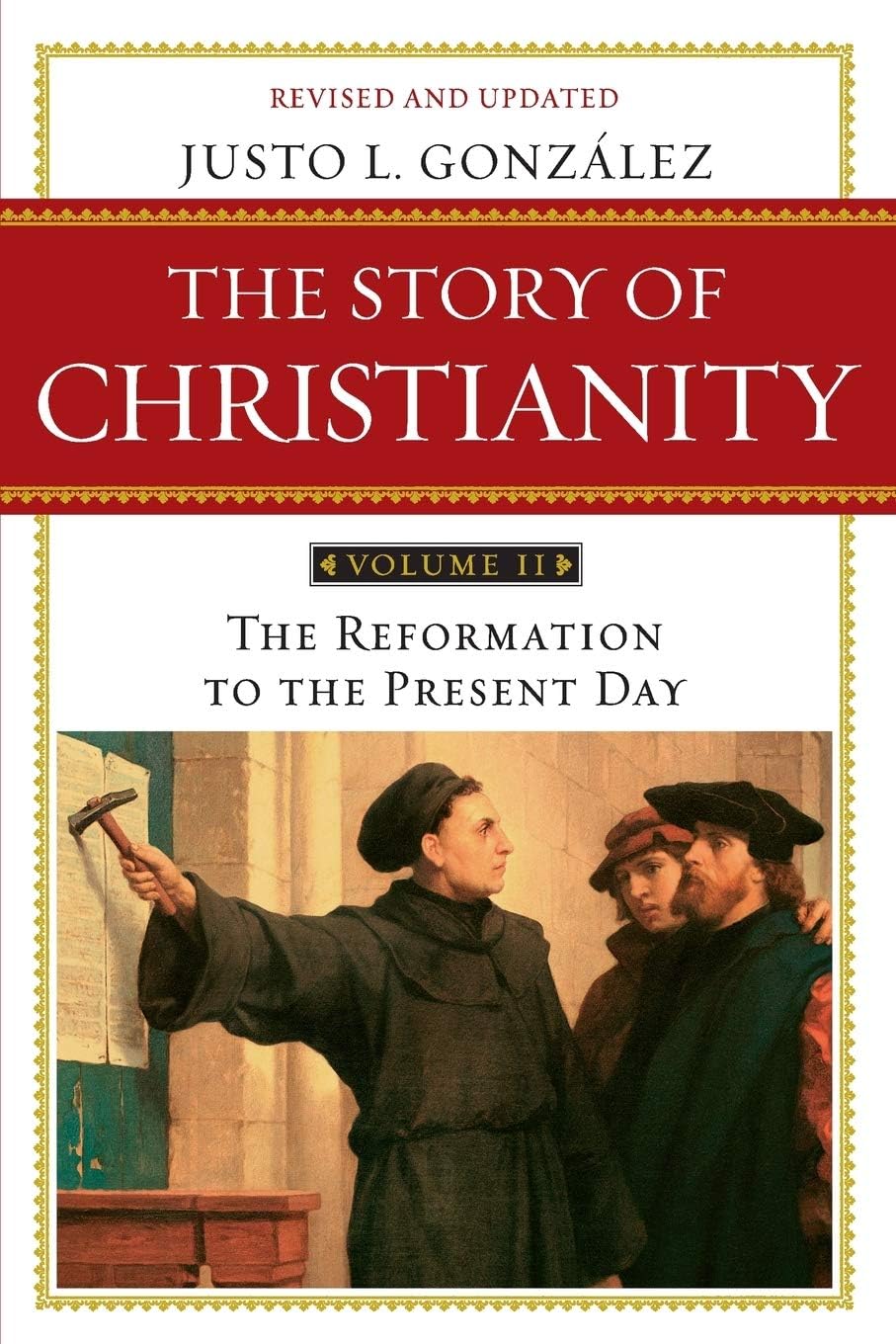
The Story of Christianity, Vol. 2: The Reformation to the Present Day
Product ID: 3460365
Buy anything from 5,000+ international stores. One checkout price. No surprise fees. Join 2M+ shoppers on Desertcart.
Desertcart purchases this item on your behalf and handles shipping, customs, and support to Vietnam.
From Justo L. Gonzalez, author of the acclaimed three-volume History of Christian Thought , Story of Christianity: Volume 2, The is the fully revised and updated second volume of The Story of Christianity . Gonzalez’s astute scholarship, lucid prose, and impassioned focus tell the narrative of church history, beginning with the Protestant Reformation of the sixteenth century and leading all the way up to the modern era. This comprehensive volume details the pivotal figures, movements, and theological debates that shaped the modern church: Key Figures of the Reformation: Delve into the lives and theologies of Martin Luther, Ulrich Zwingli, and John Calvin, and understand how their thinking shaped the course of modern Christianity. A Church Divided: Trace the story of the Reformation across Great Britain, France, and the Low Countries, and witness the Catholic response, including the pivotal Council of Trent. Orthodoxy and Revolution: Follow the development of Protestant orthodoxy and explore the dramatic upheaval of the Puritan Revolution in England and the devastating Thirty Years’ War. The Rise of Modern Thought: Examine the emergence of Rationalism and Pietism as responses to a convulsed age, setting the stage for Christianity’s journey into the present day. Review: Breathtaking - This book is breathtaking in its breadth and depth, describing not only the people, events and theological developments of Christianity, but also the political environment, and philosophers and theologians who might not all be Christian. I loved Volume I of this two-volume set, and Volume II did not disappoint. Gonzalez seems to be very thorough and very fair towards each theology shift that he describes. I thought I read on desertcart somewhere that he is Roman Catholic, but his Wikipedia page says that he is Methodist and his wife is a professor at a Presbyterian seminary. When Gonzalez tells about Luther’s spiritual journey and his theology, he puts himself in Luther’s place and tells it in a way that is sympathetic to Luther. The book has three parts: The Reformation (p 6-171), Orthodoxy, Rationalism, and Pietism (p 172-292), Beyond Christendom (p293-530) The Bainton biography of Luther and this book have differing explanations for the origin of the word “Protestant.” According to Bainton, the Emperor decreed that each territory could choose between Lutheranism and Roman Catholicism. In Lutheran territories, individuals could choose either Lutheranism or Roman Catholicism. In Roman Catholic territories, only Roman Catholicism was allowed. So the Lutherans protested. According to Gonzalez, in 1529 the Second Diet of Spire the Edict of Worms was reaffirmed. This edict condemned Luther and his followers and his books to be erased from human memory (Page 37), so the Lutherans protested. (Page 44) Maybe both explanations are true. The first four chapters describe the corruption and problems in the Roman Catholic church, Luther’s journey from monk to priest to Bible professor to Reformer, and Luther’s theology. The next several chapters describe other Protestant initiatives, the Roman Catholic response, and the role of emperors, kings, and princes, and religious wars that ensued. All of the persecutions, the burning of “heretics,” burning of books, and wars seem strange to us today, in our age of religious freedom guaranteed by the government. But since the age of Constantine, the church was closely tied to the government. Rulers believed that it was essential that all citizens should be church members of the same church and should be in agreement on dogma. Religious leaders knew that either their own dogma would be imposed on everyone, or someone else’s dogma would be imposed on them. This made it urgent to snuff out any opposing doctrine. The remaining ten chapters in Part 1 deal with other Reformed theologians and the Reformation in other countries. This is where you get a very thorough review of the secular history and how politics impacted Christianity, especially in Great Britain. Part II covers the Thirty Years’ War and various sects, philosophers and theologians, ending with the history of Christianity in the Thirteen Colonies. Part III starts with the American Revolution and ends with the present day. During the time of Pope Pius IX, 1846 – 1878, the Pope lost his influence over civil government, and made up for it by asserting himself in the ecclesiastical government, establishing the doctrine of papal infallibility. This doctrine was used once, in 1950, for the doctrine of the Assumption of Mary. Then Pope John XXIII, 1958 – 1963 and Pope Paul VI (1963 – 1978) convened the Second Vatican Council, relaxing the authoritarian power of the pope and maybe moving a bit toward the Protestant position. Some of the philosophers and theologians: Hegel, Hume, Kant, Wesley, Kierkegaard, Schleiermacher, Descartes, Barth, Bonhoeffer. I have a couple of bones to pick, but not to take away from the wonderful contribution of this book. There is a very brief mention of dispensationalism, but only as an example of fundamentalism (page 343). Cyrus Scofield is mentioned, but not Charles Nelson Darby. It seems that everywhere I turn, I run into people who adhere to Dispensational Premillennialism, and many seem to feel that if you are not a Dispensational Premillennialist, you are not really Christian. So it seems like a very big movement to me, and it gets very little attention in this book. Maybe it’s not as big as it seems. In discussing the turbulent time of the 1960s in America, he says “Then it was discovered that the public – and Congress -- had been purposefully misinformed on the incident in the Gulf of Tonkin which had precipitated the escalation of the war.” This seems over-stated. It is widely agreed that the U.S.S. Maddox was attacked by North Vietnamese torpedo boats on August 2, 1964. Two days later, there was much confusion. A SONAR operator thought there was a torpedo attack, but was almost certainly mistaken. Then he says “The very prosperity that resulted from the war – followed as it was by a significant recession – led some to wonder if the economic system on which the nation was founded did not require the artificial stimulus of war.” This is silly, because there have been many times when the United States was prosperous without the stimulus of war. On my Kindle Paperwhite, I don’t get page numbers or percent finished displayed. I can get page numbers if I tap the top of the screen, then tap an icon that appears at the bottom of the screen. As far as I can tell, this is not because of any settings that I might have changed. I bought the Kindle version in 2017, and the copyright I got is 2010, and it says second edition on the copyright page. I’m not sure this is the latest version. desertcart gives the publication date as November 25, 2014 on their web site. I have only mentioned a few of the topics covered in the book. It is densely packed with information and requires careful reading, or re-reading. I found it very worthwhile and enjoyable, but I know many of my friends do not want to read history, so it is not for everyone. Review: Tell me a story... - In another text ('The Changing Shape of Church History'), Justo Gonzalez writes about the shift away from a Eurocentric focus on the history of Christianity to a recognition that Christianity is a global phenomenon, not just due to Western missionary activity, but rather has been since its earliest day. Gonzalez keeps this global perspective in mind in his two volume narrative history, 'The Story of Christianity'. Gonzalez' presentation of the Reformation period concentrates on significant people, primarily Martin Luther, Ulrich Zwingli, and John Calvin, bringing in other people as appropriate (Tetzel, various popes, etc.). However, Gonzalez does not confine himself to a 'story of great men' approach, combine the history of ideas, events, and institutions together with the biographical narratives of the people involved. Gonzalez is also the author of a three-volume history of Christian thought, and draws material from that series into this more general church history text. Gonzalez' approach to the Reformation includes the standard Luther/Zwingli/Calvin triad, with information about the reformations in Britain, the Benelux (Low) countries, France, Anabaptists, and influences in the Catholic church. Gonzalez uses the term `Catholic Reformation' rather than Counter-Reformation, for as he states, `the Catholic Reformation was well under way when Luther was still a young boy.' Gonzalez highlights some earlier controversies that influenced Luther (Hus and others), as well as so-called `minor' actors in the unfolding historical events. This is standard for Gonzalez - he addresses the major events and people while incorporating a good deal of information about the influences and people that normally do not get `topping billing' in historical narratives. His task at recovering these neglected voices puts new perspectives to the overall flow of the history. The second part of the text deals with the various events leading past the Reformations into the Enlightenment. Denominations began to solidify established patterns of belief and practice into orthodox structures, and the general Reformation continued to diversify into Spiritualist, Pietist, and other Movements, which Gonzalez describes as options. Sometimes these had direct political motivations, and other times they were more theological in tone. Gonzalez concludes this section with the Great Awakening and Jonathan Edwards, in the thirteen colonies. In the third section, the political dimensions of religious institutions and their attendant belief and practice structures is readily apparent as the rise of nation-states, the independence movements away from colonial powers, and the increasing independence of church institutions from state control (and vice versa) takes centre stage. Christianity becomes a truly global phenomenon during this period (the late 1700s through the 1800s), but not always in the best ways. Gonzalez highlights good and bad points of the expansion of church power and missionary activity, as well as the way church justifications have been used in aid of colonial authority. In the final section, Gonzalez describes the twentieth century as an era of `drastic change'. This includes not just the Western traditions of Catholic and Protestant, but also the Orthodox traditions, on the one hand emerging from centuries of Muslim domination in Middle Eastern and North African lands, but then submerging for a time under Communist rule in Russia and East Europe, the centre of Orthodoxy after the fall of Constantinople. In a century that included world wars, expansion of trade, ecumenical and openness movements (such as Vatican II), Gonzalez sees the century ending whereby the former missionary lands of the global South are becoming themselves the evangelizers to the historically Christian North - `Thus, the lands that a century before were considered the "ends of the earth" will have an opportunity to witness to the descendents of those who had earlier witnessed to them. Each major section is introduced by a chronology; while generally acceptable, more detail here would be helpful, particularly as it relates to the history of ideas. Incorporation of authors, artists, philosophers and others apart from the specifically political and church-related figures would be helpful for the overall context. Each major section also includes a list of suggested readings, but these lists do not include many recent works of merit - Gonzalez himself admits that this text is due for a revised edition. Gonzalez has a broadly ecumenical and open approach, striving to cover a massive amount of material with fair attention both to major topics and oft-neglected voices. He does a very good job at this, and despite some minor shortcomings, this remains one of the better general church history texts available.
| Best Sellers Rank | #30,489 in Books ( See Top 100 in Books ) #21 in Christian Historical Theology (Books) #62 in History of Christianity (Books) #91 in Christian Church History (Books) |
| Customer Reviews | 4.7 out of 5 stars 1,196 Reviews |
S**G
Breathtaking
This book is breathtaking in its breadth and depth, describing not only the people, events and theological developments of Christianity, but also the political environment, and philosophers and theologians who might not all be Christian. I loved Volume I of this two-volume set, and Volume II did not disappoint. Gonzalez seems to be very thorough and very fair towards each theology shift that he describes. I thought I read on Amazon somewhere that he is Roman Catholic, but his Wikipedia page says that he is Methodist and his wife is a professor at a Presbyterian seminary. When Gonzalez tells about Luther’s spiritual journey and his theology, he puts himself in Luther’s place and tells it in a way that is sympathetic to Luther. The book has three parts: The Reformation (p 6-171), Orthodoxy, Rationalism, and Pietism (p 172-292), Beyond Christendom (p293-530) The Bainton biography of Luther and this book have differing explanations for the origin of the word “Protestant.” According to Bainton, the Emperor decreed that each territory could choose between Lutheranism and Roman Catholicism. In Lutheran territories, individuals could choose either Lutheranism or Roman Catholicism. In Roman Catholic territories, only Roman Catholicism was allowed. So the Lutherans protested. According to Gonzalez, in 1529 the Second Diet of Spire the Edict of Worms was reaffirmed. This edict condemned Luther and his followers and his books to be erased from human memory (Page 37), so the Lutherans protested. (Page 44) Maybe both explanations are true. The first four chapters describe the corruption and problems in the Roman Catholic church, Luther’s journey from monk to priest to Bible professor to Reformer, and Luther’s theology. The next several chapters describe other Protestant initiatives, the Roman Catholic response, and the role of emperors, kings, and princes, and religious wars that ensued. All of the persecutions, the burning of “heretics,” burning of books, and wars seem strange to us today, in our age of religious freedom guaranteed by the government. But since the age of Constantine, the church was closely tied to the government. Rulers believed that it was essential that all citizens should be church members of the same church and should be in agreement on dogma. Religious leaders knew that either their own dogma would be imposed on everyone, or someone else’s dogma would be imposed on them. This made it urgent to snuff out any opposing doctrine. The remaining ten chapters in Part 1 deal with other Reformed theologians and the Reformation in other countries. This is where you get a very thorough review of the secular history and how politics impacted Christianity, especially in Great Britain. Part II covers the Thirty Years’ War and various sects, philosophers and theologians, ending with the history of Christianity in the Thirteen Colonies. Part III starts with the American Revolution and ends with the present day. During the time of Pope Pius IX, 1846 – 1878, the Pope lost his influence over civil government, and made up for it by asserting himself in the ecclesiastical government, establishing the doctrine of papal infallibility. This doctrine was used once, in 1950, for the doctrine of the Assumption of Mary. Then Pope John XXIII, 1958 – 1963 and Pope Paul VI (1963 – 1978) convened the Second Vatican Council, relaxing the authoritarian power of the pope and maybe moving a bit toward the Protestant position. Some of the philosophers and theologians: Hegel, Hume, Kant, Wesley, Kierkegaard, Schleiermacher, Descartes, Barth, Bonhoeffer. I have a couple of bones to pick, but not to take away from the wonderful contribution of this book. There is a very brief mention of dispensationalism, but only as an example of fundamentalism (page 343). Cyrus Scofield is mentioned, but not Charles Nelson Darby. It seems that everywhere I turn, I run into people who adhere to Dispensational Premillennialism, and many seem to feel that if you are not a Dispensational Premillennialist, you are not really Christian. So it seems like a very big movement to me, and it gets very little attention in this book. Maybe it’s not as big as it seems. In discussing the turbulent time of the 1960s in America, he says “Then it was discovered that the public – and Congress -- had been purposefully misinformed on the incident in the Gulf of Tonkin which had precipitated the escalation of the war.” This seems over-stated. It is widely agreed that the U.S.S. Maddox was attacked by North Vietnamese torpedo boats on August 2, 1964. Two days later, there was much confusion. A SONAR operator thought there was a torpedo attack, but was almost certainly mistaken. Then he says “The very prosperity that resulted from the war – followed as it was by a significant recession – led some to wonder if the economic system on which the nation was founded did not require the artificial stimulus of war.” This is silly, because there have been many times when the United States was prosperous without the stimulus of war. On my Kindle Paperwhite, I don’t get page numbers or percent finished displayed. I can get page numbers if I tap the top of the screen, then tap an icon that appears at the bottom of the screen. As far as I can tell, this is not because of any settings that I might have changed. I bought the Kindle version in 2017, and the copyright I got is 2010, and it says second edition on the copyright page. I’m not sure this is the latest version. Amazon gives the publication date as November 25, 2014 on their web site. I have only mentioned a few of the topics covered in the book. It is densely packed with information and requires careful reading, or re-reading. I found it very worthwhile and enjoyable, but I know many of my friends do not want to read history, so it is not for everyone.
F**K
Tell me a story...
In another text ('The Changing Shape of Church History'), Justo Gonzalez writes about the shift away from a Eurocentric focus on the history of Christianity to a recognition that Christianity is a global phenomenon, not just due to Western missionary activity, but rather has been since its earliest day. Gonzalez keeps this global perspective in mind in his two volume narrative history, 'The Story of Christianity'. Gonzalez' presentation of the Reformation period concentrates on significant people, primarily Martin Luther, Ulrich Zwingli, and John Calvin, bringing in other people as appropriate (Tetzel, various popes, etc.). However, Gonzalez does not confine himself to a 'story of great men' approach, combine the history of ideas, events, and institutions together with the biographical narratives of the people involved. Gonzalez is also the author of a three-volume history of Christian thought, and draws material from that series into this more general church history text. Gonzalez' approach to the Reformation includes the standard Luther/Zwingli/Calvin triad, with information about the reformations in Britain, the Benelux (Low) countries, France, Anabaptists, and influences in the Catholic church. Gonzalez uses the term `Catholic Reformation' rather than Counter-Reformation, for as he states, `the Catholic Reformation was well under way when Luther was still a young boy.' Gonzalez highlights some earlier controversies that influenced Luther (Hus and others), as well as so-called `minor' actors in the unfolding historical events. This is standard for Gonzalez - he addresses the major events and people while incorporating a good deal of information about the influences and people that normally do not get `topping billing' in historical narratives. His task at recovering these neglected voices puts new perspectives to the overall flow of the history. The second part of the text deals with the various events leading past the Reformations into the Enlightenment. Denominations began to solidify established patterns of belief and practice into orthodox structures, and the general Reformation continued to diversify into Spiritualist, Pietist, and other Movements, which Gonzalez describes as options. Sometimes these had direct political motivations, and other times they were more theological in tone. Gonzalez concludes this section with the Great Awakening and Jonathan Edwards, in the thirteen colonies. In the third section, the political dimensions of religious institutions and their attendant belief and practice structures is readily apparent as the rise of nation-states, the independence movements away from colonial powers, and the increasing independence of church institutions from state control (and vice versa) takes centre stage. Christianity becomes a truly global phenomenon during this period (the late 1700s through the 1800s), but not always in the best ways. Gonzalez highlights good and bad points of the expansion of church power and missionary activity, as well as the way church justifications have been used in aid of colonial authority. In the final section, Gonzalez describes the twentieth century as an era of `drastic change'. This includes not just the Western traditions of Catholic and Protestant, but also the Orthodox traditions, on the one hand emerging from centuries of Muslim domination in Middle Eastern and North African lands, but then submerging for a time under Communist rule in Russia and East Europe, the centre of Orthodoxy after the fall of Constantinople. In a century that included world wars, expansion of trade, ecumenical and openness movements (such as Vatican II), Gonzalez sees the century ending whereby the former missionary lands of the global South are becoming themselves the evangelizers to the historically Christian North - `Thus, the lands that a century before were considered the "ends of the earth" will have an opportunity to witness to the descendents of those who had earlier witnessed to them. Each major section is introduced by a chronology; while generally acceptable, more detail here would be helpful, particularly as it relates to the history of ideas. Incorporation of authors, artists, philosophers and others apart from the specifically political and church-related figures would be helpful for the overall context. Each major section also includes a list of suggested readings, but these lists do not include many recent works of merit - Gonzalez himself admits that this text is due for a revised edition. Gonzalez has a broadly ecumenical and open approach, striving to cover a massive amount of material with fair attention both to major topics and oft-neglected voices. He does a very good job at this, and despite some minor shortcomings, this remains one of the better general church history texts available.
B**D
Meat and Potatoes
There are several good, and one or two "great" histories of Christianity, and there are probably dozens which rank would fare as "good home cooking". Nourishing, but not impressive. Gonzales' history is mashed potatoes with meat, as prepared by Joel Robuchon. It is the things we want to know about the people and the movements, primarily in European and American Christianity, even though the main action in Christian expansion in the 20th century and later will be in the global south (Latin America, sub-Saharan Africa, and East Asia. For that, go to Philip Jenkins' book, "The Next Christendom." Gonzales' book is NOT about theology. You will get very little on the differnces between Luther and Calvin and Wesley and the Council of Trent in this book. You will get much about the effects of these theologies on the social directions of Catholicism and various varieties of Protestantism. One of the most interesting threads in this discussion is the revelation that the United States was the hothouse of religious experimentation. The separation of church and state provisions in the constitution were dramatic in a time when every Christian country had a state religion, including England. But they were necessary, since each of the 13 colonies had a different religious foundation. From that diversity comes most of the major changes, many of the biggest ones today grew from American Wesleyism, even thought the Methodist movement started in England. Even so, there are many topics in early American Christianity which get no mention. Increase and Cotton Mather between them get only one page and Jonathan Edwards gets only four mentions on widely separated pages. Appropriate to a target audience of non-professionals, the writing is brisk and easy to follow. Appropriate to the title, it reads like a "Story". The down side to that is that there are very few notes (two pages for 552 pages of text) about sources. For that, you would need to go to Jaroslav Pelikan's History of Doctrine. For a more authoritative social history, you would need to go to the 8 volume Cambridge History of Christianity, which costs about $200 per volume. If I were to do one thing to improve the book, it would be to put a Bibliography at the end of each chapter. Gonzales, I'm sure, could hire a Grad student to do that for him. If it had such a Bibliography, I would give it a higher rank, because then it would be useful as a reference volume, where you could read the chapters which interest you, and find books to elaborate on that interest. One reviewer believed he saw a Spanish slant to the writing in this book. Frankly, I read the whole book and detected no such "prejudice". If there were, Gonzales did it very, very poorly, because neither I nor the seven other members of my class, nor the instructor, mentioned anything about it. If Gonzales was less critical of the Spanish Inquisition that we have been lead to believe it deserves, just maybe we have been mislead about the relative horrors of that versus so much else we have seen since the Reformation began.
K**R
A review on Gonzalez’s survey of church history from Martin Luther to the Prestent
I finished reading Gonzalez’s second volume of The Story of Christianity. Gonzalez takes us on a tour through all the developments of Christianities ever evolving and complex story. What I learned is very eye opening and captivating. I learned a great deal about how the church constantly has to meet the ever changing challenges of the times and how it adapts itself to be relevant in the world it finds itself in from one period to another. It is both beautiful and also tragic. The theological wealth this volume on an academic scale is invaluable to anyone studying theology or in ministry.
E**I
Thorough
Excellent read for anyone who is serious about wanting to understand the history of Christianity and the Church. The two volumes make it easy to follow the church history, key political and theological developments that impacted the future of the church. No century, time, or theological development can be covered exhaustively but this books come close to delivering the best highlights of Church history.
D**G
Reads like an ancestral portrait
Simply the BEST two volume's (This is the second of two) for informing the serious minded Christian about the birth and growth of Christianity. Gonzalez has a knack for including the relevant in a genre that pressures the writer to give it more. I wouldn't call me a serious student of history so much, but this is our heritage and it reads like an ancestral portrait. I keep it close by and frequently reread it or passages within it. It's that good. Extremely well written and accessible to all levels of readership above the middle school level (It might take a HS student a bit to read it, but the challenge is one that should be considered as important for their discipleship experience). I discovered this while back in college as it was used as a history class textbook. I believe they used it in our seminary as well.
C**N
Great read
This is an amazing book filled with detail and information. Some that I didn’t even know, if you want a good read about Christian history I would highly recommend this one.
T**N
Great perspective
I enjoyed how this books focuses on how various religious organizations that from the Christian viewpoint, are explained and put into context. It is helpful to know how the story of Christ has been viewed around the world, and how different denominations have interpreted that message. I’m sure it was no easy task to compile this information and I greatly appreciate the author’s efforts.
S**G
Reached me on time.
I love the book. It complimented my collection on various book Church History.
S**R
Student Text Book
This was needed for a clases but it was very good. The author writes clearly and and is easy to understand. I'm no historian but actually enjoyed reading this text. He provides a full perspective.
J**J
Five Stars
Brilliant introduction to Christian Church History. Read it like a novel, and enjoyed it immensely
S**.
Husband delighted!
Excellent book. Bought for my husband who is extremely pleased with it.
C**D
Another great book
Justo Gonzalez is a very intelligent author and this follow up to his previous volume is an excellent read. His teachings are quite in depth but he writes in a way that allows the reader to follow along and understand what he's saying.
Trustpilot
2 weeks ago
3 days ago